 SmartHub
 Automation
 Appointment Scheduler
 Lead Management
 Dashboard & Reports
 Task Management
 Communications Hub
 Managed chat
 Voice Receptionist
 Appointment scheduling
 Retainer signing
 Home services
 Lawyers and firms
 Medical services
 College admissions
 Real estate agents
 Marketing agencies
 About
About Partner program
 Estimate Your ROI
 Case Studies
 Blog
Blog FAQs
FAQs Login
LoginStop Chasing More Leads - Start Maximizing the Ones You Already Have





Products
Industries
Company
Resources

For most businesses, the first instinct when revenue slows is to increase marketing spend.
The conversation usually starts with buying more ads, investing in SEO, launching another campaign, or finding new channels to attract traffic. Marketing teams celebrate higher website visits. Sales teams ask for more leads. Leadership assumes that volume is the answer.
Yet, surprisingly often, the problem isn't a lack of leads.
It's what happens after those leads arrive.
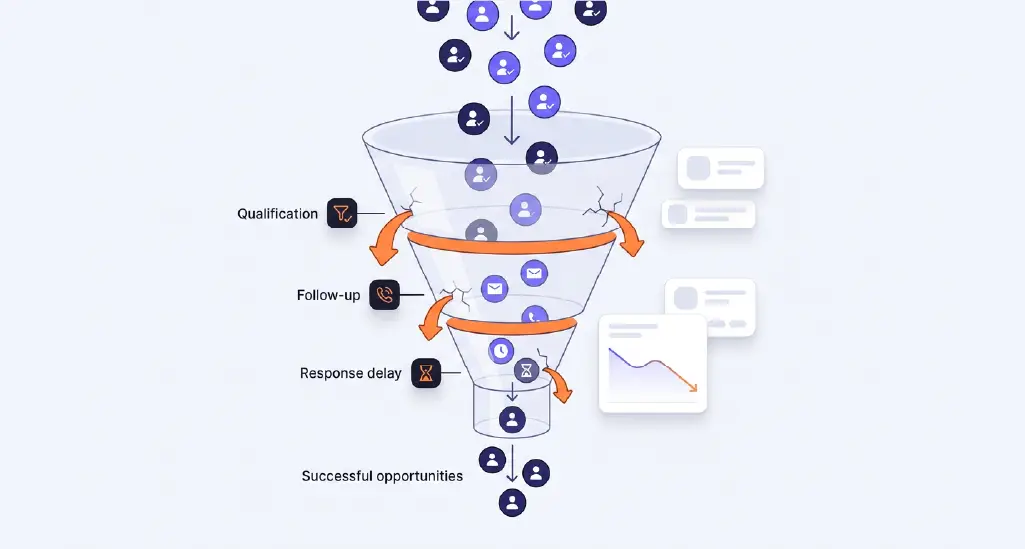
A prospect fills out a form but waits twelve hours for a response. Someone calls during lunch, but nobody answers. A qualified customer gets buried in a crowded inbox because there isn't a clear process for assigning ownership. Follow-ups happen inconsistently, and by the time someone finally reaches out, the prospect has already purchased from a competitor.
The business concludes that marketing isn't producing enough leads when, in reality, it simply isn't converting the ones it already has.
Improving lead conversion rarely starts with generating more traffic. It starts by maximizing the opportunities already sitting inside your pipeline. Businesses that understand this often find they can increase revenue significantly before spending another dollar on customer acquisition.
Imagine two home service companies operating in the same city.
Both receive roughly 250 inquiries every month through Google Ads, referrals, and their websites.
The first company believes growth comes from increasing traffic. Every month, they increase their advertising budget hoping to generate another fifty leads.
The second company looks inward instead.
They discover that almost 30% of inquiries never receive a follow-up within the first two hours. Another 20% receive only one outreach attempt before being marked as "unresponsive." Several leads are accidentally assigned to the wrong salesperson and forgotten entirely.
Rather than increasing ad spend, they improve qualification, automate routing, standardize follow-ups, and create accountability for every inquiry.
Six months later, the second company generates more revenue—not because they attracted more leads, but because they stopped losing the ones they already had.
This is one of the most overlooked opportunities in modern sales optimization.
Every missed call, delayed email, forgotten inquiry, or inconsistent follow-up represents marketing dollars that have already been spent.
Generating more traffic simply pours more water into a bucket with holes.
Businesses often confuse activity with progress.
Website traffic increases.
Lead forms increase.
Phone calls increase.
Dashboards look healthy.
Yet revenue barely moves.
The disconnect usually happens because the pipeline becomes overloaded. Sales representatives can't respond quickly enough. Marketing generates leads that sales never prioritizes. Different channels aren't connected, so conversations become fragmented.
Instead of fixing these operational gaps, businesses simply buy more traffic.
Ironically, this often makes the problem worse.
Adding another hundred leads each month doesn't improve conversions if your team is already struggling to manage the current hundred.
Growth isn't about collecting names.
It's about consistently moving people from inquiry to customer.
Also read: How to Fix a Slow Sales Pipeline Fast

Not every lead deserves identical attention.
That doesn't mean ignoring potential customers. It means understanding which conversations deserve immediate action and which require nurturing over time.
Consider a dental practice.
One person submits a form asking about cosmetic veneers and wants an appointment this week.
Another downloads a pricing guide because they're "thinking about treatment someday."
Treating both inquiries the same wastes valuable time.
Strong lead management starts with identifying buying intent early. Simple questions about urgency, budget, location, or service needs help determine how quickly someone should move through the sales process.
Without qualification, sales teams spend valuable hours chasing prospects who aren't ready while genuinely interested customers wait.
That delay often becomes the deciding factor.
The business with the fastest, most relevant response frequently earns the customer—even if they aren't the cheapest option.
Also read: Why Speed to Lead Matters Even More During Peak Demand Seasons

Many businesses underestimate how much persistence matters.
People become busy.
Emails get buried.
Phone calls happen during meetings.
Life interrupts buying decisions.
Silence doesn't always mean lack of interest.
Imagine a roofing contractor after a major storm.
A homeowner requests three different estimates.
One contractor calls once and gives up.
Another sends a quote and waits.
The third calls promptly, follows up the next morning, sends a text with scheduling options, and checks in again three days later.
That third contractor isn't being aggressive.
They're being present.
Customers frequently choose the business that stays engaged throughout the buying journey.
Consistent follow-up creates confidence.
Inconsistent follow-up creates uncertainty.
Many organizations assume prospects intentionally disappear when, in reality, they simply weren't guided toward making a decision.
Also read: What Happens When Your Business Responds to Leads in Under 60 Seconds
One of the simplest ways to improve lead conversion is reducing response time.
When someone reaches out, they're usually comparing multiple businesses.
The company that responds first gains a significant psychological advantage.
Not because they're necessarily better.
Because they appear attentive, organized, and reliable.
Think about someone whose air conditioner fails during peak summer.
They're not planning to research HVAC companies for two weeks.
They're looking for immediate help.
A response that arrives within minutes communicates professionalism long before a technician arrives.
Waiting until the next business day often means the customer has already moved on.
Speed isn't just about convenience.
It's often the first demonstration of customer experience.
Many organizations don't fail because they lack talented salespeople.
They fail because every salesperson follows a different process.
Some call immediately.
Others prefer email.
Some remember follow-ups.
Others rely on sticky notes.
Important information sits across spreadsheets, inboxes, notebooks, and disconnected systems.
Eventually, opportunities disappear without anyone realizing why.
Effective lead management creates consistency across every interaction.
Every inquiry receives ownership.
Every conversation is documented.
Every follow-up has a timeline.
Every salesperson knows exactly what happens next.
This structure doesn't remove the human element.
It strengthens it by eliminating unnecessary chaos.

There's still a misconception that automation makes customer interactions feel robotic.
Poor automation certainly can.
Good automation does the opposite.
Imagine a law firm receiving dozens of inquiries overnight.
An automated response immediately confirms receipt, answers common questions, schedules consultations, and routes urgent matters to the right intake specialist.
The next morning, the legal team begins conversations with prospects who already feel acknowledged rather than ignored.
Automation handled the administrative work.
Humans handled the relationship.
That's where technology creates its greatest value.
Businesses don't need automation to eliminate people.
They need automation to eliminate delays.
This is exactly how organizations can maximize existing leads with automation without sacrificing personalization.
Also read: What Smart Businesses Automate First — And What Still Needs a Human Touch
Businesses often measure lead generation obsessively while paying surprisingly little attention to what happens afterward.
They know how many clicks they purchased.
They know how many forms were submitted.
But they don't know:
How many qualified leads waited longer than an hour?
How many prospects never received a second follow-up?
Which marketing channel generated customers instead of just inquiries?
Which salesperson consistently converts better than others?
Without these answers, improving sales becomes guesswork.
Every stage of the customer journey contains valuable information.
When businesses measure response times, conversion stages, conversation outcomes, and follow-up consistency, patterns begin to emerge.
Instead of asking, "How do we get more leads?"
The better question becomes:
"Why aren't more of our current leads becoming customers?"
That single shift changes every decision that follows.
Many companies think of customer acquisition as something marketing owns.
Marketing generates the lead.
Sales closes the deal.
Support handles the customer afterward.
Reality is much messier.
Acquisition is a continuous experience.
The first phone call matters.
The second email matters.
Appointment reminders matter.
Rescheduling matters.
Missed calls matter.
Every interaction either builds confidence or slowly erodes it.
Customers don't remember departments.
They remember experiences.
That's why businesses with connected communication systems consistently outperform competitors that rely on disconnected tools and manual processes.
Imagine two businesses with identical marketing budgets.
The first generates 1,000 leads every month and converts 8%.
The second generates only 800 leads but converts 15%.
Despite attracting fewer inquiries, the second business produces substantially more customers.
They also spend less acquiring each customer because they aren't constantly buying replacement leads.
This is the difference between scaling volume and scaling efficiency.
One requires continuously increasing marketing spend.
The other improves profitability by strengthening the entire customer journey.
When businesses ask how to increase revenue without generating more leads, this is the answer.
Improve qualification.
Improve response time.
Improve follow-up.
Improve visibility into every conversation.
Before investing in another advertising campaign, ask whether your current pipeline is performing as well as it could.
Very often, it isn't.

Businesses rarely lose customers because someone else had a prettier website.
They lose customers because conversations happen too late, ownership isn't clear, or follow-up quietly falls apart.
The encouraging part is that these problems are solvable.
Small improvements in qualification, communication, and lead management compound over time. A slightly faster response, one additional follow-up, or better visibility across the sales pipeline can translate into dozens of additional customers every month without increasing marketing spend.
Growth doesn't always require finding more people.
Sometimes it simply requires serving the people who already found you.
If your business is investing heavily in customer acquisition but still wondering where potential customers disappear, it may be time to rethink the process rather than the marketing budget. Blazeo helps businesses capture, qualify, manage, and follow up with every lead through intelligent automation and unified customer communication—so every opportunity has the best possible chance to become revenue. Instead of chasing more leads, start maxi

