 SmartHub
 Automation
 Appointment Scheduler
 Lead Management
 Dashboard & Reports
 Task Management
 Communications Hub
 Managed chat
 Voice Receptionist
 Appointment scheduling
 Retainer signing
 Home services
 Lawyers and firms
 Medical services
 College admissions
 Real estate agents
 Marketing agencies
 About
About Partner program
 Estimate Your ROI
 Case Studies
 Blog
Blog FAQs
FAQs Login
LoginYour Best Leads Aren’t Always the Ones Who Respond First




Products
Industries
Company
Resources

A lead replies to your email within five minutes.
Another opens it, visits your pricing page, reads a case study, returns to your website two days later, and says nothing.
Which one should sales prioritize?
For many teams, the answer feels obvious. The person who replied has raised their hand. They are responsive, accessible, and seemingly interested. Meanwhile, the quieter prospect looks uncertain at best and disengaged at worst.
But responsiveness and readiness are not the same thing.
The first prospect might simply be quick with email. They may be curious but have no budget, no authority to make a decision, and no immediate reason to buy. The second may be comparing providers, building an internal business case, checking whether your solution fits their requirements, and preparing to bring a recommendation to their team.
Yet if a company treats response behaviour as its primary indicator of lead quality, the first person can easily receive more attention.
That is where lead prioritization often goes wrong.
The question is not simply, “Who responded?” It is, “What is this prospect’s behaviour telling us about how seriously they are considering a purchase?”
Understanding that difference can change which opportunities sales teams pursue, how quickly they act, and how much potential revenue disappears because the wrong signals received the most attention.

Sales teams need shortcuts.
When dozens or hundreds of leads enter a pipeline, representatives cannot investigate every person with equal intensity. They need ways to decide which leads sales teams should contact first, and visible activity naturally becomes part of that decision.
A reply is particularly seductive because it feels unambiguous.
Someone answered. Something is happening.
But a response is ultimately a communication signal, not necessarily a purchasing signal.
Consider two prospects researching accounting software for their businesses.
One responds immediately to an introductory sales email: “Looks interesting. Can you send more information?”
The other does not reply. Instead, they visit the integration page, look at pricing, compare two plans, read documentation about migrating data, and return the following morning.
The first prospect has produced the most obvious signal.
The second has produced the richer one.
Their behaviour suggests they are beginning to answer the questions that arise when somebody imagines actually using a product: Will it work with our existing systems? What will it cost? How difficult will switching be?
That is why effective sales prioritization has to look beyond whether communication happened and examine what the prospect appears to be trying to accomplish.
Also read: Your CRM Knows Who the Lead Is - But Does It Know What They Need?
Digital buying journeys generate enormous amounts of activity, but not every action deserves equal weight.
A blog visit can mean somebody is researching an industry problem.
A pricing-page visit can mean they are assessing affordability.
A case study may suggest they want proof that the solution works for companies like theirs.
A return visit to implementation or integration documentation can indicate something stronger still: they are thinking beyond the concept of buying and beginning to evaluate the practical consequences.
These are all buyer intent signals, but their value comes from context.
This distinction is important because businesses have become very good at measuring activity. CRMs, analytics platforms, email tools, chat systems, call tracking, and marketing automation can record almost every interaction.
Measurement, however, does not automatically create understanding.
A prospect who opens ten newsletters over six months may generate more recorded engagement than someone who visits your pricing and booking pages three times in a single afternoon. Counting activity alone might favour the newsletter reader. Interpreting behaviour would probably tell a different story.
Good lead prioritization is therefore less about asking who did the most and more about asking what their actions mean.

This is where traditional lead scoring can become misleading.
Imagine assigning points to common actions.
An email open earns a few points. A website visit earns several more. A form submission adds another score. Eventually, somebody crosses a threshold and becomes a “hot lead.”
The system looks objective because numbers are involved.
But the quality of the score depends entirely on whether the underlying behaviour actually correlates with purchasing intent.
Someone downloading an introductory guide may still be at the beginning of their research. Someone checking pricing, integrations, implementation requirements, and customer stories may be considerably further along even if they have never downloaded anything.
Platforms such as HubSpot and Salesforce have long incorporated lead-scoring capabilities precisely because businesses need a way to distinguish between contacts rather than treating every lead identically. The important evolution is toward combining fit and behavioural information instead of allowing a single visible action to determine priority.
The strongest lead prioritization strategies for growing businesses recognise that signals accumulate meaning when viewed together.
One pricing visit might mean curiosity.
Pricing followed by a product comparison carries more information.
Pricing, comparison, a case study, and a return visit within 48 hours begin to form a pattern.
Sales should be responding to the pattern, not simply counting the clicks.
Also read: Why Businesses Don't Have a Lead Problem - They Have a Qualification Problem
Even strong behavioural signals become more useful when paired with context.
Suppose two people request the same demo.
One works at a five-person company outside your target market and appears to be exploring products for future use.
The other is an operations director at a 200-person company that matches your ideal customer profile and has recently visited your pricing and implementation pages.
The action is identical.
The opportunity is not.
This is why how to prioritize leads for sales cannot be answered through engagement data alone. Businesses need to understand who is taking the action and why it might matter.
Company size, industry, geography, role, existing technology, use case, and potential deal value can all influence the significance of a behavioural signal.
For B2B companies in particular, role can completely change the interpretation. A junior employee downloading a report may be conducting research. A department head repeatedly reviewing implementation information could be evaluating whether a purchase is operationally viable.
Neither should automatically be ignored. But treating them as equivalent removes valuable context from the decision.
The same principle applies in consumer and service businesses. Someone casually browsing a law firm's educational content is different from a visitor repeatedly viewing information about a specific legal service and then checking consultation availability.
Behaviour becomes meaningful when businesses can connect the action to the circumstances surrounding it.

Intent tells you that somebody may want what you offer.
Urgency tells you how soon it matters.
The distinction can be enormously important.
Imagine a homeowner researching HVAC services. One person submits a general question about upgrading an air-conditioning system sometime before next summer. Another searches for emergency AC repair, visits a service-area page, checks availability, and begins a booking request on a 100-degree afternoon.
Both are legitimate leads.
But one opportunity has a much shorter shelf life.
The second customer is unlikely to spend the next week patiently waiting for one company to respond. Their immediate problem creates urgency, and urgency compresses the buying window.
Similar dynamics appear across industries.
A personal injury prospect seeking help shortly after an accident may be speaking with multiple firms. A property owner requesting an urgent plumbing repair may choose whichever qualified company can help first. A business researching software because its current contract expires in two months carries a different timeline from a business casually exploring options for “sometime next year.”
This is why lead prioritization should consider not only the probability of purchase but also the cost of delay.
A high-intent opportunity that can wait several weeks and a high-intent opportunity that may disappear within an hour should not necessarily occupy the same place in the queue.
Also read: What Happens When Your Business Responds to Leads in Under 60 Seconds
One of the most dangerous assumptions in sales is that quiet prospects have lost interest.
Sometimes they have.
Sometimes they are doing the opposite.
B2B buying in particular often involves work that happens completely outside the seller's view. A prospect might be comparing vendors, discussing budget with finance, seeking approval from leadership, sharing a proposal internally, or waiting for another stakeholder to weigh in.
From the CRM, that period can look like silence.
From inside the buying organisation, the decision may be moving forward.
This is one reason follow-up based exclusively on replies can fail. The prospect who keeps responding receives attention because their engagement is visible. The prospect who is quietly progressing through evaluation can gradually disappear from the sales team's immediate focus.
A better approach is to look for changes in behaviour.
Did the prospect return after a week of inactivity?
Did several people from the same organisation begin visiting?
Did they move from educational content toward pricing or implementation information?
Did they revisit the proposal?
Did they begin interacting with material associated with later stages of evaluation?
No individual action proves somebody will buy. Together, however, these behaviours can help businesses identify high-intent leads that would otherwise appear dormant.

There is another problem with counting engagement: old activity can make a lead look warmer than they really are.
Imagine Prospect A has visited your website 18 times over the past year.
Prospect B has visited six times, all within the past three days.
Who is more interesting right now?
Potentially Prospect B.
Momentum matters because purchasing intent is rarely static. It rises and falls as priorities, budgets, problems, and circumstances change.
A company may have researched your software nine months ago and postponed the project. Their historical activity remains in your systems, but their immediate intent may be low.
Another company may have discovered you this week and rapidly moved from a blog article to a product page, then to pricing, integrations, and a demo request.
The total number of interactions is lower. The concentration and progression of those interactions are far stronger.
Effective lead prioritization should therefore account for recency, frequency, and direction.
Not simply: “How engaged has this person been?”
But: “What has changed in their behaviour recently, and where does that behaviour appear to be heading?”
That question gets much closer to purchasing readiness.
The temptation in sales operations is to find one perfect metric.
There probably isn't one.
A better picture of lead quality emerges when several dimensions reinforce each other.
Fit tells you whether this is the kind of customer your business can serve effectively.
Intent tells you whether their behaviour suggests meaningful evaluation.
Context helps explain what those behaviours mean.
Urgency indicates whether there is a time-sensitive need.
Engagement momentum reveals whether interest is increasing, declining, or remaining static.
Conversation data can add another layer. A prospect asking, “Do you integrate with Salesforce?” is communicating something different from somebody asking, “What exactly does your company do?”
Both deserve an answer. But they are at different stages of understanding and potentially different stages of purchase readiness.
The objective is not to build an impossibly complicated scoring model. It is to prevent one easy-to-measure behaviour from dominating decisions it cannot reliably make.
Knowing which lead deserves attention is only half the job.
The signals that establish priority should also influence what happens next.
If a prospect repeatedly visits pricing, another generic “Just checking in” email wastes valuable context.
If they are exploring integrations, the sales conversation can address technical compatibility.
If they have returned to a specific service several times, the representative can focus on the problem that service solves.
If urgency is apparent, forcing the prospect through a slow sequence of automated emails may create unnecessary friction.
This is where buyer intent signals become useful beyond scoring. They allow sales teams to enter conversations with greater relevance.
Instead of saying, “Are you still interested?”
The business can answer the question the buyer is probably already asking.
That creates a fundamentally different customer experience. The prospect does not feel like another name moving through a sales cadence. They encounter a company that appears to understand where they are in the decision.
None of this means quick replies are meaningless.
A fast response can absolutely indicate interest, urgency, or readiness. When someone requests a quote and immediately responds to follow-up questions, that momentum matters.
The mistake is allowing responsiveness to become a shortcut for quality.
Fast responders should be evaluated alongside quieter prospects using the same broader picture.
Who fits?
Who is showing meaningful intent?
Whose behaviour is accelerating?
Who has a genuine problem the business can solve?
Who appears to be approaching a decision?
Who has a need that becomes less valuable if the company waits?
When those questions shape sales prioritization, responsiveness becomes one signal among many rather than the signal that determines who gets attention.
Also read: Why Speed to Lead Matters Even More During Peak Demand Seasons
When pipelines feel thin, businesses often look immediately toward acquisition.
More advertising. More traffic. More forms. More campaigns.
But generating additional leads does not solve a prioritization problem.
If a sales team already struggles to distinguish casual interest from genuine buying intent, adding more contacts can simply make the strongest opportunities harder to see.
The real advantage comes from improving the company's ability to interpret the demand it already has.
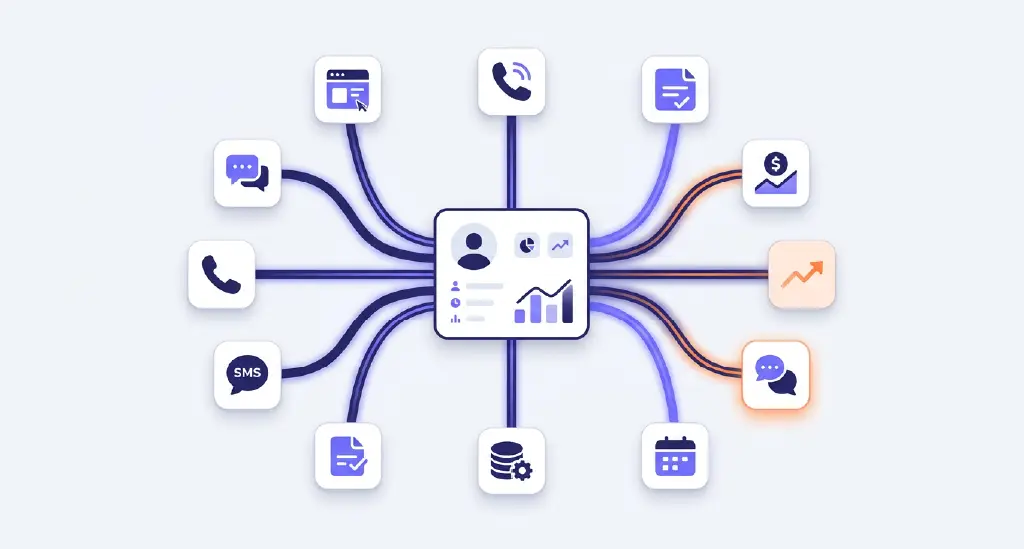
That means connecting information that often lives in separate places: website behaviour, calls, chats, texts, form submissions, CRM history, scheduling activity, and previous conversations.
The closer businesses get to seeing the entire journey, the less they have to rely on crude assumptions such as “they replied, so they must be hot” or “they haven't answered, so they must not be interested.”
For growing businesses with limited sales capacity, that distinction is particularly important. Prioritization is ultimately an allocation problem. Every hour spent chasing a low-intent lead is an hour that cannot be spent helping someone closer to a decision.

The most promising opportunity in a pipeline does not always announce itself.
Sometimes it replies instantly.
Sometimes it books a meeting.
And sometimes it quietly returns to the website, checks pricing, reads customer stories, compares options, and gathers enough information to decide between ever responding to an email.
The job of modern lead prioritization is to recognise the difference between visible activity and meaningful intent.
Businesses that combine buyer intent signals, fit, context, urgency, recency, and engagement momentum can make far better decisions about where human attention belongs. More importantly, they can respond to prospects based on what those prospects appear to need rather than simply who happened to answer first.
Because the real question is not who replied fastest.
It is who is moving closest to a decision, and whether your business can recognise that movement in time.
Blazeo helps businesses capture and manage conversations across the customer journey so valuable opportunities are less likely to disappear between channels, teams, and follow-ups. If your team is spending too much time chasing visible activity while high-intent prospects slip through unnoticed, Blazeo can help you build a more responsive path from first interaction to real conversation.

