 SmartHub
 Automation
 Appointment Scheduler
 Lead Management
 Dashboard & Reports
 Task Management
 Communications Hub
 Managed chat
 Voice Receptionist
 Appointment scheduling
 Retainer signing
 Home services
 Lawyers and firms
 Medical services
 College admissions
 Real estate agents
 Marketing agencies
 About
About Partner program
 Estimate Your ROI
 Case Studies
 Blog
Blog FAQs
FAQs Login
LoginYour Calendar Is Full. That Doesn’t Mean Your Scheduling Process Is Working




Products
Industries
Company
Resources

Open the calendar on Monday morning and things look good.
Tuesday is nearly booked. Wednesday has only two openings left. Thursday is packed from morning until late afternoon. By Friday, there is barely any white space on the screen.
For an appointment-based business, that should be a sign that something is working.
And it is. People clearly want what the business offers.
But a full calendar tells you surprisingly little about the appointment scheduling process that filled it.
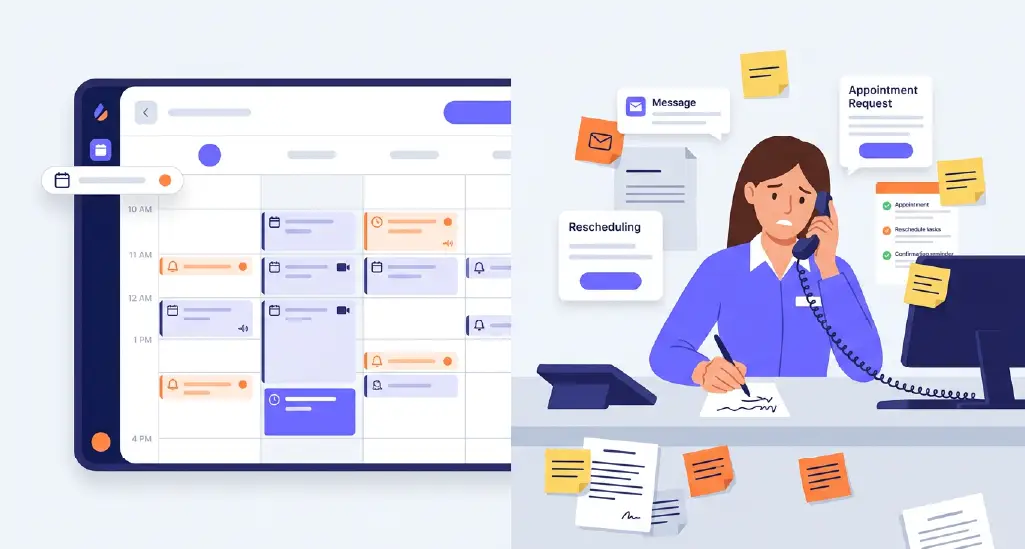
It does not show the receptionist who spent twelve minutes finding a time that worked for one customer. It does not show the three calls required to reschedule another appointment. It does not show the cancellation that arrived at 9 p.m. and left a valuable slot empty the following morning. It does not show the customer who called during lunch, received no answer and booked elsewhere.
Nor does it show the hours employees spend confirming appointments, moving bookings around, updating calendars and answering some variation of the same question: “What times do you have available?”
A calendar measures bookings.
It does not measure the friction required to create and maintain them.
For growing businesses, that distinction matters. Because when demand increases, an inefficient scheduling process does not simply become busier.
It becomes more expensive.
Imagine a dental practice with three providers and a receptionist managing the front desk.
The schedule looks healthy. Most appointment slots are occupied, and new patients continue to call.
Behind that calendar, however, the receptionist is constantly coordinating.
A patient calls to book an appointment. Two possible times are discussed before one works. Twenty minutes later, another patient calls to reschedule. The newly opened slot needs to be updated. Someone else leaves a voicemail asking whether there is anything available after 5 p.m. A patient scheduled for tomorrow has not confirmed, so the receptionist calls and leaves a message.
Then the phone rings again.
None of these tasks is unusual. That is precisely why they can become invisible.
When businesses evaluate scheduling efficiency, they often look at the outcome—how many appointments were booked—rather than the effort required to produce it.
If employees are spending hours manually coordinating appointments, a busy calendar can coexist with an inefficient operation.
The question is not only, “Are we booked?”
It is also, “How much work does it take to stay booked?”
Scheduling looks simple from the customer's side.
Choose a time. Confirm it. Show up.
Operationally, there is much more happening underneath.
Availability has to be accurate. The right employee or provider has to be available. The appointment may require a particular room, service duration, or location. Customer details need to be captured correctly. Confirmation has to happen. Reminders may need to be sent. Changes need to be reflected everywhere.
And if anything changes, part of that process starts again.
This is why appointment management should not be evaluated as a single booking event. It is a chain of interactions stretching from the customer's first attempt to schedule through the appointment itself.
Every unnecessary interaction adds friction.
For a customer, that friction might mean waiting on hold or exchanging several messages just to find an available time.
For the business, it means administrative work.
Neither appears as an empty slot on the calendar.
Also read: More Conversations, Same Team: How Businesses Scale Customer Engagement Without Burning Out.
One of the clearest signs of scheduling inefficiency is the amount of conversation required to complete a routine booking.
A customer asks whether Tuesday afternoon is available.
The business replies that Tuesday is full but Wednesday morning is open.
The customer cannot do Wednesday and asks about Thursday.
Someone checks again.

By the time a suitable appointment is found, what should have been a simple transaction has become a conversation stretching across several calls, emails, or messages.
For one appointment, this is manageable.
Multiply it across dozens or hundreds of appointments, and the cost changes considerably.
Research published by Calendly in its 2023 State of Scheduling report found that employees surveyed spent an average of 4.75 hours each week scheduling meetings. While the research covers workplace meetings rather than every type of customer appointment, it illustrates the broader operational cost of coordinating calendars manually.
The strange thing is that much of this work exists only because one person cannot see what the other can see.
The business knows its availability. The customer knows their availability. Manual scheduling forces them to exchange possibilities until those two sets overlap.
Automated scheduling can collapse much of that process by allowing customers to choose from availability the business has already defined.
The point is not to remove people from customer service.
It is to stop requiring people to perform work that does not need a person.
Booking the original appointment is only part of the workload.
Life happens after people book.
A meeting runs late. A child gets sick. A patient cannot make an appointment. A customer needs to move a consultation to another day.
When rescheduling is manual, one change can trigger another round of coordination.
The customer contacts the business. An employee finds the existing appointment, removes it, checks alternative availability, proposes another time, waits for confirmation, and updates the calendar.
Meanwhile, the original slot is now available again.
Can someone else take it?
Does anybody know it has opened?
This is one reason businesses looking to improve their appointment scheduling process should examine changes and cancellations just as closely as initial bookings.
A system may be reasonably efficient when everything goes according to plan and painfully inefficient the moment something changes.
A good scheduling process should expect change rather than treat every change as an exception.
At 4:30 PM, tomorrow's 10 AM appointment is cancelled.
The calendar updates.
There is now a hole in the schedule.
If the business has a waiting list, someone may start calling customers to see whether they can come in. If it does not, the slot may simply remain empty.
That hour had value yesterday.
It still has value today.

The difference is that the business now has very little time to sell it.
This is where cancellations expose another limitation of using calendar occupancy as the primary measure of scheduling performance. A calendar can look full several days in advance and still produce unused capacity when appointments change at the last minute.
The operational question is not whether cancellations happen. They will.
It is how effectively the process responds when they do.
Can an open slot be surfaced quickly? Can interested customers be offered earlier availability? Can confirmations and reminders reduce avoidable no-shows before they happen?
Better appointment management is partly about filling calendars. It is also about protecting the value of the time already on them.
The day before an appointment, many businesses begin the confirmation ritual.
Calls are made. Voicemails are left. Texts are sent. Employees wait for responses and update records.
It is responsible operationally, but it is also repetitive.
And repetitive administrative work becomes particularly expensive as appointment volume grows.
Consider a business handling 60 appointments per day. If manually confirming each appointment takes an average of only two minutes, that is two hours of staff time spent on confirmations every day.
Over a five-day week, that becomes ten hours.
That is before anyone has scheduled, rescheduled, or cancelled a single appointment.
This is where the case to reduce manual appointment scheduling becomes less about convenience and more about capacity.
Automated confirmations and reminders can handle predictable communication while leaving employees available for conversations that actually require judgment.
The distinction matters.
Automation works best when it removes repetitive coordination, not human connection.
Also read: Stop Chasing More Leads - Start Maximizing the Ones You Already Have

There is another type of scheduling friction that never reaches the calendar at all.
Imagine someone looking for a physiotherapist at 9:45 PM.
They find a practice online and decide to make an appointment. The website gives them a phone number and a contact form.
They are ready to book now.
The practice will respond tomorrow.
Maybe the customer waits.
Maybe they continue searching and find another provider that lets them schedule immediately.
The first practice may never know an appointment was lost.
This is particularly important because the modern customer journey does not necessarily occur during business hours. People research services after work, during commutes, late at night, or whenever the need arises.
An effective appointment scheduling process therefore has to consider not only how employees manage bookings during working hours, but what customers can accomplish when employees are unavailable.
Can they see appropriate availability? Can they request or book an appointment? Can the business capture what they need and continue the conversation later without forcing them to start over?
Availability to the customer and availability of staff do not have to be the same thing.
Businesses sometimes resist automated scheduling because they imagine opening their entire calendar to customers.
That does not have to be the model.

A well-designed scheduling workflow operates within rules established by the business.
A consultation may require 45 minutes. A certain service may only be offered on particular days. A provider may need fifteen minutes between appointments. Same-day bookings may need a cutoff time. New customers may need to answer qualifying questions before being offered an appointment.
Those are not arguments against automation.
They are the rules automation should follow.
The goal of automating appointment management for businesses is not to let customers schedule anything, anywhere, at any time.
It is to translate the business's existing scheduling logic into a process that does not require an employee to enforce every rule manually.
Done well, automation actually creates more control because the rules are consistent.
If a business wants to make business scheduling more efficient, calendar utilization is still worth measuring.
It simply should not be measured alone.
A healthier question is how much friction surrounds each appointment.
How long does it take from a customer's first request to a confirmed booking? How many calls or messages are required? How frequently are appointments rescheduled? How many cancellations become unfilled openings? How much staff time is spent confirming routine appointments?
Then there is an even more important question: how many people tried to book but never made it onto the calendar?
Those customers are difficult to see because they leave no cancellation and no empty appointment record behind.
They simply disappear.
A business that only measures completed bookings can therefore have an incomplete picture of scheduling performance.
The most efficient process is not necessarily the one with the fullest calendar today.
It is the one that turns demand into appointments with the least unnecessary friction for both customers and employees.
There is a temptation to think about scheduling efficiency entirely in terms of saving staff time.
That is only half the value.
Customers benefit from good operations too.
They do not have to call twice because nobody answered the first time. They do not have to wait for someone to check availability. They do not have to repeat information when an appointment changes. They can receive confirmation without wondering whether their booking went through.
And when they genuinely need help, there is a person available to help rather than one occupied with routine calendar administration.
That is what useful automation should accomplish.
Not fewer human interactions.
Fewer unnecessary ones.
The distinction is important because customer experience is often shaped by operational details customers should never have to think about.
Nobody finishes an effortless booking and says, “That company has excellent scheduling infrastructure.”
They simply remember that it was easy.
Also read: Automation Should Remove Work - Not Create More of It
A packed schedule can be good news.
It means people are choosing your business. It means demand exists. It means valuable time is being sold.
But it should not prevent a business from asking harder questions about how those appointments got there.
If every booking requires back-and-forth communication, if employees spend hours on confirmations, if cancellations regularly create unusable gaps, or if customers cannot schedule when staff is unavailable, the calendar may be full despite the process—not because of it.
That becomes increasingly difficult to sustain as the business grows.
A stronger appointment scheduling process removes unnecessary coordination while preserving the moments where customers actually need human help. It makes availability easier to access, routine communication easier to automate, and changes easier to manage. Most importantly, it gives staff time back for work that requires more than moving blocks around a calendar.
Because scheduling efficiency should not be judged by how crowded the screen looks.
It should be judged by how little friction it took to get there.
Blazeo helps businesses turn customer conversations into appointments without making teams manually coordinate every step. With AI-powered engagement, lead management, and scheduling capabilities working together, businesses can respond to customers, capture opportunities, and keep appointments moving around the clock. Explore Blazeo to build an appointment experience that works as efficiently behind the calendar as it appears on it.

