 SmartHub
 Automation
 Appointment Scheduler
 Lead Management
 Dashboard & Reports
 Task Management
 Communications Hub
 Managed chat
 Voice Receptionist
 Appointment scheduling
 Retainer signing
 Home services
 Lawyers and firms
 Medical services
 College admissions
 Real estate agents
 Marketing agencies
 About
About Partner program
 Estimate Your ROI
 Case Studies
 Blog
Blog FAQs
FAQs Login
LoginA Lead Came In. Now Who Owns It?




Products
Industries
Company
Resources

Getting a lead used to feel like the hard part.
Someone found your business, clicked through, filled out a form, started a chat, called your number, or requested more information. Marketing did its job. The prospect raised their hand. There is interest, there is intent, and there is an opportunity sitting right in front of you.
Then something surprisingly ordinary happens.
The lead lands in a shared inbox.
Sales assumes someone from the inbound team has it. The inbound team thinks it belongs to a regional rep. Two people see the notification, but neither responds because they assume the other will. Or, at the other extreme, three people respond independently, and the prospect suddenly has multiple representatives asking the same questions.
The lead was captured successfully. It was never really owned.
This is where a lot of businesses have a blind spot. They invest heavily in generating demand and improving lead capture, but pay far less attention to what happens during the few minutes immediately after an inquiry arrives.
A strong lead routing process closes that gap. It establishes who owns an incoming opportunity, why they own it, what should happen next, and what happens if they do not act.
Without that clarity, generating more leads can simply create more opportunities to lose them.

Imagine a growing home services company operating across several locations.
At 10:17 AM, a homeowner submits an online request about an urgent plumbing issue. The form captures everything the company asked for: name, phone number, location, service required, and preferred contact method.
Technically, the lead-generation system worked perfectly.
The request is sent to a general inbox monitored by several employees. One person assumes the branch nearest the customer will handle it. Someone at the branch sees it but believes urgent inquiries are handled by dispatch. Dispatch is busy with existing jobs and assumes sales has already contacted the customer.
At 10:42 AM, nobody has.
By then, the homeowner has probably done what customers naturally do when they need help: contacted another provider.
Nobody deliberately ignored the lead. That is precisely the problem.
There was no clear owner.
Businesses often describe these situations as a failure to follow up. But follow-up is only the visible symptom. The deeper problem is that the lead management process never established responsibility in the first place.
When responsibility is shared vaguely, accountability tends to disappear.
Lead capture answers one question: who is interested?
Lead management has to answer several more.
What does this person need? How urgent is that need? Which salesperson, location, or department is best equipped to respond? Has somebody already contacted them? What needs to happen if the assigned person is unavailable?
These questions become increasingly important as a business grows.
A founder with three employees may be able to handle every incoming inquiry personally. A small sales team might survive with a shared spreadsheet and a group chat. Everyone knows roughly what is happening because there simply is not much distance between the people involved.
Then the company adds another location. Marketing introduces more acquisition channels. The sales team grows. Calls arrive alongside web forms, live chats, social inquiries, SMS messages, and appointment requests.
Suddenly, “someone will pick it up” is no longer a process.
The weakness may not reveal itself immediately. Individual leads disappear quietly. A rep follows up late. Someone else assumes a prospect was contacted. The CRM contains the record, so from a reporting perspective the lead appears to have been captured.
But a record sitting in a system is not the same thing as an opportunity moving forward.
Also read: Why Businesses Don't Have a Lead Problem - They Have a Qualification Problem
“I thought someone else was handling it.”
Almost every growing business eventually encounters some version of it.
It usually appears after the damage has already been done.
A manager asks why a promising demo request was never followed up on. Sales says it was assigned to another team. The other team says there was no formal assignment. Someone points to an email notification. Someone else points to the CRM.
Everybody can explain what happened.
Nobody actually owned what happened.
This is why effective lead assignment needs to be more specific than simply notifying a group that a new inquiry exists.
Visibility and ownership are not interchangeable.
Ten people can see a lead while zero people feel responsible for it.
Good ownership creates a much simpler reality: at any point after a lead enters the business, someone—or a clearly defined workflow—is responsible for moving it to the next stage.

Unassigned leads are only half of the problem. Poor sales lead distribution can create the opposite problem: duplicated outreach.
Suppose a prospect asks a software company for a product demo.
An SDR sees the request and sends an email. A regional salesperson receives the same lead through a CRM notification and calls five minutes later. Meanwhile, an automated nurture sequence sends a generic “Thanks for your interest” message.
From inside the business, all three actions may look productive.
From the prospect's perspective, the company looks confused.
They may have to explain their requirements twice. They may receive different answers. They may wonder whether the first person they spoke to is actually responsible for their account.
This is not merely an internal efficiency problem. It affects trust.
Customers rarely care how a company's sales organization is structured. They should not need to understand which department owns which stage or why two systems sent their details to different people.
They experience the business as one business.
The internal process should make that experience feel equally unified.
Also read: The Cost of Internal Chaos: When Good Leads Slip Through the Cracks
Even when businesses have assignment rules, another failure often occurs during the handoff.
The lead gets transferred, but the context does not.
A prospect explains what they need in a website chat. Their information is captured and passed to sales. A salesperson then calls and begins with, “So, what can we help you with?”
The customer has to start again.
That may sound minor, but it reveals something important about the underlying system. The organization successfully moved the contact record without moving the conversation.
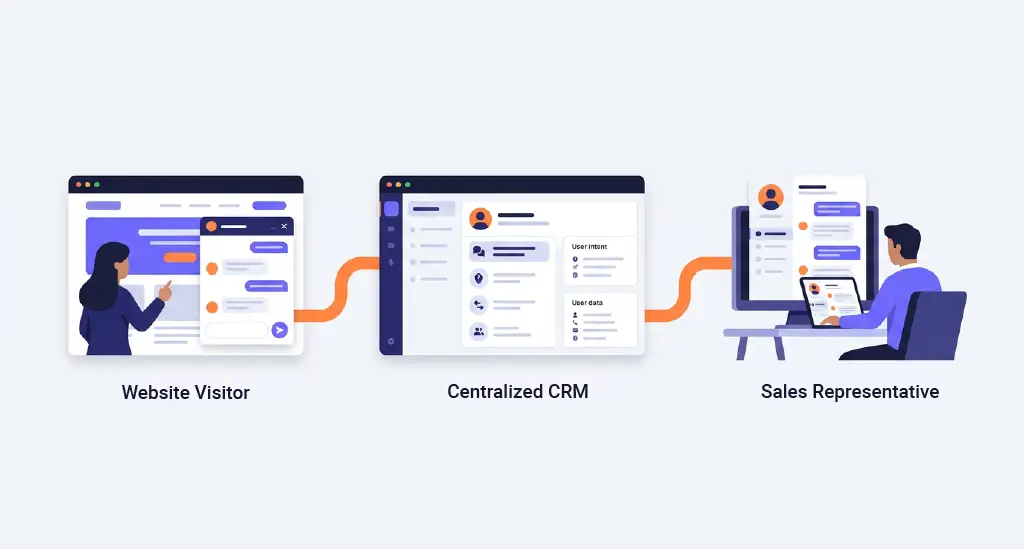
Effective lead routing should preserve both.
If the prospect has already explained that they need a roofing estimate, live in a particular service area, and want an appointment next week, the person receiving the lead should ideally begin the next conversation with that knowledge.
The handoff should feel like progress, not a reset.
This is especially important when leads move between automated systems and human teams. Automation can collect information, identify intent, and qualify an inquiry, but the value of that work disappears if the human taking over cannot see what happened before the transfer.
Technology should remove repetition from the customer journey rather than create another layer of it.
There is no universal answer to the best way to assign incoming leads because not every lead requires the same person or the same response.
A simple round-robin system can work well when salespeople have similar skills, responsibilities, and territories. Leads are distributed sequentially, helping keep workloads relatively balanced.
But equal distribution is not always intelligent distribution.

Consider a law firm handling several practice areas. A family-law inquiry should not necessarily reach the same person as a personal-injury case. A home services company may need to route leads according to ZIP code, requested service and urgency. A real estate business may assign inquiries based on neighborhood or property type. A multi-location healthcare provider may need to account for service, location and appointment availability.
The question is therefore not simply, “Who is next?”
It is, “Who is the right owner for this particular opportunity?”
That distinction is at the heart of intelligent routing.
A useful routing system starts with information the business can actually act on.
Instead of collecting every conceivable detail, businesses need to identify the few pieces of information that determine where an inquiry should go.
That might be geography. It might be product interest, company size, urgency, language, service type, or existing-customer status.
Once those conditions are known, routing rules can make the first ownership decision automatically.
But assignment alone is not enough.
A strong workflow also needs to account for reality.
What happens if the assigned salesperson is on leave? What happens if a lead arrives after hours? What happens when the designated rep does not respond within an acceptable period? What happens if the information supplied by the prospect does not match any existing routing rule?
Without answers to those questions, automation can simply make a flawed process operate faster.
The objective is not to create rules for every imaginable scenario. It is to eliminate the ambiguity that causes good opportunities to sit untouched.
The value of automating lead assignment is often described in terms of speed.
Speed matters, but accountability may matter even more.
When an incoming lead is automatically assigned to a named owner, recorded in a centralized system, and connected to a next action, there is far less room for the “I thought someone else had it” problem.
The workflow can also create safeguards.
If the owner does not respond, the lead can be escalated or reassigned. If a rep is unavailable, the system can send the inquiry elsewhere. If the prospect belongs to an existing account, the lead can be routed to the person who already knows the relationship.
Blazeo's own lead-management approach, for example, centers leads and communications in one place, with activity history, automated workflows, and follow-up capabilities designed to keep opportunities moving. Its routing capabilities can also use qualification details such as location or service type to direct conversations appropriately.
The important part is not automation for automation's sake.
It is creating a process in which every lead has somewhere to go.
Also read: Automation Should Remove Work - Not Create More of It
Consider two people contacting an HVAC company at the same time.
One writes, “I'd like an estimate for replacing my AC sometime next month.”
The other writes, “My AC stopped working, and I have a newborn at home. Can someone come today?”
They are both leads.
They should probably not enter the same queue with the same priority.
Traditional distribution models can treat incoming inquiries largely as records to be allocated. Intelligent routing has the opportunity to treat them as conversations with different levels of urgency and intent.
The second inquiry may need immediate escalation to dispatch or an available service representative. The first can enter a standard estimate or appointment workflow.
That is where routing becomes more than administrative housekeeping. It starts influencing the customer experience.
The prospect is not thinking about your CRM configuration. They are thinking, “Does this company understand what I need?”
Good routing helps the answer feel like yes.
Poor ownership can remain surprisingly well hidden when lead volume is low.
A diligent employee notices an untouched inquiry and picks it up. A manager remembers a prospect and asks someone to call. Teams compensate manually for gaps in the process.
Growth removes that safety net.
If lead volume doubles, the number of exceptions people have to notice also increases. If new locations, teams, and channels are added, there are more places for ownership to become unclear.

This is why scaling lead generation without scaling the lead management process can produce disappointing results.
Marketing may celebrate a 30% increase in inquiries while sales reports that lead quality seems worse.
Sometimes lead quality has not changed at all.
The business has simply become worse at handling the volume it worked so hard to create.
Before spending more to generate demand, it is worth asking what percentage of existing demand receives clear, timely ownership.
The answer can be uncomfortable. It can also reveal growth opportunities that do not require another dollar of ad spend.
To prevent leads from falling through the cracks, businesses need to stop treating assignment as a single event.
Ownership is a lifecycle.
A lead may begin with an automated conversation, move to an SDR, transfer to a specialist, become an appointment, and eventually reach an account manager.
At every transition, the same questions apply: who owns this now, what context do they have, and what is expected to happen next?
A reliable system makes those answers visible.
That visibility also changes management conversations. Instead of asking vaguely why leads are not converting, teams can see where they are stalling.
Perhaps inquiries are being captured quickly but waiting too long for initial outreach. Perhaps one region is overloaded. Perhaps leads are reaching sales without enough qualification. Perhaps follow-ups stop after the first unanswered call.
Clear ownership makes bottlenecks measurable.
And once a bottleneck is measurable, it becomes much easier to fix.
The irony of lead routing is that when it works well, customers should barely notice it exists.
They ask a question and reach someone who can answer it.
They explain their needs once.
If they move from one person to another, the next person understands what has already happened.
They do not receive three competing calls from the same company. They do not wait while departments decide whose responsibility they are.
Internally, however, that simplicity requires intention.
It requires clear assignment rules, centralized communication, visible activity histories, and workflows that know what to do when the normal path breaks down.
Most importantly, it requires businesses to stop thinking of lead capture as the finish line.
It is only the moment the responsibility begins.
There is a strange contradiction in how businesses think about leads.
Companies will spend heavily to earn a click, optimize a landing page to earn a form submission, and introduce new channels to capture more conversations.
Then, once somebody finally says, “I'm interested,” responsibility can become surprisingly informal.
That is the part worth fixing.
A better lead routing process does not have to make sales more complicated. It should do the opposite. The right inquiry reaches the right person, the history travels with it, ownership is visible, and unanswered opportunities have somewhere else to go.
Because the real question after a lead comes in is not whether your CRM captured it.
It is whether somebody knows what happens next.
Blazeo helps businesses capture, centralize, and manage lead conversations, using intelligent workflows to keep opportunities moving from first contact to conversion. If your leads are coming in but ownership is getting lost along the way, explore Blazeo to build a faster, more connected path from inquiry to action.

