 SmartHub
 Automation
 Appointment Scheduler
 Lead Management
 Dashboard & Reports
 Task Management
 Communications Hub
 Managed chat
 Voice Receptionist
 Appointment scheduling
 Retainer signing
 Home services
 Lawyers and firms
 Medical services
 College admissions
 Real estate agents
 Marketing agencies
 About
About Partner program
 Estimate Your ROI
 Case Studies
 Blog
Blog FAQs
FAQs Login
LoginYour CRM Knows Who the Lead Is - But Does It Know What They Need?




Products
Industries
Company
Resources

Every sales team has experienced this moment.
A new lead enters the CRM. Their name, email address, company, phone number, industry, and perhaps even their estimated budget are neatly captured. The salesperson opens the record, sees a timeline of activities, notices that the lead downloaded an eBook two weeks ago and attended a webinar yesterday, and confidently makes the call.
Within the first thirty seconds, it becomes painfully obvious that none of that information explains why the prospect reached out in the first place.
They're frustrated because no one replied to a text they sent last night. They aren't looking for the premium package that marketing assumed they wanted. They're evaluating three competitors and need a quick implementation timeline before tomorrow's board meeting. Or perhaps they already explained everything to an AI chatbot yesterday and are annoyed that they're being asked to start from scratch.
The CRM didn't miss the data.
It missed the story.
This is one of the biggest blind spots in modern customer relationships. Businesses have spent years perfecting CRM data management, believing that collecting more information naturally leads to better decisions. Yet many sales conversations still begin with guesswork because traditional CRMs excel at storing facts but struggle to capture meaning.
That distinction is becoming increasingly important. Companies no longer need systems that simply tell them who a customer is. They need systems that explain what that customer is trying to accomplish.
That difference is where better CRM customer insights are born.

Imagine walking into a doctor's office.
Before asking a single question, the physician opens your medical history. They know your age, previous surgeries, medications, allergies, and blood test results.
Would that be enough to diagnose what's wrong today?
Of course not.
The doctor still asks why you came in, what you're feeling, when the symptoms started, and how they've changed over time. Without context, historical data becomes little more than background information.
Sales works the same way.
A CRM can tell a representative that a lead opened five emails and visited the pricing page three times.
It cannot explain whether that prospect is comparing vendors, trying to convince their manager, recovering from a poor experience with another provider, or simply researching for a project six months away.
Those are entirely different conversations.
Yet they often receive the same generic follow-up because businesses mistake activity for intent.
This is why customer intent data has become one of the most valuable assets in modern sales. Intent isn't hidden inside a spreadsheet. It lives inside conversations, questions, objections, hesitations, tone, urgency, and timing.
When businesses ignore those signals, they aren't just missing information.
They're missing understanding.

Most CRMs were designed to answer operational questions.
Who owns this account?
When was the last interaction?
How many opportunities are currently open?
What's the projected revenue?
These are important metrics. They help organizations stay organized and forecast growth.
What they rarely answer is whether anyone actually understands the customer.
Consider two leads with identical CRM profiles.
Both work for healthcare organizations.
Both requested product demos.
Both have similar company sizes.
Both are marked as "high priority."
On paper, they're virtually identical.
In reality, one is desperately trying to replace a communication system that's causing patient complaints. The other is casually researching software because their current contract expires next year.
If those conversations never become part of the CRM, every salesperson approaching these leads starts with incomplete information.
That's where friction begins.
The issue isn't that CRMs collect too little information.
It's that they often collect the wrong kind.
Also read: Why Your CRM Fails After Month One | CRM Adoption Lessons

Customers reveal their priorities naturally.
They tell you what's frustrating them.
They explain why previous vendors failed.
They mention budget limitations.
They describe internal approval processes.
They share deadlines.
They express hesitation.
Sometimes they even tell you exactly what would convince them to buy.
Unfortunately, much of this disappears the moment the conversation ends.
Phone calls become forgotten memories.
Chat transcripts remain isolated in support platforms.
SMS conversations live on someone's mobile device.
Email threads stay buried in inboxes.
Voice notes never reach the CRM.
By the time another employee interacts with the same customer, everyone starts from zero again.
This fragmentation creates an invisible knowledge gap across the organization.
Instead of building upon previous conversations, every department recreates them.
The customer experiences repetition.
The business loses momentum.
One of the biggest misconceptions about customer intent data is that it's permanent.
It's not.
Intent evolves.
A prospect who downloads a buying guide may initially be gathering information.
A week later, they're comparing pricing.
Two weeks later, they're trying to solve implementation concerns.
Another month later, they may simply need reassurance before signing.
The CRM might record each interaction.
But unless it understands the conversation surrounding those interactions, it cannot recognize how the customer's priorities have changed.
That's why static CRM records often create dynamic misunderstandings.
The lead hasn't become confusing.
The business simply stopped listening.
Ask top-performing sales representatives why they consistently close deals, and many will mention something interesting.
They remember conversations.
They remember tiny details.
They recall objections from months earlier.
They know which stakeholder is skeptical.
They remember that implementation speed matters more than pricing.
They know that the buyer's biggest fear isn't spending money.
It's making the wrong decision.
Notice something?
Very little of that information comes from standard CRM fields.
It comes from experience.
The challenge is that personal memory doesn't scale.
When someone goes on vacation, changes teams, or leaves the company entirely, much of that customer understanding leaves with them.
Businesses shouldn't rely on human memory to preserve institutional knowledge.
They need systems that remember conversations just as effectively as they remember customer records.
Also read: Stop Chasing More Leads - Start Maximizing the Ones You Already Have
Many organizations believe they already track communication.
Technically, they're right.
Their CRM records that someone called.
It notes that an email was sent.
It logs that a support ticket was closed.
That's contact history.
Conversation history is something entirely different.
Conversation history captures what was actually discussed.
It remembers the customer's goals, concerns, emotional state, expectations, preferences, objections, previous promises, and unresolved questions.
The distinction is subtle but powerful.
Knowing that someone spoke with a customer yesterday is useful.
Knowing what that customer said yesterday is transformative.
This is where conversational CRM changes the equation.
Instead of reducing conversations to timestamps and activity logs, it preserves the context that makes those conversations meaningful.
It's a common complaint.
"We have everything inside the CRM."
Yet sales teams continue asking customers questions they've already answered.
Managers still struggle to understand why deals stall.
Marketing sends campaigns that don't reflect recent conversations.
Support agents remain unaware of promises made during the sales process.
This disconnect explains why CRM data isn't enough for sales teams.
Information exists.
Understanding doesn't.
The problem isn't visibility.
It's interpretation.
Businesses often optimize for collecting more fields instead of capturing richer conversations.
Ironically, adding more data frequently creates more noise rather than more clarity.
Also read: Every Customer Conversation Is Data - Most Businesses Waste It

Imagine a regional HVAC company.
A facility manager contacts them after repeated failures with their existing maintenance provider. During the first phone call, the prospect repeatedly mentions one concern.
Emergency response times.
The sales representative notes the company's address, building size, annual revenue, and estimated contract value inside the CRM.
The call recording remains somewhere else.
Three days later, another representative follows up.
They spend fifteen minutes discussing pricing packages because that's what's visible in the CRM.
The customer politely listens before interrupting.
"I appreciate the pricing, but I already explained that our biggest issue is emergency response. Can you guarantee a technician within two hours?"
The salesperson scrambles to answer.
The customer loses confidence.
Now imagine a different scenario.
The CRM doesn't simply display account details. It surfaces conversational context from previous calls, highlighting that emergency response is the customer's highest priority, that their current vendor missed multiple service-level agreements, and that the decision committee meets Friday afternoon.
The second representative begins the conversation differently.
"I read through your previous discussion. Let's focus on response guarantees because I understand that's your biggest concern."
Nothing magical happened.
The customer simply felt heard.
That single difference fundamentally changes the conversation.
The future of CRM customer insights isn't about replacing CRMs.
It's about making them smarter.
Businesses still need structured records.
They still need pipelines.
They still need forecasting.
They still need reporting.
But alongside those traditional records, they need living conversational intelligence.
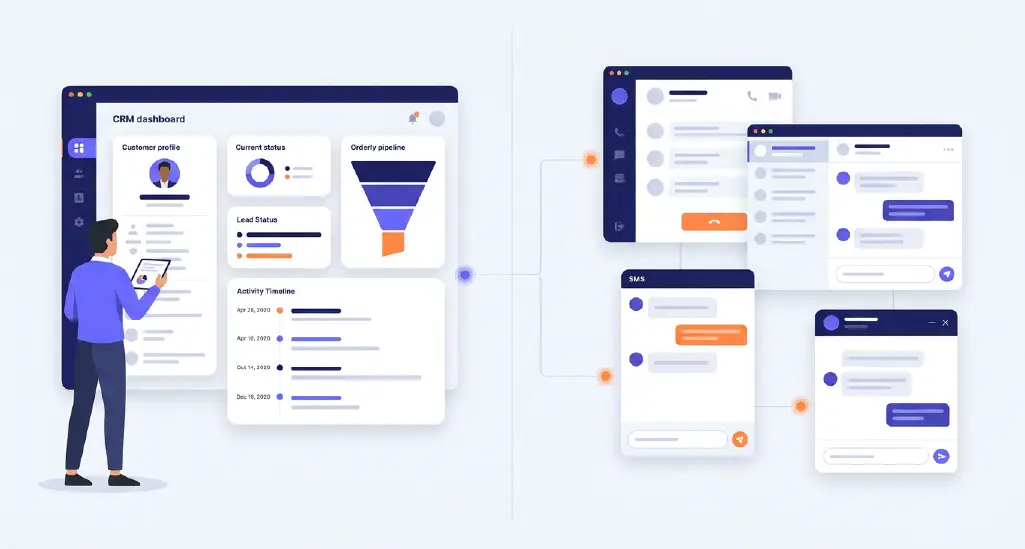
They need systems capable of connecting voice calls, live chat, SMS, emails, AI interactions, and human conversations into one continuous narrative.
This allows every employee to understand not only where a customer sits in the sales funnel but also where they stand emotionally, operationally, and strategically.
That's the missing layer modern businesses have been searching for.
Customers rarely expect perfection.
They simply expect continuity.
They don't want to explain the same problem five different times.
They don't want every department operating independently.
They don't want conversations that begin with, "Can you tell me what's going on?"
Instead, they want businesses that remember.
Businesses that connect previous discussions with future decisions.
Businesses that understand intent before asking the next question.
Organizations capable of adding customer conversation context to CRM don't just improve efficiency.
They create trust.
And trust consistently outperforms automation alone.

A CRM can tell you who your customer is.
It can tell you when they last engaged.
It can tell you what they purchased, where they work, and which salesperson owns the account.
Those are valuable insights.
But they only explain the customer on paper.
The conversations behind those records reveal what customers actually care about, what they're trying to solve, what concerns remain unresolved, and what ultimately influences their decisions.
That's the difference between storing information and creating understanding.
As customer expectations continue to evolve, businesses need more than organized databases. They need systems that preserve context across every interaction, every channel, and every stage of the customer journey.
That's where Blazeo helps bridge the gap. By combining communication across voice, SMS, web chat, email, and AI into a unified conversation history, Blazeo enables businesses to move beyond static CRM records and build richer, more actionable CRM customer insights. When every interaction contributes to a complete customer story, sales teams spend less time guessing and more time having conversations that actually move deals forward.

