 SmartHub
 Automation
 Appointment Scheduler
 Lead Management
 Dashboard & Reports
 Task Management
 Communications Hub
 Managed chat
 Voice Receptionist
 Appointment scheduling
 Retainer signing
 Home services
 Lawyers and firms
 Medical services
 College admissions
 Real estate agents
 Marketing agencies
 About
About Partner program
 Estimate Your ROI
 Case Studies
 Blog
Blog FAQs
FAQs Login
LoginThe First Conversation Is Already a Governance Event




Products
Industries
Company
Resources

Guest Post — Blazeo × KeaneAdvisors
A prospective client calls a law firm after hours.
They are worried about a deadline. They start explaining what happened, mention the other party involved, describe a document they signed, and eventually ask the question almost every intake professional has heard in one form or another:
“Do you think I have a case?”
No engagement letter has been signed. No attorney has agreed to represent the caller. The matter may never become a matter at all.
But the firm has already received information from someone seeking possible representation. Someone—or something—has communicated on the firm's behalf. Information may have been recorded, summarized, routed, or entered into another system. And what happens during those first few minutes can affect confidentiality, conflicts, expectations, and the firm's ability to show that its intake process was properly supervised.
That is why the first conversation should not be treated as merely a lead-generation event.
It is already a governance event.
Law firms understandably organize their operations around clear milestones. A conflict check is completed. An engagement letter is signed. A matter is opened. A client officially enters the firm's system.
Prospective-client conversations are less tidy.
ABA Model Rule 1.18 addresses duties to prospective clients: people who consult with lawyers about the possibility of forming a client-lawyer relationship. Its commentary recognizes that consultation can occur through oral, written, or electronic communications and that the circumstances surrounding the exchange matter.
That means firms need to think carefully about what happens before formal representation begins.
A website conversation does not become inconsequential simply because it originated on a marketing page. A telephone call is not purely administrative because a receptionist answered it. And a conversation handled by an automated system does not sit outside the firm's governance environment because a lawyer was not participating in real time.
The first important question, then, is not simply whether the person has become a client.
It is what the firm receives, says, records, and potentially implies before that decision is even made.
Legal intake is changing so quickly for a reason.
Clients expect businesses to respond quickly, and law firms are not exempt from that expectation. Yet the industry's responsiveness problem remains significant.
Clio's 2024 Legal Trends research used a third-party secret shopper to contact 500 law firms. Only 40% answered the initial phone call. Even after callbacks were included, researchers reached just 52% by phone. Only 33% responded to email.
For someone actively looking for legal help, an unanswered call can be enough to move on to another firm.
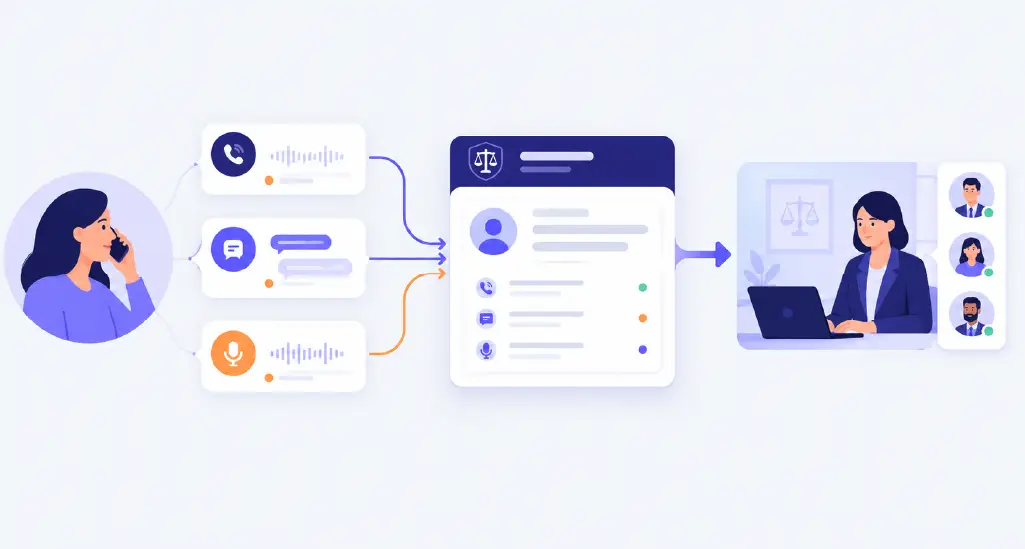
The operational response is understandable. Firms are extending intake beyond the traditional receptionist or office-hours phone line. Some use outsourced intake professionals. Others have added live chat, automated scheduling, Voice AI, or combinations of human and automated support.
Each can improve accessibility.
Each also expands the firm's intake environment.
The mistake is to treat better coverage and better governance as competing priorities. They solve different parts of the same problem.
Coverage without governance creates exposure. Governance without a workable operating channel leaves the original service problem unsolved.
The real objective is to build both.
Also read: Legal Intake Call Center: How Law Firms Handle More New Client Calls

Imagine four firms receiving the same inquiry.
At the first, an employee answers the telephone. At the second, the call reaches an outsourced intake specialist. At the third, Voice AI begins the conversation and gathers initial information. At the fourth, an automated system handles routine intake before transferring the caller to a live representative.
Those experiences may look completely different to the caller.
Behind them, however, the firm should be asking many of the same questions.
What information should be collected at this stage? What should not be collected yet? What can the person or system say about the firm's services? When does a question move beyond administrative information and toward legal judgment? What circumstances require escalation? What happens if the caller describes an urgent deadline? Where does the information go afterward? And can the firm review the interaction later?
This is where the debate around AI legal intake can become unnecessarily narrow.
The most important distinction is not human versus artificial.
A human intake representative can exceed an approved boundary. An outsourced agent can misunderstand a script. An AI system can provide an answer it was never authorized to provide. A hybrid workflow can recognize the need for escalation but fail to transfer the context the next person needs.
Technology changes how the failure might happen.
Legal intake governance determines how the firm works to prevent it.
Law firms have always relied on people other than lawyers to support client service.
Receptionists answer calls. Paralegals communicate with clients. Intake professionals gather information. Technology vendors support the systems through which those interactions occur.
ABA Model Rule 5.3 addresses lawyers' responsibilities regarding nonlawyer assistance, including assistance performed outside the firm. ABA Formal Opinion 506 similarly recognizes that appropriately trained and supervised nonlawyers may assist with prospective-client intake.
The important word is supervised.
Consider an intake representative trying to reassure a caller:
“That sounds like a strong case.”
It is a small sentence. It may even be said with good intentions.
But what did the caller hear?
Perhaps they heard empathy. Perhaps they heard a preliminary legal assessment. Perhaps they now believe the firm is likely to accept the case.
The same problem arises with statements such as, “We should definitely be able to help you,” or an overly confident explanation of fees, deadlines, outcomes, or next steps.
A longer script does not necessarily solve that problem.
Effective supervision requires the firm to define the function being delegated. Intake professionals need boundaries around what information they may collect, what they may explain, what requires escalation, and what they must not evaluate on the firm's behalf.
That principle applies whether the representative works down the hall or for an outside provider.

Voice AI introduces the same issue in a different form.
Modern conversational systems can respond naturally to an extraordinary range of questions. In an intake setting, that capability can be useful. A system can answer promptly, collect structured information, identify the reason for a call, schedule appointments, route inquiries, and help provide coverage outside conventional office hours.
But conversational ability and delegated authority are not the same thing.
Consider a caller who says:
“My employer fired me yesterday. How long do I have to file something?”
A system might be capable of generating an answer. But there is an important difference between saying that employment claims can be subject to filing deadlines and applying a specific deadline to an individual's circumstances.
There is an equally important difference between explaining a firm's intake process and recommending what the caller should do next.
This is one of the central questions in AI governance for legal intake:
Not simply, can the system answer?
But should it be permitted to answer this particular question on behalf of the firm?
ABA Formal Opinion 512 provides an important backdrop. The use of generative AI does not displace lawyers' existing professional responsibilities, including duties relating to competence, confidentiality, communication, and supervision.
That makes boundaries operationally important.
A firm implementing Voice AI needs to decide what administrative information the system may provide, what information it may collect, what subjects require transfer, and what should happen when a conversation becomes urgent, uncertain, emotionally sensitive, or dependent on legal judgment.
Blazeo's experience with AI-enabled and live-agent contact-center operations illustrates what is technically possible: answering, routing, scheduling, summaries, transfers, integrations, and combinations of automated and human support.
But those capabilities do not decide the firm's boundaries.
The firm does.
Also read: The Hybrid Model: Where Voice AI and Humans Work Together
Technology tends to reward collection.
If a system can gather a complete narrative in a few minutes, collecting more information can appear to make intake more efficient.
Legal intake introduces a reason to resist that instinct.

ABA Model Rule 1.18 and its commentary make prospective-client information particularly important. The commentary notes that a lawyer who wants to avoid receiving information that could create a disqualifying conflict should limit the initial consultation to information reasonably necessary to determine whether to undertake the representation.
That turns question order into a governance decision.
Imagine an automated intake system immediately asking a caller to “tell us everything that happened.”
The caller complies. Names are disclosed. Sensitive facts follow. Several minutes later, the system reaches the information necessary for a conflict check.
Technically, the intake worked.
Operationally, the sequence may have been poorly designed.
A more controlled process can begin with the information the firm has determined it needs for identification, routing, and conflict-related screening before moving into more substantive intake.
The precise sequence will differ by practice area and jurisdiction. Personal injury intake will not necessarily look like family law, criminal defense, immigration, or employment intake.
The principle is more durable:
The fact that a system can collect information does not mean it should collect it yet.
Eventually, many intake conversations reach a boundary.
The caller asks something the system should not answer. An urgent issue emerges. The interaction becomes unusually sensitive. A conflict-related concern appears. The caller needs someone with greater authority or judgment.
At that point, the quality of the intake process depends on what happens next.
A good hybrid model does not simply offer a “transfer to human” button. It defines what triggers that transfer, where the conversation goes, what context travels with it, how urgency is communicated, and what happens when the intended recipient is unavailable.
That last part matters more than it may appear.
Imagine telling a prospective client that the conversation needs to be escalated and then making them repeat a difficult story from the beginning because the transcript, summary, or intake information did not follow them.
That is a customer-experience failure.
But in a legal environment, it can also signal a control failure.
Blazeo's operational model combines AI-enabled engagement with human support, allowing information and context to move with an interaction when it is transferred. KeaneAdvisors' governance-first approach asks the complementary question: has the organization defined when that handoff should occur, who owns it, and how the process will be supervised?
Neither question is sufficient alone.
The handoff needs to work technically and make sense professionally.
A firm can write an excellent policy and still have a weak intake system.
The test is what happens in practice.
If a prospective client later says that an intake representative promised the firm would take the case, can the interaction be reviewed?
If an AI system failed to escalate a time-sensitive inquiry, can the firm determine why?
And when a prompt or intake script changes, can anyone identify which version was operating when a particular conversation occurred?

Governance requires evidence.
Recordings, transcripts, summaries, CRM entries, escalation histories, approved scripts, prompt versions, training records, testing results, incident logs, and remediation records can all contribute to a reviewable intake environment.
They also introduce another layer of responsibility.
Firms need to understand where prospective-client information moves, who can access it, how long it is retained, which vendors or subprocessors may interact with it, and whether the firm can retrieve or appropriately dispose of records when necessary.
This is where KeaneAdvisors' governance-first perspective becomes particularly relevant. Rather than beginning with the assumption that a technology should be deployed because it is available, the approach starts earlier: assess the use case, understand the data and risk environment, design controls, implement deliberately, and verify that those controls operate as intended.
That sequence matters because a policy is not evidence that a process works.
A system becomes governable when the firm can examine what it actually does.
There is another risk worth acknowledging.
Governance can become so focused on preventing mistakes that it creates an intake experience nobody wants to use.
A caller should not have to navigate a maze of warnings before asking whether the firm handles employment matters. A person seeking help after an accident should not feel as though they are completing a compliance questionnaire before anyone will listen.
Good governance is not about putting friction everywhere.
It is about putting control where it matters.
Routine administrative questions should remain routine. Scheduling should be simple. Basic qualification and routing can happen efficiently. Automation can remove unnecessary waiting and repetitive work.
The boundaries should become visible when the interaction approaches something that requires judgment, greater sensitivity, or different authority.
That is the advantage of thinking about how law firms should supervise client intake as an operating model rather than a static compliance exercise.
The best controls often work quietly.
The caller experiences a responsive firm.
The firm knows what happened behind the scenes.
The legal industry has good reasons to modernize intake.
People seeking legal help do not necessarily call between nine and five. They may contact several firms. They may prefer chat to telephone calls. They may expect immediate acknowledgement even when an attorney cannot speak with them immediately.
Human teams, outsourced intake, Voice AI, and hybrid systems create new ways to meet those expectations.
But speed is not the only thing a law firm is designing.
Every intake channel makes choices about what gets asked, what gets said, what gets recorded, what gets transferred, what gets escalated, and what can later be reviewed.
Those choices begin before an engagement letter.
That is why the first conversation deserves to be treated as part of the firm's governance environment rather than as a waiting room outside it.
For Blazeo and KeaneAdvisors, the two sides of that equation are complementary. Blazeo brings the operational infrastructure for responsive human, AI, and hybrid client engagement. KeaneAdvisors brings a governance-first framework for evaluating how AI and related systems should be assessed, controlled, and supervised.
Together, they point toward a more useful question for law firms considering the future of intake.
Not: Should a human or AI handle the first conversation?
But: Have we designed the first conversation so that, however it begins, the firm remains in control of what happens next?
Because the first conversation is not simply where a prospective client enters the funnel.
It is where governance begins.
This article is for general informational purposes only and does not constitute legal advice.

