 SmartHub
 Automation
 Appointment Scheduler
 Lead Management
 Dashboard & Reports
 Task Management
 Communications Hub
 Managed chat
 Voice Receptionist
 Appointment scheduling
 Retainer signing
 Home services
 Lawyers and firms
 Medical services
 College admissions
 Real estate agents
 Marketing agencies
 About
About Partner program
 Estimate Your ROI
 Case Studies
 Blog
Blog FAQs
FAQs Login
LoginYour CRM Has the Data. Why Is Your Team Still Asking the Customer?




Products
Industries
Company
Resources

A customer fills out a form on your website.
They give you their name, phone number, location, the service they need, and a brief explanation of the problem.
Later, they speak to someone over live chat and answer a few more questions. The conversation establishes what they need, when they need it, and whether they are ready to book.
The next morning, someone from your team calls.
“Can I ask what service you’re looking for?”
Then: “What area are you in?”
Then: “Have you spoken to anyone from our team before?”
From the business’s perspective, these are ordinary qualification questions.
From the customer’s perspective, something much stranger has happened.
They have already told you all of this.
The business collected the data. The CRM may even contain it. Yet at the precise moment that information could make the next interaction easier, it effectively disappears.
This is one of the most overlooked problems in customer data integration. Businesses often assume that collecting customer information and being able to use customer information are the same thing.
They are not.
A CRM can hold thousands of accurate customer records while employees continue asking customers questions the business already knows the answers to. The problem is not necessarily missing data. It is the distance between where that data lives and where the next conversation happens.
And customers can feel that distance.
Inside a company, communication is usually divided neatly.
Marketing manages forms and campaigns. Sales works inside the CRM. Customer service handles tickets. Website conversations may live inside a chat platform. Phone calls run through another system. SMS messages may sit somewhere else entirely.
Organizationally, those divisions can make sense.

Customers do not care about them.
When someone chats with your business on Monday and calls on Tuesday, they do not think they have begun a new customer journey. They believe they are continuing the same one.
That is why repetition feels so frustrating.
Research from Salesforce found that 79% of customers expect consistent interactions across departments, yet 56% say they often have to repeat or re-explain information to different representatives. Salesforce also reports that 70% expect company representatives to have the same information about them.
That expectation is reasonable.
If a business asks for information, customers naturally assume the business will remember it.
The disconnect appears when the organization remembers technically but forgets operationally.
The email address is in one record. The website conversation is in another dashboard. A salesperson has notes somewhere else. The call history shows that a conversation occurred but not necessarily what was discussed. An appointment system knows when the customer booked but may not tell the person handling the appointment why they booked.
Every system contains a fragment.
Nobody has the story.
This is where conversations about CRM customer data can become misleading.
A record can be complete on paper while still being almost useless in conversation.
Imagine a home services company receives an inquiry from a homeowner whose water heater has stopped working. During website chat, the homeowner explains the problem, confirms their ZIP code, mentions that the unit is approximately ten years old, and says they are available after 3 PM.
A lead is created in the CRM.

The record contains a name, email address, phone number, lead source, and perhaps a status such as “New Lead.”
Technically, the lead was captured successfully.
But what happens to everything else?
If the salesperson who calls later cannot immediately see the problem with the water heater, the age of the unit, the customer’s location, and the requested timing, the business has captured the contact without capturing the context.
That distinction matters.
Contact data tells a team who someone is.
Customer conversation history tells them what has already happened.
Useful context goes further still. It can show what the customer needs, what questions have already been answered, what objections were raised, what was promised, which next step was discussed, and what the business should do now.
The objective of customer data integration should therefore not simply be to move more fields into a CRM.
It should be to make relevant context available at the moment someone needs it.
Also read: Your CRM Knows Who the Lead Is - But Does It Know What They Need?
Being asked for your ZIP code twice is unlikely to destroy a customer relationship.
But repetition sends a message.
It tells the customer that the first conversation did not travel with them.
That becomes more damaging as the interaction becomes more complex.
Consider someone contacting a law firm about a sensitive legal matter. They explain the situation through an intake channel, provide personal information, answer qualification questions, and are told that someone will follow up.
Then the attorney or intake specialist calls and begins with:
“So, can you tell me what happened?”
The customer is not simply repeating data. They may be repeating something stressful, private, or emotionally difficult.
Or consider a patient who has already described why they need an appointment, a homeowner who has sent photographs of property damage, or a business buyer who has spent twenty minutes explaining their requirements to one representative before being transferred to another.
The cost of disconnected data rises with the effort required to recreate the context.
Zendesk’s 2026 CX research makes the expectation particularly clear: 81% of consumers want agents to continue conversations without forcing them to backtrack, while 74% report frustration when they have to repeat information.
Customers are not asking businesses to remember everything forever.
They are asking them not to forget what happened five minutes ago.
It is tempting to solve this problem by telling employees to “check the CRM first.”
Sometimes they should.
But that response places responsibility on employees for a structural problem.
A salesperson might have the CRM open while a customer calls, but the website chat transcript lives somewhere else. The CRM might show an activity called “Chat Completed” without displaying what the customer said. A support platform might contain the latest ticket while the sales team sees only an outdated customer profile.
Even when integrations exist, they may move only selected fields.
This is why businesses exploring how to connect customer data across channels need to look beyond whether two pieces of software technically integrate.
The better question is: What context actually survives the handoff?
If a chatbot collects six pieces of information and the CRM receives only a name and phone number, the integration worked technically and failed practically.
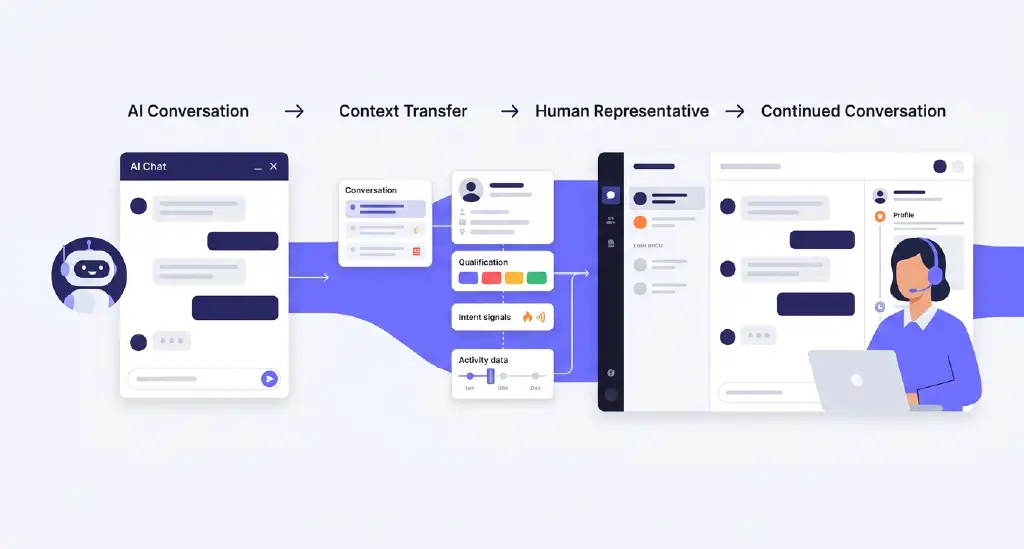
If a customer moves from AI to a human agent and the agent cannot see the conversation that just happened, the business has connected the channels without connecting the experience.
If someone books an appointment after discussing a particular concern, but the employee taking the appointment sees only a calendar entry, another important piece of context has disappeared.
Customer data integration is valuable when it preserves meaning, not merely when systems exchange records.
The quality of a connected customer experience becomes especially visible during handoffs.
Suppose a prospective client visits a website at 9 p.m. They begin a chat, explain what they need, answer qualification questions, and ask whether someone can call them the following morning.
At 9:15 AM., an employee calls.
There are two ways that conversation can begin.
The first is familiar:
“Hi, you contacted us through our website. How can I help?”
The second sounds very different:
“Hi, I saw that you spoke with us last night about replacing your water heater and that afternoons are easier for you. I wanted to follow up on the appointment options you asked about.”
The employee may be equally capable in both situations.
The difference is context.
The second conversation starts further ahead because the customer’s previous effort has not been discarded.
That is also the principle behind Blazeo’s Managed Live Chat approach to AI-to-human handoffs. Information already collected—including contact details, qualification responses, and conversation history—can remain visible to the human agent so the visitor does not have to restart the interaction.
A good handoff should transfer more than a person.
It should transfer understanding.
Also read: The Handoff is Part of the Customer Experience
This is ultimately the best test of whether an integration is useful.
Does the information collected earlier change what happens next?
If the customer already supplied their location, the next representative should not need to ask for it again.
If they already selected the service they need, the follow-up should begin with that service in mind.
If they discussed an objection with one employee, another employee should know about it before making the same sales pitch.
If they booked an appointment, the person taking that appointment should be able to see the relevant intake information and previous communication.
If they move from chat to SMS, the conversation should not suddenly lose its memory.
This is where a centralized customer conversation history becomes more useful than a collection of disconnected activity logs.

Blazeo SmartHub’s Lead Management, for example, is designed to centralize customer interactions and maintain a history of conversations and activities around a lead. Its Communications Hub brings chat, email, and SMS into a shared environment, giving teams a single timeline rather than requiring them to reconstruct conversations across separate tools.
The important idea is not the dashboard itself.
It is what the dashboard allows the employee to stop doing.
Stop searching.
Stop guessing.
Stop asking the customer to rebuild context the business already collected.
The customer feels the friction of disconnected information, but employees absorb much of its operational cost.
Every missing piece of context creates another small task.
Open another platform. Search for a chat. Ask a colleague whether they spoke to the lead. Look through old emails. Reconfirm the phone number. Ask the customer which service they wanted. Add another internal note.
None of these tasks seem particularly damaging in isolation.
Multiply them across hundreds or thousands of interactions, and they become a workflow.
This is one reason CRM integration should not be treated solely as a customer-experience project. It is also an efficiency problem.
Salesforce reports that 82% of high-performing service organizations use the same CRM platform across sales, service, and marketing, compared with 62% two years earlier. The direction is telling: stronger teams are increasingly building around shared data rather than asking departments to maintain separate versions of the customer.
The goal is not to make every employee study every previous interaction.
It is to make the relevant information easy to understand when they need it.
A useful customer record should answer, quickly: Who is this person? Why did they contact us? What has already happened? What do they need now? What should happen next?
When employees can answer those questions without interrogating the customer, CRM customer data becomes operational rather than archival.
Also read: Your Calendar Is Full. That Doesn’t Mean Your Scheduling Process Is Working

This becomes even more important as businesses introduce AI and automated workflows.
Automation without shared context can make fragmentation worse.
Imagine a customer who has already booked an appointment receiving an automated message asking whether they would like to schedule one.
Or someone who told a representative they are not interested receiving a sales sequence five minutes later.
Or an AI assistant asking the same qualification questions a customer answered on a form moments earlier.
The automation may be functioning exactly as configured.
That is the problem.
Automation operating without context can efficiently deliver the wrong experience.
Connected data makes it possible to build workflows around what is already known. Blazeo’s Automated Workflows can use triggers and branching to create different paths based on customer data and behavior rather than treating every contact identically.
Similarly, Blazeo’s Appointment Scheduler can keep client notes, service details, and communication history connected to bookings, helping the next interaction begin with more than a name and a time slot.
The principle is simple: automation should move the customer forward, not send them backward.
The solution begins by examining the customer journey from the customer’s side rather than the organization’s.
Take one real inquiry and follow it.
A customer discovers the business, submits a form, starts a chat, receives a text, speaks to someone by phone, and eventually books an appointment.
At every transition, ask what the next person or system can actually see.
Can the phone representative see what was said in chat?
Can the salesperson see the qualification information captured by AI?
Does the appointment record contain the reason for the appointment?
If a customer replies by SMS, is the earlier conversation visible?
Can someone returning three days later be recognized as the same person?
That exercise often exposes the real problem quickly.
Businesses may discover that they do not have a data shortage at all. They have a continuity shortage.
Fixing it requires a reliable customer identity across channels, integrations that pass meaningful information rather than bare contact fields, shared conversation histories, clear ownership, and systems that surface relevant context without forcing employees to hunt for it.
That is what it means to use CRM data to improve customer experience.
The CRM stops being a database people update after conversations.
It becomes part of how better conversations happen.
Also read: The Hidden Cost of Making Customers Repeat Themselves
Customers should not have to understand your technology stack.
They should not need to know that marketing uses one platform, sales uses another, and your phone provider stores conversations somewhere else.
They should simply feel that your business remembers.
That feeling can come from something remarkably small.
“We already have your address.”
“I can see the photos you sent.”
“I saw you spoke with Sarah yesterday.”
“You mentioned afternoons work better, so I’ve checked those appointments first.”
Those sentences tell the customer that their previous effort mattered.
And that is ultimately the purpose of customer data integration.
Not to collect more data.
Not to create larger CRM records.
Not to add another dashboard.
It is to turn what the customer has already told you into context that makes the next interaction easier.
A CRM that stores customer information is useful. A business that can carry that information across channels, conversations, and handoffs is something more valuable: connected.
Blazeo SmartHub is built around that continuity, bringing customer conversations and lead context together so teams can see what has already happened and continue from there rather than beginning again.
If your CRM already has the data, your customers should not have to keep giving it back to you. Blazeo can help connect customer conversations, preserve context across touchpoints, and give your team the information it needs to move every interaction forward. Explore Blazeo SmartHub and turn disconnected customer data into a connected customer experience.

