 SmartHub
 Automation
 Appointment Scheduler
 Lead Management
 Dashboard & Reports
 Task Management
 Communications Hub
 Managed chat
 Voice Receptionist
 Appointment scheduling
 Retainer signing
 Home services
 Lawyers and firms
 Medical services
 College admissions
 Real estate agents
 Marketing agencies
 About
About Partner program
 Estimate Your ROI
 Case Studies
 Blog
Blog FAQs
FAQs Login
LoginThe Handoff is Part of the Customer Experience




Products
Industries
Company
Resources

A customer starts a conversation through a website chat because they need help choosing the right service. The AI assistant asks what they are looking for, where they are located, how soon they need it, and whether they would like to speak with someone. The customer answers every question.
Then the conversation moves to a person.
“Hi! How can I help you today?”
It sounds friendly. It is also frustrating.
The customer has already explained how they can be helped. They have given the business the context it needs. Yet the moment another person enters the conversation, that context seems to disappear.
Now imagine the same problem happening after a phone receptionist transfers someone to sales. Or when a sales representative passes a customer to onboarding. Or when one support agent hands a conversation to another at the end of a shift.
Businesses tend to think about these moments as transfers. Customers experience them as part of the same conversation.
And customers notice when that conversation suddenly forgets them.
Salesforce reports that 56% of customers say they often have to repeat or re-explain information to different representatives. Zendesk research goes even further: 74% of consumers consider repeating themselves a significant frustration.
The problem, then, is not simply whether the customer eventually reaches the right person. It is what happens on the way there.
A business can respond quickly, automate efficiently, and have helpful employees, yet still deliver a fragmented customer experience if information repeatedly disappears between people, teams, or systems. A good customer service handoff is therefore about much more than moving a conversation to the right person.
It is about making sure the customer never feels as though the conversation has started over.
Inside a company, the reasons for transferring a conversation can be perfectly logical.
A receptionist cannot answer a technical pricing question, so the inquiry goes to sales. An AI assistant recognizes that a problem is too complex to resolve automatically, so it escalates to a human agent. A sales representative closes a deal and sends the account to onboarding.
From an operational perspective, responsibility has changed.
From the customer’s perspective, it has not.
They are still talking to the same business.
This is where many approaches to customer experience management break down. Companies organize themselves around departments, roles, queues, shifts, tools, and permissions. Customers organize their experience around one much simpler question: does this business understand what I need?
When the answer suddenly appears to become “no” during a transfer, the organizational structure becomes visible.
The customer hears it in questions such as:
“Can you explain the issue again?”
“What service were you interested in?”
“Did you already speak with someone?”
“What was your order number?”
“Can you tell me what happened from the beginning?”
Each question may be reasonable for the employee asking it. Together, they communicate something less reassuring: whatever I told you earlier did not travel with me.
That matters because customers increasingly judge businesses on the experience surrounding the product, not just the product itself. Salesforce reports that 80% of customers consider the experience a company provides as important as its products and services.
The handoff is part of that experience.

Make every conversation feel connected. Explore how Blazeo helps businesses keep customer context moving across AI and human interactions.
Also read: More Conversations, Same Team: How Businesses Scale Customer Engagement Without Burning Out
Repeating information sounds like a relatively minor inconvenience until you consider what the customer has already done.
They may have explained a complicated problem to an AI assistant. They may have answered qualification questions on a form. They may have spent ten minutes on the phone with reception. They may have uploaded a document, provided an account number, described what they have tried, or explained why their situation is urgent.
Then they are transferred and asked to do it again.
The frustration is not simply that repetition takes time. It is that repetition suggests nobody was really listening.
That becomes especially damaging when the customer has already invested significant effort in explaining the situation.
Imagine contacting an insurance company about an incorrect claim, explaining the discrepancy to the first representative, being transferred to another department, and then being asked to reconstruct the entire situation again. The second employee may be perfectly capable of solving the problem, but the experience has already accumulated friction.
The same thing can happen in a much shorter sales conversation.
A homeowner tells an AI assistant that their air conditioner has stopped working, that the house is becoming uncomfortably hot, and that they need someone as soon as possible. The system gathers their address and confirms that the company serves their area. Then it transfers the conversation to scheduling.
If the scheduler opens with, “What can we help you with?” the business has effectively discarded the value of everything that happened before the transfer.
A better opening would be: “I can see your AC has stopped working and you’re looking for the earliest available appointment. Let me check what we have.”
The difference is only a sentence.
The experience is completely different.
One makes the customer restart. The other makes them feel recognized.
This is the central principle behind how to improve customer service handoffs: moving the customer is not enough. The context of the conversation has to move too.
That context includes more than a transcript.
A long transcript technically preserves information, but it can still force the next employee to hunt through paragraphs of conversation while the customer waits. A useful handoff should make the important information immediately understandable.
What does the customer want? What has already been established? What questions have already been answered? What has the business promised? Is there urgency? What action is expected next?
Consider a lead who begins with an AI assistant and says they are interested in a service for three locations. They explain that they need to launch within the month, ask whether the business supports a particular integration, and eventually request a call.
If the sales representative receives only a name, phone number, and “new lead” notification, most of the conversation has effectively been lost.
The representative now has to rediscover the customer.
But if the handoff communicates that this is a three-location prospect with a near-term deadline, a specific integration question, and an explicit request for a call, the salesperson can begin where the previous conversation ended.
That is what it means to create seamless AI-to-human handoffs.
AI should not simply decide when a person needs to take over. It should help that person take over intelligently.

See how Blazeo’s AI-powered customer engagement solutions help capture conversations, qualify opportunities, and connect customers with the right next step without losing momentum.
Transitions often feel awkward because nobody explicitly acknowledges that a transition has happened.
The AI disappears. A human appears. The receptionist transfers the call. Another voice answers. A new employee enters the chat.
The customer is left wondering: Do they know why I am here? Did the other person explain anything? Am I about to start again?
These questions are particularly important as AI becomes a bigger part of customer communication.
Twilio research found that 78% of consumers consider the ability to switch from an AI agent to a human important. Yet only 15% said they had experienced a seamless AI-to-human handoff.
That gap is significant.
The problem is not necessarily that customers reject AI. It is that automation can create an additional point of friction when the connection between AI and humans is poorly designed.
A good handoff removes that uncertainty quickly.
The receiving person should be able to signal three things almost immediately: I know who you are, I understand why you are here, and I know what needs to happen next.
That does not require an elaborate introduction.
“Sarah filled me in on the delivery issue, including the replacement that hasn’t arrived. I’m going to check the shipment status now.”
In a single sentence, the customer knows the transfer worked.
This is an underrated part of AI-human collaboration. Much of the conversation around AI focuses on whether AI can answer questions accurately or when it should escalate to a person. But escalation itself is not enough.
The transition has to preserve conversational continuity.
Also read: How Do AI Receptionists Work? From First Call to Final Response
There is another side to AI-to-human handoffs: once escalation becomes necessary, AI should not make the customer fight for it.
Picture a customer saying, “I’ve already tried resetting it three times, and I need someone to help me.”
A poorly designed system continues suggesting troubleshooting steps because its workflow says those steps must be completed.
The customer becomes increasingly explicit.
“I need a person.”
The system responds with another automated question.
At that point, the technology is no longer reducing friction. It has become the friction.
Research reinforces why the human option still matters. Verizon’s 2025 CX research found that 47% of consumers identified being unable to speak or chat with a live human when needed as their biggest frustration with automated interactions. The same research found satisfaction was considerably higher for interactions handled mostly or entirely by humans than for AI-led interactions.
The answer is not to remove AI from customer service. It is to design a better relationship between AI and people.
Effective AI-human collaboration depends on recognizing that automation and human support are not competing channels. They are different resources within the same customer journey.
AI can handle routine questions, collect information, identify intent, qualify inquiries, schedule appointments, and resolve straightforward requests. Humans become especially valuable when situations involve ambiguity, exceptions, emotion, negotiation, judgment, or complexity.
The best handoff happens when the system recognizes that boundary early enough to preserve trust.
And when it hands over, everything it has learned should become useful to the person taking over.

CTA: Let AI handle what it can—and make it easier for your team to step in when it matters. Explore Blazeo’s AI-powered customer communication solutions.
It is easy to frame this as an AI problem.
It is not.
Businesses have been losing context between humans for decades.
Reception takes a call and transfers it to sales without explaining why the customer called. Sales closes a customer and passes only basic account information to onboarding. A support agent reaches the end of a shift and leaves the next agent to reconstruct an unresolved case.
The tools may have changed. The experience has not.
This is why improving conversation handoffs between teams requires businesses to think beyond individual employee performance.
A salesperson may provide an excellent experience while they own the conversation. An onboarding specialist may also provide an excellent experience once they understand the account.
The failure can occur entirely in the space between them.
Suppose a customer spends several weeks discussing requirements with sales. They explain that one feature is essential, agree on a particular implementation timeline, and mention an internal deadline repeatedly.
Then onboarding begins.
The new contact asks, “So, tell me a little about what you’re hoping to accomplish.”
It might be intended as a welcoming question.
To the customer, it can sound astonishing.
We already discussed this.
The relationship has changed internally, but the customer should not have to rebuild it externally.
Also read: What Smart Businesses Automate First — And What Still Needs a Human Touch
Some of the worst handoffs are not the ones where information disappears.
They are the ones where responsibility disappears.
One employee believes another person is handling the customer. The second person assumes the first employee will follow up. The CRM records the activity, but no clear next action has an owner.
The customer waits.
This creates an uncomfortable paradox: a business can have more people involved in a conversation and somehow become less responsive.
A seamless handoff therefore requires more than context. It requires explicit ownership.
Someone must know: this is mine now.
That matters particularly when conversations move between functions. Reception may identify the need, sales may qualify it, operations may fulfill it, and support may maintain the relationship. Every transition creates an opportunity for responsibility to become blurry.
Customers should never need to manage that ambiguity themselves by sending messages such as, “Just checking who I should be speaking to about this.”
If they have to coordinate the business in order to get service from the business, the handoff has already failed.

A seamless experience does not require pretending that no transfer occurred.
Customers understand that different people have different expertise. They generally do not expect the first person they contact to solve everything.
What they expect is continuity.
There is nothing inherently wrong with saying, “I’m going to connect you with our billing team because they can resolve this.”
In fact, explaining the reason for a transfer can increase confidence. It tells the customer that the business understands the issue and knows who is best equipped to handle it.
The problem begins when the transfer feels like abandonment.
“Please hold while I transfer you” is very different from “I’m connecting you with Maya in billing. I’ve shared the details about the duplicate charge, so you won’t need to explain everything again.”
The first describes a system action.
The second manages a customer experience.
That difference is at the heart of customer experience management. Operational processes still happen, but they are designed around how those processes feel to the person moving through them.
Every customer interaction creates information.
The first question reveals intent. The next answer adds detail. A follow-up establishes urgency. A booking request signals readiness. A complaint reveals friction. An employee adds interpretation. A CRM contributes history.
Ideally, the conversation becomes more informed as it progresses.
Yet many fragmented customer journeys do the opposite.
Each transfer resets part of the context, meaning the business somehow knows less about the customer at the beginning of every new stage.
That is backwards.
A mature customer service handoff should allow context to accumulate.
By the time a conversation reaches the person most capable of resolving it, that person should have the richest understanding of the situation, not the poorest.
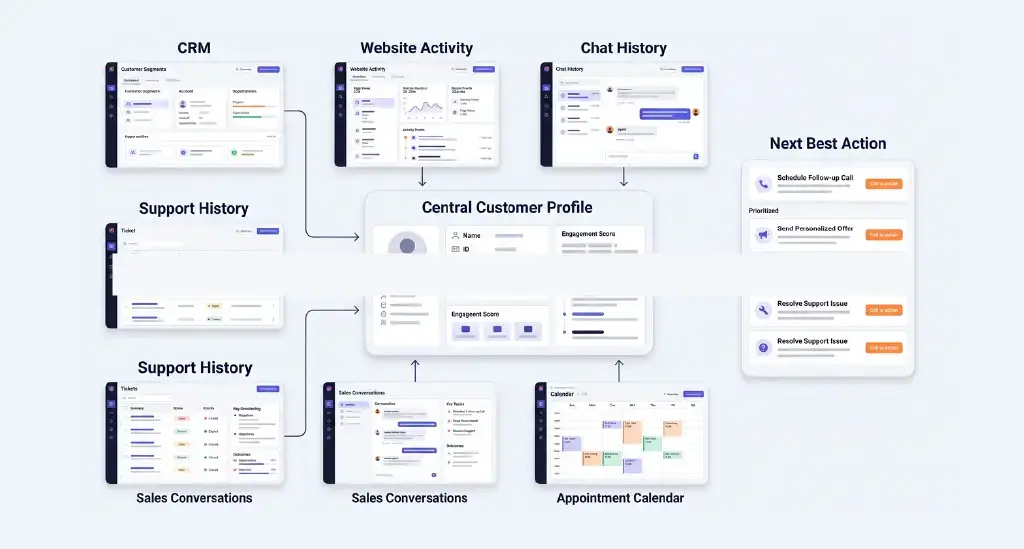
This is where connected systems, conversation summaries, clear routing rules, CRM data, and thoughtful automation become valuable. Their purpose is not merely to store information. It is to make that information available at the exact moment someone needs it.
The stakes are higher than operational convenience. Zendesk reports that six in ten customer service agents say a lack of consumer data often causes negative customer experiences.
When information is fragmented, employees struggle too.
A representative without context has to interrogate the customer for it. A representative with context can use that same time to solve the problem.
The technology becomes valuable when the customer no longer has to compensate for what the business failed to remember.
Also read: More Conversations, Same Team: How Businesses Scale Customer Engagement Without Burning Out
Businesses often evaluate handoffs by asking operational questions.
Was the conversation routed correctly? Did the escalation happen? Did the salesperson receive the lead? Was the ticket assigned?
Those questions matter, but they do not reveal the full customer experience.
A better question is: what did the customer have to do because the handoff happened?
Did they have to repeat their name? Explain their problem again? Correct something that had already been established? Ask who was responsible? Wait while the next employee searched for context? Follow up because nobody took ownership?
The more work the customer has to perform to bridge internal gaps, the weaker the handoff.
This is also a useful way to think about preventing customers from repeating information during transfers. The goal is not simply to eliminate duplicate questions. It is to eliminate unnecessary customer effort.
Sometimes a receiving employee genuinely needs clarification. Asking a more specific follow-up is not a failure.
If the customer previously said, “I need this installed soon,” the next employee might reasonably ask, “Would Tuesday or Wednesday work better?”
That moves the conversation forward.
Asking, “When do you need it?” moves backward.
A seamless handoff does not mean never asking another question.
It means never making the customer unnecessarily retrace their steps.

The strongest customer experiences often feel surprisingly simple.
Not because nothing complicated is happening behind the scenes, but because the complexity stays behind the scenes.
AI may identify intent. A receptionist may route the request. Sales may qualify it. A specialist may answer a technical question. Another employee may schedule the appointment. A CRM may record everything.
The customer does not need to understand that architecture.
They need to experience one coherent relationship with one business.
That is ultimately what a good conversation handoff protects.
It protects context so customers do not have to repeat themselves. It protects momentum so conversations do not restart. It protects ownership so requests do not disappear between teams. It protects trust by showing that when customers tell a business something, the business remembers.
As AI becomes more involved in customer service, getting this relationship right will become even more important. Gartner reported in 2025 that 95% of customer service leaders surveyed planned to retain human agents, reinforcing a future that is increasingly digital-first rather than human-free.
The question for businesses, then, is not whether AI or humans should own the customer experience.
It is how well they can work together to create one.
Responsiveness matters. Automation matters. Routing matters.
But none of them can compensate for a conversation that keeps forgetting its own history.
The handoff is not the space between two parts of the customer experience.
It is the customer experience.
With Blazeo, businesses can bring AI-powered conversations and human support closer together, helping customers move from initial inquiry to the right next step without unnecessary friction. Whether that next step is answering a question, qualifying a lead, scheduling an appointment, or bringing a person into the conversation, the goal is the same: keep the conversation moving without making the customer start over.
Ready to create customer conversations that feel connected from the first message to the final handoff? Explore Blazeo and see how AI-powered customer engagement can help your business respond, qualify, schedule, and connect customers with the right people at the right time.

