 SmartHub
 Automation
 Appointment Scheduler
 Lead Management
 Dashboard & Reports
 Task Management
 Communications Hub
 Managed chat
 Voice Receptionist
 Appointment scheduling
 Retainer signing
 Home services
 Lawyers and firms
 Medical services
 College admissions
 Real estate agents
 Marketing agencies
 About
About Partner program
 Estimate Your ROI
 Case Studies
 Blog
Blog FAQs
FAQs Login
LoginEvery Lead Channel, One Inbox: The Simpler Way to Grow Your Business




Products
Industries
Company
Resources


Growth rarely breaks because of a lack of leads anymore. Most businesses today are drowning in conversations. The real problem begins after the lead arrives.
A customer messages your business on Instagram asking about pricing. Ten minutes later, they send a WhatsApp message because nobody replied. Meanwhile, your sales rep is buried inside email threads, another lead fills out a website form, and someone from support accidentally responds to a prospect with outdated information.
By the end of the week, nobody knows which leads were contacted, who followed up, or which conversations actually converted into revenue.
This is what modern lead chaos looks like.
And for many businesses, it is happening silently.
The issue is not marketing. It is fragmentation.
The average company today communicates across multiple platforms simultaneously. Instagram DMs, Facebook Messenger, WhatsApp, website chat, email, calls, LinkedIn inquiries, forms, and SMS all compete for attention. While every channel promises better customer engagement, the operational reality is far messier.
Instead of creating smoother experiences, disconnected communication channels often create slower responses, duplicated efforts, lost opportunities, and frustrated teams.
That is exactly why businesses are now shifting toward a unified inbox for business.
Not because it sounds trendy. Because it solves a very real operational problem.
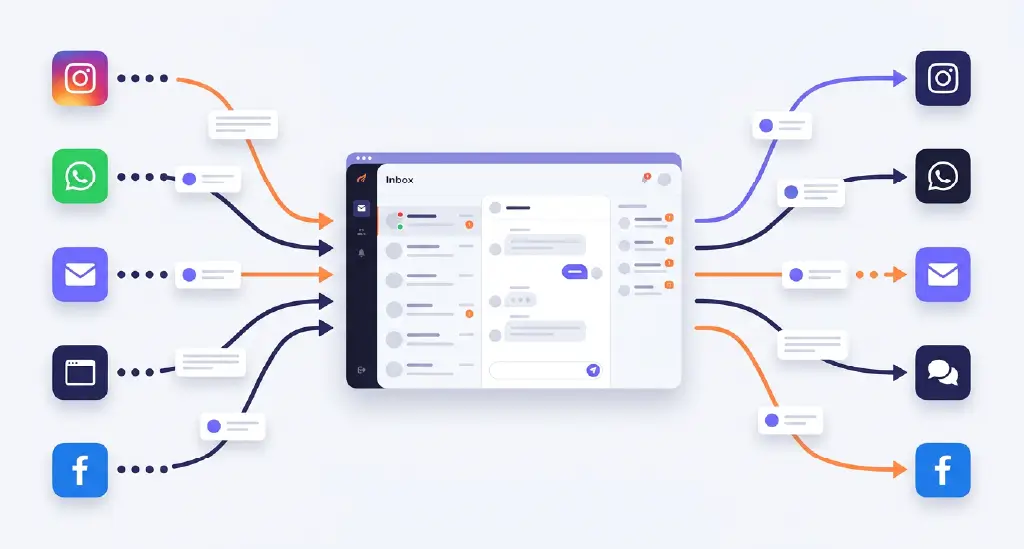
When every lead channel flows into one centralized workspace, teams stop scrambling and start responding with clarity. Conversations become trackable. Follow-ups become consistent. Managers gain visibility. Customers feel heard faster.
And most importantly, revenue stops slipping through the cracks.
What Is a Unified Inbox for Business?
A unified inbox for business is a centralized communication platform that combines messages from email, WhatsApp, Instagram, Facebook Messenger, website chat, SMS, and other channels into one shared workspace. It helps teams respond faster, manage leads more efficiently, and maintain conversation history across every customer touchpoint.
Most businesses do not realize how expensive fragmented communication becomes over time.
At first, handling leads across separate apps feels manageable. A small team can manually switch between WhatsApp, Instagram, email, and spreadsheets. But growth quietly compounds the complexity.
One new campaign generates more website inquiries. Seasonal demand increases support messages. Sales teams expand. Suddenly, what once felt manageable becomes operational chaos.
The biggest problem is not even missed messages. It is context switching.
Imagine a sales rep speaking to a customer on WhatsApp while checking pricing details in email and looking for previous notes in a CRM. Every platform becomes another tab, another login, another opportunity for information to disappear.
Over time, response quality drops because teams are mentally overloaded.
A study by Harvard Business Review found that constant task switching reduces productivity significantly because employees struggle to refocus after interruptions. In sales and customer communication, this matters even more because delays directly impact conversions.
A lead who reaches out today expects speed. Not tomorrow morning. Not “when someone sees the notification.”
Now imagine this happening at scale.
One fashion retailer running ads during a seasonal campaign discovered they were losing nearly 35% of incoming leads simply because inquiries were scattered between Instagram DMs, WhatsApp, and Facebook comments. Customers often received delayed or inconsistent replies because different team members handled different channels independently.
The business initially assumed marketing performance was weak.
In reality, the communication system was broken.
After centralizing all lead conversations into a single workspace, their average response time dropped dramatically within weeks. More importantly, conversions improved without increasing ad spend.
That is the power of omnichannel lead management when executed correctly.

Businesses still organize communication internally by departments and platforms.
Customers do not.
A buyer may discover your brand through a TikTok ad, ask a question on Instagram, visit your website later, and eventually complete the purchase after receiving a WhatsApp follow-up.
To them, it is one continuous journey.
To most businesses, it becomes four disconnected conversations.
This disconnect creates friction customers can immediately feel.
Nothing frustrates a buyer more than repeating information multiple times because teams lack visibility into prior conversations. The moment a customer has to explain their issue again, confidence drops.
Today’s customers expect continuity.
They expect brands to remember context regardless of where the conversation started.
This is where a customer inbox becomes far more than a convenience tool. It becomes part of the customer experience itself.
When teams can see previous interactions across every channel in one place, conversations feel natural instead of transactional. Sales reps understand history instantly. Support teams respond with context. Marketing teams gain visibility into what customers are actually asking before buying.
The result is not just operational efficiency.
It is trust.
And trust converts.
Also read: Why Speed to Lead Matters Even More During Peak Demand Seasons
Many businesses obsess over optimizing campaigns while ignoring one of the most important conversion factors: response speed.
The reality is brutally simple.
The faster you reply, the higher your chances of conversion.
This becomes even more critical when managing leads from multiple channels because opportunities disappear quickly when conversations are fragmented.
A prospect reaching out through WhatsApp may contact three competitors simultaneously. If your team misses the message because nobody was monitoring that platform at the time, the lead is already gone.
Not because your product was worse.
Because your systems were slower.
One SaaS company discovered that their average first response time across all channels was nearly four hours during peak periods. The leadership team initially blamed low sales on lead quality.
After implementing a centralized inbox system, response times dropped below 15 minutes for most inquiries.
The same marketing campaigns suddenly began converting significantly better.
No pricing changes. No major sales retraining. No new ad strategy.
Just faster, centralized communication.
Businesses often underestimate how much revenue lives inside operational simplicity.
The businesses growing fastest right now are not necessarily the ones with the largest teams.
They are the ones removing friction fastest.
This matters especially during growth quarters where communication volume increases rapidly.
More campaigns mean more inbound conversations. More conversations mean more opportunities for confusion unless systems are centralized early.
Many companies try solving this by hiring more people.
But scaling chaos only creates bigger chaos.
A team of ten working across disconnected channels still struggles if visibility is poor. Meanwhile, a leaner team using a unified inbox for business can often outperform larger competitors simply because communication flows more smoothly.
The operational difference becomes visible quickly.
Leads no longer disappear between shifts. Managers can monitor conversations centrally. Sales and support stop duplicating efforts. Internal collaboration improves because everyone works from shared information instead of isolated apps.
Most importantly, growth stops feeling reactive.
Instead of constantly “catching up,” teams finally operate proactively.
That psychological shift alone transforms how businesses scale.
Also read: Mid-Year Revenue Check: Where Leads Are Slipping Through the Cracks
Many brands still misunderstand omnichannel lead management as simply “having all messages in one place.”
The real value runs deeper.
It creates alignment.
Sales, support, and marketing often operate with fragmented information because communication histories remain siloed inside separate platforms. This creates inconsistent messaging and missed insights.
For example, marketing teams may continue promoting offers customers are actively complaining about in support conversations. Sales teams may push leads aggressively without realizing those customers already had unresolved service issues.
Centralized communication changes this dynamic.
When every interaction becomes visible, teams gain a fuller picture of customer behavior.
Patterns emerge faster.
Managers notice which channels convert best. Teams identify recurring objections earlier. Businesses discover where leads drop off most frequently.
This kind of visibility directly improves decision-making.
One healthcare clinic managing inquiries across calls, Facebook messages, and website forms struggled with appointment coordination and follow-ups. Patients often received delayed responses because front desk staff manually checked multiple platforms throughout the day.
After adopting centralized communication management, the clinic reduced missed inquiries substantially and improved appointment booking consistency within months.
The biggest improvement was not technological.
It was organizational clarity.

One part of this conversation rarely gets discussed enough: employee exhaustion.
Scattered communication systems create invisible burnout.
Constant notifications across multiple apps keep teams mentally fragmented throughout the day. Employees begin operating in permanent reaction mode instead of focused execution.
This eventually affects morale, response quality, and retention.
A centralized customer inbox reduces cognitive overload because teams no longer waste energy searching for conversations, switching between tools, or asking colleagues for missing information.
Everything becomes easier to locate.
Easier systems create calmer teams.
Calmer teams communicate better.
And better communication drives better customer relationships.
This is one of the reasons businesses investing in centralized workflows often notice improvements beyond revenue alone. Team collaboration improves naturally because communication becomes transparent instead of isolated.
Also read: The Cost of Unstructured Conversations: Why Growth Breaks at Scale
The next generation of business growth will not come from adding more communication channels endlessly.
It will come from managing them intelligently.
Customers will continue moving fluidly across platforms. AI-driven communication will accelerate expectations further. Businesses responding slowly or inconsistently will struggle more each year.
This is why unified communication systems are quickly becoming infrastructure rather than optional software.
The companies adapting early gain an enormous advantage because they build operational discipline before scale magnifies inefficiencies.
And this applies across industries.
Real estate agencies managing inquiries from property portals and WhatsApp. E-commerce brands handling Instagram and website chat simultaneously. Healthcare providers juggling calls and appointment requests. Service businesses coordinating multiple lead sources daily.
The industries differ.
The operational problem remains the same.
Disconnected conversations create disconnected growth.
Some businesses hesitate to centralize communication because they fear automation may make customer interactions feel robotic.
But the opposite is often true.
When teams spend less time searching for information or manually tracking conversations, they gain more time to actually communicate thoughtfully.
Customers feel the difference immediately.
Responses become faster but also more informed. Conversations continue naturally instead of restarting repeatedly. Teams can personalize interactions because customer history remains accessible.
Technology works best when it removes friction without removing humanity.
That balance matters enormously today because customers can instantly recognize generic communication.
The businesses winning trust right now are not necessarily the loudest.
They are the ones creating smoother experiences.
Every business eventually reaches a moment where communication either supports growth or quietly sabotages it.
For many companies, that moment arrives sooner than expected.
More leads should feel exciting. But without centralized systems, growth often creates stress instead of momentum.
Leads pile up. Teams lose visibility. Customers wait longer. Revenue leaks silently.
This is why simplifying communication is no longer just an operational improvement.
It is a growth strategy.
A proper unified inbox for business creates clarity at the exact moment businesses need it most. It brings every lead channel into one manageable workflow so teams can respond faster, collaborate better, and convert more consistently.
And in a market where customers expect immediate, seamless communication, that simplicity becomes a competitive edge.

A unified inbox for business combines customer messages from multiple platforms into one centralized dashboard so teams can manage conversations efficiently.
Omnichannel lead management helps businesses track and respond to leads across multiple communication channels without losing context or missing opportunities.
A centralized inbox reduces app switching and gives teams immediate visibility into all incoming conversations, allowing faster replies.
Yes. Faster response times and better conversation tracking often improve lead conversion rates and customer satisfaction.
Most businesses include email, WhatsApp, Instagram, Facebook Messenger, website chat, LinkedIn inquiries, SMS, and support tickets.
Absolutely. Small businesses benefit from centralized communication because it simplifies lead tracking and prevents missed inquiries.
The businesses that grow strongest this quarter will not necessarily be the ones generating the most leads.
They will be the ones managing conversations most effectively.
Because modern growth is no longer just about attracting attention. It is about sustaining momentum once customers reach out.
When every message, inquiry, and lead lives across disconnected platforms, opportunities inevitably slip away. But when communication becomes centralized, businesses regain visibility, speed, and consistency.
That is where smarter growth begins.
With Blazeo, businesses can bring every lead channel into one intelligent workspace, simplify omnichannel lead management, and create faster, more connected customer experiences without the chaos of scattered communication tools.