 SmartHub
 Automation
 Appointment Scheduler
 Lead Management
 Dashboard & Reports
 Task Management
 Communications Hub
 Managed chat
 Voice Receptionist
 Appointment scheduling
 Retainer signing
 Home services
 Lawyers and firms
 Medical services
 College admissions
 Real estate agents
 Marketing agencies
 About
About Partner program
 Estimate Your ROI
 Case Studies
 Blog
Blog FAQs
FAQs Login
LoginThe Cost of Unstructured Conversations: Why Growth Breaks at Scale





Products
Industries
Company
Resources

There’s a moment every growing company eventually hits.
Leads are coming in. The pipeline looks healthy. Marketing is doing its job. And yet, something feels off.
Revenue isn’t keeping up with demand. Conversion rates fluctuate unpredictably. Some sales reps are closing deals effortlessly while others, just as experienced, struggle to move conversations forward.
At first, it’s easy to blame external factors.
But if you look closely—really closely—the problem often sits somewhere far more subtle.
Inside the conversations themselves.
Because when conversations are unstructured, growth doesn’t just slow down.
It breaks.
Sales process standardization for scaling teams is the practice of creating a consistent, repeatable framework for how every sales conversation is structured—from the first interaction to the final decision.
At its core, it answers a simple but critical question:
What should a “good” sales conversation look like—every time?
In high-growth environments, this clarity becomes essential. Without it, each sales rep operates based on personal instinct, experience, or guesswork. While that might work in the early stages, it quickly becomes a liability as teams expand and deal volume increases.
Standardization doesn’t mean turning conversations into scripts or removing flexibility. Instead, it focuses on defining the key stages and outcomes that every conversation should move through.
These typically include:
When these elements are clearly defined, conversations stop being reactive and start becoming intentional.
This is especially important for teams trying to scale. As more reps join, consistency becomes harder to maintain. Without a standardized approach, performance gaps widen, onboarding slows down, and forecasting becomes unreliable.
On the other hand, when sales process standardization is in place, teams gain:
In many ways, standardization acts as the bridge between early-stage intuition and scalable execution.
It allows companies to preserve what works—while making it teachable, repeatable, and measurable across the entire team.
In the early days, unstructured conversations don’t feel like a problem.
Founders are often the first salespeople. They know the product deeply. They understand the customer instinctively. Conversations feel natural, fluid, even intuitive.
A prospect asks a question, and the founder answers with context. They adapt in real time. They read signals that aren’t written down anywhere.
Deals close not because there’s a defined process, but because there’s clarity in the person driving the conversation.
But then growth happens.
And suddenly, the thing that once worked effortlessly begins to fragment.
Because intuition doesn’t scale.
Without sales process standardization, every rep starts creating their own version of what a “good conversation” looks like.
One focuses heavily on product features. Another rushes toward pricing. A third spends too long building rapport but never moves the deal forward.
The result isn’t just inconsistency.
It’s unpredictable.
Many teams don’t intentionally choose chaos. It creeps in quietly under the assumption that autonomy leads to better performance.
“Let them find their style.”
“Everyone sells differently.”
“Top performers don’t follow scripts.”
And while there’s truth in that, it often becomes an excuse to avoid building structure.
The cost of this shows up in ways that aren’t always obvious at first.
A lead who asks the same question gets three completely different answers depending on who responds.
A high-intent prospect loses momentum because the conversation drifts without direction.
A promising deal stalls simply because the rep didn’t know how to guide the next step.
Over time, these moments compound.
What looks like a lead quality issue is often a conversation quality issue.
What feels like a pipeline problem is actually a process problem.
This is where sales workflow optimization stops being a nice-to-have and becomes essential.
Also read: Inbound vs Outbound Leads: 7 Powerful Differences That Drive Results in 2026

Imagine two nearly identical prospects reaching out to the same company.
They have similar needs. Similar budgets. Similar timelines.
The only difference is who responds to them.
In the first scenario, the conversation starts well but quickly loses direction. The rep answers questions reactively, jumping from topic to topic. There’s no clear progression, no framing of the problem, no alignment on outcomes.
By the end of the call, the prospect says, “Let me think about it.”
And then disappears.
In the second scenario, the conversation feels different from the start.
The rep acknowledges the inquiry but immediately anchors the discussion around the prospect’s goals. They ask layered questions, connecting pain points to potential outcomes. They anticipate objections before they surface.
The conversation doesn’t feel scripted.
It feels intentional.
By the end, the prospect isn’t just informed.
They’re confident they're speaking with same company, about the same product, without sacrificing lead quality.
Different outcome.
This is the real cost of unstructured conversations.
Not just lost deals—but lost clarity.

As teams grow, the gaps created by unstructured conversations widen.
New hires don’t just need to learn the product. They need to understand how conversations should flow. Without clear guidance, they rely on guesswork or mimicry.
Sometimes they shadow top performers. But what they see isn’t always what they understand.
Because great conversations often look effortless from the outside.
What’s invisible is the structure underneath.
Without a defined framework, onboarding becomes inconsistent. Coaching becomes reactive. Performance becomes uneven.
This is why many companies struggle with scaling sales teams even when demand is strong.
Growth exposes what lack of structure hides.
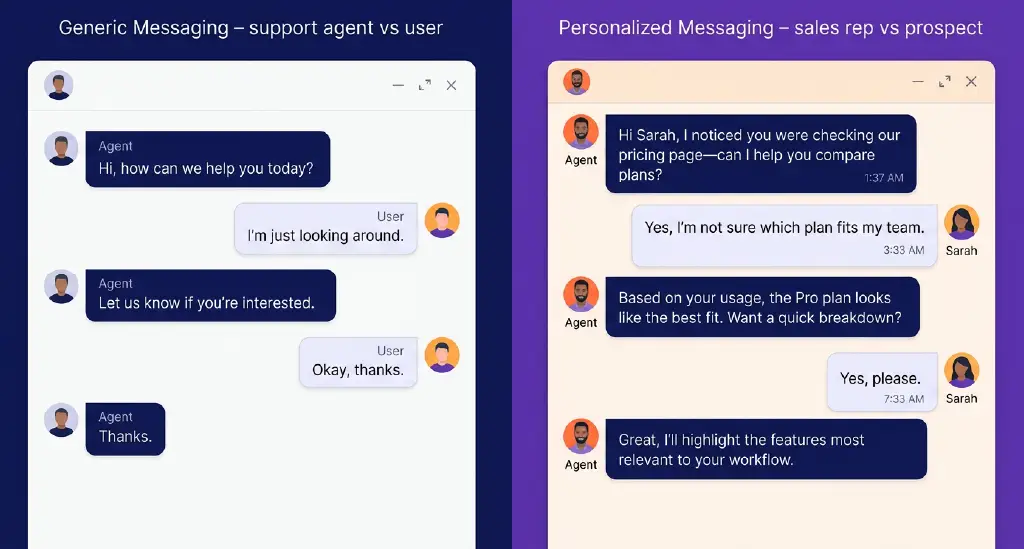
One of the biggest misconceptions around sales process standardization is that it kills personalization.
In reality, the opposite is true.
When there’s no structure, personalization becomes shallow.
Reps rely on surface-level details—first names, company size, industry buzzwords—without truly understanding the buyer’s context.
Conversations feel customized on the outside but generic underneath.
True personalization isn’t about saying different things.
It’s about asking better questions.
It’s about knowing when to probe deeper, when to challenge assumptions, and when to guide decisions.
Structure doesn’t restrict this.
It enables it.
Because when the flow of the conversation is clear, reps have more mental space to focus on the human in front of them.
Also read: From Intake to Revenue: How Conversational AI Impacts the Entire Sales Pipeline
Standardization doesn’t mean turning conversations into rigid scripts.
It means defining the critical moments that every conversation should pass through.
It means understanding how a conversation opens, how it explores the problem, how it builds urgency, and how it leads to a decision.
Think of it like a map rather than a script.
The route is clear, but the journey adapts based on who’s on the road.
For example, a well-structured conversation doesn’t start with a pitch.
It starts with alignment.
Instead of asking generic questions, the rep frames the purpose of the conversation and sets expectations.
As the conversation progresses, there’s a deliberate shift from understanding the current state to uncovering gaps, then to exploring possible outcomes.
Nothing feels forced.
But nothing is left to chance.
This is what people mean when they ask how to standardize the sales process without losing authenticity.
It’s not about control.
It’s about consistency in what matters.
Standardizing sales conversations doesn’t require rigid scripts or heavy processes. Instead, it’s about building a clear, flexible structure that guides reps while still allowing for natural interaction.
Here’s a step-by-step approach to implementing sales process standardization effectively:
Start by looking at what’s already happening.
Review sales calls, email threads, and chat transcripts to identify patterns. Pay close attention to:
This step helps you uncover what’s working—and what isn’t—without making assumptions.
Top performers often follow a structure, even if they don’t realize it.
Break down their conversations to understand:
These insights form the foundation of your standardized framework.
Instead of scripting exact words, define the stages every conversation should include.
For example:
This ensures every conversation follows a logical flow—without feeling forced.
Provide reps with guiding questions and principles, not rigid scripts.
For example:
This approach preserves authenticity while maintaining consistency.
Once the framework is defined, roll it out through structured training.
Focus on:
Alignment is critical—everyone should understand not just what to do, but why it matters.
Standardization isn’t a one-time effort.
Track key metrics like:
Use this data to refine your framework over time.
As patterns evolve, your structure should evolve with them.
The real impact comes from consistent reinforcement.
Managers should:
This turns standardization into a living system—not just a document.
When done right, standardizing sales conversations doesn’t make interactions robotic—it makes them reliable, intentional, and scalable.
It shifts sales from being dependent on individual talent to being driven by a repeatable system that anyone on the team can execute.
And that’s what ultimately transforms growth from unpredictable to sustainable.
When conversations are structured, something powerful begins to happen.
Patterns emerge.
This transforms how teams operate.
Coaching becomes precise because there’s a shared framework to reference.
Performance becomes predictable because success is no longer dependent on individual intuition alone.
Forecasting becomes reliable because deal progression follows a consistent path.
Over time, this creates momentum.
Not the chaotic kind driven by bursts of activity—but the steady kind driven by repeatable outcomes.
This is the foundation of true sales workflow optimization.
Also read: The Anatomy of a Winning Sales Conversation: What Top-Performing Teams Do Differently
Despite the clear benefits, many teams delay investing in structure.
Part of it is fear.
There’s a concern that introducing structure will slow things down or disrupt what’s already working.
Part of it is complexity.
Defining a conversation framework feels intangible compared to optimizing tools or increasing lead flow.
And part of it is visibility.
It’s easier to see how many leads you have than to measure the quality of the conversations happening within them.
But the longer this is ignored, the more expensive it becomes.
Because scaling without structure doesn’t just create inefficiencies.
It amplifies them.
Fixing unstructured conversations doesn’t happen overnight.
It starts with observing what’s already happening.
Listening to calls. Reading transcripts. Identifying where conversations lose momentum or create confusion.
From there, patterns begin to surface.
These insights become the foundation of your framework.
And once that framework exists, everything changes.
Training becomes intentional. Feedback becomes actionable. Conversations become aligned.
Growth stops feeling fragile.
And starts feeling scalable.
At its core, the reason why sales teams struggle to scale isn’t a lack of effort or talent.
It’s a lack of shared understanding.
When every conversation is different, every outcome is unpredictable.
When there’s no common structure, there’s no common standard.
And without that, growth depends on luck more than design.
The companies that scale successfully aren’t the ones with the most leads.
They’re the ones with the most clarity in how those leads are handled.

Sales process standardization is creating a consistent framework for how sales conversations are conducted, ensuring predictable and scalable results.
They create inconsistent buyer experiences, reduce conversion rates, and make performance unpredictable across teams.
It provides clear conversation flow, improves coaching, and helps reps guide prospects more effectively toward decisions.
No, it enhances personalization by giving reps a structure that allows deeper, more meaningful conversations.
By defining key conversation stages—like discovery, problem framing, and decision guidance—without forcing rigid wording.
Platforms like CRM systems, conversation intelligence tools, and AI-driven sales platforms (e.g., Blazeo) help structure and analyze conversations.
There’s a quiet shift that happens when conversations become structured.
Sales stops feeling like an art reserved for a few top performers.
And starts becoming a system that anyone on the team can execute with confidence.
Leads don’t just move faster.
They move with purpose.
If you’re serious about scaling, the question isn’t whether you need more leads.
It’s whether your conversations are built to handle the ones you already have.
This is where platforms like Blazeo come in—not just to automate conversations, but to bring structure, context, and intelligence into every interaction.
Because growth doesn’t break from lack of demand.
It breaks from lack of direction.
And structured conversations are what turn momentum into something sustainable.