 SmartHub
 Automation
 Appointment Scheduler
 Lead Management
 Dashboard & Reports
 Task Management
 Communications Hub
 Managed chat
 Voice Receptionist
 Appointment scheduling
 Retainer signing
 Home services
 Lawyers and firms
 Medical services
 College admissions
 Real estate agents
 Marketing agencies
 About
About Partner program
 Estimate Your ROI
 Case Studies
 Blog
Blog FAQs
FAQs Login
LoginEvery Inquiry Answered: How Omnichannel Communication Increases Conversion Rates




Products
Industries
Company
Resources

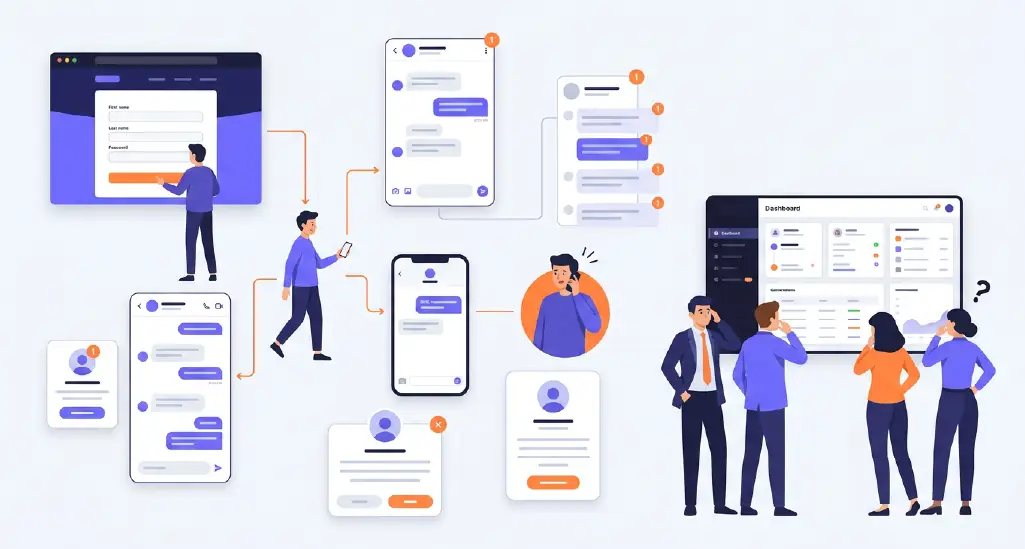
A prospect fills out a contact form on your website.
An hour later, they send a Facebook message because they haven't received a response.
The next morning, they call your business and leave a voicemail.
By afternoon, they submit another inquiry through your website because they're unsure whether anyone saw their previous messages.
Meanwhile, your sales team sees only one of those interactions.
The marketing team sees another.
Customer support has no visibility into either.
The prospect, who was genuinely interested in buying, now feels ignored.
Eventually, they move on to a competitor.
Most businesses assume they lose leads because of pricing, competition, or product limitations.
In reality, many opportunities are lost because communication breaks down long before a sales conversation ever begins.
Customers no longer interact through a single channel. They move between websites, text messages, social media platforms, phone calls, email, and live chat without thinking twice.
Unfortunately, many businesses still manage these conversations as if each channel exists independently.
The result is fragmented communication, slower response times, frustrated teams, and lower conversion rates.
This is why omnichannel communication has become one of the most important growth strategies for modern businesses.
When every inquiry is captured, tracked, and responded to from a single system, businesses stop losing opportunities in the gaps between channels.
And those gaps are often much larger than leaders realize.

Most companies don't notice communication problems until they become severe.
On the surface, everything appears to be working.
The website receives inquiries.
The sales team receives calls.
Messages arrive through Facebook and Instagram.
Emails continue flowing into inboxes.
Each channel functions independently.
The problem is that customers don't think in channels.
They think in conversations.
When a customer reaches out, they expect the business to recognize them regardless of where they choose to communicate.
They don't care whether their previous message came through a website form, an SMS, or a social platform.
They simply expect continuity.
Businesses, however, often create entirely different experiences depending on the communication channel being used.
A prospect may receive an immediate response through live chat but wait hours for an email.
A customer who spoke with a sales representative by phone may need to repeat the same information when reaching out through social media.
A lead may disappear entirely because one department never sees a message sent to another channel.
These small breakdowns create friction.
And friction kills conversions.
The longer it takes for a prospect to receive a meaningful response, the less likely they are to move forward.
Also read: The Cost of Unstructured Conversations: Why Growth Breaks at Scale
Ten years ago, businesses could largely control how customers contacted them.
Today, customers decide.
A prospect might discover your company through Google, visit your website from a mobile device, send a question through Instagram, continue the conversation through text messaging, and finally book a meeting after receiving an email.
To the customer, this feels natural.
To a business operating with disconnected systems, it can feel chaotic.
The challenge isn't that customers are using more channels.
The challenge is that businesses often lack visibility across them.
Consumers have become accustomed to seamless digital experiences.
Customers expect businesses to recognize them across every interaction.
Continuity between past and present conversations has become the norm.
Fast, relevant responses are now considered a basic expectation rather than a bonus.
When these expectations aren't met, trust begins to erode.
And trust is often the deciding factor in whether a prospect becomes a customer.
Many businesses confuse omnichannel communication with simply being present on multiple platforms.
The two are not the same.
Having email, phone, live chat, Facebook Messenger, SMS, and web forms doesn't automatically create an omnichannel experience.
In fact, managing channels separately often creates more complexity.

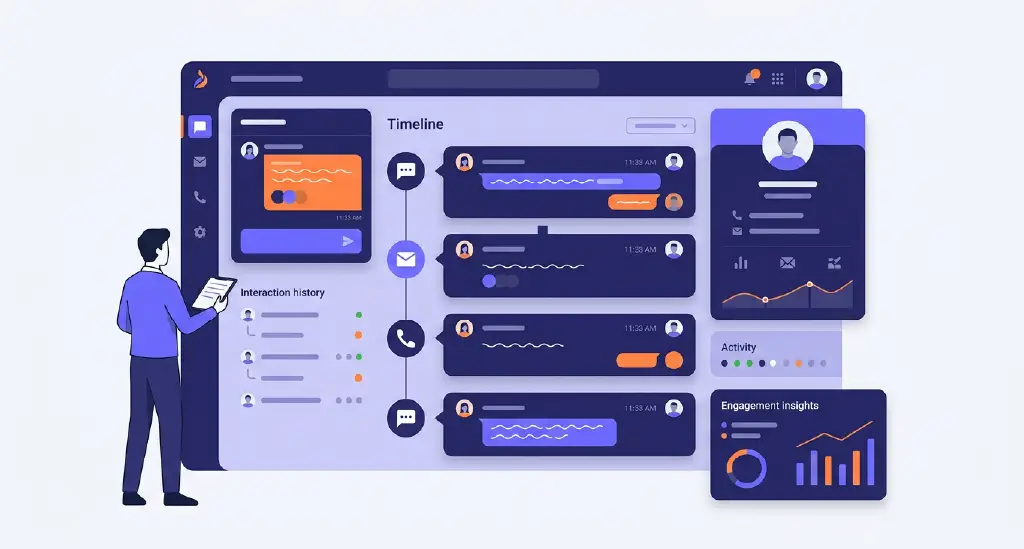
True omnichannel communication connects every interaction into a single customer journey.
Regardless of where a conversation begins, every interaction becomes part of one continuous record.
When a sales representative opens a conversation, they can immediately see previous emails, text messages, website inquiries, phone calls, and chat interactions.
Nothing gets lost.
Nothing needs to be repeated.
The customer experiences a consistent relationship rather than a series of disconnected interactions.
This continuity dramatically improves both customer experience and operational efficiency.
Also read: Every Lead Channel, One Inbox: The Simpler Way to Grow Your Business
Imagine a home services company generating leads from Google Ads, Facebook campaigns, website traffic, and referral sources.
A potential customer visits the website after seeing a Facebook advertisement.
They submit a form requesting a quote.
Before receiving a response, they send a text message asking a follow-up question.
Later that evening, they call the business.
Each interaction indicates strong buying intent.
Yet if those communications live in separate systems, no one sees the complete picture.
The sales representative handling the phone call may have no idea the prospect already submitted a form.
The marketing team may never know the customer called.
The business sees three separate interactions instead of one highly engaged lead.
This happens every day.
Not because teams are careless.
Because their tools weren't designed to create a unified customer view.
When businesses lose context, they lose momentum.
And momentum is often what drives conversions.
One of the biggest advantages of omnichannel communication is speed.
When conversations are centralized, teams spend less time searching for information and more time helping customers.
Imagine a prospect reaches out through your website chat.
The next day, they send an SMS.
Later, they respond to an email campaign.
With a customer communication platform that connects every channel, the sales team immediately sees the entire history.
Earlier questions are readily available within the conversation history.
All previously shared details remain visible in one place.
With complete context at hand, representatives can continue the discussion without starting over.
The prospect feels recognized.
The business responds faster.
Trust grows.
The sales process moves forward.
These improvements may seem small individually, but collectively they create a significant impact on conversion rates.
Also read: Conversations That Convert vs Conversations That Stall: Spotting the Difference Early
As businesses grow, communication volume increases rapidly.
What begins as a manageable number of conversations can quickly become overwhelming.
Without centralized visibility, teams often resort to juggling multiple applications throughout the day.
One browser tab for Facebook.
Another for Instagram.
Several inboxes for email.
Separate systems for SMS, phone calls, and website inquiries.
Every additional platform creates another opportunity for delays, missed messages, and communication breakdowns.
Unified inbox software addresses this challenge by bringing every conversation into one place.
Instead of switching between systems, teams work from a single source of truth.
Messages arrive in one dashboard.
Customer history remains accessible.
Follow-ups become easier to manage.
Managers gain visibility into response times and team performance.
Most importantly, leads stop falling through the cracks.

Consider a growing HVAC company during peak summer season.
Demand is high.
Phone lines are busy.
Website inquiries increase daily.
Social media messages arrive throughout the day.
Customers are searching for immediate help.
Without omnichannel communication, inquiries become scattered across multiple platforms.
The office staff struggles to keep up.
Response times slow down.
Potential customers contact competitors instead.
Now imagine the same company using a unified communication system.
Every inquiry flows into one platform.
Website forms, calls, texts, and social messages appear in a shared workspace.
Automated routing ensures the right team member receives the inquiry immediately.
Managers can see which leads require follow-up.
No communication channel operates in isolation.
The company doesn't necessarily generate more leads.
It simply converts more of the leads it already has.
And that distinction matters.
Often, the fastest path to growth isn't increasing lead volume.
It's improving how existing opportunities are handled.
The best sales teams today are not necessarily the ones with the largest budgets.
They are the ones with the best visibility.
Lead communication tools help organizations understand where prospects are engaging, what questions they're asking, and how conversations are progressing.
Instead of relying on fragmented information, teams gain a complete picture of buyer intent.
This visibility enables smarter follow-ups.
A salesperson can prioritize a prospect who has interacted across multiple channels rather than treating every inquiry equally.
Managers can identify bottlenecks before they impact revenue.
Marketing teams can understand which communication channels generate the highest-quality conversations.
The result is a more coordinated and effective revenue operation.
Also read: What Top Teams Automate Before Summer (And What They Never Should)
Many small and medium-sized businesses assume omnichannel communication is only necessary for large enterprises.
In reality, SMBs often benefit even more.
Large organizations can sometimes absorb inefficiencies through sheer scale.
Smaller businesses cannot.
When resources are limited, every lead matters.
Every inquiry matters.
Every missed opportunity carries a greater impact.
The best omnichannel communication platform for SMBs helps level the playing field.
It enables smaller teams to deliver the type of connected customer experience typically associated with much larger organizations.
Customers receive faster responses.
Teams stay organized.
Opportunities remain visible.
Growth becomes more predictable.
Customer expectations will continue evolving.
New communication channels will emerge.
Response times will become even more important.
Businesses that continue managing conversations in silos will face increasing challenges.
Those that embrace unified communication will be positioned to build stronger relationships, improve operational efficiency, and convert more opportunities.
The future isn't about adding more communication channels.
It's about connecting them.
Customers want convenience.
Teams need visibility.
Businesses need consistency.
Omnichannel communication delivers all three.
Businesses that implement omnichannel communication gain a significant advantage by ensuring every customer interaction is captured, tracked, and responded to efficiently.
Key benefits include:
By unifying conversations across email, phone, SMS, social media, website forms, and live chat, businesses create a seamless customer journey that builds trust and increases conversions.
Omnichannel communication is a strategy that connects customer interactions across multiple channels—including email, phone, SMS, social media, and website chat—into a single, unified conversation history.
It reduces response delays, eliminates communication gaps, and helps teams maintain context throughout the customer journey, leading to higher trust and better conversion rates.
Multichannel communication simply offers multiple communication options. Omnichannel communication connects those channels together to provide a seamless customer experience.
When customer interactions are spread across separate systems, inquiries can be missed, duplicated, or delayed, causing prospects to lose confidence and choose competitors.
A unified inbox consolidates messages from email, SMS, phone calls, social media, web forms, and chat into one platform, making communication easier to manage.
Yes. Small and medium-sized businesses often benefit the most because they have fewer resources and need to maximize every lead opportunity.
Most businesses should integrate:
Most businesses don't have a lead generation problem.
They have a communication problem.
Potential customers are already reaching out through websites, social media, text messages, phone calls, and email. The challenge is ensuring every inquiry receives timely, informed, and consistent attention.
Omnichannel communication eliminates the gaps where opportunities are lost. By bringing conversations into a unified system, businesses can respond faster, maintain context, improve customer experiences, and ultimately increase conversion rates.
The companies that win in today's market won't necessarily be the ones generating the most inquiries. They'll be the ones answering every inquiry effectively.
Blazeo helps businesses unify conversations across channels, giving teams a complete view of every customer interaction from first contact to conversion. If you're ready to stop losing opportunities to disconnected communication, it's time to see how Blazeo can help.