 SmartHub
 Automation
 Appointment Scheduler
 Lead Management
 Dashboard & Reports
 Task Management
 Communications Hub
 Managed chat
 Voice Receptionist
 Appointment scheduling
 Retainer signing
 Home services
 Lawyers and firms
 Medical services
 College admissions
 Real estate agents
 Marketing agencies
 About
About Partner program
 Estimate Your ROI
 Case Studies
 Blog
Blog FAQs
FAQs Login
LoginYour Team Shouldn’t Have to Remember What the System Can Remember




Products
Industries
Company
Resources

A customer calls on Tuesday afternoon and asks for a callback on Thursday.
Someone writes it down.
Another lead fills out a form after business hours and needs to be assigned to the right salesperson the next morning. A client books an appointment and needs a confirmation. Another misses theirs and should be contacted about rescheduling. Meanwhile, a prospect who sounded interested last week is waiting for someone to follow up.
None of these tasks is particularly difficult. Yet together, they create one of the most fragile systems inside a growing business: people having to remember what needs to happen next.
The problem is rarely that employees do not care. It is that human memory was never designed to function as business infrastructure.
As customer conversations multiply across calls, emails, chats, forms, social channels, calendars and CRM records, employees are expected to carry an expanding inventory of unfinished actions in their heads. Eventually, something gets missed.
This is where workflow automation becomes more than a productivity tool. Done well, it becomes a form of organisational memory: a system that knows what happened, what should happen next, when it should happen, and who should be responsible for it.
And unlike a person, the system does not have to remember.
It simply executes.

Consider a receptionist at a busy home services company.
At 9:15 AM, a customer asks to be called after lunch. At 9:40, another needs an appointment moved. At 10:05, a new enquiry comes in for a service area that needs to be checked before the lead is assigned. By 11:00, a technician has asked the office to confirm tomorrow’s jobs. Meanwhile, emails are arriving, and the phone keeps ringing.
Every individual request feels manageable.
The difficulty is holding all of them together while continuing to work.
This is one reason administrative work expands so easily. Asana’s 2023 Anatomy of Work research found that knowledge workers spent 58% of their day on “work about work” rather than the skilled work they were actually hired to do. Workers estimated that better processes could save them 4.9 hours every week.
Microsoft has identified a similar problem. Its Work Trend Index found that the average employee spent 57% of their Microsoft 365 time communicating and 43% creating, while 68% said they lacked enough uninterrupted focus time during the working day.
A significant part of modern work is therefore not simply doing the job. It is coordinating the job: checking messages, finding information, remembering requests, updating records, and making sure something that was supposed to happen actually happened.
That creates a hidden operational tax.
Also read: Every Customer Conversation Is Data - Most Businesses Waste It
Businesses often mistake a familiar process for a reliable one.
“We always call leads back.”
“Sarah normally handles those.”
“Someone checks the calendar in the morning.”
“We send reminders the day before.”
These statements may describe habits. They do not necessarily describe systems.
A real workflow has a trigger, an action, an owner, and an outcome. If a qualified lead arrives, for example, the system should know where that lead goes. If an appointment is created, a confirmation should follow. If the customer does not respond, another action may need to happen. If a conversation becomes complex, it may need to move to a human.
When those decisions exist only in employees’ heads, the workflow becomes dependent on attention.
And attention is variable.
Someone goes on leave. A Monday becomes unusually busy. Three urgent calls arrive at once. A Slack message pushes an earlier request out of view. The person responsible assumes someone else handled it.
The task has not disappeared. Only the organisation’s awareness of it has.
That is precisely what good business workflow management is meant to prevent.

A forgotten task often looks insignificant from inside the business.
One callback was late. One reminder did not go out. One lead sat unassigned for a few hours.
To the customer, however, that missed action may be the entire experience.
Imagine someone searching for an HVAC company because their air conditioning has stopped working. They submit enquiries to three businesses. One company responds and says someone will call shortly. The employee taking the enquiry genuinely intends to arrange that callback.
Then the day gets busy.
Four hours later, nobody has called.
By then, another company has already answered the customer’s questions and scheduled a technician.

The first company may record this as a lead that “didn’t convert.” Operationally, something more specific happened: the next step depended on somebody remembering it.
Sales teams face the same pressure at scale. Salesforce reported in 2024 that sales representatives spent 70% of their time on non-selling tasks. Its 2026 statistics put the average seller’s actual selling time at just 40%.
When employees are already spending much of their day coordinating, documenting, and administering work, asking them to serve as a manual reminder system creates another place for revenue to leak.
Also read: The Hidden Cost of Making Customers Repeat Themselves
The more useful way to think about workflow automation is not “software doing jobs instead of people.”
It is software remembering commitments on behalf of people.
A customer requests a callback at 3 PM. The system records it and triggers the appropriate task.
A new lead arrives. The system evaluates predefined criteria and routes it to the right person.
An appointment is booked. The confirmation goes out automatically.
The appointment is tomorrow. The reminder is sent.
The customer does not show. A rescheduling follow-up begins.
A salesperson completes a call. The next task is created according to the lead’s stage.
Nothing has to sit in someone’s mental queue.
That distinction matters because task automation is most valuable when it removes the need for employees to constantly ask themselves, “What am I forgetting?”
Research from Zapier illustrates how large that burden can become. In a 2021 survey of 1,000 U.S. knowledge workers at small and mid-sized businesses, repetitive tasks such as data entry consumed an average of 17.3 hours per week. Nearly half of respondents said these tasks took time away from strategic work.
Automation does not make human attention unlimited. It simply stops spending that attention where software can reliably do the remembering.
Many businesses focus automation on the obvious front-end moments: answering a message, capturing a form, or sending an email.
But some of the most valuable automation happens after a customer interaction.
Suppose a prospective client contacts a law firm after hours. They explain the type of matter they need help with, provide their contact information, and indicate that they want a consultation.
Capturing that information is useful.
But the real business outcome depends on what happens next.
Does the lead enter the right pipeline? Is the consultation booked? Is the calendar updated? Does the prospect receive confirmation? Will they receive a reminder? If they miss the consultation, will someone follow up? Can the attorney see the context before speaking to them?
The conversation itself is only the beginning.
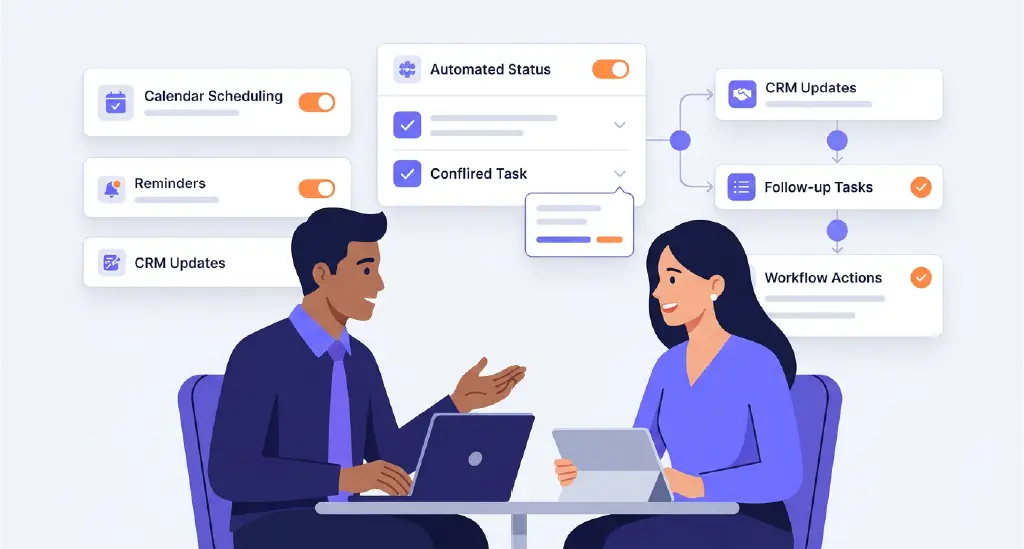
This is why systems such as Blazeo SmartHub connect customer communication with lead management, task management, appointment scheduling, and automation. SmartHub can automatically create tasks and reminders, while its appointment tools connect scheduling to existing workflows.
The objective is not simply to store information.
It is to make information actionable.
Also read: Automation Should Remove Work - Not Create More of It
Follow-up is one of the clearest examples of memory-dependent work.
A lead says, “Call me next month.”
A customer asks for information before deciding.
A prospect completes a consultation but is not ready to buy.
Everyone agrees that follow-up should happen.
The vulnerability lies in the time between the promise and the action.
A salesperson may create a reminder. They may write a note. They may flag the email. Or they may simply remember the conversation and assume they will remember it again three weeks later.
Automated follow-up changes that relationship.

Instead of the employee carrying the future action mentally, the workflow carries it. Timing, communication sequences, tasks, and escalation rules can be determined when the trigger occurs.
Blazeo’s lead management platform, for example, brings lead communications into one place, maintains an activity history, and supports automated workflows for meeting invitations, reminders, and post-appointment follow-ups.
That continuity is important because automation should not only remember that something needs to happen. It should preserve enough context to help the next action make sense.
Otherwise, businesses simply automate disconnected activity.
Appointments create dozens of small memory tasks.
Someone needs to confirm the booking. Someone may need to send instructions. The customer needs a reminder. A cancellation needs to free the slot. A rescheduled meeting needs to update the calendar. A no-show may require another message.
Individually, each action takes minutes.
At scale, the administrative burden becomes substantial.
This is where businesses can automate repetitive business tasks without making the customer experience feel impersonal. A confirmation does not become less useful because software remembered to send it. A customer does not care whether an employee manually opened a calendar before offering an available time. They care that the time was accurate and the booking worked.
Blazeo’s Automated Appointment Scheduler is built around this idea. It can handle confirmations, pre-appointment reminders, rescheduling, and no-show follow-ups while synchronising availability with calendars. It can also route customers based on factors such as service type, availability, and history.
The system is effectively remembering the operational rules surrounding every appointment.
The employee can focus on the appointment itself.
There is an important distinction here.
The goal is not to automate every task simply because automation is possible.
A sensitive complaint may need empathy. A complicated sales conversation may require judgment. An unusual request may fall outside standard rules. A high-value prospect may benefit from direct human attention.
The strongest workflows recognise that boundary.
Routine, predictable and time-dependent actions are ideal candidates for automation. Nuanced decisions remain with people.
This can also apply to customer conversations themselves. Blazeo’s AI Answering Service combines Voice AI with human receptionists, allowing routine enquiries, intake, qualification, scheduling and routing to be handled systematically while bringing in people when conversations require greater understanding.
The value of automation is therefore not measured by how many humans it removes.
It is measured by how much unnecessary cognitive load it removes from those humans.
Every growing company eventually discovers an uncomfortable dependency.
There is often one person who knows how everything works.
They remember which customer needs a callback. They know which salesperson handles a particular territory. They know which appointments need confirmation. They know which leads are urgent and which client asked for something last Friday.
Their competence can hide a weak system.
Until they take a holiday.
Then questions begin.
Was this customer contacted?
Who owns this lead?
Did anyone confirm tomorrow’s appointment?
What happened after this conversation?
Where is the note?
A mature operation should not lose its memory when an employee closes their laptop.
This is another reason business workflow management matters. Processes need to exist independently of the individuals performing them. Activity histories, automated task creation, routing logic, scheduled follow-ups, and centralised customer context turn personal knowledge into organisational knowledge.
The employee remains valuable.
The organisation simply stops making that employee responsible for holding the operation together mentally.
When businesses talk about automation, the conversation often begins with efficiency.
How many hours can we save?
How many tasks can we automate?
How much manual work can we eliminate?
Those questions matter, but they miss something larger.
The real advantage is continuity.
A customer can contact the business at 9 p.m. and still move forward. A lead can be routed without waiting for someone to check a spreadsheet. An appointment can generate its own reminders. A missed meeting can trigger another opportunity to connect. A salesperson can open a record and see what has already happened rather than reconstructing the story from emails and memory.
Work continues because the process remembers where it left off.
That is what it really means to use workflow automation to prevent missed follow-ups. The business becomes less dependent on perfect human recall and more dependent on defined processes.
That shift matters even more as a company grows.
Ten outstanding customer actions may be manageable mentally.
A hundred are not.
A thousand should never be.
Your employees were hired for judgment, creativity, expertise, relationships, and problem-solving.
They should not spend their working lives remembering that a prospect needs a callback at 2:30.
Businesses that want to reduce manual task management should start by identifying every place where a process currently depends on someone remembering something later.
Those moments reveal where operational memory is missing.
The right workflow automation does not make a business less human. It gives people more capacity to be human where it counts: listening to customers, solving difficult problems, building relationships, and making decisions software cannot.
The system remembers the task.
Your team handles the work that deserves their attention.
Ready to stop relying on memory? Explore Blazeo and put your next steps on autopilot.

