 SmartHub
 Automation
 Appointment Scheduler
 Lead Management
 Dashboard & Reports
 Task Management
 Communications Hub
 Managed chat
 Voice Receptionist
 Appointment scheduling
 Retainer signing
 Home services
 Lawyers and firms
 Medical services
 College admissions
 Real estate agents
 Marketing agencies
 About
About Partner program
 Estimate Your ROI
 Case Studies
 Blog
Blog FAQs
FAQs Login
LoginThe Customer Replied. How Fast Does Your Business Know What to Do Next?




Products
Industries
Company
Resources

Businesses have spent years trying to shorten response times.
Answer the lead within minutes. Reply before a competitor does. Send an automated acknowledgement immediately. Make sure someone is available after hours.
Customers certainly expect that speed. Research cited by Zendesk found that 72% of customers want immediate service. But there is another expectation hiding behind that number: 70% expect anyone they interact with to have the full context of their situation.
That is where the conventional response-time conversation starts to fall apart.
Imagine a prospective customer submits an enquiry and receives a response within seconds. The business asks a question. The customer replies.
And then nothing happens for forty minutes.
The problem is not necessarily that nobody saw the message. Someone may have. The problem is that the business does not immediately know what should happen next.
Who owns the conversation now? Does sales need to respond, or customer service? Is this person ready to book, or do they need another qualification question? Has someone already spoken to them? Is there availability tomorrow? Does a manager need to approve the request? Should the CRM be updated before anyone replies?
The customer has done their part. The business is still figuring out its own.
This is where a fast first response can become a slow customer experience.
A strong customer response workflow therefore cannot be measured only by how quickly a conversation begins. It also needs to determine how quickly the business can understand a reply, decide what it means, identify the right next action, and actually make that action happen.
That gap is decision latency. And in many businesses, it is where momentum quietly disappears.
Response time is easy to measure because it has a clear starting point.
A customer sends a message at 10:02. The business replies at 10:04. Two-minute response time. Excellent.
But customer conversations rarely end with that first reply.

A dental practice might ask whether a prospective patient is looking for a consultation or an emergency appointment. A home services company might ask for the customer's postcode. A legal practice might request a few details about the case. A dealership might ask which model the customer is interested in.
The customer answers.
Now the operational work begins.
The new information has to be understood in the context of everything that came before it. Someone may need to determine the customer's intent, assign ownership, check another system, confirm availability, or decide whether the conversation needs escalation.
This is what happens after a customer responds, and it is often far less streamlined than the initial contact.
A business can automate the first "Thanks for getting in touch" in seconds while still relying on people to manually coordinate every meaningful step afterwards.
From the customer's perspective, the distinction does not matter. They do not experience your automated acknowledgement, CRM, scheduling software, sales team, and operations team as separate systems.
They experience one business.
And that business either knows what to do next or it does not.
Also read: Not Every Lead Needs the Same Next Step
Not every delay looks like neglect.
Sometimes an employee is actively trying to help while the customer waits.
Consider a prospective client who responds, "Yes, Thursday afternoon works for me."
That sounds like a simple message. Internally, however, it could trigger several small decisions.
The employee may need to reopen the conversation and remember what service was discussed. Then they check a calendar. The requested time is unavailable, so they look for alternatives. They may need to confirm which employee can take the appointment. Perhaps the customer asked for a special service that requires approval. Once a time is identified, the employee returns to the conversation and responds.
None of those actions is particularly difficult.
Together, they create friction.
Five minutes looking for context. Seven minutes waiting for an answer from a colleague. Ten minutes before somebody notices the internal message. Another few minutes checking the calendar.
A business can lose half an hour without anyone consciously deciding to make the customer wait.
The operational burden behind those small delays is significant. Microsoft's Work Trend Index found that 62% of surveyed workers said they struggled with spending too much time searching for information during the workday. The same research found that the average employee spent 57% of their time communicating through meetings, email, and chat rather than creating.
Put that environment behind a busy customer-facing team, and the problem becomes clearer. Employees are not simply answering customers. They are searching, checking, messaging colleagues, and reconstructing information before they can answer them.
That is why improving business process efficiency is not simply about asking employees to work faster. The more useful question is how many decisions, searches, and handoffs are required before the next customer-facing action can occur.
If every reply creates a miniature internal investigation, delays are built into the process.
One of the biggest sources of decision latency is context retrieval.
A customer replies, but the employee handling the message does not immediately know what the reply refers to.
They open the CRM. Search for the contact. Read previous notes. Check an email thread. Look at an earlier chat. Perhaps they ask a colleague, "Did you already speak to this person?"
Only then can they decide how to respond.
The problem becomes more visible when conversations move across channels.
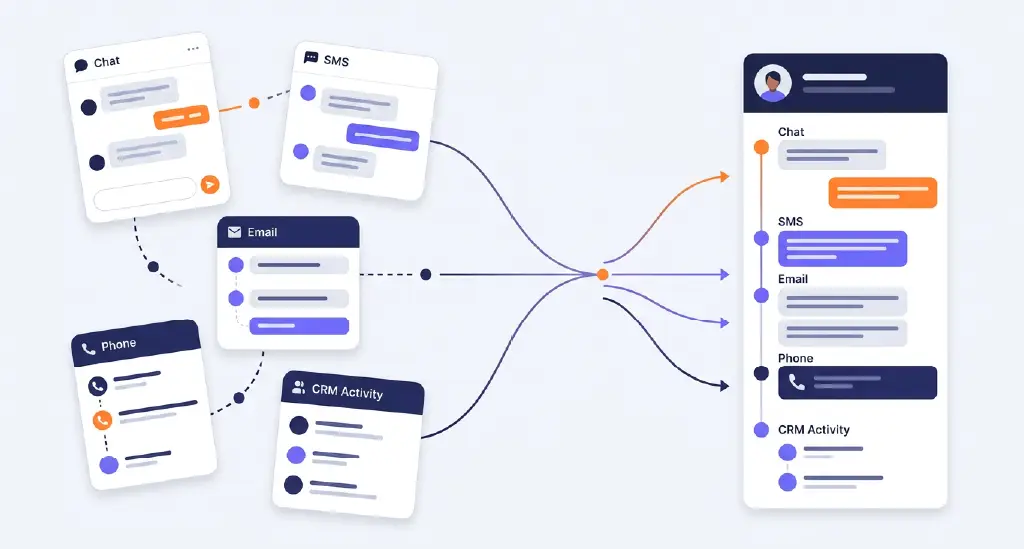
Someone may first interact with a business through website chat, later answer an SMS, and then call. If those interactions are treated as isolated events, employees repeatedly reconstruct a story the business should already know.
And customers increasingly expect businesses to do better. Zendesk reports that 67% of consumers expect more personalized service now that AI can analyze their previous interactions.
That creates two kinds of cost when context is missing.
The first is operational. Employees spend time searching instead of responding.
The second is experiential. Customers are asked to repeat information they have already provided.
A customer who has already explained what they need should not have to explain it again simply because a different employee opened the conversation.
An effective customer engagement workflow makes previous context available at the moment a decision needs to be made. The question changes from "What is going on with this customer?" to "Given what we already know, what should happen next?"
That difference can remove minutes, sometimes hours, from a conversation.
It is also where connected conversation management becomes more valuable than isolated automation. Blazeo is designed to help businesses manage customer conversations while maintaining the context needed to keep those interactions moving rather than treating every new message as a fresh start.

Another common delay appears when a customer reply changes who should own the conversation.
Suppose a home services business receives a message asking about pricing. An automated assistant gathers the customer's location, type of service, and preferred date. The customer then says:
"That works. Can someone come tomorrow morning?"
The conversation has changed.
This is no longer a general enquiry. It is a high-intent scheduling opportunity.
But what happens internally?
If the reply simply lands in a shared inbox, someone must notice it, recognise its significance, and decide who should take over. One employee may assume dispatch handles it. Dispatch may assume the sales representative is still managing the lead. By the time somebody claims ownership, the customer may already be speaking to another provider.
This is a response management problem, not necessarily a staffing problem.
The business had people available. What it lacked was a reliable mechanism for translating the customer's message into ownership and action.
Good workflows reduce ambiguity. When a customer reaches a certain stage, the conversation should be routed accordingly. When intent changes, ownership can change with it. When human intervention is needed, the appropriate person should receive the context required to continue rather than starting from zero.
The faster a business can answer "Who owns this now?", the less likely a valuable conversation is to stall between teams.
Sometimes the next action is obvious, but the employee cannot take it.
A customer asks whether a discount can be honoured. A sales representative needs approval.
A client wants to reschedule outside the normal policy. Customer service needs a manager.
A prospect requests a custom package. Someone has to confirm pricing.
Internally, these may seem like ordinary business controls. Externally, they appear as silence.
The employee sends an internal message and waits. The manager is in a meeting. The request sits untouched. Eventually an answer comes back, and the employee returns to the customer.
The customer never sees the approval process. They only see the gap between their question and the business's answer.
This does not mean every decision should be automated or employees should be allowed to approve everything themselves. It means approval pathways should be designed with customer momentum in mind.
A mature customer response workflow can recognise when approval is required, route the request immediately, provide the approver with the relevant context, and make the outcome visible to the person responsible for responding.
The goal is not to eliminate judgment.
It is to eliminate unnecessary waiting around judgment.
Also read: A Lead Came In. Now Who Owns It?
Decision latency becomes particularly expensive because it rarely happens only once.
Consider a customer trying to book a consultation.
They enquire and receive an immediate response. They answer a qualification question fifteen minutes later.
The business takes twenty minutes to review the reply.
It asks for their preferred day.
The customer responds immediately.

Another employee needs to check availability and replies thirty minutes later.
The customer chooses a slot.
The booking requires confirmation from someone else, creating another delay.
Each pause might appear acceptable on a dashboard. Yet the overall conversation feels sluggish.
A process that could have been completed in ten minutes stretches across half a day.
And customers have increasingly little patience for fractured experiences. Zendesk's 2025 CX Trends research found that 63% of consumers were willing to switch to a competitor after just one bad experience.
This is why businesses looking to reduce delays in customer communication need to examine the entire chain of actions rather than isolated response-time metrics.
Customers experience cumulative friction.
Every unnecessary pause creates another opportunity for attention to move elsewhere, urgency to decline, or a competitor to become easier to deal with.
Speed is not simply how quickly you enter the conversation.
It is how effectively you keep it moving.
Not every reply should trigger the same response.
That is where simplistic automation often falls short.
If every incoming message produces another generic automated message, the business may technically be responding quickly while making little progress.
Compare three replies:
"Just looking for pricing."
"I need this fixed today."
"Yes, I'm ready to book."
They are all customer responses. They are not the same operational event.
The first might require information or nurturing. The second signals urgency and may require immediate human intervention. The third should probably move directly toward scheduling or purchase.
A useful workflow therefore needs more than speed. It needs context.
This is where businesses can begin to automate next steps in customer conversations without automating the entire relationship.
Automation can help interpret known signals, surface relevant history, assign conversations, trigger tasks, send reminders, update records, or initiate scheduling. Humans can remain responsible for situations that require nuance, persuasion, empathy, or judgment.
The strongest systems do not try to remove people from customer communication. They remove the unnecessary operational work surrounding the conversation.
Also read: Stop Chasing More Leads - Start Maximizing the Ones You Already Have
Much of the conversation around automation has focused on sending things.
Send the welcome message. Send the reminder. Send the follow-up.
But some of the greatest efficiency gains happen before a message is sent.
A good workflow can determine that the person replying is an existing lead. It can recognise which service they asked about. It can surface the last conversation. It can identify the appropriate owner. It can create the next task. It can update the CRM. It can trigger a scheduling step.

By the time a human needs to intervene, much of the administrative thinking has already been organised.
This changes the role of automation.
Instead of simply producing faster replies, it becomes part of the business's operational memory and decision infrastructure.
That matters because employees are often managing many conversations simultaneously. Asking them to remember which lead needs a callback, which appointment needs confirmation, which customer is waiting for approval, and which prospect should be contacted tomorrow creates an enormous amount of invisible cognitive work.
Industry data suggests employees themselves see value in AI support here. Zendesk's 2025 CX research found that 73% of agents believed an AI copilot would help them do their jobs better by reducing routine work and allowing greater focus on complex issues.
The better the workflow, the less administrative work needs to live inside someone's head.
There is an assumption that efficiency and personal service sit at opposite ends of a spectrum.
They do not have to.
Imagine contacting a business you spoke to two days ago and receiving:
"Hi Sarah. Yes, I can see you were asking about the Tuesday consultation. We still have the 3:30 slot available. Would you like me to reserve it?"
That interaction feels more personal than:
"Hi! How can we help you today?"
The difference is context.
When systems preserve context and help employees understand the next action quickly, customers encounter fewer resets. The business appears attentive because it remembers.
This is one reason response management should not be reduced to message volume or average response time. A fast but contextless response can create more work for both sides. A more intelligent workflow can make the conversation shorter, clearer, and more useful.
Efficiency becomes visible to the customer as competence.
And competence builds trust.
The most revealing way to evaluate a workflow is to follow a real customer reply through the business.
Not the first enquiry. The reply after it.
Ask what has to happen before the next meaningful action occurs.
Does someone have to search for context? Does an employee need to decide which department owns the conversation? Is availability stored somewhere else? Does information have to be manually copied into the CRM? Is someone waiting for internal approval? Does a task need to be created manually? If nobody remembers to follow up, does the conversation simply disappear?
These are the moments where decision latency accumulates.
The goal is not necessarily to automate every one of them. Some decisions genuinely require human judgment.
The opportunity is to distinguish judgment from administration.
Choosing how to respond to a frustrated customer may require a person. Finding that customer's previous messages should not.
Deciding whether to make an exception to a policy may require a manager. Getting the request in front of that manager should not depend on somebody remembering to send another message.
Negotiating a complex sale may require an experienced representative. Assigning a high-intent prospect to that representative should not take twenty minutes.
That distinction is at the heart of how to improve customer response workflows.
Automation should handle predictable movement so people can focus on meaningful decisions.
For businesses handling growing conversation volumes, Blazeo can help connect AI-powered conversations, lead capture, qualification, scheduling, and human support so that more of those predictable next steps happen without additional manual coordination.
Also read: More Conversations, Same Team: How Businesses Scale Customer Engagement Without Burning Out
If businesses want to understand how responsive they really are, first-response time is not enough.
A more revealing question is:
How long does it take us to know what to do after the customer replies?
That measurement exposes a different category of inefficiency.
A business might discover that messages are acknowledged within two minutes, but qualified leads wait an average of forty-five minutes for assignment. Or that customers choose appointment times quickly, but confirmations take hours because employees manually coordinate calendars. Or that simple requests stall whenever manager approval is involved.
These delays can remain invisible when performance is measured primarily around first contact.
Tracking the movement between stages creates a fuller picture of the customer journey.
When did the customer reply? When was intent understood? When was ownership established? When was the required action triggered? When did the conversation actually move forward?
The distance between those moments tells a business much more about its operational responsiveness than a single response-time metric.
Customers do not care how many internal systems are involved in answering their question.
They care whether the experience moves.
They notice when a business remembers what they said. They notice when the right person enters the conversation without requiring another explanation. They notice when an appointment can be confirmed without a long internal detour. They notice when one answer naturally leads to the next step.
And they notice when none of that happens.
That is why speed needs a broader definition.
The fastest business is not necessarily the one that sends the first message first. It is the one that can repeatedly turn customer information into the right next action with the least unnecessary friction.
A strong customer response workflow creates that continuity. It connects conversations with context, ownership, scheduling, internal processes, and follow-up so that momentum does not disappear every time the customer says something new.
With Blazeo, businesses can bring AI-powered customer conversations, lead qualification, appointment scheduling, and human support into a more connected engagement process—helping teams move from customer response to meaningful action without relying on employees to manually coordinate every step.
Because responding quickly gets the conversation started.
Knowing what to do next is what moves the customer forward.
Ready to reduce the gaps between customer replies and business action? Explore Blazeo and see how smarter customer engagement can help every conversation reach its next step faster.

