 SmartHub
 Automation
 Appointment Scheduler
 Lead Management
 Dashboard & Reports
 Task Management
 Communications Hub
 Managed chat
 Voice Receptionist
 Appointment scheduling
 Retainer signing
 Home services
 Lawyers and firms
 Medical services
 College admissions
 Real estate agents
 Marketing agencies
 About
About Partner program
 Estimate Your ROI
 Case Studies
 Blog
Blog FAQs
FAQs Login
LoginNot Every Lead Needs the Same Next Step




Products
Industries
Company
Resources

A lead comes in at 10:14 AM.
They have visited your pricing page three times, looked at the same service twice, and now they are asking whether you can get them started before the end of the month.
Another lead arrives two minutes later. They have never visited your website before. Their question is simple: “Can you tell me a little more about how this works?”
In many CRM systems, both people become the same thing: New Lead.
The same status can trigger the same automated email, the same qualification sequence, the same follow-up schedule, and eventually the same invitation to book a call.
Operationally, the workflow is doing exactly what it was designed to do.
The problem is that the customers are telling you two completely different stories.
One may be approaching a buying decision. The other has barely begun exploring. One needs momentum. The other needs information. Treating them identically does not make the customer journey efficient. It makes the system easier to manage at the customer's expense.
This is where customer journey personalization needs to move beyond personalized messages and start influencing what actually happens next.
Because the real question is not simply, “Who is this lead?”
It is, “What does this lead need from us right now?”
Customer journeys look wonderfully organized when they are drawn on a whiteboard.
Awareness becomes consideration. Consideration becomes intent. Intent becomes conversion.
Actual customers are considerably less cooperative.
Someone may discover a business this morning and be ready to buy this afternoon because their need is urgent. Another prospect may follow the company for six months, download several resources, open emails, and still have no intention of buying soon.
Someone else may disappear halfway through the journey and return three months later with a completely different level of urgency.
The traditional funnel is not necessarily wrong. It is simply too broad to tell a business what should happen during an individual conversation.
And customers increasingly expect businesses to understand that difference.
McKinsey research found that 71% of consumers expect companies to deliver personalized interactions, while 76% become frustrated when they do not. The financial case is significant too: McKinsey reports that personalization most often produces a 10% to 15% revenue lift, depending on the industry and how effectively it is executed.
Personalization, then, is no longer just a marketing flourish.
But there is an important distinction between personalizing what a customer sees and personalizing what a business does.
Changing the first name in an email is personalization.
Recognizing that one customer needs an immediate phone call while another needs two more weeks before hearing from sales is something much more useful.
Also read: Voice SMS Chat Convergence for Unified Customer Journeys
Imagine two people asking a home-services business the same question:
“Do you have availability this week?”
The first is casually comparing providers for work they may have done sometime this month.
The second has a problem at home that needs attention tomorrow.
A keyword-based system might see the same inquiry twice.
A context-aware system sees urgency in one conversation and exploration in the other.
That difference should change the next action.
The urgent customer may need immediate scheduling or a call from an available team member. The researching customer may need pricing information, a helpful answer, and room to decide.
This is what meaningful customer journey personalization looks like.
It is not about constructing a unique journey for every person who enters the CRM. That would quickly become operationally impossible.
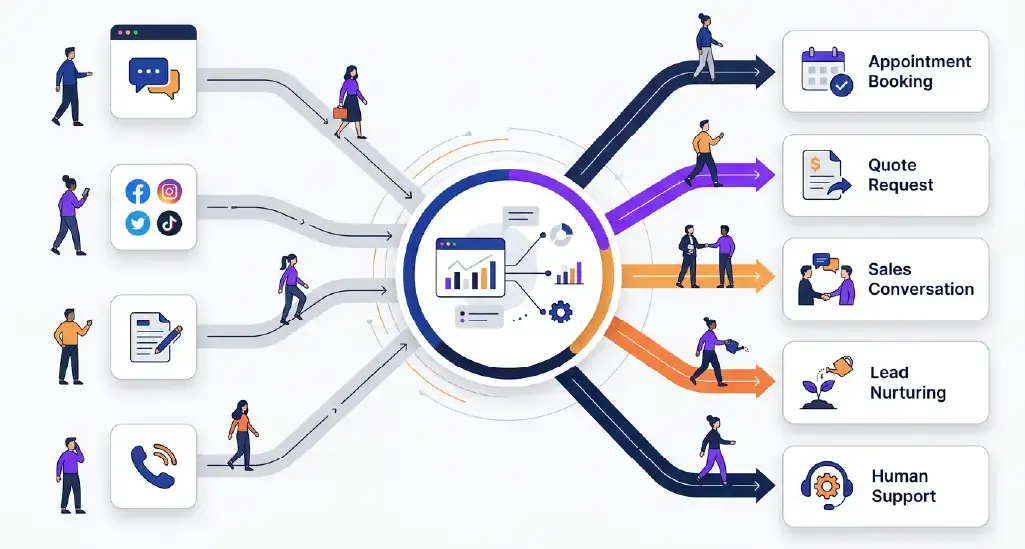
It is about recognizing meaningful differences in customer intent, urgency, readiness, and need, then allowing those differences to influence the next step.
That next step might be a call.
It might be an appointment.
It might be another qualification question.
It might be an automated follow-up.
Sometimes, it might be doing nothing yet.
Blazeo helps businesses capture and qualify customer conversations so teams can move promising opportunities toward the right next step instead of forcing every lead through the same sequence.
CTA: Explore Blazeo’s lead qualification and engagement solutions.
CRM stages are useful because businesses need structure.
“New Lead.”
“Qualified.”
“Opportunity.”
“Follow-Up.”
These labels help teams organize pipelines containing hundreds or thousands of prospects.
But a stage is a summary. A conversation contains context.
Suppose a software company receives two leads categorized as “New.”
One asks:
“Does your platform integrate with Salesforce?”
The other asks:
“We need this across 40 locations by November. Is that something your team can support?”
The CRM status is identical.

The commercial meaning is not.
The second message contains several powerful signals at once. There is scope. There is scale. There is a deadline. There is likely an active evaluation underway.
That customer probably should not wait in the same queue as someone asking a preliminary product question.
This is where customer intent becomes more valuable than a generic status.
What did the person ask? What have they already viewed? Have they returned repeatedly? Did they mention a deadline? Are they asking about pricing, availability, implementation, integrations, contracts, or cancellation terms? Have they already spoken with someone?
No individual signal tells the entire story.
Together, however, they can help determine what should happen next.
Also read: A Lead Came In. Now Who Owns It?
Speed matters enormously when intent is high.
HubSpot cites research showing that the odds of qualifying a lead fell dramatically when businesses waited 10 minutes or longer to follow up, with the likelihood continuing to decline as the delay increased.
But “respond to every lead immediately” is not necessarily the lesson businesses should take from that.
The more useful lesson is that speed becomes particularly valuable when the customer is already showing intent.
Consider a legal-services prospect who sends a message saying they need to speak with someone about an urgent matter today.
The workflow captures the details. An automated acknowledgement is sent. A CRM record is created. The lead enters the normal queue. Someone reviews it four hours later.
Technically, every system worked.
Commercially, the process failed.
Urgency should have changed the route.
The same applies to a customer asking whether a contractor can visit tomorrow, a prospect trying to schedule an appointment while availability still exists, or a business buyer who needs approval before a Friday deadline.
A strong lead engagement strategy does not simply make everything faster.
It recognizes when speed matters.
The reverse can be just as damaging.
Someone downloads a guide at 11:00 AM.
At 11:07, their phone rings.
At 11:12, they receive an email asking when they are free for a demo.
The company may consider this an excellent lead response.
The prospect may consider it exhausting.
Interest is not the same as readiness.
Someone can be genuinely interested in a problem without being ready to speak to sales. Turning every small engagement signal into an immediate conversion attempt can make supposedly personalized experiences feel strangely impersonal.
This is where personalized lead nurturing earns its place.
Instead of asking how quickly a lead can be moved toward a call, businesses can ask what would genuinely help that person progress from where they currently are.
Perhaps they need an educational resource.
Perhaps they need an answer to one question.
Perhaps they need a case study relevant to their industry.
Perhaps they need a follow-up next week.
Or perhaps they simply need space.
Personalization is not always about doing more.
Sometimes it is about knowing when not to push.
Also read: Your Calendar Is Full. That Doesn’t Mean Your Scheduling Process Is Working
The challenge is becoming harder for sales teams because customer expectations are rising while teams are already stretched.
Salesforce's 2026 State of Sales research found that 67% of sales professionals say personalization is more important to customers than it was a year earlier. The same research found that salespeople spend only 40% of an average workweek actually selling, with the remaining 60% consumed by activities outside direct selling.
That creates an obvious operational tension.
Customers expect more individualized attention, but businesses cannot solve that expectation simply by asking employees to manually examine every lead and remember every detail.
The system has to help.
Automation should surface context, handle routine actions, preserve conversation history, and recognize signals that require a different response.
The objective is not to remove humans from the customer journey.
It is to make sure human attention goes where it adds the most value.
There is another problem hiding inside rigid journeys: repetition.
A prospect explains their requirements through website chat.
Then they are directed to a form asking what they need.
Later, someone from sales calls and opens with:
“So, tell me a little about what you're looking for.”
From the company's perspective, those interactions may belong to three different tools.
From the customer's perspective, they have just told the same company the same thing three times.
That does not feel personalized.
It feels like nobody was listening.
Good qualification should build on what the business already knows.
If someone has already said they need a particular service for three locations before October, the next question should advance the conversation from there.
The difference is subtle but important.
“Tell me what you need” starts again.
“I can see you're looking for X across three locations before October. Can I ask you about Y?” moves forward.
This is one reason connected customer context matters so much.
McKinsey notes that customers increasingly expect businesses to recognize them across interactions, and effective personalization requires companies to combine data to develop a more holistic view of the customer journey.
The customer should not have to become the integration layer between your systems.
Blazeo helps businesses keep customer conversations moving across qualification, scheduling, follow-up, and human engagement, so the next interaction can build on what the customer has already shared.
CTA: See how Blazeo helps businesses manage customer conversations.
Lead scoring can help businesses prioritize large volumes of prospects.
A visitor receives points for opening emails, returning to the website, downloading content, visiting the pricing page, or attending a webinar.
Eventually, the score crosses a threshold, and sales gets involved.
There is nothing inherently wrong with that model.
The danger is confusing activity with intent.
A competitor may spend half an hour studying your product pages.
A university student may download every report you publish.
An existing customer may repeatedly visit pricing because they are checking their current package.
Meanwhile, a highly qualified prospect may visit once and write:
“We're replacing our current provider next month. Can someone walk me through implementation and pricing?”
They may have almost no behavioral history.
But their conversation tells you nearly everything you need to know.
This is why customer signals work best when they are interpreted together.
Behavior gives you clues.
Conversation gives those clues meaning.

Imagine three conversations arriving at a software company within the same hour.
The first prospect wants to know whether the product integrates with their CRM.
The second says they are comparing three vendors and making a decision on Friday.
The third has already created an account but cannot get an important feature to work.
All three have engaged with the business.
Only one needs a sales conversation urgently.
The first may simply need a clear answer and supporting documentation. The second may warrant immediate human outreach. The third does not need lead nurturing at all; they need support.
Sending all three an automated “Ready to book a demo?” email would not simply be ineffective.
It would reveal that the business is responding to the existence of a lead rather than the meaning of the conversation.
This is what it really means to personalize follow-up based on customer intent.
Follow-up should not only answer the question, “When should we contact them again?”
It should answer, “What should happen when we do?”
Automation is essential when businesses are managing conversations at scale.
It can answer common questions, gather contact details, qualify inquiries, trigger follow-ups, schedule appointments, update records, and make sure opportunities do not quietly disappear.
The mistake is assuming that because automation can continue, it always should.
A conversation might begin with a straightforward pricing question.

Automation handles it easily.
Then the prospect explains that they operate multiple locations, have an unusual implementation requirement, are replacing an existing provider, and have a six-week deadline.
The conversation has changed.
Continuing through three more scripted questions because the workflow says three questions are remaining is not efficient.
It is friction disguised as automation.
The best systems have exit points.
Complexity can be a signal.
Frustration can be a signal.
High commercial intent can be a signal.
Repeated misunderstanding can be a signal.
An explicit request for a person is certainly a signal.
At some point, the right next step becomes human intervention.
As AI becomes more common across customer-facing operations, that judgment becomes increasingly important. McKinsey reports that AI-driven personalization can improve customer satisfaction by 15% to 20%, increase revenue by 5% to 8%, and reduce cost to serve by as much as 30%. But those gains depend on using context and real-time decision-making rather than simply adding more automation.
The goal is not maximum automation.
The goal is better decisions at scale.
With Blazeo, businesses can use AI-powered customer engagement alongside human support, helping routine conversations move efficiently while giving higher-value or more complex interactions the attention they need.
CTA: Explore Blazeo’s AI-powered customer engagement solutions.

Most businesses already have plenty of customer signals.
The problem is where those signals live.
The CRM knows where the lead came from.
The website knows what they viewed.
The chat knows what they asked.
The calendar knows whether they booked.
Sales knows what happened during the call.
Support knows what went wrong afterwards.
Each system may work perfectly well on its own.
The customer still experiences one company.
If those signals cannot influence one another, strange things start happening.
Someone who has already booked an appointment keeps receiving booking prompts.
A prospect who had a detailed sales conversation gets a generic introductory message.
A customer dealing with a support problem receives an upsell.
A high-intent lead sits inside a standard nurture sequence.
A customer asks for a human and is sent into another automated flow.
These are not merely messaging mistakes.
They are context failures.
Effective customer journey personalization depends on the business becoming more informed after every interaction, not starting again every time the channel changes.
There is an obvious temptation here.
If one journey is too rigid, create dozens.
Then hundreds.
One workflow for high-intent leads. Another for medium intent. One for enterprise prospects. Another for returning visitors. Another for customers who viewed pricing twice but did not book.
Eventually, personalization becomes another maze.
The better approach is not necessarily to predict every possible journey.
It is to identify the moments when customer context should change the next action.
When someone expresses urgency, the route changes.
When someone demonstrates strong buying intent, the route changes.
When someone is clearly still researching, the route changes.
When someone has already provided qualification information, the next conversation starts further ahead.
When automation reaches the limits of what it can handle well, a human takes over.
That creates adaptability without trying to map every possible path in advance.
For years, personalization has been discussed primarily in terms of content.
The right message.
The right offer.
The right recommendation.
Those things still matter.
But the next stage of personalization is operational.
It is about determining the right action.
Should we answer?
Should we call?
Should we schedule?
Should we qualify?
Should we nurture?
Should we wait?
Should a person step in?
That is where customer data becomes useful rather than merely interesting.
McKinsey estimates that personalization can reduce customer acquisition costs by as much as 50%, increase revenues by 5% to 15%, and improve marketing ROI by 10% to 30%.
Those outcomes do not come from knowing more about customers for the sake of knowing more.
They come from using what you know to create a better experience.
The most effective personalized customer journey may be the one the customer barely notices.
They ask a simple question and get a simple answer.
They show urgency, and somebody responds quickly.
They are not ready, and nobody pressures them.
They return later, and the business remembers where the conversation stopped.
They provide information once rather than three times.
The situation becomes complicated, and a human appears before they have to demand one.
From the customer's perspective, none of this feels like a sophisticated CRM strategy.
It feels like dealing with a business that is paying attention.
That is ultimately what customer journey personalization should achieve.
Customers are not identical records waiting to be moved through predefined stages. They arrive with different needs, timelines, questions, levels of knowledge, and degrees of readiness.
The job of a modern customer engagement system is not to force those differences into the same workflow.
It is to recognize when those differences should change what happens next.
Blazeo helps businesses turn customer conversations into smarter next steps—from AI-powered engagement and lead qualification to appointment scheduling, follow-up, and human support. Explore Blazeo to build customer journeys that respond to what each lead actually needs, instead of making every lead follow the same path.
Because the goal is not to make every customer complete the journey you designed.
It is to make the next step make sense.

