 SmartHub
 Automation
 Appointment Scheduler
 Lead Management
 Dashboard & Reports
 Task Management
 Communications Hub
 Managed chat
 Voice Receptionist
 Appointment scheduling
 Retainer signing
 Home services
 Lawyers and firms
 Medical services
 College admissions
 Real estate agents
 Marketing agencies
 About
About Partner program
 Estimate Your ROI
 Case Studies
 Blog
Blog FAQs
FAQs Login
LoginThe Cost of a Conversion That Goes Nowhere




Products
Industries
Company
Resources

A customer sends a message at 10:17 AM.
They want to know whether a service is available in their area. Someone responds within a few minutes. There is a short exchange. The customer asks about pricing. The business answers. A few more messages go back and forth.
Then the conversation ends.
No appointment is booked. No call is scheduled. No follow-up is created. Nobody establishes whether the customer is ready to buy, needs more information, or should be routed to someone else. By the afternoon, the exchange has disappeared beneath newer conversations.
From an activity standpoint, the interaction may look successful. An inquiry came in. The team responded. The customer was engaged. Perhaps response-time targets were even met.
From a revenue standpoint, however, almost nothing happened.
This is one of the less visible problems in customer engagement: businesses can become very good at generating and handling conversations without becoming equally good at moving those conversations forward.
The difference matters.
More conversations can create more opportunities, but only when those conversations progress toward something. Without a clear next step, even a highly responsive business can end up operating a very busy system that produces surprisingly little revenue.
That is why conversation conversion rate deserves as much attention as conversation volume.

Something is reassuring about activity.
Phones ringing, live chats opening, website forms arriving, social media messages accumulating, and sales representatives replying all create the impression that demand is healthy. For many businesses, increasing that activity is an explicit growth objective.
Marketing teams work to generate more leads. Sales teams are encouraged to increase outreach. Customer service teams are measured on response rates. Businesses add communication channels because customers increasingly expect to be able to reach them wherever they happen to be.
All of this can increase the number of conversations taking place.
But a conversation is not, by itself, a business outcome.
Consider a home-services company receiving 500 inquiries in a month. If 300 of those conversations simply answer basic questions and end without an estimate, appointment, follow-up, or other defined action, the business does not necessarily have an inquiry problem.
It may have a progression problem.
The same thing happens in healthcare practices when prospective patients ask about availability but never book. It happens in professional services when prospects request pricing but are never qualified. It happens in automotive businesses when customers inquire about a vehicle but never reach the appropriate salesperson.
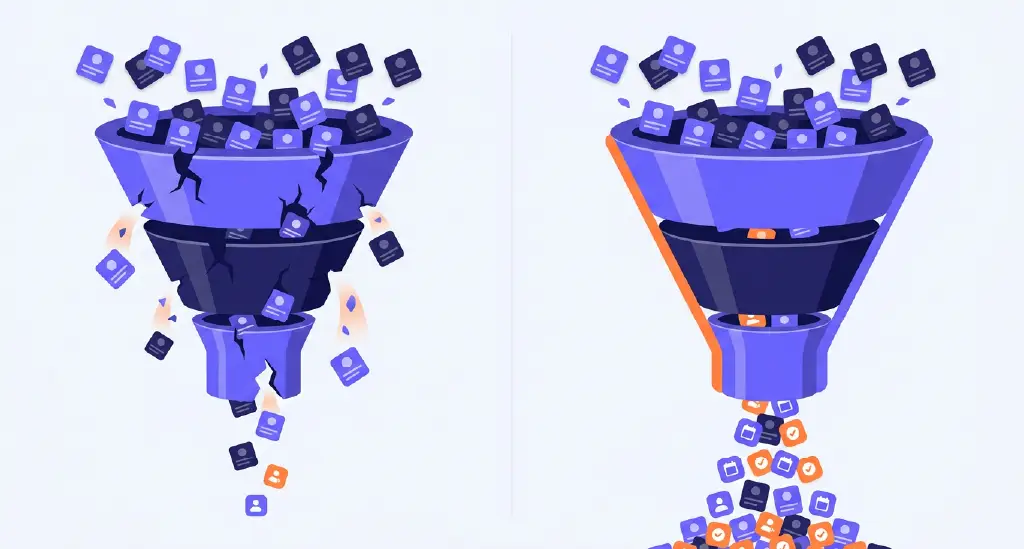
In each case, the top of the funnel can look active while the middle quietly leaks opportunity.
This is where customer engagement ROI becomes more complicated than counting how many people contacted the business.
The more useful question is what happened because they did.
For years, businesses have been told to respond faster, and with good reason.
A slow response can cost a company a customer before the conversation has even started. Someone looking for an urgent service, comparing providers, or trying to book an appointment is unlikely to wait indefinitely while a business gets back to them.
But speed solves only the first part of the problem.

Imagine someone contacting an HVAC company because their air conditioner has stopped working.
The company replies immediately:
“Yes, we service your area.”
That is useful information.
But what happens next?
If the customer has to ask another question, wait for someone else to join the conversation, repeat their address, explain the problem again, and then figure out how to schedule a technician, the initial fast response becomes far less meaningful.
A better conversation might establish the service area and then immediately move toward the logical next action:
“We do service your area. I can help you check the next available appointment. What ZIP code are you in?”
The difference is subtle, but commercially significant.
The first response answers a question.
The second advances an outcome.
An effective sales conversation strategy needs both.
Also read: Stop Measuring Activity. Start Measuring Conversation Outcomes
Not every customer conversation needs to end in a sale.
That would be unrealistic.
Some people are researching. Some are comparing prices. Some are not qualified. Some need time. Others may simply not be a good fit.
But almost every meaningful commercial conversation should end with greater clarity than it started with.
That might mean an appointment has been booked. It might mean a quote has been requested. A prospect may have been transferred to the right specialist. A follow-up might have been scheduled for next week. The customer may have received the information needed to make a decision.
Even discovering that a lead is not qualified is progress because the business now knows where that opportunity stands.
The real problem is ambiguity.
A conversation that simply stops leaves the business with very little information.
Did the customer lose interest?
Did they choose a competitor?
Were they waiting for someone to follow up?
Was the price too high?
Did they need an appointment link that nobody sent?
Were they actually ready to buy but unsure what to do next?
Without a defined outcome, the business cannot tell the difference.
And when hundreds or thousands of conversations behave this way, that uncertainty becomes expensive.
One of the reasons customer inquiries don't convert is that businesses often treat every conversation as though it represents the same level of opportunity.
It does not.
A customer asking, “What time do you close?” is not necessarily equivalent to someone saying, “I need an appointment tomorrow.”
A prospect downloading a brochure is not necessarily equivalent to someone asking for a proposal.
Someone casually checking pricing is different from someone whose current provider has failed and who needs a replacement immediately.
Yet without effective qualification, all of these interactions can enter the same queue.
That creates two problems.
The first is obvious: sales teams spend time on conversations that are unlikely to generate revenue.
The second is more damaging: genuinely valuable opportunities can receive the same treatment as low-intent inquiries.
Qualification does not need to turn every interaction into an interrogation. In many cases, a few well-chosen questions can establish what matters.
What does the customer need? How soon do they need it? Where are they located? Are they looking to book, buy, compare, or simply gather information?
These questions create context.
And context determines what should happen next.
That is the foundation of stronger lead conversion. Businesses do not need to push every customer toward the same destination. They need to understand enough about the customer to determine the right destination.
Now imagine that the customer has been qualified.
They are interested. They fit the business. They are ready to take the next step.
Then the conversation reaches the wrong person.
This happens constantly in businesses with multiple departments, locations, service categories, or sales representatives.
A prospective patient asks about a specialist and reaches general reception. A homeowner wants a specific service but enters a generic customer-service queue. A B2B prospect asks for enterprise pricing and receives a standard support response.
The customer may still receive an answer.
But the conversation loses momentum.
Routing matters because intent has a shelf life.
When someone is actively trying to solve a problem, there is a window in which moving them forward is relatively easy. Every unnecessary transfer, delayed handoff, or request to repeat information adds friction to that window.
The customer who began the conversation ready to buy can gradually become the customer who says, “Never mind, I’ll get back to you.”
Often, they do not.
Good routing, therefore, is not merely an operational concern. It is part of conversion.
The purpose is not simply to send messages somewhere. It is to connect the customer with the person, workflow, or action most capable of progressing the opportunity.
Also read: Why Customers Stop Replying (And How Businesses Can Win Them Back)
Some conversations fail in a much quieter way.
They end politely.
“Let us know if you have any questions.”
“Feel free to reach out when you’re ready.”
“Hope that helps.”
There is nothing inherently wrong with any of these phrases. Sometimes they are exactly appropriate.
But when used at the wrong stage of a buying conversation, they can effectively hand the entire burden of progression back to the customer.
Consider a dental practice speaking with someone interested in teeth whitening.
The prospect asks about the price. The practice provides it and ends with, “Let us know if you’d like to book.”
Technically, the next step has been mentioned.
But the customer still has to restart the conversation.
Compare that with:
“If you’d like, I can check what appointments we have available this week.”
Now the next action is immediate, specific, and easy.
This does not mean every conversation should become aggressively sales-driven. In fact, forcing a close too early can damage trust.
The goal is not pressure.
It is direction.
Customers should not have to reverse-engineer the business's process to figure out what they are supposed to do next.
Not every conversation is ready to progress immediately.
A prospect may need to speak to a partner. A patient may need to check their schedule. A customer may be waiting until payday. A B2B buyer may need internal approval.
These are normal buying conditions.
The problem begins when “not now” becomes “never heard from again.”
Suppose a prospective client contacts a law firm, has a productive initial conversation, and says they need a few days to think about it.
The conversation ends.
Five days later, nobody follows up.

Two weeks later, the prospect is effectively lost.
The firm may eventually conclude that the lead simply was not interested.
But that conclusion confuses customer hesitation with customer rejection.
A defined follow-up changes the situation entirely.
Instead of “Let us know when you’re ready,” the conversation might end with an agreement to reconnect the following week.
Now the opportunity has a future state.
That distinction is critical when businesses are trying to improve sales conversation conversion rates. Conversion does not always happen during the first interaction. Sometimes the job of the first conversation is simply to earn the next one.
Also read: The Follow-Up Gap: What Happens Between “I’m Interested” and “I’m Ready”

When growth slows, businesses often look upstream.
They increase advertising. Launch another campaign. Add another lead source. Spend more on paid search. Push harder on social media.
Sometimes that is exactly what is needed.
But if existing conversations are failing to progress, increasing lead volume can simply increase the number of opportunities being lost.
Imagine a business currently generates 1,000 customer inquiries and converts 8 percent into appointments.
It decides it needs more revenue and increases marketing enough to generate 1,500 inquiries.
If the underlying conversation conversion rate remains unchanged, the business has indeed created more appointments.
But it has also created 460 additional conversations that did not convert.
Those conversations still consume resources.
Someone responds to them. Someone answers questions. Systems process them. Marketing pays to acquire many of them. Staff spends time managing them.
This is why conversion efficiency matters alongside acquisition.
If the same business improves how it qualifies, routes, and advances its existing conversations, it may generate additional revenue without proportionally increasing lead volume or workload.
Growth does not always require more conversations.
Sometimes it requires getting more value from the conversations already happening.
Traditional engagement metrics often focus heavily on activity.
How many inquiries arrived? How quickly did the team respond? How many chats were handled? How many calls were answered?
Those metrics matter, but they describe only the beginning of the customer journey.
A stronger measurement framework asks what happened next.
Did the inquiry become an appointment?
Did the customer request a quote?
Did a qualified opportunity reach sales?
Did the prospect agree to a follow-up?
Did the conversation end with a defined action?
Did the customer disappear after receiving an answer?
This is where conversation conversion rate becomes useful.
The exact definition can vary by business because “conversion” itself varies. For a clinic, it may mean a booked appointment. For a home-services company, it might be a scheduled estimate. For a B2B company, it may be a qualified meeting. For another business, it could be a purchase or completed application.
What matters is that the organization defines progression clearly.
Otherwise, a successful conversation and a dead-end conversation can look identical in reporting.
Also read: Why Businesses Don't Have a Lead Problem - They Have a Qualification Problem
The businesses that successfully turn more customer conversations into revenue tend to think beyond individual replies.
They think about the path.
What is the customer trying to accomplish?
What information does the business need?
What is the most logical next step?
Who or what should handle that step?
What happens if the customer is not ready today?
These questions turn customer engagement from a sequence of disconnected messages into a process.
Technology can play an important role here.
Automation can collect basic information before a human joins. AI can help identify intent and answer routine questions. Routing logic can send high-intent inquiries to the appropriate person. Scheduling tools can allow customers to book immediately. Follow-up workflows can re-engage opportunities that have not yet converted.
But automation is useful only when the underlying journey makes sense.
Automating a directionless conversation simply makes it directionless faster.
The goal is to remove unnecessary friction while preserving the judgment, empathy, and flexibility that customers often need when making a decision.
It is easy to frame conversion entirely as something the business wants.
More appointments. More qualified leads. More sales.
But a well-designed conversation is usually better for the customer too.
Consider the difference between two experiences.
In the first, a customer contacts a business, explains what they need, receives a partial answer, gets transferred, repeats themselves, waits, receives another answer, and eventually hears, "Someone will get back to you."
In the second, the business understands the request early, gathers the necessary information, routes it correctly, and offers a clear next action.
The second experience is more likely to convert, but it is also simply easier.
That matters because customers rarely experience a business through its internal organizational chart.
They do not care which department owns an inquiry or which system stores their information.
They experience one conversation.
When that conversation feels coherent, the business feels organized.
When it goes nowhere, the business feels difficult.
Some lost conversations were never likely to become revenue.
That is unavoidable.
But others were close.
The customer had intent. The business had the right solution. The conversation had already begun.
Then something small broke the chain.
Nobody asked the qualifying question.
The inquiry reached the wrong team.
The scheduling link was never offered.
The promised callback did not happen.
The conversation ended without a next step.
These losses are particularly important because the business has already done much of the difficult work.
It attracted attention.
It generated interest.
It earned a response.
It created engagement.
The remaining challenge was progression.
That is why businesses trying to understand how to convert customer conversations into sales should not begin only by asking how they can generate more demand.
They should examine where existing demand stops moving.
A growing business should want customers to reach out.
But the goal cannot simply be to create an ever-busier inbox.
A healthy customer engagement operation should make it increasingly easy to understand why people are contacting the business, identify which conversations represent meaningful opportunities, and guide those opportunities toward the right next step.
That is where customer engagement ROI becomes visible.
Not in the number of messages exchanged, but in what those messages make possible.
A conversation that answers a question has value.
A conversation that answers the question, understands the customer's intent, and helps them move forward has considerably more.
And when businesses design their engagement systems around that distinction, conversion stops being something that happens after the conversation.
It becomes part of the conversation itself.
Businesses do not necessarily need more conversations. They need fewer valuable conversations ending without a destination.
That means looking beyond response rates and message volume to understand whether customer interactions are actually progressing. It means qualifying intent without creating friction, routing opportunities intelligently, making next steps obvious, and ensuring promising conversations do not disappear simply because the customer was not ready at that exact moment.

The strongest sales conversation strategy is not about pushing every person toward a sale.
It is about making sure every conversation has purpose.
With Blazeo, businesses can bring AI, automation and human support together to help capture inquiries, respond quickly, route conversations effectively, support appointment booking, and maintain follow-up without losing the human element customers still value.
Because the real measure of customer engagement is not how many conversations your business starts.
It is how many of them actually go somewhere.

