 SmartHub
 Automation
 Appointment Scheduler
 Lead Management
 Dashboard & Reports
 Task Management
 Communications Hub
 Managed chat
 Voice Receptionist
 Appointment scheduling
 Retainer signing
 Home services
 Lawyers and firms
 Medical services
 College admissions
 Real estate agents
 Marketing agencies
 About
About Partner program
 Estimate Your ROI
 Case Studies
 Blog
Blog FAQs
FAQs Login
LoginStop Measuring Activity. Start Measuring Conversation Outcomes




Products
Industries
Company
Resources

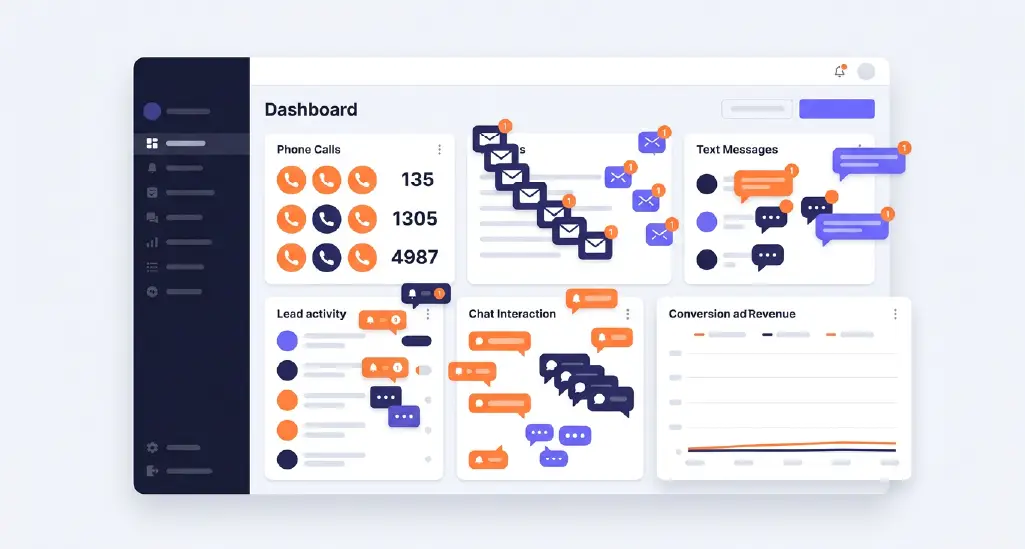
There is a version of a sales dashboard that looks reassuring at first glance.
Calls are up. Emails are going out. Text messages are being sent. Response rates look healthy. The team is following up faster and touching more leads than it did last quarter. Almost every graph appears to be moving in the right direction.
Then someone asks the question that matters: Are more customers actually moving forward?
Suddenly, the dashboard becomes less comforting.
Because a business can generate more activity without generating more qualified conversations, it can increase response volume without increasing the number of appointments. It can shorten response times without improving conversion. And it can give salespeople increasingly ambitious activity targets while revenue barely moves.
That is the problem with relying too heavily on traditional sales performance metrics. They can tell businesses how much work is happening without necessarily revealing what that work is accomplishing.
The answer is not to stop measuring activity. Calls, messages, response rates, and follow-ups still matter. But they need to be treated as inputs rather than proof of performance.
The more useful question is what happens after the activity.
Did the prospect engage meaningfully? Was there genuine buying intent? Did the conversation uncover a need? Did the lead qualify? Was an appointment booked? Did the opportunity progress? And eventually, did any of it contribute to revenue?
That is where measuring sales performance becomes much more useful.
Activity has always been attractive because it is easy to see.
A manager can open a CRM and find that one representative made 70 calls while another made 40. A dashboard can count emails, texts, conversations, follow-ups, and logged tasks almost instantly.
Those numbers create something tangible to manage.
If results are disappointing, the obvious response is often to increase them. Make more calls. Send more messages. Follow up more frequently. Contact leads faster.
There is some logic behind that approach. Sales requires action, and teams that rarely contact prospects are unlikely to generate many opportunities.
But activity eventually becomes a poor proxy for effectiveness.
Imagine two representatives.
One makes 80 calls and reaches 12 people. Three conversations go beyond a quick exchange, and one prospect agrees to another conversation.
Another makes 45 calls, reaches 10 people, has six meaningful conversations, qualifies four opportunities, and books three appointments.
The first representative wins if the organization primarily measures activity.
The second wins if it measures outcomes.
That distinction becomes increasingly important as businesses introduce automation. Modern systems can dramatically increase the number of interactions a business can initiate. Automated emails, SMS follow-ups, AI-supported conversations, lead routing, reminders, and nurture sequences allow companies to engage prospects at a scale that would once have required much larger teams.
McKinsey has estimated that more than 30% of sales-related activities can be automated, while its research into high-performing sales organizations has found that automation can create substantially more selling capacity.
But when producing activity becomes easier, activity itself becomes less meaningful as evidence of performance.
Sending 5,000 messages is not impressive if they produce almost no valuable conversations.
Activity Is an Input, Not an Outcome

This is the distinction that many sales dashboards blur.
A call made is an input.
A message sent is an input.
A follow-up attempted is an input.
Even a reply received is not necessarily a meaningful business outcome.
Someone responding “not interested” technically increases response volume. So does someone asking to be removed from a contact list. So does a prospect replying with a question and disappearing immediately afterward.
The activity happened. The response happened. But the opportunity did not necessarily become more valuable.
This is why the debate around sales activity metrics vs outcome metrics should not be framed as choosing one or the other. Activity metrics are useful for diagnosing how work gets done. Outcome metrics tell you whether that work creates value.
If qualified conversations are declining because representatives are barely contacting leads, activity data exposes the problem.
But if representatives are already making hundreds of attempts and qualified conversations remain low, demanding another 20% increase in outreach may simply create another 20% of ineffective activity.
The metric needs context.
The difference is subtle but important: activity explains effort; outcomes explain effectiveness.
Also read: Automation Should Remove Work - Not Create More of It

This becomes especially important when businesses measure engagement.
“Responses” sound valuable because someone has answered. But response volume combines very different kinds of interactions into a single number.
Consider a home-services company receiving inquiries from homeowners.
One prospect replies to a text with, “Thanks.”
Another says, “Yes, my AC stopped cooling this morning. Can someone come tomorrow afternoon?”
Both might appear as responses on a basic engagement dashboard.
Commercially, however, they are completely different.
The second conversation contains a problem, urgency, intent, and a potential next step. It has moved the relationship closer to an appointment.
That is why conversation analytics becomes more useful when it examines what is happening inside interactions rather than simply counting them.
Conversation intelligence platforms have demonstrated this principle by connecting call data to CRM outcomes such as win rates, revenue, and sales-cycle length. Gong, for example, has historically analyzed recorded sales conversations against corresponding CRM results to identify conversational patterns associated with successful outcomes.
The lesson is broader than any particular platform.
A conversation should not be considered successful simply because it occurred.
Its value depends on what it revealed and where it led.
A better measurement system follows movement through the customer journey.
Start with a lead entering the business.
Was the lead contacted?
Did contact become a genuine two-way conversation?
Did that conversation establish enough interest, fit, need, or urgency to qualify the opportunity?
Did qualification produce a next step?
Did the next step happen?
Did the opportunity move further through the pipeline?
Did it ultimately produce revenue?
Now the business can see something that call counts alone cannot show: where momentum is being created and where it disappears.
Suppose a team receives 1,000 leads and initiates conversations with 700. That sounds strong.
But perhaps only 180 become meaningful conversations, 70 qualify, 35 book appointments, 22 actually attend, and eight become customers.
Suddenly, the important questions change.
Instead of asking, “How do we send more messages?” the company can ask why so many contacts fail to become meaningful conversations.
Instead of celebrating 35 appointments, it can investigate why 13 never happen.
Instead of pushing for more outreach, it can study why only eight of the 22 completed appointments convert.
That is what useful sales productivity metrics should do. They should help a company locate the point where value is being created or lost.
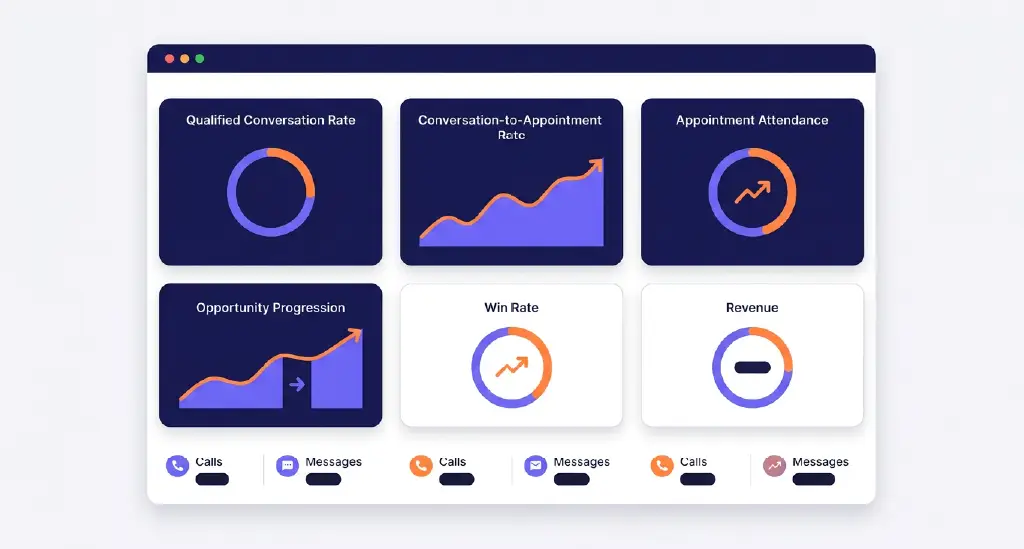
One of the most useful shifts a growing business can make is separating “conversations” from qualified conversations.
The definition will vary by business.
For a law firm, a qualified conversation may establish whether the prospect has a potentially relevant case, falls within the firm's practice area, and wants to speak with an attorney.
For an HVAC company, it might identify the service required, the location, urgency, and willingness to schedule.
For a B2B software company, qualification could involve business need, authority, timing, company fit, or another combination of buying signals.
What matters is that the definition represents something commercially meaningful.
Once that definition exists, a business can measure the percentage of conversations that reach it.
That gives managers a much richer performance signal than total conversation volume.
If conversation volume rises 40% while qualified conversations rise only 5%, something is wrong. Perhaps targeting has deteriorated. Perhaps automated outreach is generating low-intent replies. Perhaps representatives are failing to uncover customer needs. Perhaps lead sources have changed.
Without qualification data, all the business sees is growth.
With it, the business can distinguish more conversations from better conversations.
Also read: The Follow-Up Gap: What Happens Between “I’m Interested” and “I’m Ready”
Good sales conversations create movement.
That movement does not always mean an immediate purchase. Depending on the business, it might mean scheduling a consultation, requesting a quote, agreeing to a demo, confirming eligibility, sending documents, booking a service, or accepting another call.
This makes next-step conversion one of the most useful sales KPIs to examine.
HubSpot defines sales conversion rate around prospects completing desired actions within the sales process, including movement from one pipeline stage to another or ultimately becoming customers.
That stage-by-stage view matters because revenue is often too distant to diagnose the problem on its own.
If revenue falls, leaders know there is a problem.
But where?
Did lead quality decline? Are conversations failing to qualify prospects? Are qualified prospects failing to book? Are appointments being missed? Are proposals stalling? Are salespeople losing deals late in the process?
Outcome metrics make the funnel visible rather than treating revenue as a final score with no explanation behind it.
The word “productivity” creates another measurement trap.
A productive salesperson is often imagined as someone moving constantly: calling, typing, following up, updating records, responding to messages, and jumping between systems.
But motion is not necessarily productivity.
Research from McKinsey has repeatedly highlighted the importance of customer-facing time. Its analysis has found that high-performing sales representatives spend more time interacting with customers than lower-performing peers, while non-selling work continues to consume a significant share of sales-team capacity.
This creates a better way to think about sales productivity.
The goal of automation should not simply be to help a salesperson perform 100 actions where they previously performed 50.
It should help remove low-value work so the salesperson has more capacity for the conversations and decisions where human involvement creates the most value.
A system might handle the first response, gather basic information, answer routine questions, send reminders, nurture a prospect, and identify signals of intent.
Then a human can step in when the conversation becomes complex, sensitive, commercially significant, or ready for progression.
That is not merely higher activity.
It is a better allocation of attention.
Metrics do more than describe performance. They influence it.
Tell a team that success means making 100 calls per day, and people will optimize toward making 100 calls.
Tell them that response volume is the goal and processes will evolve to generate responses.
Tell them appointments booked are the only thing that matters, and appointments may be booked whether or not prospects are sufficiently qualified or likely to attend.
This is why poorly designed sales performance metrics can create the behaviour they were intended to prevent.
A metric becomes dangerous when the team can improve the number without improving the underlying business result.
Imagine a company rewards representatives heavily for appointments booked.
Bookings rise.
Management celebrates.
Then attendance rates fall.
Representatives have learned, consciously or otherwise, that getting almost anyone onto the calendar produces the result they are measured against.
The company has optimized one stage while weakening the next.
A healthier measurement system therefore connects adjacent outcomes.
Appointments booked matter alongside appointments attended.
Qualified opportunities matter alongside progression.
Conversation volume matters alongside qualification rate.
Pipeline matters alongside revenue.
Each metric gives the next one context.

Businesses wondering about the best sales performance metrics to track can begin at the end rather than the beginning.
Start with revenue.
Then move backward through the chain of events required to create it.
Revenue came from closed customers.
Those customers came from opportunities that progressed successfully.
Those opportunities came from qualified conversations.
Those conversations came from customer engagement.
That engagement came from outreach, inbound inquiries, follow-ups, and other activities.
Now activity has a clear place in the model.
It is the beginning of the chain, not the definition of success.
This structure also makes problems easier to diagnose.
A team might discover that its outreach-to-conversation rate is excellent but its conversation-to-qualification rate is poor. Another might qualify leads effectively but struggle to convert qualification into appointments. Another may book plenty of appointments but have a serious no-show problem.
Each requires a different intervention.
Without outcome-based measurement, all three teams might receive the same instruction: do more outreach.
Numbers show where performance changes. Conversation data can help explain why.
If one representative consistently turns more conversations into qualified opportunities, leaders can examine what that person does differently.
Perhaps they ask better questions.
Perhaps they identify urgency earlier.
Perhaps they explain the next step more clearly.
Perhaps they listen rather than rushing toward a pitch.
Perhaps they respond differently to objections.
Gong’s research into sales conversations is built around this idea: conversation data can be studied against outcomes to identify patterns associated with winning or losing deals.
That moves coaching beyond vague advice.
Instead of telling someone to “have better conversations,” managers can investigate which behaviours correlate with progression and where individual representatives tend to lose momentum.
This is how to measure sales conversation effectiveness in a way that is genuinely useful: connect what happens during the interaction to what happens afterward.
Also read: More Conversations, Same Team: How Businesses Scale Customer Engagement Without Burning Out
There is an easy test for whether a metric deserves space on a sales dashboard.
Ask what decision you would make if the number changed.
If calls fall sharply, perhaps there is a capacity or process problem.
If conversations remain high but qualification falls, investigate lead quality or conversation effectiveness.
If qualification remains healthy but appointments decline, examine how the next step is being presented or scheduled.
If bookings rise while attendance falls, investigate qualification, reminders, scheduling friction, or appointment quality.
If every activity metric improves while revenue stays flat, stop congratulating the dashboard and find the broken connection.
That is the difference between reporting and intelligence.
Reporting tells you what happened.
Useful measurement helps you understand what to do about it.
A sales organization does not exist to generate calls, messages, emails, CRM updates, or even conversations.
It exists to create customer and business outcomes.
That does not make activity irrelevant. A team cannot generate results without doing the work. But activity needs to remain connected to the reason the work exists.
The strongest sales KPIs that actually measure revenue performance therefore tell a connected story: how efficiently activity becomes engagement, how often engagement becomes a qualified conversation, how frequently qualified conversations produce next steps, how consistently opportunities progress, and how much of that progression ultimately turns into revenue.
As automation makes it possible to contact more people, respond faster, and maintain more conversations simultaneously, this distinction will become even more important.
Businesses will have no shortage of activity.
The competitive advantage will come from knowing which activity actually matters.

That is also where a model like Blazeo can help businesses think beyond simple contact volume. By combining AI-powered engagement and automation with human support where it matters, businesses can focus less on generating more activity for activity’s sake and more on moving the right conversations toward meaningful outcomes.
Because the goal was never to make the dashboard busier.
It was to move the business forward.

