 SmartHub
 Automation
 Appointment Scheduler
 Lead Management
 Dashboard & Reports
 Task Management
 Communications Hub
 Managed chat
 Voice Receptionist
 Appointment scheduling
 Retainer signing
 Home services
 Lawyers and firms
 Medical services
 College admissions
 Real estate agents
 Marketing agencies
 About
About Partner program
 Estimate Your ROI
 Case Studies
 Blog
Blog FAQs
FAQs Login
LoginThe Follow-Up Gap: What Happens Between “I’m Interested” and “I’m Ready”




Products
Industries
Company
Resources

A prospect fills out a form on Tuesday afternoon.
They have looked through your services, checked a few pages on your website, and finally decided to reach out. Maybe they ask for pricing. Maybe they book a consultation. Maybe their message is only six words long: “I’d like to learn more.”
Your sales team responds quickly. There is a conversation. The prospect sounds genuinely interested.
And then…nothing.
They do not say no. They do not choose a competitor, at least as far as you know. They simply stop moving.
This is where many businesses make one of two mistakes. They either treat silence as rejection and move on, or they respond by increasing the pressure: another email, another call, another “just checking in” message.
Neither approach acknowledges what may actually be happening.
Interest and readiness are not the same thing.
A person can believe they need what you sell and still need several days, weeks, or even months before they are prepared to make a decision. They may be comparing options, waiting for a budget to open up, discussing the purchase internally, dealing with another priority, or simply trying to decide whether the problem is urgent enough to solve now.
The period between “I’m interested” and “I’m ready” is the follow-up gap. And a strong sales follow-up strategy is not about filling that gap with more messages. It is about staying useful while the prospect works their way toward a decision.
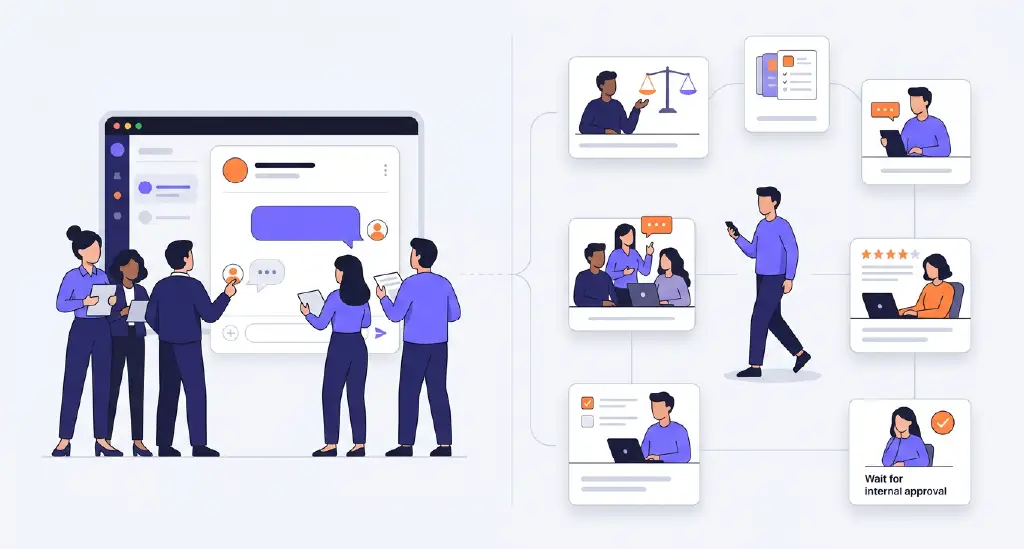
Image idea: A visual customer journey moving from “I’m Interested” through comparison, hesitation, research, internal discussion, and competing priorities before reaching “I’m Ready.”
Sales teams naturally pay attention to visible signs of intent.
Someone requests a demo. Someone asks for a quote. Someone downloads a guide and then visits the pricing page. Someone starts a conversation through live chat.
These actions matter, but they are easy to overinterpret.
A prospect asking about pricing has not necessarily decided to buy. They may simply be trying to determine whether buying is realistic. A prospect requesting a demo might still be evaluating three alternatives. Someone asking detailed questions may actually be discovering how complicated the decision is.
This distinction changes the role of prospect follow-up.
If every expression of interest is treated as a near-sale, follow-up becomes a series of attempts to force a decision:
“Are you ready to move forward?”
“Have you had a chance to review the proposal?”
“Just following up again.”
But if interest is treated as the beginning of a decision process, the conversation changes.
Now the question becomes: what does this person still need before they can comfortably move forward?
That is where follow-up starts becoming valuable rather than repetitive.
Also read: Your Fastest Salesperson Might Be Your Workflow
From the seller’s side, silence often looks like inactivity.
From the buyer’s side, a great deal may be happening.
Imagine a small business owner looking for a new customer communication platform. She has spoken with a salesperson and likes what she has seen. But she also needs to check whether the platform integrates with her existing systems. She needs to discuss the cost with her business partner. She is wondering how difficult implementation will be. Meanwhile, payroll is due, an employee has called in sick, and two customers have complained about an unrelated issue.

The purchase has not disappeared. It has simply moved down her immediate priority list.
That difference matters.
The seller might see four days without a reply and conclude that the lead has gone cold. The buyer might still be interested but have no new information to share.
A thoughtful lead nurturing strategy accounts for this uneven pace. It recognizes that the customer’s timeline does not automatically match the sales team’s pipeline schedule.
The goal is therefore not constant contact. It is continuity.
When the prospect returns to the decision, your business should still feel familiar, helpful, and easy to engage with.

There is nothing inherently wrong with checking in. The problem is when checking in becomes the entire strategy.
Consider the difference between two follow-ups.
The first says, “Hi Sarah, just following up to see if you’ve made a decision.”
The second says, “Hi Sarah, you mentioned that getting your front-desk team comfortable with a new system was one of your concerns. I thought this short implementation guide might help you see what the transition typically looks like.”
Both messages reopen the conversation.
Only one gives the prospect a reason to appreciate the interruption.
This is the principle at the center of effective sales engagement: every interaction should ideally reduce uncertainty, answer a question, remove friction, or make the next step easier.
A follow-up can share a relevant customer story. It can clarify a pricing question. It can answer an objection that came up in the previous conversation. It can provide a comparison, explain implementation, or simply offer an easier way to reconnect.
The message no longer exists because the salesperson needs an answer.
It exists because the prospect may need something.
That subtle shift is what keeps persistence from becoming pressure.
Also read: The Cost of Internal Chaos: When Good Leads Slip Through the Cracks
There is no universal number that works for every lead, product, or buying cycle.
And that is exactly why “how often should sales teams follow up with leads?” is the wrong question when asked in isolation.
A better question is: what has the prospect done, and what does that behavior tell us about their current level of intent?
Someone who requests a same-day quote is showing different intent from someone who downloaded an introductory guide three weeks ago. Someone who has already discussed pricing and implementation requires a different cadence from someone who has only asked a broad question.

The stronger the buying signal, the more reasonable timely follow-up becomes.
We can see this principle clearly in ecommerce. Mailchimp, for example, recommends reaching out relatively quickly after cart abandonment because adding a product to a cart represents meaningful purchase intent. Its guidance suggests an initial reminder shortly after abandonment, followed by more spaced-out communication rather than endless messages.
Browse abandonment is treated differently. Someone who merely looked at a product has shown weaker intent, so Mailchimp recommends a more gradual sequence, beginning with a reminder and later adding social proof or an offer of help.
The same logic applies beyond ecommerce.
Your follow-up strategy for interested prospects should respond to intent rather than forcing every lead into the same arbitrary schedule.
One of the biggest weaknesses in traditional follow-up sequences is repetition.
Day one: “Want to talk?”
Day three: “Still interested in talking?”
Day seven: “Following up to see if you want to talk.”
The timing changes. The message does not.
A better sequence evolves.
Early follow-up can focus on immediacy. Did the prospect get the information they requested? Is there a question preventing them from taking the next step?
Later follow-up can focus on confidence. Would a case study help? Is there a common objection worth addressing? Could the prospect benefit from understanding what implementation, onboarding, or results typically look like?
As more time passes, follow-up can become lighter and more contextual. Instead of asking repeatedly for a meeting, the business can remain relevant until another buying signal appears.
That is what it really means to understand how to nurture leads until they are ready to buy. Nurturing is not simply stretching a sales sequence across more days. It is allowing the conversation to mature.
Also read: Why Businesses Don't Have a Lead Problem - They Have a Qualification Problem
Suppose a prospect tells your team during a phone call that their biggest concern is after-hours coverage.
Two days later, they receive an automated email promoting your lowest price.
A week later, another salesperson calls and asks what problem they are trying to solve.
Technically, your company followed up three times.
Experientially, the prospect started over three times.
This is where many follow-up systems fail. They track activity without preserving enough context.
The CRM may show that an email was sent, a call happened, and another task is due Thursday. But the quality of the next interaction depends on knowing what was actually said.
What did the customer care about?
What were they hesitant about?
Which questions were already answered?
What did they say needed to happen before they could proceed?
When conversational context carries forward, follow-up stops feeling like a sequence and starts feeling like a relationship.
Instead of “I wanted to see if you’re still interested,” the business can say, “Last time we spoke, you were comparing whether after-hours support would justify the additional cost. Here’s something that may help.”
The second message proves that the first conversation mattered.
Automation has made it easy to schedule persistence.
That is useful, but it also creates a dangerous assumption: if follow-up can happen automatically, it should.
A workflow can send an email after one day, another after three days, a text on day five, and a reminder to call on day seven. But automation cannot make an irrelevant message valuable simply by delivering it at the correct time.
The strongest systems use timing and context together.
Real-world cart-recovery strategies illustrate this well. Mailchimp’s abandoned-cart automation can trigger a series of reminders after a shopper leaves without completing a purchase, but the messages are tied to a specific behavior: the shopper actually placed something in the cart.
The communication has a reason to exist.
Sales teams need the same discipline.
A follow-up should ideally connect to something the prospect did, said, asked, viewed, or needed—not simply the fact that seven days have passed.
One of the most overlooked parts of prospect follow-up is knowing when to reduce intensity.
If someone has ignored five messages, the answer is rarely to make the sixth message louder.
Repeated silence is a signal.
Perhaps the timing is wrong. Perhaps priorities changed. Perhaps the prospect is interested but does not want another sales conversation right now. Perhaps they have quietly decided against the purchase.
A good sales follow-up strategy leaves room for all of those possibilities.
That might mean moving someone from active sales outreach into a longer-term nurture path. Instead of another meeting request next Tuesday, they might receive an occasional relevant resource, product update, customer story, or useful piece of insight.
The door remains open without someone standing in the doorway.
This is one of the most practical ways to improve sales follow-up without annoying customers: give prospects enough space to return voluntarily.
Sales communication often comes with a request attached.
Book the demo. Schedule the call. Review the proposal. Sign the agreement. Tell us your decision.
Over time, that creates a relationship in which every interaction costs the prospect something.
A better lead nurturing strategy balances asks with value.
Imagine that a prospect is considering an answering solution because their team regularly misses calls after business hours. The first conversation establishes the problem, but the prospect is not ready to commit.
The next useful touchpoint might not be another demo request. It could be a short explanation of what happens to missed leads when response times stretch overnight. Later, a relevant customer example could show how another business handled similar coverage issues. Eventually, when the prospect begins reconsidering the problem, your company is associated with helping them understand it—not simply asking them to buy.
This is especially important for longer sales cycles.
The longer the gap between interest and readiness, the less effective constant conversion-focused messaging becomes.
Businesses spend enormous effort deciding what their next message should say.
Sometimes the better investment is making sure they remember what the prospect already said.
That means capturing conversations across calls, chat, SMS, email, and other channels instead of treating each interaction as an isolated event.
It means allowing a salesperson to see that a prospect asked about weekend availability in chat before calling them.

It means knowing that someone already discussed budget with another team member.
It means recognizing that a returning prospect is not a brand-new lead simply because they came back through a different channel.
When this context is available, follow-up becomes more precise.
The business does not have to guess what might matter. The customer has already told them.
The follow-up gap will always exist.
People rarely move from curiosity to commitment in a perfectly straight line. They hesitate. They compare. They get distracted. They reconsider priorities. They disappear for two weeks and suddenly return ready to move.
Businesses cannot control that process.
They can control what happens around it.
A strong sales follow-up strategy keeps the conversation alive without suffocating it. It uses behavior to determine timing, context to determine messaging, and restraint to determine when another touchpoint will help rather than hurt.
Most importantly, it remembers that a lead is not simply waiting inside a pipeline stage. There is a person on the other side making a decision.
The businesses that handle this period well are not necessarily the ones that send the most emails or make the most calls. They are the ones that remain useful enough to be remembered when “I’m interested” finally becomes “I’m ready.”
Blazeo helps businesses create that kind of continuity by bringing AI-powered and human conversations together across the customer journey, so promising leads can stay engaged without being buried under generic follow-ups. If your team is losing opportunities somewhere between first contact and purchase readiness, Blazeo can help you close the follow-up gap and turn more conversations into real opportunities.

