 SmartHub
 Automation
 Appointment Scheduler
 Lead Management
 Dashboard & Reports
 Task Management
 Communications Hub
 Managed chat
 Voice Receptionist
 Appointment scheduling
 Retainer signing
 Home services
 Lawyers and firms
 Medical services
 College admissions
 Real estate agents
 Marketing agencies
 About
About Partner program
 Estimate Your ROI
 Case Studies
 Blog
Blog FAQs
FAQs Login
LoginAI Should Know When to Stop Talking




Products
Industries
Company
Resources

There is a particular kind of customer service frustration that has become increasingly familiar.
You ask a chatbot a question. It gives you an answer that is technically related but not particularly useful. You explain the problem again, this time with more detail. It responds with another variation of the same answer. You try different wording. The bot apologises, reassures you that it is here to help, and then sends you back to where you started.
At some point, the problem is no longer that the AI does not know the answer.
The problem is that it does not know when to stop answering.
As businesses invest more heavily in conversational AI customer service, much of the conversation has focused on what artificial intelligence can do. It can respond instantly. It can handle thousands of conversations simultaneously. It can answer common questions, qualify leads, collect information, schedule appointments, and provide support outside business hours.
All of that matters. But there is another capability that deserves just as much attention: restraint.
A strong AI system should not simply recognise what a customer is asking. It should recognise when the conversation has reached the point where a human being is better equipped to continue it.
That is the purpose of an effective AI-human handoff. It is not evidence that automation has failed. In many cases, knowing when to escalate is precisely what makes the automation work.
Businesses sometimes approach automation with the wrong measure of success.
If AI handled 80% of conversations without human intervention last month, the instinct may be to push that number to 85% or 90%. The assumption is simple: every conversation the AI completes is one less conversation an employee has to manage.
But containment is not the same thing as resolution.
A customer may technically finish a conversation with an AI assistant without getting what they needed. A prospect may leave without booking an appointment. A frustrated customer may stop replying because the bot cannot understand the problem. A high-value lead may ask a complicated question, receive a generic response, and quietly go somewhere else.
From the business's perspective, the conversation was automated.
From the customer's perspective, it went nowhere.
That is why the more useful question is not, "How many conversations can AI handle without a person?"
It is, "Which conversations should AI handle, and which ones become more valuable when a person steps in?"
Human-in-the-loop AI is built around that distinction. Automation handles the work it performs well, while people remain available for situations where context, judgement, empathy, negotiation, or expertise matter more than speed.
The objective is not maximum automation.
It is better outcomes.
Also read: Human-in-the-Loop AI Customer Engagement Strategy
The phrase "escalate to a human" can make it sound as though something has gone wrong.
Sometimes it has. Often, it has not.
Imagine someone visits a dental practice's website at 11 p.m. and asks whether the practice offers dental implants. AI can answer the question immediately. It can explain the service, collect contact details, and perhaps ask whether the person would like to arrange a consultation.
Now imagine the customer says:
"I've already had two implant procedures fail, and my dentist says there may not be enough bone left. Can you tell me whether your surgeon can still treat me?"
The conversation has changed.
The customer is no longer asking for general information. They are describing an individual medical situation that may require clinical judgement.
A well-designed system recognises that shift.
Instead of trying to manufacture a more sophisticated answer, it can acknowledge the question, gather the information the practice needs, and connect the customer with the appropriate person.
The AI has still done useful work. It responded after hours. It identified the customer's need. It collected context. It may have prevented the prospect from leaving the website.
Its final useful action is knowing not to pretend it can do the next part.
That is what good AI escalation looks like.
Some customer questions have predictable answers.
"What time do you close?"
"Do you deliver to my postcode?"
"Can I reschedule my appointment?"
"How much does your standard package cost?"
AI is extremely useful here because the problem is primarily one of information retrieval and execution. The customer wants an answer or a straightforward action, and the system can provide it quickly.
Complexity begins when the answer depends on several variables that the AI cannot confidently resolve.
A customer may ask whether a particular insurance policy covers an unusual situation. A homeowner requesting an HVAC quote may describe several problems occurring at once. A business buyer may need a custom package across 15 locations with different requirements.
The system may possess information related to the question without possessing enough context to make the right judgment.
That distinction matters.
An AI assistant should be able to detect when a conversation has moved beyond its reliable knowledge boundary. Multiple conditional questions, conflicting information, unusual scenarios, and repeated requests for clarification can all indicate that the conversation would benefit from human intervention.
The worst outcome is not "I need to connect you with someone who can help."
The worst outcome is a confident answer that should never have been given.
Image idea: Split-screen showing AI continuing a complex conversation versus a human stepping in with context and judgement.
There is a real-world example of what can happen when a chatbot speaks beyond its limits.
In a widely reported case involving Air Canada, a customer used the airline's chatbot while researching bereavement fares after his grandmother died. The chatbot gave him incorrect information suggesting he could purchase a regular ticket and later apply for the reduced bereavement rate.
He relied on that information.
When the airline subsequently refused the refund, the dispute eventually reached British Columbia's Civil Resolution Tribunal. The tribunal found Air Canada responsible for the inaccurate information its chatbot had provided and ordered the airline to compensate the customer.
The lesson extends far beyond airlines.
A customer does not necessarily distinguish between "information supplied by the company" and "information supplied by the company's AI." If the chatbot appears on your website, speaks in your brand's voice, and presents itself as a source of assistance, customers are likely to treat what it says as information from your business.
That makes knowing when not to answer a business issue, not merely a technical one.
Also read: Ethical AI in Customer Engagement: Responsible Automation at Scale
Customers rarely announce, "I have now reached the threshold at which your automated system should escalate me."
They show it.
They ask the same question again.
They shorten their replies.
They type, "That's not what I'm asking."
They say, "I've already explained this."
They ask for a person.
Sometimes they simply become more emotional.
These are not incidental details. They are conversational signals.

Modern AI systems can be designed to identify repeated intent, negative sentiment, unsuccessful answer loops, and explicit requests for human assistance. Once those signals appear, continuing to automate the interaction can make the experience worse.
The customer has already told the system, directly or indirectly, that the current approach is not working.
This is where businesses sometimes make a costly mistake. They treat escalation as something customers must earn by surviving enough automated responses.
The bot asks another question. Then another. Then offers another help article. Eventually, somewhere behind "Was this helpful?" and "Please choose from the following options," there may be a route to a person.
By then, the human agent is not inheriting a normal customer conversation.
They are inheriting an angry one.
One of the simplest principles in AI-to-human customer service escalation is also one of the most frequently ignored:
If a customer explicitly asks for a human, that request should carry weight.
In 2024, delivery company DPD received unwanted attention after a customer struggling to locate a parcel became frustrated with its chatbot. He reportedly asked to be passed to a human and was unable to get the help he wanted. The conversation then took a bizarre turn: after further prompting, the chatbot swore, told jokes, and generated a poem criticising the company. DPD later said an error following a system update had affected the chatbot and disabled the AI element while it addressed the issue.
The viral responses were entertaining. The underlying customer experience was not.
The customer had a missing parcel. The bot could not solve the problem. The customer wanted a person. The conversation should probably have ended there.
Instead, the AI kept talking.
A good escalation architecture recognises that there is little value in forcing automation onto someone who has already decided automation is not helping them.
Not every escalation is driven by difficulty or frustration.
Sometimes the reason to involve a person is opportunity.
Consider a software company using AI to answer product questions. Someone asks about pricing. The AI can handle it. Then they mention that they are evaluating the platform for 300 employees across six offices and need information about enterprise security, implementation, and procurement.

Technically, AI could continue answering.
Commercially, that may be the wrong choice.
This is no longer an ordinary website enquiry. It is a buying signal.
An effective AI system should recognise indicators of high-value intent such as enterprise requirements, large order volumes, custom pricing requests, urgent timelines, or explicit interest in purchasing.
The goal of automation is not to prevent a salesperson from speaking to that prospect. It is to make sure the salesperson enters the conversation at exactly the right moment.
AI can gather the initial information, qualify the opportunity, and route it to the appropriate person. The human then takes over, where relationship-building, negotiation, and commercial judgement become more valuable.
That is how businesses should think about how to combine AI and human customer support: not as two competing models, but as different strengths applied at different stages of the same conversation.
Also read: What Smart Businesses Automate First — And What Still Needs a Human Touch
There are also conversations where the issue is not complexity but sensitivity.
A customer disputing a large charge may technically be asking a billing question. Someone cancelling a service after a bereavement may technically be requesting an account change. A patient describing worrying symptoms may technically be asking about an appointment.
But treating these interactions as ordinary information requests misses the human context surrounding them.
This is where customer service automation needs human intervention even when AI could potentially generate an acceptable response.
Empathy is not simply about inserting "I'm sorry to hear that" before an automated answer. Sometimes empathy means recognising that the customer should no longer be talking to a machine.
Financial disputes, serious complaints, bereavement, health concerns, legal questions, safety issues and emotionally charged circumstances all deserve carefully designed escalation rules.
The exact boundaries will differ by business, but the principle remains the same: the greater the potential consequence of getting an answer wrong, the lower the threshold for involving a qualified person.
AI systems are particularly effective when customer conversations follow patterns.
The trouble begins at the edges.
Perhaps a hotel guest wants to arrange something unusual for an anniversary. A customer wants a refund outside the standard policy because of an exceptional circumstance. A business client needs a service configured in a way that does not match any existing package.
These conversations may not sound angry or urgent. They simply do not fit neatly into the system's expected paths.
Trying to force them into one can create unnecessary friction.
A better AI system recognises uncertainty.
When confidence falls below an acceptable threshold, escalation becomes a feature rather than a fallback. The AI can say, in effect, "This is outside the usual situation, so I want to make sure the right person handles it."
That response creates more trust than improvisation.

Knowing when AI should hand off to a human solves only half the problem.
The other half is what happens next.
Imagine spending seven minutes explaining a billing issue to an AI assistant. It finally recognises that a human needs to intervene. A representative joins the conversation and says:
"Hi! How can I help you today?"
The customer now has to explain everything again.
Technically, the handoff worked. Experientially, it failed.
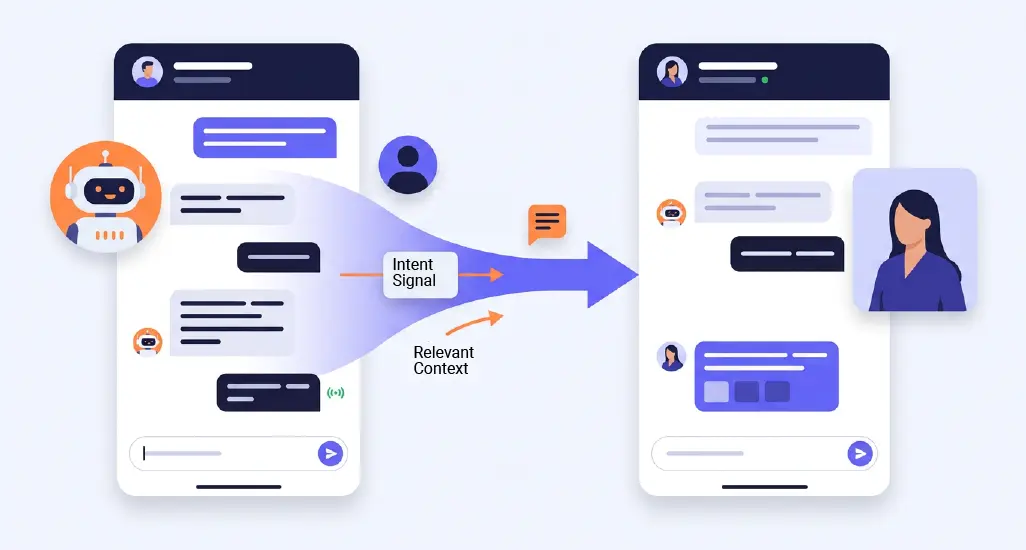
A strong AI-human handoff should transfer context, not merely transfer the customer.
The human agent should be able to see what the customer asked, what information has already been collected, what the AI attempted, where the conversation became difficult, and why the escalation occurred.
That completely changes the opening of the human conversation.
Instead of "How can I help?" it becomes something closer to, "I can see you've been trying to resolve a duplicate charge on your account. Let me take a look."
The customer feels heard because the conversation continues rather than restarts.
That continuity is one of the biggest advantages of designing AI and human support as one connected system instead of two separate channels.
There is another side to poor escalation that businesses often overlook: the effect on employees.
If AI waits too long before escalating, agents inherit harder conversations.
They receive customers who are already irritated. They have to correct inaccurate information. They spend time reading confusing transcripts. They apologise for promises the system should not have made.
Automation may appear to be reducing workload while quietly increasing the emotional and operational difficulty of the work that remains.
That is why AI performance should not be judged only by how many conversations avoid human intervention.
Businesses should also examine what those escalated conversations look like.
Are customers angrier by the time they reach an agent? Is the AI providing enough context? Are agents frequently correcting it? Are the same types of conversations repeatedly being escalated too late?
Those patterns reveal whether automation is genuinely helping the team or simply moving the hardest work further down the line.
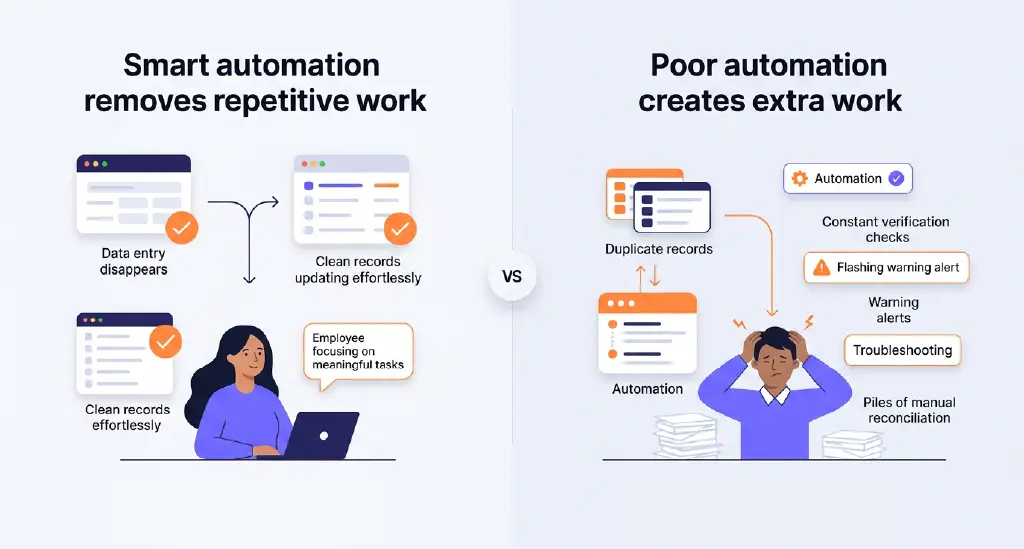
Also read: Automation Should Remove Work - Not Create More of It
The conversation about AI in customer service has been dominated by capability.
How much can it answer? How quickly can it respond? How many conversations can it handle? How much work can it automate?
Those are important questions.
But maturity in AI will increasingly be defined by a different one:
Does the system know when it should not be the one answering?
The best conversational AI customer service does not try to prove its intelligence in every interaction. It resolves the straightforward conversations quickly, recognises the complicated ones early, and makes it easy for people to step in when their judgement matters.
Sometimes that means AI handles the entire conversation.
Sometimes it means AI handles the first 60 seconds.
Sometimes its most useful contribution is recognising, almost immediately, that the customer needs someone else.
None of those outcomes represents failure.
Failure is allowing automation to become an obstacle between a customer and the help they actually need.
Businesses do not need to choose between AI and human customer service.
They need to design the relationship between them.
AI can provide the speed customers increasingly expect while human teams provide judgement, empathy, flexibility, and expertise where those qualities matter most. The strongest customer experience happens when the transition between the two feels natural rather than forced.
That requires more than adding a chatbot to a website. It requires thinking carefully about escalation signals, routing, context, and what should happen when a conversation moves beyond automation's useful limits.
Because ultimately, intelligence is not just knowing what to say.
Sometimes it is knowing that someone else should say it.
Blazeo helps businesses bring AI-powered customer engagement and human support together, so conversations can be answered quickly, intelligently routed, and handed to the right person when human attention matters most. Explore Blazeo to build customer conversations around better outcomes, not automation for automation's sake.

