 SmartHub
 Automation
 Appointment Scheduler
 Lead Management
 Dashboard & Reports
 Task Management
 Communications Hub
 Managed chat
 Voice Receptionist
 Appointment scheduling
 Retainer signing
 Home services
 Lawyers and firms
 Medical services
 College admissions
 Real estate agents
 Marketing agencies
 About
 Partner program
 Estimate Your ROI
 Case Studies
 Blog
 FAQs
 Login
Home Services Answering Service: AI, Live Agent, or Hybrid?




Products
Industries
Company
Resources

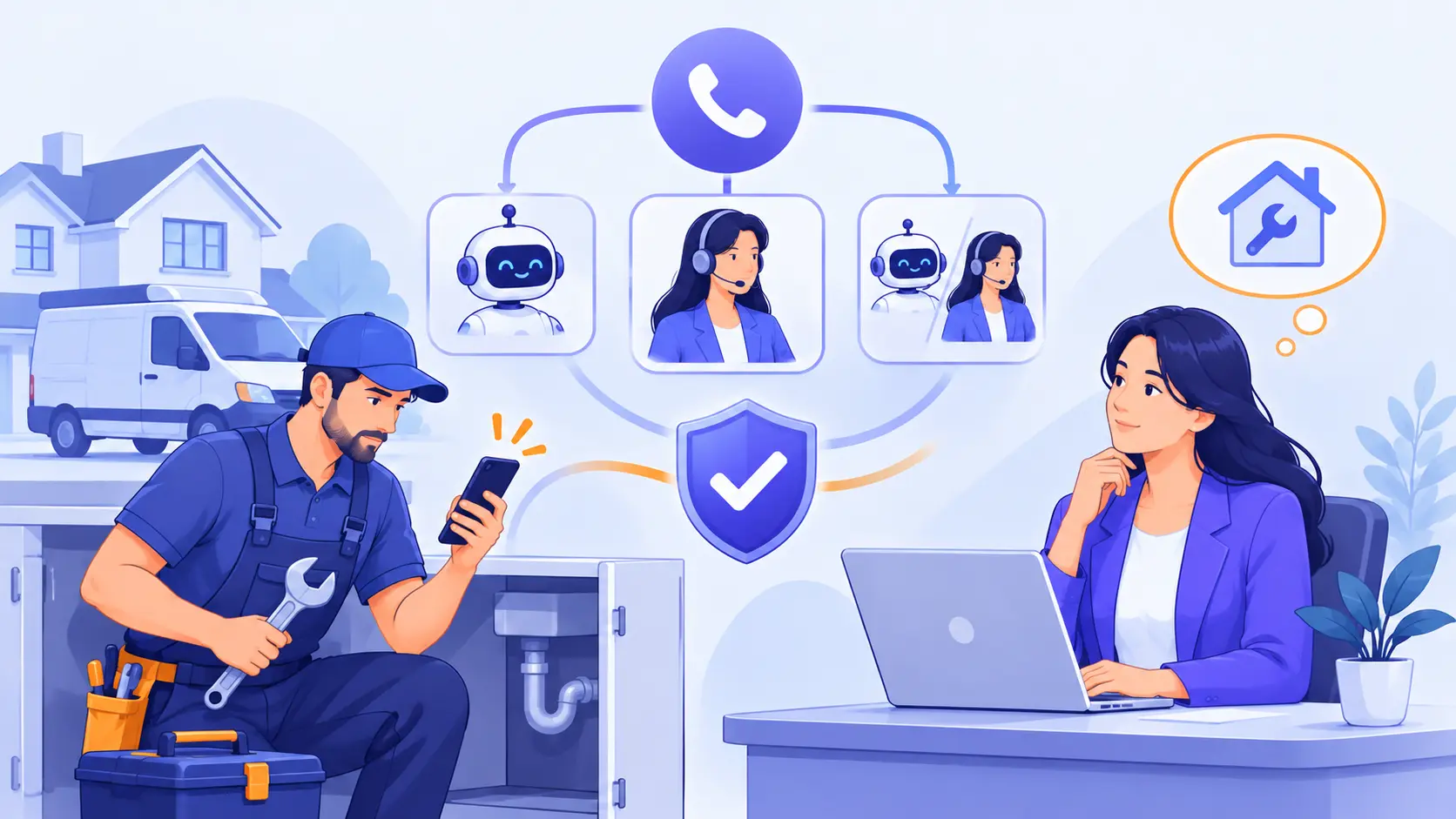
You're under a kitchen sink at 4 pm, wrench in one hand, while your phone buzzes on the truck seat... By the time you wipe your hands, that caller has already booked the next company on Google.
Invoca's July 2026 Home Services Lead Conversion Benchmarks Report found that a person answered only 52% of inbound home services calls. A home services answering service exists to close that gap.
In this guide, you'll see how AI, live agent, and hybrid answering differ, how each call type should be routed, and how to choose a setup you won't regret after the first storm week.
This kind of service picks up calls for your trade business when the crew is busy or the office is closed. It greets callers, gathers job details, books or routes the call, and sends you a clear summary.
It handles the phone, not the repair, so the real work still lands with your crew.
An answering service for home services fits several kinds of shops:
It works across HVAC, plumbing, roofing, electrical, landscaping, and remodeling, though firms with a full office team may only need overflow help.
| Job | What it means | Who usually does it |
| Answering | Picks up and takes details | Service or receptionist |
| Dispatching | Sends a tech to the job | Your office or on-call lead |
| Booking | Puts the job on the calendar | Service, if connected |
Many services stop after the message, so ask what happens next. The best setups connect to your calendar or field software.
The same service handles very different calls in each trade:
You can see how a roofing answering service or a landscaping answering service works on those pages.
The biggest gaps in home services call answering show up after hours, during peak season, and while your crews are on a job site. The numbers below show how big those gaps get.
| Measure | Result |
| Inbound calls answered by a person | 52% |
| Home services missed call rate | 14% |
| HVAC calls outside business hours | 9.8% in October, 14.1% in June |
| Unanswered callers who contact a competitor | 62% |
Some of these figures reached us through secondary summaries, so treat them as a direction, not a verdict. Honestly, not every missed call is a lost job, since some are spam or repeat callers.
You can estimate your own loss with four numbers: calls per week, the share you miss, your booking rate, and your average job value. Here's a quick example, for illustration only:
Pull a week of call logs from your phone system and swap in your real numbers. Small leaks add up fast over a full season.
A home services answering service runs on one of three models: AI only, live agents, or hybrid. Each fits a different call mix, budget, and risk level, so the best choice depends on your calls.
| Feature | AI only | Live agent | Hybrid |
| Coverage | Always on | Depends on staffing | Always on, people behind it |
| Speed | Instant answer | Short wait possible | Instant answer |
| Empathy | Limited with upset callers | Strong | Strong after handoff |
| Consistency | Same script every time | Varies by agent | Script plus human judgment |
| Cost pattern | Lowest, setup matters | Per call or minute | Middle, plan based |
| After call work | Depends on setup | Depends on service | Depends on integrations |
A good AI voice receptionist answers instantly, never puts anyone on hold, and handles many calls at once with a steady script. Vendor roundups put plans at around $50 to $100 a month, though results depend on setup.
It can struggle with upset callers, unusual jobs, noisy lines, and tricky price questions.
Live agents bring tone and judgment, so they handle stressed callers and odd requests better than any script can.
That human touch costs more, usually through per call or per minute fees. Shift gaps are possible, and per call pricing can climb fast in busy season.
In a hybrid answering service, AI answers first and handles routine calls, then live agents take the urgent, upset, or complex ones.
The handoff matters most here, since your caller shouldn't have to repeat the same details twice.
Choose AI only when your calls are mostly routine and a missed escalation costs little. Choose hybrid when emergencies, upset callers, or high ticket jobs are common. Ask yourself three quick questions:
Two or more yes answers point toward hybrid.
24/7 home services call answering only works when every call type has a clear next step. This map shows who handles what, so nothing falls through the cracks. Adjust it to your shop.
| Call type | AI handles | Live agent handles | Escalate to owner |
| New estimate request | Collects details, books visit | Special project requests | Large or commercial jobs |
| Emergency (burst pipe, no heat, gas concern) | Spots urgency, starts script | Confirms details, pages on-call tech | On-call tech, then backup |
| Existing customer reschedule | Moves the appointment | Handles scheduling conflicts | Job already in progress |
| Price or service area question | Answers from your rules | Unusual quote requests | Custom pricing |
| Upset or repeat caller | Takes message, flags it | Calms caller, warm transfer | Serious complaints |
| Vendor, spam, or sales call | Screens and filters | Rarely needed | Known vendors only |
| Warranty or complaint | Logs the issue | Gathers full details | Every case |
Define what counts as an emergency in your trade, then decide who gets paged and in what order. A no-heat call at 1 am should never sit in a queue.
For a gas smell, fire, smoke, or medical danger, the caller is told to contact 911 or the utility first. The service never gives repair advice.
Add a backup contact too, in case your first on-call tech doesn't respond.
Booking should write straight into your calendar or field service software, such as ServiceTitan, Housecall Pro, or Jobber, so you don't end up with double bookings.
Look for call summaries, texts, and missed call text back as follow up, and be wary of any service that only sends an email message.
The same questions apply to website chats, so see how live chat for service businesses works, and how appointment setting covers the booking step.
There's no single best option for every shop. The best virtual receptionist services for home services contractors in the US fit your trade, call mix, and season, so pick a home services answering service with a method.
| Criterion | What good looks like |
| Trade knowledge | Knows your jobs and terms |
| Emergency handling | Written rules, fast on-call paging |
| Booking into software | Writes to your calendar directly |
| Hours and surge coverage | Handles storm and heat waves |
| Bilingual coverage | Spanish speaking callers handled well |
| Reporting | Summaries and recordings you can review |
| Data handling | Clear rules on storage and ownership |
| Pricing clarity | No surprise overage or fees |
Plans usually bill per call, per minute, a flat monthly fee, or a hybrid mix. Storm and heat waves can double your call counts, so check overage rules before you sign. Recent examples, as of November 2026:
Run ten calls across daytime, evening, and weekend hours, plus one 2 am emergency. Include an upset caller, a price shopper, and a Spanish speaker.
Then score each call on greeting, accuracy, booking, and handoff.
Push back, or walk away, when a contract shows any of these:
If it isn't in writing, assume it isn't included.
As a home services answering service, Blazeo pairs an AI voice receptionist with trained U.S. based agents, so routine calls are handled fast and urgent ones reach a person.
The home services call answering page covers AI voice and chat as the first layer, live agents for sensitive or complex calls, appointment scheduling, text follow up, and lead tracking in SmartHub.
Blazeo answers and routes your calls, but it won't fix the pipe, and it can't promise more booked jobs. Your results depend on your setup, your call mix, and your follow up.
| Call stage | AI layer | Live agent |
| Answer | Greets and picks up instantly | Steps in when needed |
| Qualify | Asks routine job questions | Handles complex or sensitive calls |
| Book | Schedules appointments | Takes over unusual requests |
| Escalate | Flags urgent calls | Passes urgent calls to you |
Curious how it sounds on your own calls? See how it works or read more about the AI voice receptionist.
It's round the clock phone coverage for trade businesses that answers, screens, books, and escalates calls. It covers nights, weekends, and peak season, so urgent jobs reach your on-call tech instead of voicemail.
It depends on your call mix. Hybrid suits emergencies and upset callers, while AI only can work well for routine calls. Use the decision rule above to see which side your shop falls on.
Yes, if it connects to your calendar or field service software. Without that link, it only takes messages, so ask about integrations and which job fields sync before you sign.
It should answer, apply your emergency rules, page the on-call tech, and book non-urgent jobs for the next day. You should also get a clear summary of every call by morning.
You now have three models to weigh, a routing map for every call type, emergency rules to write down, and a scorecard to pick a home services answering service with confidence.
This week, pull seven days of call logs, mark the missed and slow ones, and run three test calls on any provider you're considering.
When you're ready, see how Blazeo handles home services call answering or request a demo. A week of honest data will tell you more than any sales page can.

