 SmartHub
 Automation
 Appointment Scheduler
 Lead Management
 Dashboard & Reports
 Task Management
 Communications Hub
 Live chat
 AI chatbot
 Voice AI
 Voice call centers
 Appointment scheduling
 Retainer signing
 Home services
 Lawyers and firms
 Medical services
 College admissions
 Real estate agents
 Marketing agencies
 About
About Partner program
 Estimate Your ROI
 Case Studies
 Blog
Blog FAQs
FAQs Login
LoginOne Inbox, Multiple Locations: How Growing Teams Stay Organized at Scale




Products
Industries
Company
Resources
As of March 2024 we have renamed Apexchat to Blazeo. We are excited to share the next part of our journey with our customers and partners.
The name ApexChat implies that we are primarily a chat company, which is no longer true. Now we have many offerings, such as call center services, AI, Appointment setting, SMS Enablement, Market Automation, and Sales acceleration (Q2 2024), that go beyond chat. The new name will not only allow us to convey the breadth of our offering but will also better convey our company’s mission and values.
Blazeo, which is derived from the word Blaze, evokes a sense of passion, speed, and energy. A “Blaze” is captivating, illuminates, and represents explosive growth. Blazeo encapsulates our mission to ignite such growth for our customers and partners by delivering innovation with passion, speed, and energy.

Growth is exciting until communication starts breaking.
A dental support organization opens its fourth location. An HVAC company expands into neighboring cities. A restoration group acquires another regional operator. A legal firm launches a second office to serve a growing client base.
Revenue grows. Headcount increases. New opportunities emerge.
But so does complexity.
Suddenly, leads are coming in from multiple phone numbers, websites, social channels, chat widgets, contact forms, and review platforms. Different offices begin using different tools. Team members create their own processes. Messages slip through cracks. Customers receive inconsistent responses. Managers lose visibility into what is actually happening across locations.
The problem isn't growth itself.
The problem is communication fragmentation.
Key Takeaway: Multi-location customer communication helps growing businesses centralize conversations, improve lead response times, maintain consistency across locations, and deliver a better customer experience.
Many businesses discover that the systems that worked perfectly for one location become a liability once they start scaling. The challenge is no longer generating leads. It's managing conversations consistently across every office, branch, and team.
This is why successful multi-location businesses are increasingly investing in centralized communication systems. They understand that growth without visibility creates operational chaos.
And at the center of that strategy sits one powerful concept: one inbox for every location.

Imagine a homeowner searching for emergency HVAC repair during a heatwave.
They submit a contact form on your website. They also send a Facebook message because they need immediate help. Later, they call your local office.
Three inquiries.
Three channels.
Potentially three different employees handling the same customer.
Now multiply that scenario across five offices, dozens of employees, and hundreds of inquiries every week.
This is where communication starts breaking down.
Many multi-location businesses operate with disconnected systems. One office manages leads through email. Another relies on spreadsheets. A third uses text messages. A fourth handles inquiries primarily through phone calls.
No one has a complete picture.
The customer experiences your brand as one company, but internally, communication behaves like several unrelated businesses.
This disconnect creates expensive consequences.
Leads wait longer for responses. Duplicate follow-ups occur. Appointments get missed. Sales opportunities disappear. Managers struggle to understand performance across locations.
The bigger the organization becomes, the more costly these communication gaps become.
Also read: The Cost of Unstructured Conversations: Why Growth Breaks at Scale
Multi-location customer communication is the process of managing customer conversations across multiple offices, branches, or service areas from a centralized platform. Instead of each location operating independently, businesses gain visibility into every interaction, including calls, texts, emails, web chats, and social media messages.
A centralized communication strategy ensures that customers receive consistent responses regardless of which location they contact. It also helps leadership monitor response times, improve lead conversion rates, and create a unified customer experience across the entire organization.
Businesses with multiple locations often use shared inbox software, omnichannel communication platforms, and centralized lead management tools to streamline communication and support growth at scale.
Customers don't think in terms of locations.
They think in terms of brands.
When someone contacts a dental group with ten locations, they expect every interaction to feel connected. They assume your team already knows their history. They expect information shared with one office to be accessible to another.
Companies like Starbucks and McDonald's have conditioned consumers to expect consistency regardless of location.
That expectation now extends to local businesses.
If a customer calls your Dallas office after previously speaking with your Houston location, they don't want to repeat their story from scratch.
If someone fills out a consultation request online, they expect the office handling their inquiry to have that information immediately.
Disconnected communication systems create friction at exactly the moment businesses should be building trust.
And trust is often the deciding factor in whether a lead becomes a customer.
Consider a growing restoration company operating across six service areas.
Each location has talented staff. Each office works hard. Yet management notices inconsistent performance.
Some locations convert inquiries at nearly twice the rate of others.
Customer complaints vary significantly between regions.
Follow-up times are impossible to measure accurately.
At first glance, it appears to be a staffing issue.
But after investigation, the real problem emerges.
Every office is managing communication differently.
One team responds to inquiries within minutes. Another checks messages several times daily. Some employees document customer interactions. Others don't.
Without centralized lead management, leadership has no reliable way to enforce standards or identify issues before they impact revenue.
This scenario plays out repeatedly across industries.
Dental groups struggle to coordinate patient inquiries between locations.
Legal firms lose track of consultation requests during intake handoffs.
HVAC companies experience inconsistent response times between service territories.
Franchise organizations fight constant battles against fragmented customer experiences.
Communication silos don't just create operational inefficiencies.
They directly affect revenue.
Also read: What Top Teams Automate Before Summer (And What They Never Should)
The difference between fragmented communication and centralized communication becomes more apparent as organizations grow. The table below highlights the operational impact of each approach.
| Communication Challenge | Centralized Communication Solution |
|---|---|
| Multiple inboxes across locations | One shared inbox for all channels |
| Limited visibility into conversations | Real-time visibility across teams |
| Inconsistent customer responses | Standardized communication workflows |
| Missed leads and follow-ups | Automated lead tracking and routing |
| Duplicate customer records | Unified conversation history |
| Difficult performance reporting | Centralized analytics and reporting |
| Location-specific processes | Consistent customer experience across locations |
| Manual handoffs between teams | Seamless collaboration and ownership |
The best multi location customer communication systems create visibility without sacrificing local autonomy.
That distinction matters.
Centralization doesn't mean every office loses control.
Instead, it means every conversation becomes accessible, trackable, and manageable from a single platform.
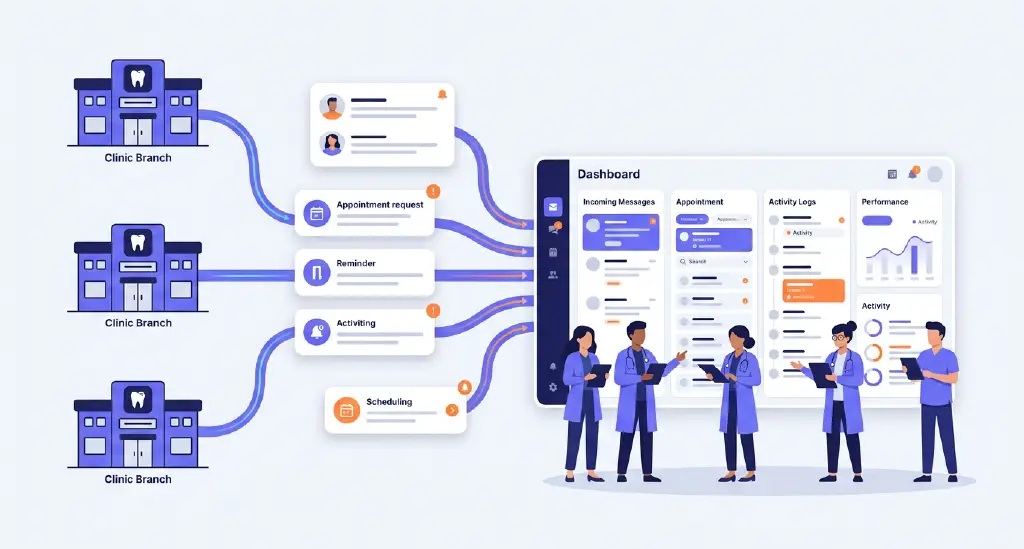
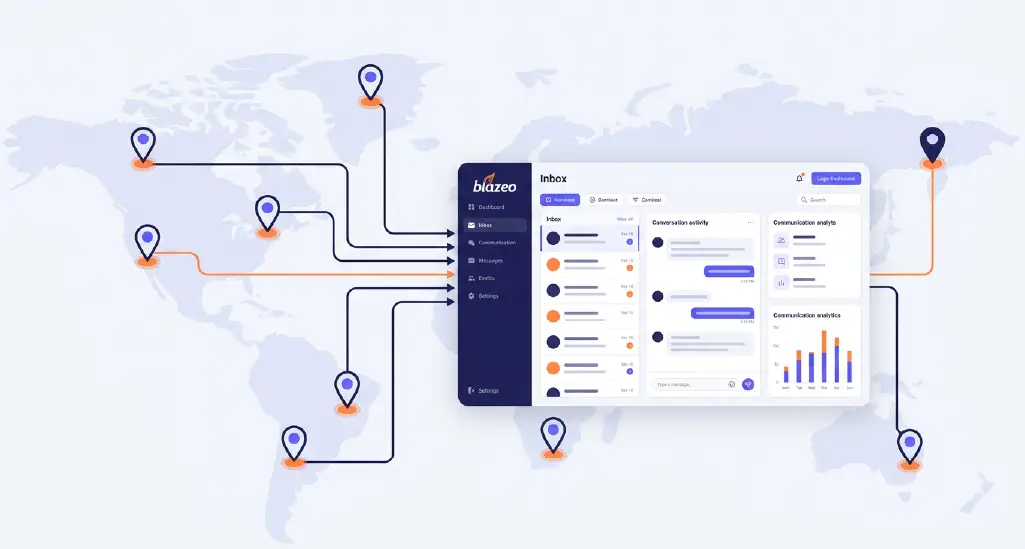
Imagine a shared inbox software solution where inquiries from phone calls, SMS, web chat, social media, and email all appear in one place.
Each location maintains ownership of its conversations.
Managers can monitor activity across all offices.
Leadership gains complete visibility into response times, lead status, and conversion performance.
When a customer reaches out, the entire conversation history is immediately available regardless of which office engages them.
The result isn't just greater efficiency.
It's a significantly better customer experience.
Dental Support Organizations offer one of the clearest examples of why centralized communication matters.
Many DSOs grow through acquisition. New practices join the network while retaining their local identity.
Patients continue interacting with familiar offices, but operationally, the organization must function as a unified business.
Without centralized communication, patient inquiries become difficult to manage.
A prospective patient might contact multiple locations seeking availability.
Existing patients may move between offices.
Call center teams often need visibility into appointment history and previous interactions.
Leading DSOs solve this by creating centralized communication environments where patient conversations are accessible across locations while maintaining appropriate operational boundaries.
The outcome is faster scheduling, improved patient experiences, and greater consistency throughout the organization.
HVAC businesses often experience rapid geographic expansion.
A company starts with one service area. Demand increases. New territories are added.
Before long, the business is managing multiple dispatch teams, service regions, and local phone numbers.
The challenge isn't finding work.
It's managing the flood of incoming inquiries.
During peak summer months, a single missed call can represent thousands of dollars in lost revenue.
When communication is fragmented, leads frequently bounce between offices. Customers encounter delays. Opportunities disappear before anyone realizes they existed.
Organizations that successfully scale typically adopt centralized lead management systems that route inquiries intelligently while maintaining complete visibility across locations.
This allows leadership to identify bottlenecks quickly, maintain service standards, and ensure no lead falls through the cracks.
Also read: HVAC Lead Response Time: The Hidden Revenue Killer During Summer Peaks
At a certain point, email alone stops working.
Personal inboxes create individual ownership but limited visibility.
Managers can't see what's happening.
Teams can't collaborate effectively.
Customer histories become scattered across multiple accounts.
Shared inbox software solves this challenge by turning communication into a team sport rather than an individual responsibility.

Instead of inquiries living inside someone's personal email account, conversations become organizational assets.
Everyone works from the same source of truth.
Teams know who is handling each conversation.
Managers can identify delays before they become problems.
Customers receive faster, more coordinated responses.
For growing organizations, this shift often represents a turning point in operational maturity.
The relationship between organization and conversion is stronger than many businesses realize.
Most lost leads don't disappear because competitors offer dramatically better services.
They disappear because nobody responded quickly enough.
Or because follow-up wasn't consistent.
Or because communication broke down during a handoff.
Centralized communication platforms address all three issues.
Leads are immediately visible.
Conversations remain accessible.
Ownership is clearly defined.
Follow-up becomes measurable.
The result is a faster, more reliable customer journey.
When businesses eliminate communication friction, conversion rates often improve naturally because prospects receive the responsiveness they expected from the beginning.
One of the biggest mistakes growing organizations make is implementing systems designed for their current size rather than their future scale.
A process that works perfectly for two locations often fails at ten.
A communication strategy built around individual employees becomes risky as teams expand.
The goal should be creating infrastructure that supports growth before growth creates problems.
That means establishing standardized communication workflows, centralized visibility, shared accountability, and consistent customer experiences across every location.
The organizations that scale most effectively rarely wait until communication becomes chaotic.
They build systems proactively.
As a result, growth feels controlled rather than overwhelming.
Most businesses view communication as an operational necessity.
The best businesses view it as a competitive advantage.
When every inquiry is visible, every follow-up is tracked, and every location operates from the same communication framework, customer experiences improve dramatically.
Response times become faster.
Team collaboration becomes easier.
Management decisions become more informed.
Customers feel understood regardless of which office they contact.
In competitive industries like dental, legal, restoration, and HVAC services, these seemingly small improvements often determine which businesses continue growing and which struggle to maintain consistency.
Because scale isn't just about adding locations.
It's about ensuring every new location strengthens the customer experience instead of complicating it.

Multi-location customer communication is the process of managing customer conversations across multiple offices, branches, or service areas using a centralized communication platform.
Centralized communication gives teams visibility into customer interactions, reduces missed leads, improves response times, and creates a more consistent customer experience across locations.
Shared inbox software allows multiple team members to manage customer conversations from a single inbox, making it easier to collaborate and track inquiries.
Centralized lead management ensures that inquiries are routed correctly, followed up consistently, and tracked throughout the customer journey, reducing lost opportunities.
Yes. Modern communication platforms allow each location to manage its own conversations while giving leadership visibility across the organization.
Dental groups, HVAC companies, restoration businesses, legal firms, franchises, healthcare organizations, and other multi-location businesses benefit significantly from centralized communication.
Growth should create opportunities, not communication chaos.
Yet many multi-location businesses discover that every new office, branch, or territory introduces another layer of complexity. Without the right systems, conversations become fragmented, visibility disappears, and valuable leads slip through the cracks.
The solution isn't more spreadsheets, more inboxes, or more manual processes.
It's creating a centralized communication environment where every conversation, lead, and customer interaction is connected.
When teams operate from a single source of truth, they respond faster, collaborate better, and deliver the consistent experiences customers expect.
That's exactly why growing organizations are turning to Blazeo. With shared inbox capabilities, centralized lead management, omnichannel communication, and visibility across every location, Blazeo helps businesses scale without losing control of the customer experience.
Because when every location operates from one connected communication hub, growth becomes far easier to manage.