 SmartHub
 Automation
 Appointment Scheduler
 Lead Management
 Dashboard & Reports
 Task Management
 Communications Hub
 Managed chat
 Voice Receptionist
 Appointment scheduling
 Retainer signing
 Home services
 Lawyers and firms
 Medical services
 College admissions
 Real estate agents
 Marketing agencies
 About
About Partner program
 Estimate Your ROI
 Case Studies
 Blog
Blog FAQs
FAQs Login
LoginSummer Surge Ready: Can Your Team Handle More Leads Without Dropping Quality?




Products
Industries
Company
Resources

A scalable lead management system helps businesses handle increasing lead volume without sacrificing response speed, personalization, or conversion quality. During seasonal demand spikes, AI-powered workflows and automation become essential for maintaining customer experience and maximizing revenue.
Every business loves a busy season until it actually arrives.
The leads start pouring in faster than usual. Demo requests spike overnight. Sales reps are juggling follow-ups while marketing celebrates higher campaign performance. Slack notifications refuse to slow down. At first, the momentum feels exciting. Then the cracks begin to show.
Someone forgets to follow up with a high-intent lead.
Another prospect receives a generic response six hours too late.
A returning customer gets treated like a first-time inquiry because the context never made it into the CRM.
And suddenly, the very surge you worked so hard to create starts costing you revenue.
This is the reality many growing businesses face during seasonal demand spikes. Whether it’s summer promotions, holiday shopping, travel season, enrollment periods, or industry-specific peak months, growth can expose operational weaknesses faster than slow periods ever will. The problem is rarely lead generation itself. It’s what happens after the lead arrives.
A high-performing business is not the one generating the most leads. It’s the one that can consistently handle more demand without sacrificing speed, personalization, or customer experience.
That is where a strong lead management system becomes the difference between scalable growth and operational chaos.
When companies struggle during peak demand seasons, leadership often assumes the problem is staffing limitations.
Some executives immediately conclude that more SDRs are needed.
Others believe expanding the support team is the only solution.
In many cases, managers suggest extending shifts to keep up with growing demand.
But most of the time, the problem is not a lack of people. It is a lack of systems built to support scale.
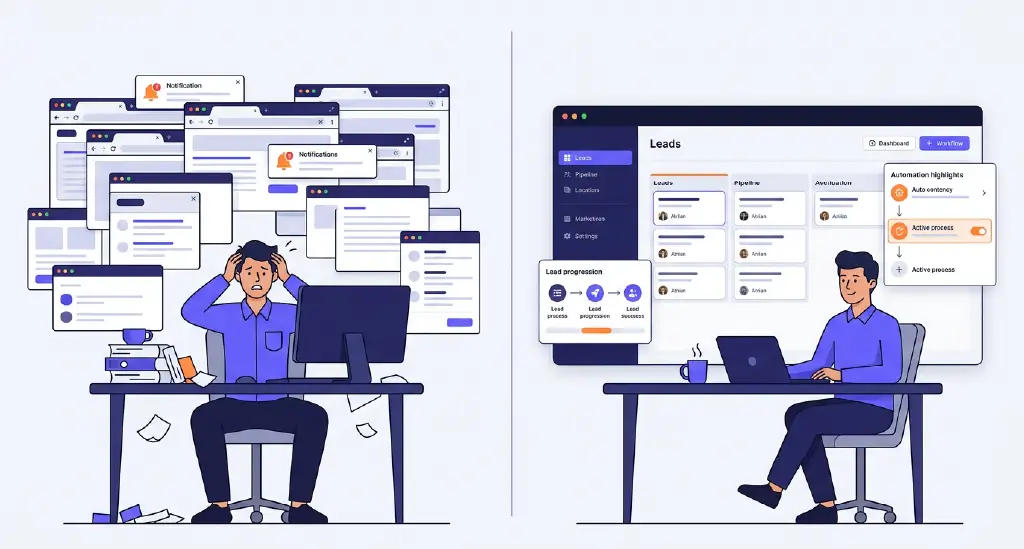
A sales team operating manually can handle moderate lead flow reasonably well. Reps can personalize outreach, keep tabs on follow-ups, and maintain healthy conversations. But once inbound volume doubles or triples, manual workflows begin collapsing under pressure.
Leads get buried in inboxes.
Duplicate conversations happen across channels.
Follow-up timing becomes inconsistent.
Important context disappears between departments.
The customer experience becomes fragmented.
What makes this dangerous is that many businesses do not notice the damage immediately. Revenue reports may still look healthy on the surface because more leads are entering the funnel. But underneath, conversion efficiency quietly deteriorates.
A business generating 5,000 leads with poor response quality may actually underperform compared to a business generating 2,000 highly managed leads with excellent follow-through.
The companies that survive seasonal surges successfully are the ones that prepare their infrastructure before demand spikes arrive.
A scalable lead management system is a framework that helps businesses organize, automate, prioritize, and respond to leads efficiently as demand grows. It combines CRM workflows, AI-powered automation, lead routing, and centralized customer data to ensure businesses maintain speed and consistency during periods of rapid growth.
Without scalable systems, businesses often experience delayed follow-ups, inconsistent communication, and lost revenue opportunities during seasonal demand spikes.
The goal is not simply handling more leads. The goal is maintaining high-quality customer experiences while increasing operational efficiency.
Imagine a home services company running aggressive summer advertising campaigns.
The ads perform exceptionally well. Website traffic surges. Quote requests increase by 70% in two weeks. On paper, everything looks successful.
But internally, the team begins falling behind.
Some leads receive responses within five minutes. Others wait until the next day. Customers calling through social media receive different pricing information than those who filled out forms on the website. Sales reps are overwhelmed and start prioritizing only the “easy” inquiries.
By the end of the quarter, management notices something confusing: lead volume increased dramatically, but closed revenue only improved marginally.
What happened?
The business expanded demand without scaling its lead handling system.
This is far more common than companies admit.
According to multiple sales studies, response time has a direct impact on conversion likelihood. The longer a lead waits, the colder the opportunity becomes. During seasonal spikes, delayed communication becomes even more damaging because customers are often comparing multiple vendors simultaneously.
The danger is not just losing leads. It is losing trust.
Customers remember friction.
Many recall the frustration of repeating themselves across multiple conversations.
Others notice when responses take far too long to arrive.
Prospects also recognize robotic replies that fail to address their actual questions.
And in crowded markets, customer memory directly affects brand reputation.
Also read: Mid-Year Revenue Check: Where Leads Are Slipping Through the Cracks
There is a misconception that scaling means continuously hiring.
In reality, scalable businesses focus on removing operational bottlenecks before expanding headcount.
A scalable lead handling system for growing teams creates consistency regardless of how many inquiries enter the funnel. It ensures that customer experience remains stable even during unpredictable demand spikes.
This does not mean removing the human element. It means protecting it.
When repetitive administrative tasks consume sales teams, human conversations suffer. Reps spend more time organizing leads than actually building relationships.
Strong systems eliminate unnecessary friction so teams can focus on higher-value interactions.
This includes intelligently routing leads based on intent, automating first-touch responses, centralizing customer data, tracking conversation history, and ensuring no lead disappears because someone forgot to update a spreadsheet.
The businesses scaling successfully today are not necessarily the ones with the biggest sales teams. They are the ones using automation strategically to support human performance.
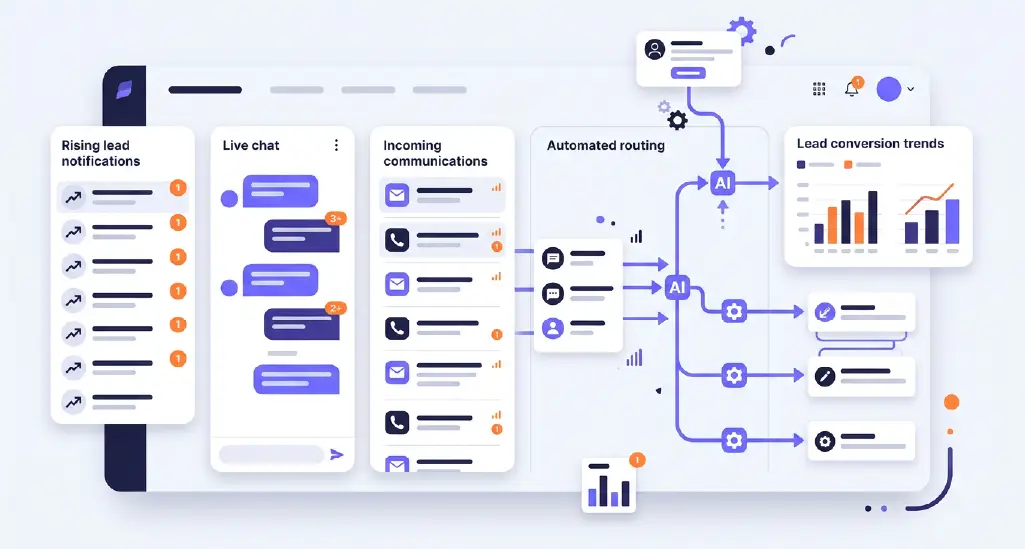
AI-powered lead management systems improve response times by automating repetitive tasks, prioritizing high-intent inquiries, and instantly routing leads to the right departments.
Instead of manually sorting inbound requests, businesses can use AI to:
Faster response times often lead to higher conversion rates because customers receive relevant answers while purchase intent remains high.
For years, automation carried a negative reputation.
Customers associated it with stiff chatbots, generic replies, and frustrating support experiences. Businesses feared losing authenticity if they relied too heavily on automation tools.
But AI-powered systems have evolved significantly.
Today, intelligent automation is less about replacing conversations and more about improving responsiveness, continuity, and efficiency.
Consider an e-commerce brand preparing for a summer product launch.
Without AI support, customer inquiries during launch week could overwhelm the support and sales teams. Questions about pricing, shipping timelines, product availability, and recommendations flood every communication channel simultaneously.
Now imagine that same company using AI-driven workflows integrated into its lead management system.
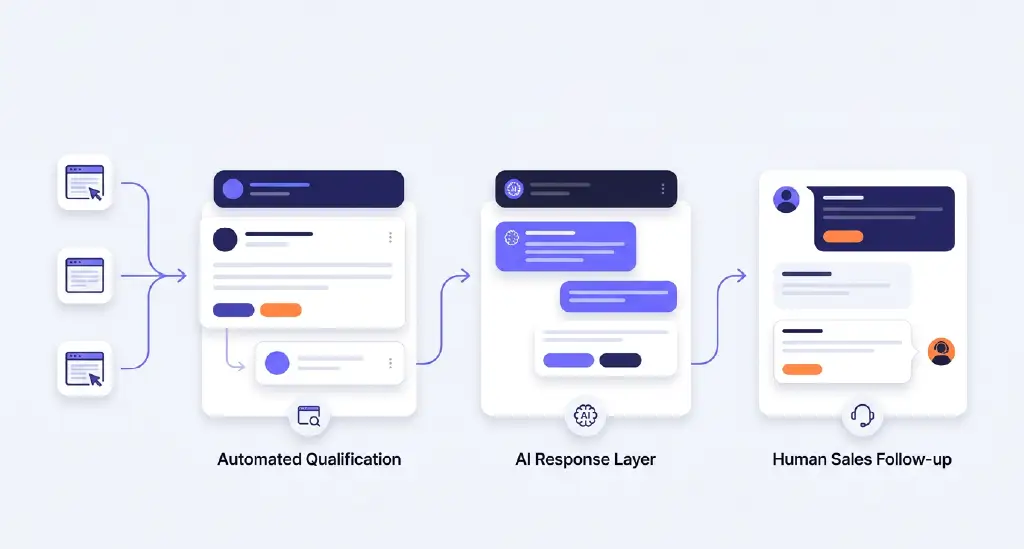
Incoming leads are automatically categorized based on urgency and buying intent.
Frequently asked questions are answered instantly.
Sales-qualified inquiries are prioritized for human follow-up.
Conversation history is synced across channels so customers never need to repeat themselves.
Sales reps receive contextual summaries before engaging with prospects.
Instead of drowning under demand, the team maintains control and consistency.
That is the real value of AI during seasonal growth periods. It protects customer experience while allowing businesses to scale lead handling efficiently.
Also read: Human-in-the-Loop AI Customer Engagement Strategy
Businesses investing in scalable sales automation and AI customer engagement tools are often better positioned to maintain consistency during periods of rapid growth.
Not all automation improves customer experience.
In fact, poorly implemented automation often makes businesses feel colder and less trustworthy.
Customers can immediately recognize when a company prioritizes efficiency over relevance.
Generic templated responses, poorly timed follow-ups, and disconnected messaging create frustration rather than convenience.
The goal of automation should never be to sound robotic faster.
It should be to remove delays, reduce confusion, and create smoother customer journeys.
Good automation feels invisible.
For example, if a lead downloads a pricing guide from your website during a seasonal campaign, your system should understand the context behind that action. Instead of sending an irrelevant nurture email two days later, the system could trigger a personalized response aligned with the prospect’s stage in the buying journey.
That level of coordination becomes nearly impossible with fragmented tools and manual workflows.
Businesses that succeed during peak seasons treat automation as an enhancement to human connection, not a replacement for it.
Successful companies that manage seasonal surges effectively typically start preparing well before demand begins to rise.
First, leadership teams audit response times to identify potential delays.
Next, managers identify gaps in lead routing that could create bottlenecks during peak periods.
Additionally, operations teams evaluate whether their CRM accurately reflects real customer conversations and interactions.
Finally, decision-makers examine where leads may be slipping through the cracks before higher volumes arrive.
Most importantly, they stress-test their systems before campaigns go live.
One SaaS company preparing for a summer enrollment push realized that their SDR team was manually assigning every inbound demo request. During slower months, the process worked adequately. But forecasting showed that lead volume would nearly double during peak weeks.
Instead of hiring aggressively, the company redesigned its workflow.
Lead qualification became automated.
Intent scoring helped prioritize high-conversion opportunities.
AI-assisted summaries reduced time spent reviewing prospect history.
Response workflows became standardized across channels.
The result was not just faster response times. The quality of engagement improved because reps had more time to focus on actual selling.
This is the hidden advantage of scalable systems. They improve both speed and quality simultaneously.
Also read: The Anatomy of a Winning Sales Conversation: What Top-Performing Teams Do Differently
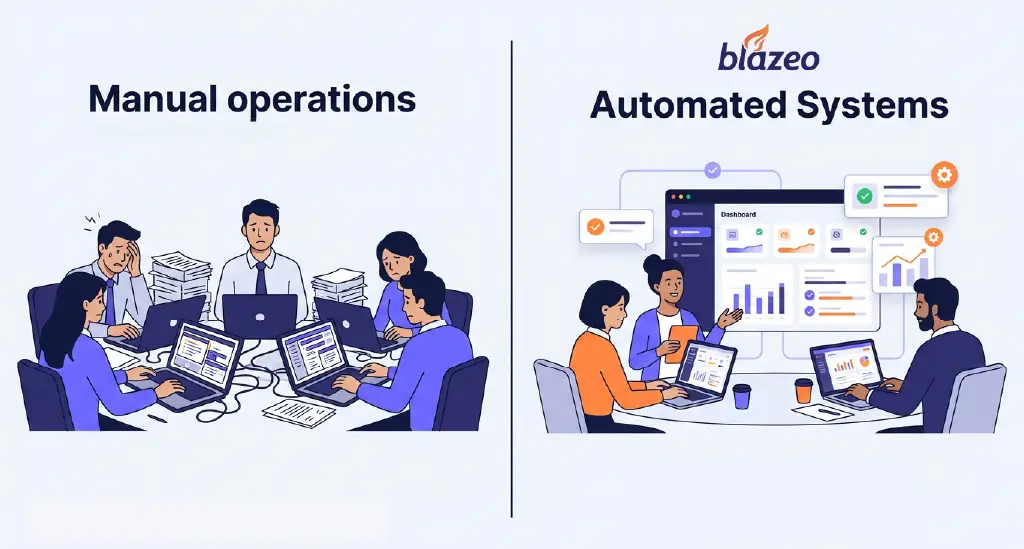
One of the biggest misconceptions about growth is that pressure automatically creates productivity.
In reality, overwhelmed teams make slower decisions, commit more errors, and provide weaker customer experiences.
If your team feels exhausted every time demand increases, your systems are likely relying too heavily on manual effort.
Businesses wondering how to manage more leads efficiently should begin by identifying which activities truly require human involvement.
Does a sales rep really need to manually sort inbound requests?
Should support agents repeatedly answer identical questions during campaign periods?
Does customer information need to live across disconnected platforms?
Every repetitive process that can be intelligently automated creates more room for meaningful customer interaction.
The healthiest scaling strategies protect team energy alongside operational performance.
Because burned-out teams eventually affect retention, morale, and long-term growth.
Ironically, customers become less patient precisely when businesses become busier.
During seasonal surges, buyers expect faster answers, smoother experiences, and greater convenience. Competition also intensifies because multiple brands are fighting for attention simultaneously.
That means your operational experience becomes part of your competitive advantage.
A fast, organized, responsive brand feels trustworthy.
A slow, disorganized brand feels risky.
Even if your product is excellent, poor lead handling can quietly erode confidence before the sales conversation truly begins.
This is especially important in industries where timing directly influences purchasing behavior, including retail, SaaS, healthcare, education, real estate, and hospitality.
In these markets, operational responsiveness is no longer optional. It is part of the product experience itself.
The modern sales environment changes too quickly for rigid systems.
Lead sources evolve constantly. Customer behavior shifts seasonally. Communication channels multiply every year.
Businesses that rely entirely on manual coordination struggle to adapt at scale.
Meanwhile, companies investing in flexible systems gain operational resilience.
They can launch campaigns faster.
Handle demand spikes more confidently.
Maintain customer experience under pressure.
And make smarter decisions because their data is centralized and actionable.
This adaptability matters even more during uncertain economic conditions, where efficiency and responsiveness directly affect profitability.
A scalable lead management system is no longer a luxury reserved for enterprise companies. It is foundational infrastructure for any growing business expecting seasonal growth.
A scalable lead management system helps businesses manage increasing lead volume efficiently using automation, CRM workflows, AI routing, and centralized customer data.
Businesses can use AI-powered automation, lead scoring, CRM integrations, and automated follow-ups to handle higher lead volumes efficiently without dramatically increasing headcount.
Many companies lose leads because manual workflows cannot keep up with higher inquiry volume, causing delayed responses, inconsistent communication, and missed follow-ups.
AI improves lead management by automating repetitive tasks, prioritizing high-intent leads, reducing response times, and providing contextual customer insights to sales teams.
Industries with seasonal demand fluctuations like SaaS, retail, healthcare, education, hospitality, and real estate benefit significantly from scalable lead management systems.
The biggest advantage is maintaining fast, consistent customer experiences even during periods of rapid business growth or seasonal demand surges.
Growth should feel exciting, not chaotic.
If seasonal spikes consistently leave your team overwhelmed, your leads unmanaged, and your customer experience inconsistent, the issue is not demand. It is infrastructure.
The businesses that scale successfully are the ones preparing before the surge arrives. They invest in systems that support faster response times, smarter workflows, and better customer experiences without exhausting their teams in the process.
AI and automation are no longer optional add-ons. They are becoming essential tools for businesses that want to grow sustainably while maintaining quality at scale.
Businesses using scalable lead management systems and AI-driven workflows are better equipped to maintain customer experience, improve conversion rates, and support sustainable growth during high-demand seasons.
That is exactly where Blazeo comes in. From intelligent automation to streamlined lead workflows and real-time engagement tools, Blazeo helps growing teams handle higher lead volumes without losing the personalization and responsiveness customers expect. Because the goal is not just generating more leads. It is building a system capable of converting them consistently, even during your busiest seasons.
