 SmartHub
 Automation
 Appointment Scheduler
 Lead Management
 Dashboard & Reports
 Task Management
 Communications Hub
 Managed chat
 Voice Receptionist
 Appointment scheduling
 Retainer signing
 Home services
 Lawyers and firms
 Medical services
 College admissions
 Real estate agents
 Marketing agencies
 About
About Partner program
 Estimate Your ROI
 Case Studies
 Blog
Blog FAQs
FAQs Login
LoginAI Call Center Voice Agent: The Future of Customer Support




Products
Industries
Company
Resources

You were on hold for 20 minutes just to confirm your order status. Every business running a call center without an AI call center voice agent is actively losing customers to that exact frustration. That experience is something millions of customers face every single day without relief.
AI technology is changing this reality fast. Businesses are no longer losing customers to poor phone experiences. They are responding instantly, resolving issues accurately, and operating around the clock without burning out their teams.
AI voice agents are reshaping how modern support teams handle volume, speed, and consistency together. This blog uncovers exactly how smarter, faster customer support works and why forward-thinking businesses are already making the switch right now.
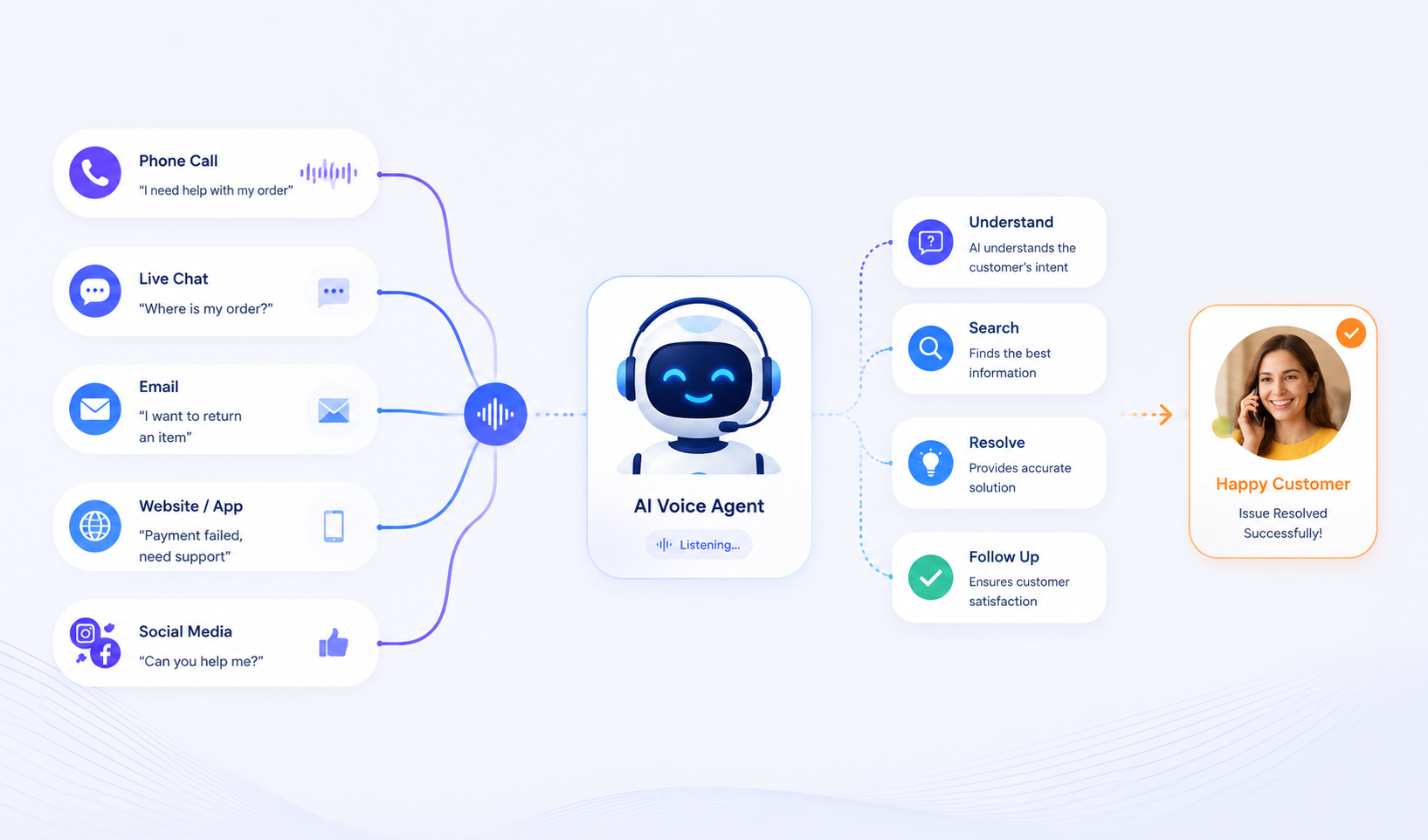
Most people still picture a clunky robot reading from a script when they hear an automated phone system. That picture is completely outdated today. An AI call center voice agent listens, processes meaning, and responds the way a well-trained human representative actually would.
The technology runs on natural language processing and machine learning, working simultaneously in real time. NLP picks up intent and context rather than just matching keywords to preset answers. Real callers never speak in perfectly structured sentences, and the system handles that without missing a beat.
Conversational AI solutions enable genuine two-way dialogue instead of one-sided scripted responses. The system follows the conversation, remembers what was said, and adjusts every response accordingly. That gap between modern voice AI and the phone trees customers have dreaded for years is enormous.
Calls get routed based on what the caller actually needs from the very first exchange. Appointments get scheduled, FAQs get resolved, and complaints get handled without a human agent involved. Volume does not matter; ten calls or ten thousand get the same consistent treatment every time.
Also read this: https://www.blazeo.com/blog/best-ai-voice-services-for-customer-engagement-guide
Anyone managing a call center during a product launch knows exactly how fast things unravel under pressure. Queues stack up, agents burn out, and customers walk straight to competitors who actually pick up. That is not an occasional problem; it is the daily reality for businesses running human-only support right now.
Customer expectations have shifted hard toward instant, always-on support with zero tolerance for waiting around. A caller hitting a 20-minute hold queue in 2026 is not staying on the line patiently. They hang up, leave a review, and tell others before the week ends.
An AI call answering service absorbs volume spikes, covers after-hours calls, and holds quality steady at any scale. Businesses making the switch are reporting faster resolution times and stronger retention within months. No burnout, no shift gaps, no dropped calls during the moments that matter most.
Conversational AI customer service handles all routine tasks, so human agents stay free for what genuinely requires empathy. Every call a traditional center drops is a customer relationship quietly breaking down unnoticed. Businesses ignoring this shift are paying for it in revenue and reputation each single day.
Good support staff burns out fast when call volume outpaces team size every single week. An AI call center voice agent steps in without salary, benefits, or sick days. That difference alone makes the budget conversation with leadership remarkably straightforward.
Nobody waits on hold at 2 am when a billing issue is keeping them up at night. AI voice agents answer the moment a call connects, every single time without exception. Customers who get that kind of response stop shopping around for someone who treats them better.
Tired agents say the wrong thing sometimes, and one bad answer can cost a customer permanently. Every caller gets the same checked, confirmed response pulled from the same source. That steadiness does something no flashy rebrand ever manages to pull off with customers.
Hiring twenty people for December and letting them go in January is a horrible cycle. The system handles three times the call volume without a single new person onboarded. Real agents stay focused on situations where tone, patience, and human reading actually change outcomes.
Some sectors were hemorrhaging customers through support failures years before anyone called it a crisis. AI voice agent services for businesses gave those industries a way out that actually held up under pressure. Healthcare, retail, logistics, and finance all shared one ugly common problem that traditional hiring never fixed.
Front desk staff at clinics were quitting because the phone literally never stopped ringing between shifts. Conversational AI solutions now field scheduling calls, insurance questions, and refill requests without anyone picking up. Patients finally get through, and that single fix changes how they talk about their doctor to others.
Nobody plans for a product to go viral overnight and flood support lines before breakfast. AI fields return requests, order questions, and policy queries without burning through overtime budgets. A shopper who gets an answer in seconds completes that purchase instead of closing the tab permanently.
Hiring a full support team means payroll, benefits, training cycles, and inevitable turnover eating your budget quarterly. An AI call answering service removes every one of those overhead layers permanently. That money doesn't disappear; it moves toward things that actually grow the business.
Training a new agent takes weeks, and they still make mistakes during their first live calls. AI updates instantly when products change, policies shift, or new query types emerge overnight. The brand voice stays locked in regardless of who is calling or when.
Here is where the numbers actually land for businesses making the switch:
The AI call center voice agent absorbs the repetitive, high-volume calls that drain human agents daily. Freed from routine queries, your team handles emotionally complex situations with full attention. Quality doesn't drop; it actually improves where it matters most.
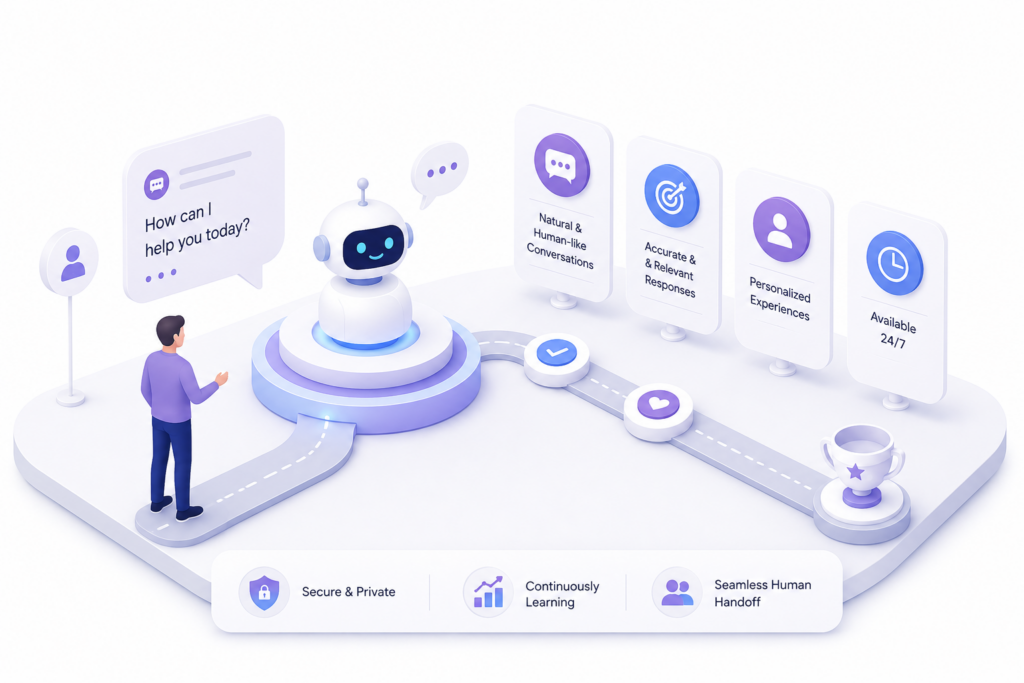
Most voice bots feel like talking to a wall, and callers hang up angrier than before. Great conversational AI customer service doesn't just answer, it actually understands what the caller means. That gap between responding and understanding is where most platforms completely fall apart.
Context matters more than keywords when someone is frustrated and explaining a problem mid-sentence. Systems that track the full conversation remember what was said three exchanges ago without asking again. Callers notice that immediately, and it changes the entire emotional tone of the interaction.
AI voice agents that handle complexity well know exactly when to stop and bring a human in. That handoff needs to feel smooth, not like the caller is being transferred into a void. Done right, it actually increases trust rather than signaling that the AI hit its limit.
Tone, pacing, and word choice do quiet work that most businesses never think to measure carefully. A voice that sounds calm, clear, and natural keeps callers engaged instead of defensive. That quality becomes a competitive edge that shows up directly in retention and satisfaction scores.
Most businesses lose potential customers the moment a call goes unanswered after hours close. AI voice agent services for businesses keep that conversation alive when your team physically cannot be there. Every answered call is a conversion opportunity that would have otherwise gone completely cold.
At Blazeo, we were built around that problem because missed calls carry a real and measurable revenue cost. We help businesses respond instantly to every inbound call, including weekends, holidays, and late evenings. Our AI call center voice agent handles high volumes without letting response quality slip under pressure.
We integrate directly with existing CRMs, so every interaction feeds into your actual workflow seamlessly. Smart intent-based routing sends each caller exactly where their situation needs to go. Industry-specific configurations mean the system speaks your business language from the very first call.
Businesses still treating AI as a future consideration are already falling behind competitors who moved first. The AI call center voice agent is not a concept sitting in a roadmap somewhere waiting. It is deployed, proven, and actively handling millions of real calls across industries right now.
Conversational AI solutions are shifting from reactive to predictive in ways that fundamentally change support operations. Systems now identify why a customer is likely calling before the conversation even begins. Emotion detection adjusts tone mid-call while multilingual support scales globally without a single additional hire.
Deeper CRM integrations make every call smarter and more personally relevant than the one before. Conversational AI customer service is becoming the baseline expectation, not the differentiator it once was. Businesses that set that standard today will be the ones customers actively choose to stay with.
Also read this: https://www.blazeo.com/blog/what-best-voice-ai-call-center-providers-do/
Tone detection catches frustration before it boils over and shifts the conversation naturally. Most difficult calls settle down simply because the caller finally feels someone is actually listening.
You train it on your own product data, so it answers based on actual knowledge. Callers asking technical questions stop getting the runaround they usually get from undertrained staff.
Honestly, faster than most teams expect. Configuration and integration run at the same time, and most businesses are taking live calls within a few days of starting setup.
Some companies are upfront about it; others are not. Callers rarely care either way because what they actually want is a straight answer delivered without making them wait.
One system handles it all. The moment a caller speaks another language, it switches without skipping a beat. No rebuilding, no extra budget, no separate team managing it.
It hands the call to a human without making the caller repeat everything from scratch. That transition feels deliberate rather than like the system quietly threw in the towel.
Encryption and compliance are baked into how serious platforms are built, not patched on later. Caller data stays locked down without your team needing to babysit the process.
After a call closes, the system already knows who needs a follow-up and when. Your team wakes up to completed outreach instead of a pile of callbacks to make.
Customer support no longer runs on office hours, and businesses still thinking it does are losing ground fast. The AI call center voice agent delivers always-on availability, real cost savings, and scalable performance. Every caller gets a human-like experience that builds genuine loyalty. Missing calls at scale causes damage that quietly compounds every single month without anyone noticing until revenue drops.
An AI call answering service is no longer optional for businesses that want to stay relevant and competitive. The wins covered here show up in real retention numbers, cost sheets, and satisfaction scores. Teams that move on this today will set the pace everyone else chases tomorrow. That decision starts with one step taken right now before competitors move first.

