 SmartHub
 Automation
 Appointment Scheduler
 Lead Management
 Dashboard & Reports
 Task Management
 Communications Hub
 Managed chat
 Voice Receptionist
 Appointment scheduling
 Retainer signing
 Home services
 Lawyers and firms
 Medical services
 College admissions
 Real estate agents
 Marketing agencies
 About
About Partner program
 Estimate Your ROI
 Case Studies
 Blog
Blog FAQs
FAQs Login
LoginConversational AI in Healthcare: Improving Patient Outcomes




Products
Industries
Company
Resources

The front desk phones are already ringing before the doors even open. Conversational AI in healthcare is why more clinics are finally getting ahead of that problem without adding headcount or burning out the people already there. Front desk teams juggle check-ins, insurance calls, and walk-ins all at once. A patient on hold hangs up. A reminder from yesterday sits unsent. A follow-up call falls completely through the cracks.
That's not a management failure. It's just what happens when patient volumes outgrow the systems built to handle them. This blog covers how the technology actually works in real clinical settings, where it's making the most difference, and what outcomes clinics are seeing after they put it to use.
Here's a scenario more common than most clinic managers want to admit. A patient calls to confirm their 10 AM appointment. They get placed on hold. Three minutes pass. They hang up, skip the visit, and the clinic marks it as a no-show without ever knowing why it happened.
Staff in high-volume clinics often report that the phones genuinely never stop during peak hours. That's not an exaggeration. A team of three handling sixty-plus inbound calls while managing walk-ins and insurance verification at the same time isn't coping. It's absorbing chaos as best it can.
The downstream effects are real and measurable. High no-show rates hit revenue hard. Missed callbacks mean patients with actual clinical needs fall out of the system entirely. Delayed responses affect care quality in ways that don't always show up immediately but absolutely show up eventually. This is the core problem that conversational AI in healthcare exists to address.
Voice AI in healthcare gets attention in this space precisely because hiring more staff doesn't solve it. Most clinics can't hire their way out of call volume. An AI voice agent in healthcare handles that volume without burning out the people already there.
The simplest way to describe Conversational AI for healthcare is this. It's software that has a real conversation with a patient, not just a scripted exchange where one wrong word breaks everything.
It listens to what a patient actually says, picks up on the intent behind the words, and responds with something useful. If someone calls and says, "I think I need to push my appointment back a few days," the system understands that it isn't a cancellation. It checks the calendar and offers alternatives without a human needing to step in.
That distinction matters because most clinics that have tried chatbot tools before walked away disappointed. Those older systems work fine when patients say exactly the right phrase. The moment someone speaks naturally, things fall apart. Conversational AI solutions handle variation, ask a clarifying question when needed, and don't leave patients feeling like they've hit a wall.
Integration is usually less painful than clinics expect. Most platforms connect to existing EHR systems and scheduling tools through standard APIs. No full overhaul required. Conversational AI in healthcare sits on top of what's already in place and handles the communication layer that currently falls entirely on staff.

Not every part of a clinic's communication breaks down in the same way. Some gaps happen at the start of the patient journey, some in the middle, and some long after the visit is over. Conversational AI in healthcare shows up differently across each of those stages, and understanding where it genuinely fits helps separate real value from marketing noise.
Healthcare voice automation picks up where front desk capacity runs out. Inbound scheduling calls get handled automatically. The system asks the right questions, checks availability, confirms the booking, and wraps up the call without anyone on staff touching it. Cancellations work the same way.
The reminder piece is where many clinics see the first clear win. Voice AI for clinics sends automated reminder calls and texts without any manual effort from staff. A mid-size primary care practice that rolled out automated reminders saw a measurable drop in no-show rates within its first quarter after going live. Staff weren't spending an hour each morning calling patients to confirm visits. That time went back to in-person care, where it actually belongs.
Before a patient speaks to anyone clinical, an AI voice agent in healthcare can collect the information that matters most. It walks the patient through structured symptom questions, gathers responses, and routes the call based on what it finds. Urgent cases move faster. Lower-priority contacts get handled without tying up clinical staff.
Voice AI in healthcare doesn't make a clinical judgment. That's important to be clear about. What it does is triage the information flow so the clinician's time goes to the patients who need it most. Patients who get clear guidance on whether their situation needs immediate attention versus a regular appointment also tend to make genuinely better decisions about where to seek care.
This is probably where Conversational AI for healthcare does some of its quietest and most important work. Patients managing diabetes or hypertension often go weeks without meaningful contact with their care team. That gap is exactly where things go wrong.
Automated check-ins change that. The system reaches out between visits, asks about recent symptoms, checks on medication adherence, and flags anything concerning to the care team. If a patient mentions they've been dizzy for three days, a clinician hears about it before it becomes something worse.
These Conversational AI solutions don't replace the scheduled visit. They make sure the space between visits isn't a complete blackout for chronic care patients who need more consistent monitoring than a quarterly appointment can realistically provide.
Ask any nurse coordinator in a busy practice what eats up their time, and the answer is rarely the clinical work. It's the calls. Is my prescription ready? Did anyone look at my lab results? I need to check whether my insurance covers this before Friday. These are legitimate questions from real patients. They just don't require a clinical brain to answer.
Healthcare voice automation handles this layer completely. Prescription refill requests, insurance verification, test result notifications, pre-visit intake, all of it can run through automated conversation without staff involvement. When clinics put conversational AI in healthcare to work here, staff get that time back for care coordination and direct patient interaction that actually requires their expertise.
The burnout piece is worth saying plainly. Healthcare loses good people every year, and a real portion of that is the administrative load piling up shift after shift. When Voice AI for clinics absorbs routine call volume, something shifts for the people delivering care. Job satisfaction goes up. Daily stress drops. That outcome doesn't just matter for staff. It directly affects the quality of care patients receive.
Blazeo is a platform specifically built around this. It takes on the communication tasks that drain clinical teams without changing how the existing team works or adding friction to their day.

Not every platform is worth evaluating seriously. Some products look solid in a demo and fall apart in an actual clinical environment within the first month. That's a waste of time and money, and it tends to make staff distrust the category entirely.
HIPAA compliance is the non-negotiable starting point. If a vendor can't clearly walk through how patient data is stored, who can access it, and what their breach response looks like, stop the conversation there. That's not a technicality. It's a basic requirement.
Conversational AI solutions worth the investment will integrate directly with the EHR and scheduling systems already in place. Multilingual support matters more than most vendors want to discuss, particularly in clinics where a significant portion of patients aren't fluent in English. A system that only works in one language will leave people underserved.
Watch for these red flags during evaluation:
AI voice agent in healthcare deployments live or die on implementation support, not just features. At Blazeo, we provide full onboarding, compliance setup, and EHR integration support as a Conversational AI in healthcare partner for practices of every size. That support is often what separates a deployment that sticks from one that gets quietly abandoned.

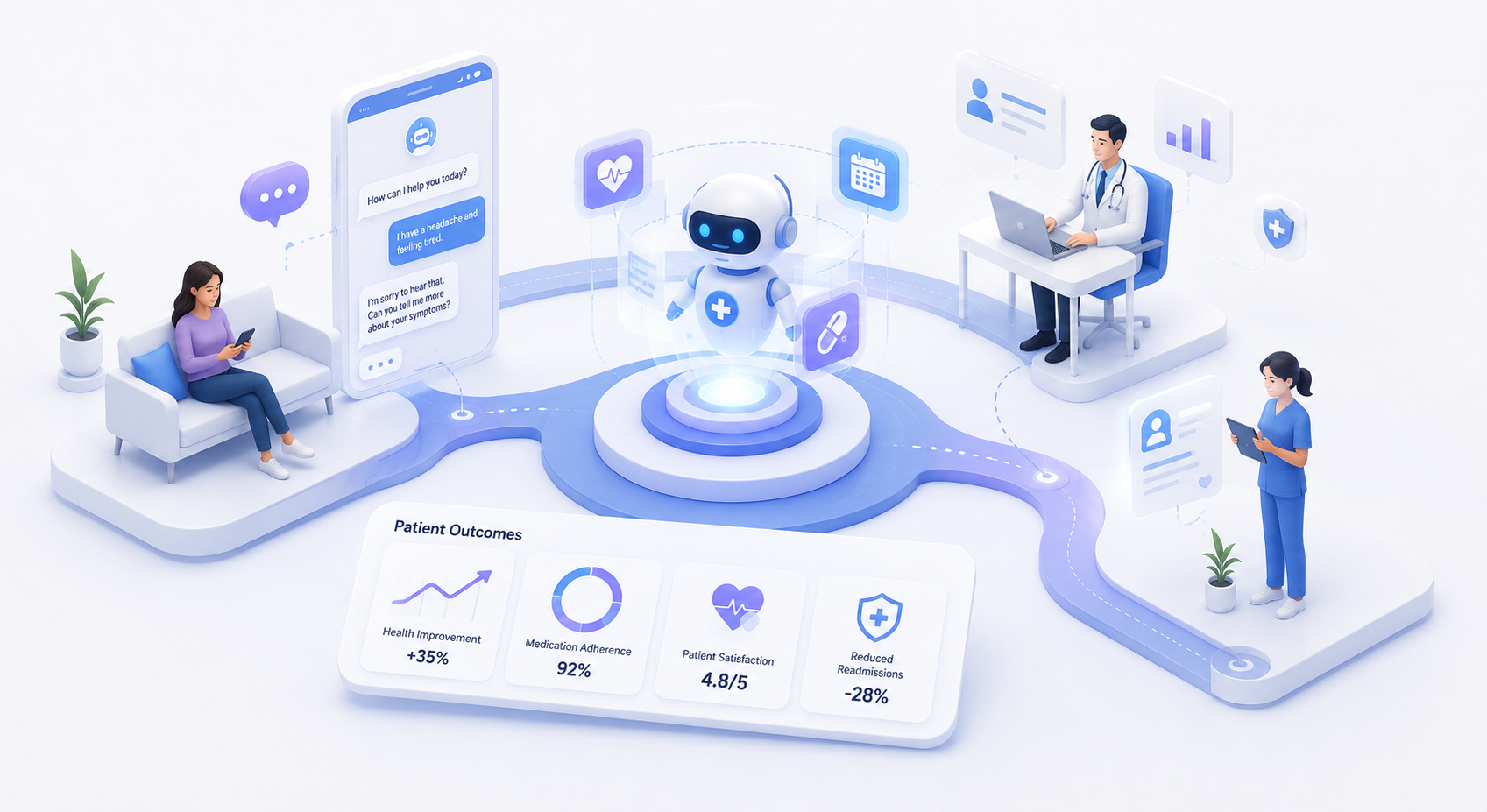
This is where things get harder to argue with. Voice AI in healthcare has started producing results that show up in independent research, not just vendor slide decks.
Accenture Health reported that AI-powered patient communication can cut missed appointment rates by up to 30 percent when reminders are automated and sent proactively. That number carries real weight because no-shows are one of the most expensive and preventable problems in primary care. Thirty percent changes a clinic's operating reality tangibly.
Conversational AI for healthcare has also moved patient satisfaction scores in a consistent direction. KLAS Research found that clinics using AI-assisted communication tools score higher on patient experience surveys, particularly around responsiveness and wait times. Patients are fairly straightforward about this. If someone answers quickly, they notice. If nobody does, they absolutely notice that too.
Research published in JAMIA found that chronic care patients receiving regular automated check-ins between visits were significantly less likely to be readmitted within 30 days compared to patients receiving standard care without follow-up contact. The mechanism isn't complicated. When someone checks in, problems get caught earlier. A multi-location urgent care group that deployed voice AI for after-hours triage saw first-contact resolution rates climb while patient wait times at intake dropped. Not because staff worked harder, but because the right work was going to the right people.
It connects to systems like your EHR and scheduling platform, listens to what patients say, identifies what they actually need, and responds without a human stepping in. It handles natural speech variation, so patients don't need to phrase things perfectly for it to work.
Healthcare AI is built specifically for clinical language, compliance needs, and how patient interactions actually flow. General chatbots are rigid and break easily. Healthcare platforms adjust when patients go off-script and connect directly to scheduling and clinical systems, which general tools aren't designed for.
Yes. It sends pre-visit instructions, collects intake information, confirms current medications, and answers common questions before the patient arrives. That cuts down on paperwork at check-in and makes the time spent with the clinician more focused and productive for both sides.
Reputable platforms follow HIPAA requirements for data storage, access control, and breach response. Conversations are encrypted, access is role-limited, and every interaction is logged. Ask any vendor for compliance documentation upfront and don't move forward without seeing it.
Bias is a genuine concern, not a hypothetical one. Systems trained on limited datasets perform less accurately for non-English speakers and underrepresented groups. Multilingual support and regular demographic performance audits should be part of any serious vendor evaluation process.
It handles information collection, routing, and communication. Flags show urgent symptoms and get the right cases in front of clinicians faster. It isn't designed to make clinical decisions, and any platform suggesting otherwise deserves real skepticism before you commit to it.
Yes. Prescription refill requests, insurance queries, test result notifications, and scheduling calls can all run without physician involvement. That time returns to the care team for work that requires actual clinical expertise and direct patient contact, rather than routine call management.
Compliant platforms are currently used in many clinical settings. Safety depends on how the system handles cases it can't resolve and whether it identifies itself as AI. Audit both before committing to any deployment and don't take a vendor's word for it.
Patient care has always come down to whether people feel heard and followed up with. When a clinic misses a call, forgets a reminder, or fails to check in after discharge, that patient feels it. Sometimes they find another provider. Often, they just quietly stop engaging with preventive care altogether. Conversational AI in healthcare addresses all of that without asking clinical staff to do more with less.
It handles the communication load that's been quietly building for years and keeps patients in contact between visits rather than waiting for things to get bad enough to call back in. The shift from reacting to reaching out is what separates clinics that maintain strong patient relationships from those that don't. That shift is available right now, and the outcomes consistently back it up.
