 SmartHub
 Automation
 Appointment Scheduler
 Lead Management
 Dashboard & Reports
 Task Management
 Communications Hub
 Managed chat
 Voice Receptionist
 Appointment scheduling
 Retainer signing
 Home services
 Lawyers and firms
 Medical services
 College admissions
 Real estate agents
 Marketing agencies
 About
About Partner program
 Estimate Your ROI
 Case Studies
 Blog
Blog FAQs
FAQs Login
LoginWhat the Best Voice AI Call Center Providers Do Differently




Products
Industries
Company
Resources

Every day, slow and inconsistent service quietly pushes customers toward competitors without warning. High agent turnover, long wait times, and experiences that change with every call are bleeding call centers dry. The Best Voice AI Call Center Providers are changing how companies respond to that pressure directly.
Voice AI now handles calls at scale, delivering faster resolutions and consistent experiences across every interaction. Not every provider takes the same approach, and that execution gap creates a measurable difference in real results. Some platforms are fundamentally built differently from the rest.
This blog breaks down what actually separates strong voice AI deployments from weak ones. If scaling your call operation without sacrificing quality matters to you, what comes next is worth reading carefully.
Customer expectations keep climbing while most call center infrastructure hasn't budged in years. Agents burn out fast and hand off inconsistent service every single day. Legacy IVR systems trap callers inside menus that rarely solve what they called about.
Traditional call centers bleed out 30 to 45 percent of their agents yearly due to turnover. That revolving door drags quality down and sends abandonment rates through the roof. AI call center companies are moving ahead by knocking these bottlenecks out before the damage runs too deep.
Doing nothing here carries a price that shows up fast in churn figures. Competitive businesses stopped treating a switch to an AI-powered call center as something to revisit later. Every quarter on legacy systems, while competitors automate, it is ground that gets harder to win back.

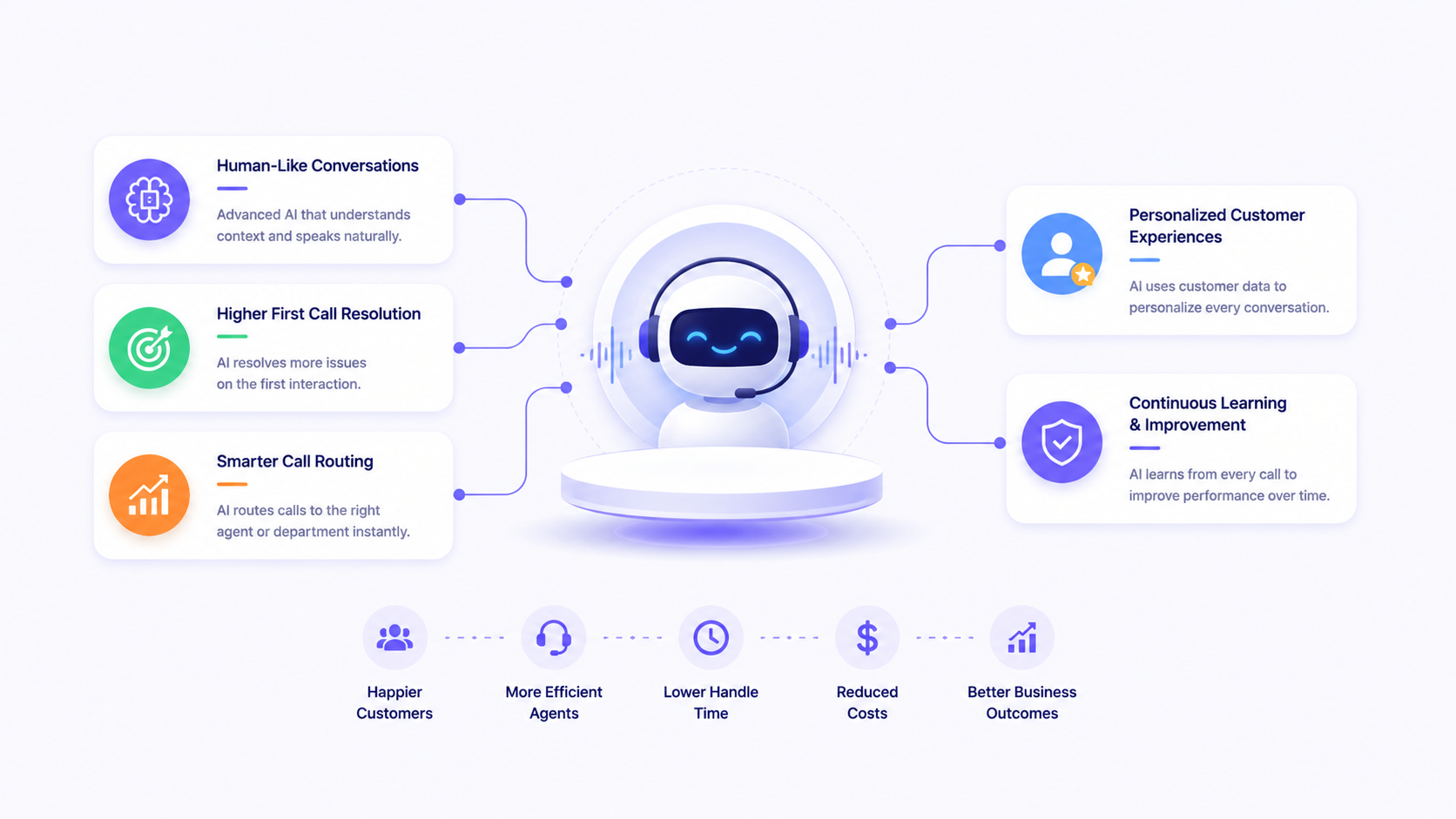
An AI voice call center catches what callers say in real time and works out what they actually want. It talks back in natural language without a stiff script running the show. It skips the menu maze and gets straight to sorting the callout immediately.
AI call center automation manages routing, responses, and live escalations without waiting for a human to step in. When a call needs an agent, it hands off instantly with every detail already waiting. Service runs day and night without shift gaps or patchy handoffs breaking things apart.
Every call handled makes the next one sharper and more accurate. The system does not sit at launch-day performance forever; real data keeps pushing it forward. That steady improvement draws a hard line between platforms that coast and ones that keep earning their place.
Live production volume finds every crack that a platform managed to hide during the demo. Latency and how responses sound to a real caller sort genuine performers from the crowd. Best Voice AI Call Center Providers hold up when volume spikes and conversations get messy simultaneously.
Strong platforms wire directly into existing CRMs and helpdesks without demanding a costly rebuild first. They chew through edge cases and mid-call direction changes without losing the plot. Real AI call center automation drops the rigid script model and responds to what callers actually say.
Blazeo earns its spot here because its conversation handling shifts on the fly naturally. It never defaults to the same tired recovery path when something unexpected lands. The strongest providers keep pushing performance forward long after the contract gets signed.
We built our AI voice call center around the real headaches that call centers wake up to daily. Calls go sideways constantly, and our approach to AI call center automation was shaped around that reality. When a conversation takes a hard turn, our system follows it naturally without stalling.
That flexibility pulls mid-call drop-offs down and cuts unnecessary escalations fast. Better containment, faster resolution, and lower cost per call follow directly from building this way. Every interaction stays on track because the platform responds to what callers genuinely say, not what a script hoped they would.

Inbound and outbound are two genuinely different problems that need different platform strengths. Inbound lives on containment rate, natural escalation paths, and real-time sentiment detection. Outbound runs on pacing, compliance handling, and personalization that holds up at scale.
Most AI call center companies sharpen their platform in one direction and stretch it to cover the other. That stretch shows up the moment real campaign volume or a compliance audit hits. Finding the best voice AI for outbound call automation means pressing vendors hard on pacing controls and consent verification.
|
Use Case |
Key Priority | What to Evaluate |
|
Inbound |
Containment rate |
Escalation logic, sentiment detection |
|
Outbound |
Compliance + pacing |
Personalization depth, call cadence |
| Both | Flexibility |
Unified platform vs. two separate tools |
Ask vendors directly about their inbound and outbound track record before shortlisting anyone. A provider that stumbles on that question is telling you something important. Their answer reveals exactly where their platform actually stands today.

Low latency is not a selling point; it is the baseline for any AI-powered call center under real load. When response time lags during peak volume, callers feel it, and containment rate drops fast. Every other feature becomes irrelevant if timing breaks when it matters most.
Top platforms connect to existing CRMs and helpdesks without months of custom development slowing things down. Real-time analytics and call-level reporting separate useful platforms from ones that look good in a deck. Multilingual support and consistent voice quality across accents matter more than most buyers think to ask about.
The Best Voice AI Call Center Providers focus on measurable outcomes rather than feature counts built for procurement checklists. A properly configured deployment at go-live looks different from the same platform ninety days in. That gap is where the strongest platforms separate themselves cleanly from everyone else.
Polished demos are built to impress, not to reflect real production conditions. Voice cloning guarantees, unlimited scalability claims, and instant setup timelines are what AI call center companies consistently oversell. When a vendor dodges peak-load performance questions, that silence tells you everything.
Outbound automation pitches carry their own specific warning signs worth catching early. Vague compliance language and manual do-not-call processes always land back on your team later. The best voice AI for outbound call automation handles pacing, consent, and scrubbing automatically inside the platform. If it doesn't, keep looking.

A structured pilot exposes what a vendor demo is specifically designed to hide. Demos use hand-picked scenarios under controlled conditions that never reflect real volume. Best Voice AI Call Center Providers welcome structured evaluations because their platforms hold up when conditions get uncomfortable.
Build your pilot around latency under load, containment rate, escalation accuracy, and failure recovery behavior. Never let vendors set the test parameters; your operation defines what success looks like. Running two AI-powered call center platforms side by side on real data cuts through every marketing claim fast.
Healthcare and finance deployments need compliance and data handling locked down before the pilot starts. Volume caps, overage triggers, and SLA exclusion language all need a hard look before signing. At Blazeo, we support structured pilot evaluations and give buyers transparent access to real performance data throughout the entire process.
The first thirty days are about the system finding its footing on your actual call types. Containment rate nudges up, and average handle time starts shrinking noticeably. The team begins seeing where the dead weight actually sat all along. Treat these as directional signals; the full payoff comes later.
By sixty days, the numbers stop fluctuating and start telling a readable story. CSAT scores move, cost per call drops, and escalation accuracy gets tight enough to trust. The best voice AI for outbound call automation hits measurable ROI faster at this point. The efficiency gains are straightforward to track and hard to argue with.
Bad data, rushed onboarding, and mismatched use cases quietly strangle results before ninety days arrive. Best Voice AI Call Center Providers stay involved with clients well past launch day. That ongoing presence after go-live separates deployments that keep climbing from ones that go flat fast.
Healthcare clicked early with AI voice call center deployments because the calls are predictable and high volume. Appointment reminders, after-hours triage, and prescription refill routing run on repeatable patterns. Voice AI handles these without pulling clinical staff off the floor. Compliance pressure also pushes operators toward platforms with built-in safeguards rather than manual gap-filling.
Financial services work the same angle across collections calls, account updates, and fraud alerts. These need to land fast and accurately every single time without exception. Retail and e-commerce point voice AI at order status, returns, and delivery issue calls. These interactions bury contact centers during every peak season without much warning.
Real estate and home services teams run it on lead qualification and automatic appointment booking. Agents never burn time on conversations that haven't earned their attention yet. Best Voice AI Call Center Providers shape platforms around how each vertical actually runs. The right provider walks in already knowing your industry, not just the size of your call queue.
Voice AI actually understands what callers say, no pressing 1 for billing, 2 for support. It reads intent on the fly, which is why containment rates improve almost immediately after go-live.
Realistically, 60 to 90 days for inbound. Outbound tends to show ROI faster since the number of calls handled and time saved are straightforward to track from day one.
Latency under real load, containment by call type, escalation accuracy, and how it recovers from failures. Run it on your actual volume demo conditions, which will always flatter the platform.
Healthcare, financial services, retail, and real estate tend to move fastest. High call volume, repetitive interaction types, and compliance pressure make the efficiency gains land harder to achieve in those sectors.
Inbound is about resolving calls without transferring them. Outbound adds compliance, pacing, and personalization at scale. Most vendors are stronger in one direction, worth confirming before you shortlist anyone.
Vague SLAs, inflated voice cloning claims, and suspiciously short setup timelines. If a vendor dodges questions about peak-load performance, that's your answer about whether they can handle production.
Pacing, consent checks, and DNC scrubbing should all run inside the platform automatically. If your team is still managing any of that manually, the architecture isn't where it needs to be.
Volume caps, overage triggers, what's actually excluded from the SLA, and how painful the exit clause is. Good providers write contracts around real production conditions, not optimistic projections.
Faster resolutions, lower costs, and reliable experiences across every call stop customers from walking out the door. These gains add up fast and quietly determine whether your operation grows or stays stuck. One weak deployment can set a call center back further than most teams expect.
Not every platform holds up when real call volume hits hard. How a system handles pressure, messy edge cases, and shifting demand tells you everything about the provider behind it. Most platforms reveal exactly what they are made of within the first few live weeks.
Best Voice AI Call Center Providers do not just automate calls; they change how every single customer interaction plays out. Judge providers on live production numbers and real client results, not a rehearsed demo built to impress.