 SmartHub
 Automation
 Appointment Scheduler
 Lead Management
 Dashboard & Reports
 Task Management
 Communications Hub
 Managed chat
 Voice Receptionist
 Appointment scheduling
 Retainer signing
 Home services
 Lawyers and firms
 Medical services
 College admissions
 Real estate agents
 Marketing agencies
 About
 Partner program
 Estimate Your ROI
 Case Studies
 Blog
 FAQs
 Login
After-Hours Leads Aren’t the Problem. What Happens to Them Next Is




Products
Industries
Company
Resources

A potential customer finds your business at 9:43 PM. They have a question, a problem to solve, and enough interest to reach out. They fill out a form, send a message, or call the number on your website.
Your system captures the inquiry. An automated response confirms that someone will be in touch. The lead is safely recorded.
And then nothing happens until the next morning.
By that point, the customer may have contacted two competitors, booked an appointment elsewhere, or simply moved on. Your business was technically available when they reached out, but that availability did little to help them take the next step.
This is where the conversation around after-hours lead management often falls short. Businesses have spent years trying to ensure they never miss an inquiry. They have invested in chatbots, answering services, online forms, and automated messaging to extend their availability beyond traditional working hours.
Those investments matter. But capturing an inquiry and moving it toward a meaningful outcome are two different things.
The real challenge isn't necessarily getting someone to answer at night. It's making sure the conversation doesn't lose momentum after that first interaction.
Consider a home services company receiving an inquiry on a Saturday evening. A homeowner reports that their air conditioner has stopped working. An automated system collects their name, phone number, address, and a brief description of the problem.
From a lead capture perspective, everything has worked.
But what happens next?
If the request sits in a general inbox until Monday, the business has collected information without responding to the urgency behind it. The homeowner wasn't simply looking to register interest. They needed to know whether someone could help, how soon assistance might arrive, and what they should do in the meantime.
This distinction matters because not every lead shows the same level of intent or urgency.
Someone downloading a brochure at midnight may be comfortable waiting until the next business day. Someone requesting emergency plumbing assistance probably isn't. A prospective patient asking about routine appointment availability has different expectations from someone trying to reach an on-call medical provider.
A system that treats all three inquiries identically may be efficient at recording demand, but ineffective at responding to it.
This is why 24/7 lead capture should be understood as the beginning of an after-hours workflow rather than its ultimate objective.
The question is no longer whether your business received the inquiry. It's whether the business knows what needs to happen because of it.
Speed has long been associated with stronger lead conversion, but the relationship deserves a closer look.
A widely cited study published in Harvard Business Review, based on research involving more than two million sales leads, found that companies attempting to contact potential customers within an hour were nearly seven times as likely to qualify them as those waiting even one hour longer.
The research predates today's conversational AI tools, but its underlying lesson remains relevant: delays can make it significantly harder to turn initial interest into a productive sales conversation.
However, responding quickly is not necessarily the same as responding effectively.
Imagine receiving an instant message that says, "Thank you for contacting us. Our team will respond during business hours."
The acknowledgment is immediate, but the customer still has no clearer understanding of what happens next.
Now consider a different interaction. The system recognizes the service being requested, asks two relevant questions, checks whether an appointment is available, and offers the customer a confirmed next step.
Both businesses responded quickly. Only one helped the customer make progress.
This is the difference between measuring response time and evaluating response quality.
For businesses looking to convert more after-hours inquiries, the more useful question is whether each interaction reduces uncertainty, establishes the customer's needs, and creates a clear path forward.
Also read: Why High-Intent Leads Go Cold in Under 24 Hours

One of the biggest missed opportunities in after-hours lead management is postponing qualification until a human representative becomes available.
Traditional workflows often separate lead capture from lead assessment. A form collects basic contact details, and a sales or service representative later determines whether the inquiry is relevant, urgent, or worth pursuing.
That separation creates unnecessary delays, especially when the initial conversation could have gathered enough information to determine an appropriate next step.
Consider a law firm receiving several inquiries overnight. One prospective client wants to understand whether the firm handles employment disputes. Another is looking for an update on an existing case. A third has a time-sensitive legal concern that may require prompt review.
These conversations shouldn't enter the same queue without distinction.
An effective intake process can establish the nature of each inquiry, collect appropriate preliminary details, identify existing-client requests, and flag matters requiring attention. For legal intake, it must also respect confidentiality, avoid unauthorized legal advice, and follow the firm's conflict-checking and escalation procedures.
The objective isn't to replace professional judgment. It's to make sure the right information is available when that judgment is needed.
The same principle applies across industries.
A property management company might need to distinguish a prospective tenant asking about availability from an existing resident reporting an urgent maintenance issue. A healthcare practice may need to separate routine scheduling from situations that should be directed to an approved clinical triage process.
Qualification becomes valuable when it changes what happens next.
Solutions such as Blazeo can support this approach by connecting conversational intake with the operational steps that follow. The important consideration is not simply how much information an automated interaction can collect, but whether that information helps the business make an appropriate decision.
Once an inquiry has been qualified, it needs somewhere meaningful to go.
This sounds straightforward, yet routing is often where after-hours workflows break down.
A business may have separate teams for sales, scheduling, customer support, and urgent service requests. During working hours, employees can compensate for unclear processes by forwarding messages, asking colleagues for help, or manually assigning inquiries.
After hours, those informal workarounds are less reliable.
An inquiry might reach the wrong inbox. A high-priority request may be grouped with routine messages. A lead may be assigned to someone unavailable, with no backup process to move it forward.
The problem isn't always a lack of staff. Sometimes it's a lack of decision-making built into the workflow.
Effective routing requires the system to understand more than where a message originated. It should account for the nature of the request, the customer's location, the relevant service, the urgency involved, and the team's availability.
Take a multi-location dental practice. Route an inquiry about a routine cleaning to scheduling at the preferred branch. A billing question belongs with administration. A report of severe pain or swelling may require an approved urgent-care escalation message rather than being treated as an ordinary booking request.
These distinctions matter because routing determines whether the customer reaches the right next step without having to explain everything again.
They also reduce the burden on employees returning to work the following morning.
Instead of sorting through an undifferentiated collection of overnight inquiries, teams can start with conversations already categorized, documented, and assigned according to clear rules.
Also read: Your Best Leads Aren’t Always the Ones Who Respond First
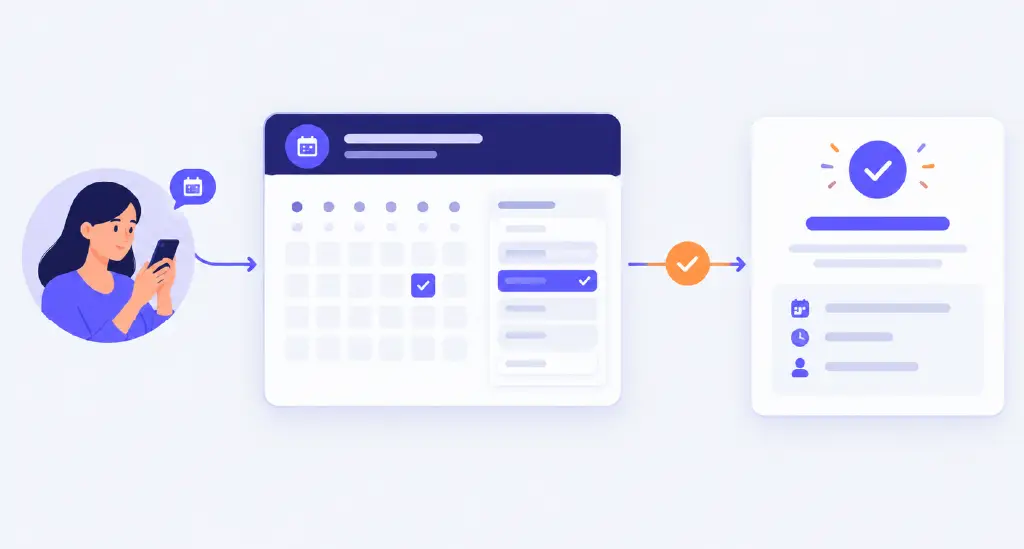
There is a meaningful difference between a customer saying they would like an appointment and a customer actually having one.
For appointment-driven businesses, scheduling is often the point where after-hours interest becomes a concrete commitment.
Imagine a prospective customer contacting a cleaning company at 10 p.m. to arrange a home visit. The business captures the request and promises a callback the following morning.
The customer then visits another company's website, sees an available appointment, and books it.
 n.
The first company didn't necessarily lose the opportunity because it was unavailable. It lost the opportunity because the customer couldn't complete the action they wanted to take.
This is where scheduling integrations can make a substantial difference.
When an after-hours interaction can access current availability, apply booking rules, and confirm an appropriate appointment, the customer doesn't need to wait for someone to manually coordinate the details.
The process should also account for practical constraints. A business may need to limit appointments by location, staff availability, service duration, or eligibility. A consultation may require preliminary qualification before a slot can be offered.
Without those checks, automated scheduling can create more problems than it solves.
A confirmed booking that the business cannot honor damages trust. An appointment made without the necessary information may require additional work or rescheduling.
The goal is therefore not to automate every booking indiscriminately. It's to make scheduling available when the system has enough reliable information to complete it correctly.
For organizations evaluating Blazeo's scheduling and conversational automation capabilities, this is an important distinction: the value lies in helping customers complete the next step, not merely giving them another channel through which to request it.
Automation is useful when it handles predictable tasks reliably. It becomes a liability when it continues a conversation that requires human judgment, reassurance, or intervention.
An after-hours answering service should therefore be able to recognize its own limits.
A customer describing an unusual billing dispute may need a representative who can review the account. A caller dealing with a sensitive legal matter may require a trained intake specialist. Someone reporting an urgent property maintenance problem may need an on-call technician rather than another automated message.
In each case, the system must recognize when ordinary intake is no longer sufficient.
This requires escalation rules that are defined before the conversation takes place. Businesses need to decide which situations warrant immediate attention, who receives those requests, what information accompanies the handoff, and what happens when the designated person is unavailable.
A particularly important detail is the failed escalation.
Suppose an automated system identifies an urgent service request and attempts to transfer it to an on-call employee. The employee doesn't answer. Does the system try a backup contact? Does it explain the situation to the customer? Does it flag the request for immediate review?
Without a fallback, escalation can become another dead end.
Blazeo's hybrid Voice AI approach combines automated call handling with human-agent support for conversations that need it. This reflects an important operational principle: automation should handle what it can reliably resolve and make human assistance accessible when necessary.
The strongest after-hours workflows aren't necessarily the ones that automate the most conversations. They're the ones that know which conversations should not remain automated.
Also: Automation Should Remove Work - Not Create More of It
Not every after-hours inquiry can be resolved immediately.
Some customers need a detailed quotation. Others require approval, a specialist consultation, or information that isn't available until the next working day.
In these situations, lead follow-up automation can help preserve momentum, provided it does more than send generic reminders.
Consider a prospective customer who contacts a renovation company on Sunday evening. They explain that they want to remodel their kitchen, share an approximate budget, and indicate that they hope to begin within three months.
The system captures the conversation and arranges a consultation request.
On Monday, a sales representative calls and asks, "So, what kind of work are you looking to have done?"
The customer now has to repeat information they already provided.
This is a small but revealing failure. The business captured the conversation but didn't carry its context into the next interaction.
A more effective workflow would make the customer's requirements, previous responses, and agreed next steps available to the representative. The follow-up could then begin with a relevant discussion about the project rather than another round of basic questions.
It should also distinguish between leads that require different kinds of follow-up.
A customer who has already booked an appointment may benefit from a confirmation or reminder. Someone awaiting a quotation needs an update on when to expect it. A prospect who abandoned a scheduling conversation might appreciate an opportunity to complete the booking.
Sending all three the same automated message would ignore the progress each has already made.
The timing and frequency of communication matter, too. Follow-up should respect customer preferences, applicable consent requirements, and reasonable contact hours. Automation that repeatedly contacts someone without adding value can undermine the trust the original conversation established.
The purpose is continuity, not simply more communication.

For many businesses, Monday morning reveals whether their after-hours processes actually worked.
A team might return to dozens of weekend inquiries spread across voicemail, website chat, email, social media, and contact forms.
If those interactions are disconnected, employees spend the first part of their day reconstructing what happened.
They listen to recordings, read messages, check calendars, identify duplicate inquiries, and determine which customers still need assistance.
That administrative effort has a cost beyond the time it consumes. While employees organize yesterday's demand, new inquiries continue arriving.
A connected after-hours workflow changes the starting point.
The team should be able to see which customers received answers, which appointments were confirmed, which conversations were escalated, and which opportunities still require action.
Just as importantly, someone should own every unresolved next step.
A lead marked as qualified but assigned to nobody is still at risk. A callback scheduled without a responsible employee may never happen. An escalation recorded as attempted but not completed needs further attention.
This is where connected lead management becomes especially valuable.
Blazeo's SmartHub and lead management capabilities bring intake, scheduling, and lead tracking into a more connected process, helping businesses maintain visibility across conversations and their outcomes.
For the morning team, that means the opportunity to begin with action rather than investigation.
Businesses frequently evaluate after-hours services by the number of calls answered, conversations handled, or leads collected.
Those figures establish whether the service is being used, but they reveal relatively little about whether it is improving business outcomes.
A company might capture 100 inquiries over a weekend and celebrate its availability. Yet if only a small proportion receive an appropriate next step, the headline number offers an incomplete picture.
A more useful evaluation follows the inquiry through its lifecycle.
How many leads were successfully qualified? How many received confirmed appointments? How often did urgent requests reach the right person? How many follow-ups happened as promised? Which inquiries remained unresolved when the team returned?
These questions connect activity to operational performance.
They also help identify where improvements are needed. If a business receives plenty of qualified inquiries but few confirmed appointments, scheduling may be the bottleneck. If appointments are booked but customers frequently fail to attend, confirmation and reminder processes deserve attention.
And if high-priority leads are consistently left unresolved, the issue may be ownership or escalation rather than initial response speed.
A 2011 study published in Harvard Business Review illustrates why this distinction matters. Researchers audited 2,241 U.S. companies and found that 23% never responded to a test web inquiry. Among those that responded within 30 days, the average response time was 42 hours. While the study focused on response times rather than actual conversions, its findings highlight how easily potential opportunities can be lost when businesses lack an effective follow-up process.
Modern businesses have more tools to prevent that outcome. What matters is whether those tools are configured around measurable progress rather than the appearance of constant activity.
A business doesn't need every after-hours inquiry to become an immediate sale. Some conversations will require time, human involvement, or additional information before they can progress.
But every legitimate inquiry should have a clear and appropriate next step.
That may mean confirming an appointment, transferring an urgent request, collecting information for a quotation, or assigning a follow-up to the right person.
The outcome will vary. The need for continuity doesn't.
This is ultimately what effective after-hours lead management should accomplish. It should connect the moment someone reaches out with the decisions, people, and systems needed to move their request forward.
Being available around the clock is useful. Making that availability productive is what creates value.
Blazeo helps businesses go beyond 24/7 answering with AI-powered and human-supported conversations, lead qualification, appointment scheduling, and connected follow-up workflows.
Explore Blazeo and request a demo to see how your business can turn after-hours inquiries into meaningful next steps, without leaving every opportunity waiting for the next working day.

