 SmartHub
 Automation
 Appointment Scheduler
 Lead Management
 Dashboard & Reports
 Task Management
 Communications Hub
 Managed chat
 Voice Receptionist
 Appointment scheduling
 Retainer signing
 Home services
 Lawyers and firms
 Medical services
 College admissions
 Real estate agents
 Marketing agencies
 About
 Partner program
 Estimate Your ROI
 Case Studies
 Blog
 FAQs
 Login
Best Legal Intake Software and Services in 2027: 10 Options Ranked by Speed-to-Lead




Products
Industries
Company
Resources

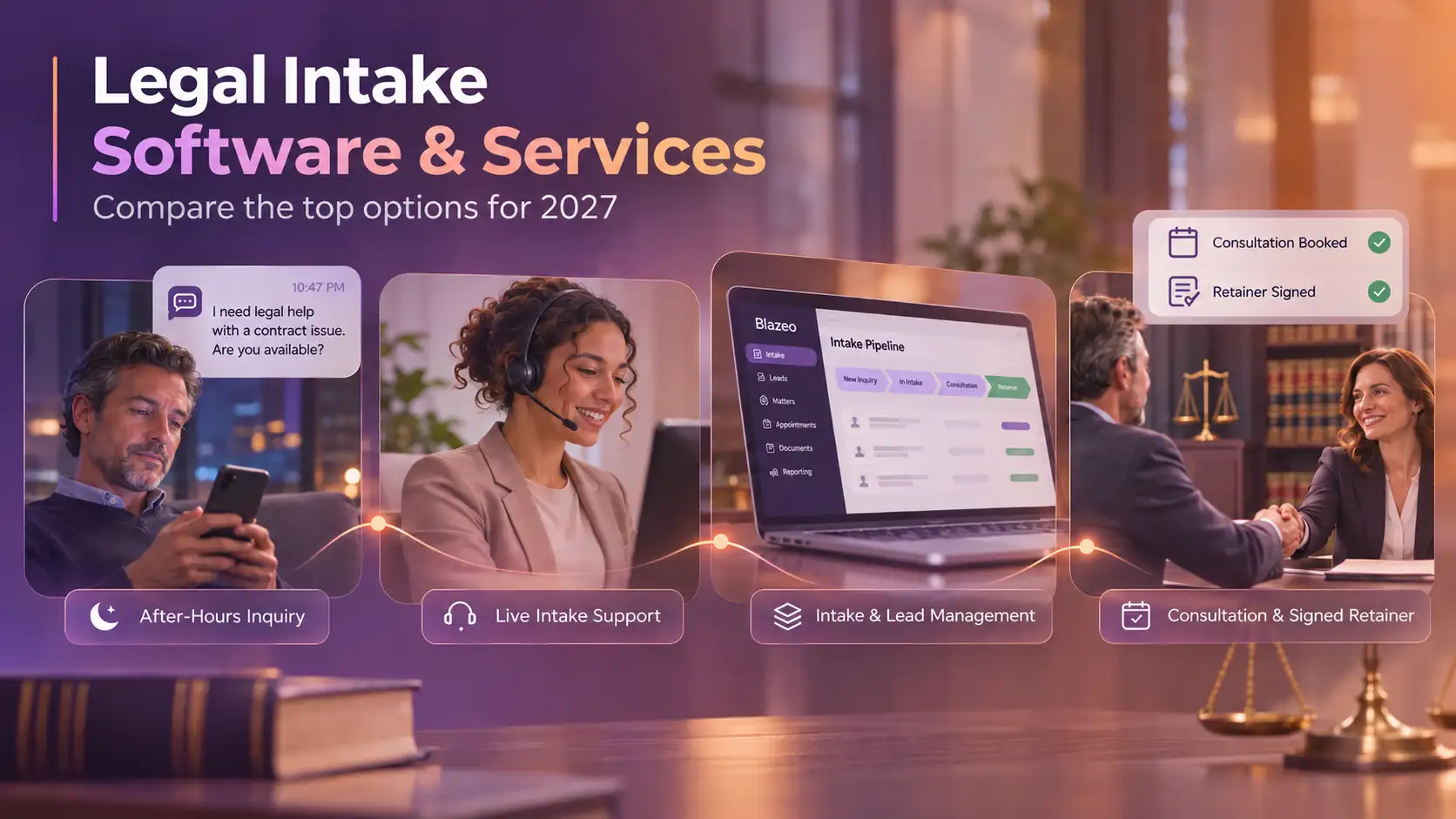
A potential client who fills out your website form at 9:47 p.m. is usually filling out two or three other firms' forms too. The firm that responds first, with a real conversation, tends to sign the case. That is why legal intake software and legal intake services matter more than almost any other line in a law firm's marketing budget: they decide whether paid leads become retained clients.
The trouble is that "intake" covers three very different things. Some products are software your staff uses to track and follow up on leads. Some are services where trained people answer your calls and chats around the clock. A growing number are hybrids that pair AI with live agents. This guide compares 10 options across all three, ranked by the one thing every firm cares about: how quickly and completely each one turns an inquiry into a qualified lead, including at 2 a.m.
Disclosure: This guide is published by Blazeo, which appears on this list. We've explained exactly how we ranked each option below so you can apply the same criteria yourself.
| If your firm is… | Start with | Why |
|---|---|---|
| A personal injury or high-volume firm that runs ads around the clock | Blazeo | 24/7 live agents on every channel, plus booking, retainer signing and follow-up automation |
| A small firm that mostly needs phone coverage | Smith.ai, Ruby, or Answering Legal | Legal-trained receptionists, simple per-call or per-minute plans |
| Running a mass tort or TV campaign | Alert Communications | Large legal-only call center built for volume spikes |
| Already on Clio, Filevine, or Lawmatics | Your platform's intake module plus a 24/7 front line | Software organizes leads; it doesn't answer them after hours |
Before comparing vendors, it helps to know which kind of tool you actually need. Most firms that are unhappy with intake bought the wrong category, not the wrong vendor.
| Intake software (CRM) | Intake services (people) | Hybrid (AI + people) | |
|---|---|---|---|
| What it does | Tracks leads, sends forms and e-signatures, automates follow-up | Trained agents answer calls and chats, qualify, and book consults | AI handles routine inquiries instantly; live agents take complex or emotional ones |
| Who responds to a 2 a.m. lead | An automated text or email, unless your staff is awake | A live agent | AI immediately, with a live agent when needed |
| Examples | Lawmatics, Clio Grow, Lead Docket, Captorra | Alert Communications, Ruby, Answering Legal | Blazeo, Smith.ai, Intaker (AI agents) |
| Typical pricing | Per user or per firm, monthly | Per call, per minute, or per lead | Mixed; often per lead or per conversation |
| Biggest risk | Fast tracking of leads nobody called back | Inconsistent quality across agents | Poor handoff between AI and humans |
Many firms end up with two layers: a CRM such as Clio Grow or Lawmatics to manage the pipeline, and a 24/7 service or hybrid in front of it so no inquiry waits until morning. Most of the services below integrate directly with those CRMs.
We scored each option on five criteria, weighted toward what most affects signed cases:
Because speed-to-lead carries the most weight, services and hybrids that respond 24/7 rank above software that relies on your team to respond. That isn't a judgment on software quality: several CRMs below are excellent, and many firms should use one alongside a service. Vendor details come from each company's published materials and third-party review sites as of November 1, 2026.
| # | Option | Type | 24/7 live response | Channels | Pricing model |
|---|---|---|---|---|---|
| 1 | Blazeo | Hybrid service + intake platform | Yes | Chat, phone, SMS, social, LSA | Quote; app listings from $49/mo |
| 2 | Smith.ai | Hybrid service | Yes | Phone, chat | Per call; AI and human plans |
| 3 | Alert Communications | Service (call center) | Yes | Phone, chat, text | Quote |
| 4 | Ruby | Service | Yes | Phone, chat | Per minute; chat per bundle |
| 5 | Answering Legal | Service | Yes | Phone | Per minute, month-to-month |
| 6 | Intaker | Software + AI agents | AI only | Chat, SMS, phone, LSA, social | Per user (about $80/user/mo reported) |
| 7 | Lawmatics | Intake CRM | No | Forms, email, SMS | Quote |
| 8 | Clio Grow | Intake CRM | No | Forms, email, booking | Bundled in Clio's top tier |
| 9 | Lead Docket (Filevine) | Intake CRM | No | Forms, tracking | From $300/mo reported |
| 10 | Captorra | Intake CRM | No | Scripts, e-sign, tracking | Quote |
Best for: Personal injury and other high-volume firms that want one partner to respond to, qualify, book, sign, and follow up with every lead, on every channel, 24/7.
Blazeo (formerly ApexChat) is the most complete option on this list. It pairs 24/7 live agents trained in legal intake with AI, and wraps them in an intake platform that handles booking, signing, and follow-up. Instead of stitching together a chat vendor, an answering service, a texting tool, and an automation platform, a firm gets the whole front end of intake from one provider.
Strengths: Live humans and AI on every channel including LSA, booking and retainer signing inside the conversation, built-in follow-up and workflow automation, legal-specific qualification, CRM integrations.
Gaps: Blazeo is not a practice management system, so billing, matter management, and documents stay in tools like Clio or Filevine, which it connects to.
Pricing model: Quoted based on lead volume and services; app directory listings (such as Clio's) show plans starting at $49/month.
Best for: Small and mid-size firms that mainly need phone coverage, with a choice between AI, human, or hybrid answering.
Smith.ai sells AI-only, hybrid, and fully human receptionist plans, plus live chat. It says more than 5,000 law firms use it and offers practice-area intake flows for personal injury, family, criminal defense, estate planning, immigration, and employment law. Receptionists can run conflict checks, book consultations, and call back web-form leads, and the service integrates with Clio, MyCase, and Lawmatics.
Strengths: Flexible AI/human mix, strong legal focus, bilingual agents, outbound callbacks on form leads.
Gaps: Per-call pricing can climb quickly for firms with high call volume; chat and phone are separate products.
Pricing model: Per call. Third-party reviews in 2026 cite human receptionist plans starting around $300/month for 30 calls, with cheaper AI plans.
Best for: Mass tort, personal injury, and firms running TV or radio campaigns that create sudden call spikes.
Alert Communications is a legal-only call center founded in 1965, based in Camarillo, California, with a team of more than 400 people. It handles bilingual intake across personal injury, medical malpractice, immigration, and mass tort, and offers retainer e-signing, outbound campaigns, and live chat and text. It is part of EverService, alongside brands such as Nexa and Client Chat Live.
Strengths: Scale, deep mass tort experience, bilingual coverage, retainer services.
Gaps: Built for volume; smaller firms may find it more than they need. Pricing is not fully published.
Pricing model: Quote based on volume.
Best for: Small firms that want a live person on every call and website chat, with a polished, front-desk feel.
Ruby has offered US-based virtual receptionists since 2003 and pairs them with managed live chat. Both run 24/7/365. Receptionists answer with the firm's greeting, transfer calls, take messages, follow the firm's intake script, schedule appointments, and can handle outbound calls. Ruby integrates with Clio, Filevine, Lawmatics, MyCase, and Rocket Matter.
Strengths: Live humans on phone and chat around the clock, strong reputation for caller experience, broad legal software integrations.
Gaps: Spanish-speaking and outbound support are not available around the clock; no texting, social, or LSA coverage; per-minute costs add up for busy lines.
Pricing model: Per minute for reception, reported from about $250/month for 50 minutes; chat sold in bundles, reported from $140/month for 10 chats.
Best for: Solo and small firms that want a legal-only phone answering service with no contract.
Answering Legal answers calls only for law firms, 24/7, in English and Spanish. Every plan includes full legal intake scripts, appointment scheduling, call transfers, and CRM integrations with tools such as Clio Grow, Lawmatics, PracticePanther, MyCase, and Smokeball. It also positions itself as overflow coverage that picks up when your office misses a call.
Strengths: Legal-only focus, all features in every plan, month-to-month terms, free trial.
Gaps: Phone only, so website chat and text need another tool.
Pricing model: Per minute, month-to-month, with a free trial.
Best for: Firms that want software-driven website chat and texting with AI agents and have staff to take over qualified leads.
Intaker is an intake automation platform that brings website chat, two-way SMS, phone, WhatsApp, Facebook, and Google Local Services Ads leads into one hub. It offers video-first chat, AI agents trained on legal intake, automated follow-up sequences, and a "live call connect" feature that moves a chat into a phone call. It is reported to serve more than 2,000 law firms.
Strengths: Broad channel coverage, strong automation, LSA support, ISO 27001 certification.
Gaps: AI handles first contact; complex or emotional conversations still depend on your staff being available.
Pricing model: Per user; third-party sources report about $80/user/month.
Best for: Firms that want intake, marketing automation, and pipeline reporting in one legal CRM.
Lawmatics is a legal CRM covering intake forms, e-signature, automated nurture campaigns, appointment scheduling, and reporting on lead sources and conversion. It integrates with many front-line services, including Blazeo, Smith.ai, and Answering Legal, so leads and transcripts land in one pipeline.
Strengths: Deep automation, strong reporting, wide integration list.
Gaps: Software, not a response team; reviewers mention a learning curve for setup.
Pricing model: Custom pricing through sales.
Best for: Firms already running Clio Manage.
Clio Grow is Clio's intake and CRM product, covering online intake forms, lead tracking, consultation booking, and e-signature before a matter moves into Clio Manage. In Clio's 2026 lineup it is bundled into the top tier (renamed from Complete to Expand), and a large app directory connects it to chat and answering services.
Strengths: Seamless handoff into Clio Manage, one vendor for intake and practice management.
Gaps: Intake features are gated to the top tier; no live response to after-hours leads on its own.
Pricing model: Per user; bundled into Clio's top tier.
Best for: Personal injury firms on Filevine that want intake-to-case analytics.
Lead Docket, now Filevine's intake and lead tracking product, offers custom intake forms, lead scoring, AI lead summaries, document automation with e-signature, and conversion reporting by marketing source. Leads move into Filevine case management without re-entry.
Strengths: Strong analytics and lead scoring, tight Filevine integration.
Gaps: Reviewers note it suits larger firms best; it relies on your staff or a separate service to respond.
Pricing model: Reported to start at $300/month.
Best for: Personal injury and mass tort firms that need structured intake scripts and sign-up tracking.
Captorra is an intake and lead management system built for personal injury and mass tort, also used in bankruptcy, criminal defense, and immigration. It provides intake scripts, process automation, e-signature, tracking of physical sign-up packages, referral management, and marketing reporting.
Strengths: PI and mass tort focus, referral management, custom fields.
Gaps: Smaller integration list; some reviewers report sync issues with case management systems.
Pricing model: Quote.
Legal intake software is the system a law firm uses to capture, qualify, and track prospective clients before they become matters. It usually includes intake forms, lead tracking, follow-up automation, and e-signature. It does not, on its own, respond live to new inquiries; that is the job of your intake staff or an intake service.
Software organizes and automates the intake process for your team. A service provides the people (and often AI) who actually answer calls and chats, qualify leads, and book consultations, typically 24/7. Many firms use both.
Intake CRMs typically charge per user or per firm, from under $100 to several hundred dollars a month. Intake services usually charge per call, per minute, or per lead, so cost scales with volume. Ask each vendor for pricing at your expected monthly lead count.
AI can respond instantly, collect structured information, and handle routine inquiries. It must not give legal advice, and many callers, especially after an accident or arrest, want a person. Most firms get the best results from AI backed by live agents.
Speed-to-lead is the time between a prospective client's first inquiry and a meaningful response. Prospective clients often contact several firms at once, so the first firm to respond with a real conversation has a major advantage in signing the case.
If your intake problem is organization, a CRM like Lawmatics, Clio Grow, or Lead Docket will fix it. If your problem is leads going cold before anyone talks to them, you need a front line that responds around the clock on every channel. And if you want both without managing several vendors, choose a provider that answers live and books, signs, and follows up automatically, then connects to the CRM you already use.

