 SmartHub
 Automation
 Appointment Scheduler
 Lead Management
 Dashboard & Reports
 Task Management
 Communications Hub
 Managed chat
 Voice Receptionist
 Appointment scheduling
 Retainer signing
 Home services
 Lawyers and firms
 Medical services
 College admissions
 Real estate agents
 Marketing agencies
 About
 Partner program
 Estimate Your ROI
 Case Studies
 Blog
 FAQs
 Login
8 Lead Conversion Metrics Every Business Should Track in 2027




Products
Industries
Company
Resources

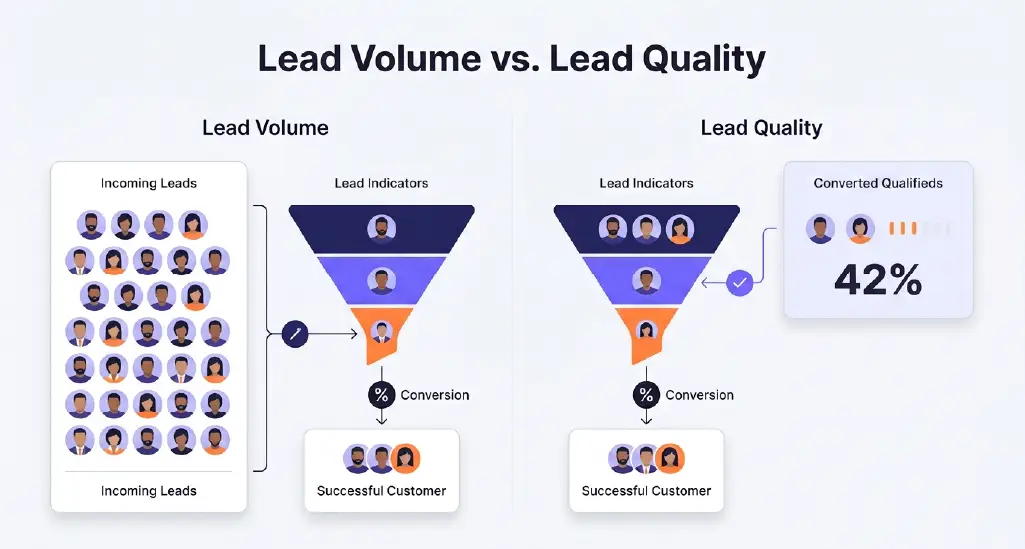
Generating leads is often treated as the clearest indication that a business's marketing efforts are working. More website inquiries, phone calls, form submissions, and campaign responses suggest that potential customers are interested. But interest alone does not generate revenue, and a growing list of leads does not necessarily mean a growing customer base.
Consider two businesses running similar marketing campaigns. Both generate 500 inquiries in a month. The first celebrates the volume of incoming leads but has little visibility into what happens after someone makes contact. The second tracks how quickly those inquiries receive a response, how many prospects are reached, how many qualify, and how many eventually become paying customers.
At the end of the month, the first business can report how many leads it generated. The second can explain how effectively those leads contributed to revenue, where opportunities were lost, and what needs to improve.
That distinction is becoming increasingly important as businesses prepare for 2027. Customers can discover providers, compare alternatives, and initiate conversations across multiple channels. Meanwhile, marketing and sales teams have access to more data than ever, yet much of it remains disconnected from the outcomes that matter.
The challenge is no longer simply collecting information. It is identifying which measurements reveal meaningful progress.
Lead conversion metrics help businesses understand the journey between an initial inquiry and a completed sale. When tracked consistently, they expose weaknesses in responsiveness, qualification, scheduling, follow-up, and acquisition efficiency.
The following eight metrics offer a practical framework for evaluating that journey and improving the decisions that shape it.

A potential customer fills out a contact form requesting a quotation. They receive an automated acknowledgment immediately, but a sales representative does not reach out until the following afternoon.
Technically, the business responded. From the customer's perspective, however, the actual conversation began much later.
Lead response time measures the interval between an inquiry entering the business and the first meaningful attempt to engage that prospect. It is one of the most revealing lead management KPIs because it shows whether marketing-generated interest is receiving timely attention.
The distinction between an automated confirmation and a meaningful response matters. A message saying that someone will be in touch does not necessarily answer the customer's question, establish their requirements, or move the conversation forward.
Research published in Harvard Business Review, based on an analysis of 1.25 million sales leads received by US companies, found that businesses attempting to contact potential customers within an hour were nearly seven times as likely to qualify those leads as businesses that waited even an hour longer. Although the research predates today's AI-powered communication tools, it highlights the longstanding commercial importance of acting while customer interest is still fresh.
Lead response time is calculated by subtracting the time an inquiry was received from the time the first qualifying response or contact attempt occurred.
For example, if a customer submits an inquiry at 10:00 a.m. and receives a meaningful response at 10:18 a.m., the response time is 18 minutes.
Businesses should monitor both median response time and the percentage of inquiries answered within an established service target. The median helps describe a typical experience, while service-target performance reveals how reliably the business responds on time.
Response times should also be evaluated separately for working hours, evenings, weekends, and different inquiry channels. A business that responds quickly during office hours but leaves weekend inquiries untouched until Monday may have a significant operational blind spot.
This is where automated lead acknowledgment, intelligent routing, and AI-powered communication can help. Solutions such as Blazeo's Voice AI can support incoming conversations and capture information when staff is unavailable, while connected workflows help ensure inquiries are directed toward an appropriate next step.
The objective is not merely to respond faster. It is to reduce the time between customer interest and useful engagement.
Also read: Lead Response Time vs Conversion Rate: What Businesses Should Measure
A business may respond to every inquiry and still struggle to connect with prospective customers.
Calls go unanswered. Emails remain unopened. Messages arrive at inconvenient times. Some prospects provide incomplete contact information, while others lose interest before a representative reaches them.
This creates a critical distinction between attempting contact and successfully establishing it.
Contact rate measures the percentage of leads with whom a business establishes meaningful two-way communication. It helps determine whether the leads entering the sales process are actually accessible and engaged.
Contact rate = (Leads successfully contacted ÷ Total leads) × 100
Suppose a business receives 400 leads and successfully establishes conversations with 260 of them.
Its contact rate is 65%.
The remaining 35% represents a mixture of missed opportunities, unreachable prospects, invalid contact details, and individuals who may no longer be interested. Without examining those reasons, the business cannot determine whether the problem originates in lead quality or the way inquiries are handled.
A low contact rate can point to several operational issues. Representatives may be calling at unsuitable times, relying too heavily on one communication channel, or failing to make appropriate additional attempts after an unanswered call.
For example, a home services company might receive inquiries from homeowners during their working day. If its team calls only during standard office hours, many prospects may be unavailable. Offering an opportunity to schedule a callback or continue the conversation through another preferred channel could make engagement easier.
CRM analytics can make these patterns visible by connecting contact attempts, communication channels, outcomes, and timestamps to individual lead records.
Rather than simply reporting how many calls were made, businesses can identify which outreach methods produce actual conversations.
A useful contact rate is not about increasing the number of attempts indefinitely. It is about making each attempt more relevant, timely, and respectful of the customer's preferences.
Not every inquiry represents an immediate sales opportunity.
Someone downloading a resource may be researching a problem. Another prospect may be comparing prices without a defined purchase timeline. A third may be ready to proceed but require confirmation that the business can meet a specific requirement.
Treating all three prospects identically can waste sales capacity and create frustrating customer experiences.
Lead qualification rate measures the proportion of leads that meet a business's established criteria for becoming genuine sales opportunities.
Lead qualification rate = (Qualified leads ÷ Leads assessed for qualification) × 100
If a business evaluates 300 leads and determines that 120 meet its qualification criteria, its qualification rate is 40%.
The calculation is straightforward, but the definition of a qualified lead requires careful consideration.
For a business-to-business software provider, qualification may depend on company size, operational requirements, purchasing authority, budget, and implementation timeline. For a home renovation company, it may involve service location, project scope, budget expectations, and readiness to begin.
These criteria should reflect the realities of the business rather than an arbitrary scoring system.
A high qualification rate can indicate effective audience targeting and messaging, but it is not automatically evidence of superior performance. Qualification criteria that are too broad may inflate the figure, while overly restrictive criteria may exclude prospects who could become valuable customers later.
The most useful approach is to establish clear definitions and review them against eventual sales outcomes.
Connected CRM systems help businesses compare qualification decisions with downstream results. If a particular marketing campaign generates a large number of inquiries but very few qualified opportunities, the issue may be the campaign's targeting or the expectations created by its messaging.
Conversely, a smaller campaign attracting prospects with clear requirements and purchasing intent may produce substantially greater commercial value.
Automated intake workflows can support this process by collecting relevant information before a representative takes over. However, automation should help identify the right next step, not dismiss prospects simply because they are not ready to purchase immediately.
In 2027, businesses that understand the difference between lead quantity and lead suitability will be better positioned to allocate their sales resources effectively.
For businesses that depend on consultations, demonstrations, assessments, or service appointments, booking represents an important transition in the customer journey.
A prospective customer has moved beyond asking a question and agreed to a specific next step.
Yet this transition is not always seamless.
Imagine a customer contacting a dental clinic to inquire about a consultation. The receptionist explains the available services but asks the customer to call again later to confirm an appointment. The customer intends to do so, but the conversation ends without a booking.
The inquiry was handled, but the opportunity did not progress.
Appointment booking rate measures the percentage of eligible leads that successfully schedule an appointment.
Appointment booking rate = (Leads that book an appointment ÷ Appointment-eligible leads) × 100
If 150 leads are eligible for consultations and 90 schedule an appointment, the booking rate is 60%.
Using appointment-eligible leads as the denominator is important. Including inquiries that do not require appointments can make the metric misleading.
A low booking rate may indicate scheduling friction rather than a lack of customer interest. Customers may be offered inconvenient time slots, experience delays in receiving availability, or encounter unnecessary steps between their initial inquiry and booking confirmation.
A professional services firm, for instance, might receive strong interest in introductory consultations but lose prospects because appointment requests require several emails before a mutually suitable time is confirmed.
Connecting communication tools with scheduling systems can reduce this friction. Businesses can offer available slots, record customer preferences, send confirmations, and ensure the appointment is reflected in the CRM without relying on repeated manual updates.
For organizations handling substantial inquiry volumes, Blazeo's AI-powered customer communication and scheduling capabilities can help create a more consistent path from initial contact to appointment booking.
The broader lesson is that a conversation should not be considered successful simply because information was exchanged. Where an appointment is the intended next step, the business should understand whether that step actually happened.
Also read: Appointment Setting Service Cost: Per Appointment vs Subscription
Securing an appointment is encouraging, but the booking itself does not guarantee that a meaningful sales conversation will take place.
Customers forget appointments, encounter scheduling conflicts, or change their minds. Sometimes they never receive clear confirmation of the date, time, or location. In other cases, the business fails to communicate what the appointment involves or what the customer should prepare.
These seemingly minor gaps can affect the entire sales process.
Appointment attendance rate measures the percentage of scheduled appointments that customers actually attend.
Appointment attendance rate = (Appointments attended ÷ Scheduled appointments due) × 100
If a business has 100 appointments scheduled to take place during a month and 78 customers attend, its attendance rate is 78%.
The remaining 22 appointments represent more than unused calendar slots. They may involve wasted staff capacity, missed revenue opportunities, and additional administrative work.
Consider a financial advisory firm that schedules introductory consultations. Its marketing campaigns generate a steady flow of appointments, but nearly a quarter of prospective clients fail to attend.
Without tracking attendance, the firm might conclude that its acquisition strategy is performing well because the calendar remains full. In reality, its advisors are spending valuable time preparing for meetings that never happen.
Understanding the reasons behind missed appointments is essential.
A customer who cancels in advance and reschedules should not be treated the same as someone who fails to appear without notice. Businesses should therefore distinguish completed appointments, cancellations, rescheduled meetings, and no-shows within their CRM records.
Automated confirmations and reminders can help reduce avoidable scheduling problems. However, reminders should communicate useful information rather than simply repeat that an appointment exists.
A confirmation might include the appointment's purpose, expected duration, location or meeting link, and an easy way to reschedule.
The timing of reminders should also reflect the nature of the service. A medical consultation, property viewing, and software demonstration may require different preparation and communication.
Tracking appointment attendance alongside booking rates allows businesses to distinguish scheduling success from actual customer participation.
A business with an 80% booking rate but a 50% attendance rate may need to improve its confirmation process before investing in additional lead generation.
Many purchasing decisions require more than one interaction.
A prospective customer may need to consult a family member, review a quotation, compare alternatives, or wait until a particular project becomes financially feasible.
A business that interprets this delay as disinterest risks abandoning a potentially valuable opportunity. But repeatedly contacting someone without considering their circumstances can be equally counterproductive.
Effective follow-up depends on understanding what the customer needs next.
Follow-up effectiveness measures how successfully subsequent outreach moves existing leads toward a defined outcome, such as booking an appointment, providing requested information, advancing to the next sales stage, or completing a purchase.
Follow-up progression rate = (Leads that advance after follow-up ÷ Leads receiving follow-up) × 100
For example, a sales team follows up with 200 prospects who previously expressed interest but had not committed to a next step. If 50 subsequently progress to a consultation, proposal, or purchase, the follow-up progression rate is 25%.
This metric is more meaningful than simply counting the number of follow-up messages sent.
A representative making 100 calls is not necessarily more effective than someone making 30 well-timed contacts that lead to genuine progress.
Imagine a customer requesting a quotation for a kitchen renovation. During the initial conversation, they explain that they are waiting for approval on their renovation budget and expect to make a decision in three weeks.
A generic automated reminder sent every morning would do little to help. A relevant follow-up three weeks later, referencing the original project and offering an updated quotation, would be considerably more useful.
This is where connected CRM data becomes especially valuable.
When customer preferences, previous conversations, objections, and expected decision dates are recorded in one place, teams can follow up with context rather than starting every interaction from the beginning.
Automation can support these workflows by scheduling reminders, assigning tasks, and identifying leads that require attention. It can also help prevent opportunities from disappearing when representatives are busy or responsibilities change.
Salesforce's State of Sales research has highlighted the substantial time sales representatives spend on activities other than selling, reinforcing the value of reducing administrative work that competes with customer-facing activity.
Still, automation should not turn every customer into a sequence of identical messages.
Businesses should measure follow-up effectiveness by the progress it produces, not the volume of activity it generates.
Of all the sales performance metrics available to businesses, the lead-to-customer conversion rate provides one of the clearest connections between lead generation and commercial outcomes.
It answers a question that marketing dashboards alone cannot fully address: how many of the people expressing interest ultimately become customers?
Lead-to-customer conversion rate = (New customers acquired from leads ÷ Total leads generated) × 100
Suppose a business generates 1,000 leads and eventually converts 75 into paying customers.
Its lead conversion rate is 7.5%.
That figure becomes significantly more informative when examined alongside the earlier stages of the customer journey.
A low conversion rate does not necessarily indicate weak marketing. The business may be attracting suitable prospects but losing them because of delayed responses, ineffective qualification, scheduling problems, or inconsistent follow-up.
Alternatively, the sales process may be working well, but the marketing campaigns may be attracting people whose needs do not align with the services offered.
Consider two marketing channels producing different results.
Hypothetical campaign results showing how fewer leads can produce more customers.
If the business evaluates campaigns only by lead volume, Campaign A appears more successful. Once customer acquisition is considered, Campaign B presents a different picture.
This is why lead conversion rates should be examined by marketing source, service category, customer segment, and sales representative where appropriate.
The importance of connecting lead management with measurable outcomes cannot be overstated. A structured approach to managing customer inquiries, supported by timely communication, organized lead information, and consistent follow-through, can help businesses identify conversion opportunities and improve sales performance. Solutions like Blazeo bring these elements together, helping businesses create a more seamless journey from initial inquiry to customer conversion.
However, any performance figure should be interpreted according to what the business counts as a conversion. A completed appointment, qualified opportunity, and paying customers represent different milestones, and businesses need to distinguish between them when evaluating results.
Measurement also requires consistency.
Businesses with longer sales cycles should avoid comparing newly generated leads with customers acquired during the same calendar month without accounting for the time required to convert. A prospect who enters the pipeline in January may not purchase until March.
Cohort-based reporting, which follows leads according to when they entered the pipeline, provides a more reliable picture of eventual conversion.
CRM analytics can support this by connecting original lead sources to subsequent interactions, opportunities, and completed sales.
The result is a more complete understanding of marketing effectiveness, one based on customers acquired rather than inquiries accumulated.
A business can improve its conversion rate and still struggle to generate profitable growth.
If the cost of attracting and converting customers rises faster than the revenue those customers produce, higher sales volumes may conceal an underlying financial problem.
Customer acquisition cost, commonly abbreviated as CAC, measures how much a business spends to acquire each new customer.
Customer acquisition cost = Total acquisition-related marketing and sales costs ÷ New customers acquired
Suppose a company spends $15,000 on marketing and acquisition-related sales activities during a defined period and acquires 75 new customers.
Its customer acquisition cost is $200.
The calculation should include relevant marketing and sales expenses rather than advertising expenditure alone. Depending on the business, these may include campaign costs, agency fees, sales compensation, acquisition software, and other attributable expenses.
This is also where businesses must distinguish customer acquisition cost from cost per lead.
Cost per lead measures the expense of generating an inquiry. Customer acquisition cost measures the expense of acquiring an actual customer.
The two figures can tell very different stories.
Imagine a business comparing two acquisition channels.
Channel A appears more efficient when evaluated by cost per lead. However, Channel B produces more than twice as many customers at a substantially lower acquisition cost.
The example demonstrates why optimizing exclusively for cheaper inquiries can lead to poor business decisions.
Google Ads, for instance, distinguishes between different conversion actions and their associated costs. Its reporting framework also allows advertisers to evaluate conversion value relative to advertising expenditure. These distinctions matter because a recorded conversion may represent a form submission, phone call, or another action rather than a completed sale.
Businesses should therefore connect advertising data with CRM sales outcomes wherever possible.
CAC also becomes more meaningful when considered alongside customer lifetime value, gross margin, and the time required to recover acquisition spending.
A company selling a one-time, low-margin service cannot necessarily sustain the same acquisition cost as a subscription business with recurring revenue and strong retention.
By connecting acquisition expenditure to actual customers and revenue, businesses can determine which channels support sustainable growth rather than simply producing inexpensive leads.
Also read: The Cost of a Conversion That Goes Nowhere
Tracking eight separate metrics is useful, but understanding how they influence one another is where the greatest value emerges.
Consider a business experiencing a decline in its overall lead-to-customer conversion rate.
Without connected data, its marketing team might assume that lead quality has deteriorated. Sales representatives might argue that prospects are less interested, while management may decide to increase advertising expenditure to compensate for weaker results.
A connected CRM can reveal a more precise explanation.

The business may discover that lead qualification rates have remained stable, but response times have increased significantly because inquiries are not being distributed quickly enough. Or it may find that appointment bookings are rising while attendance is declining because confirmations are inconsistent.
These are different problems requiring different solutions.
A CRM should provide more than a record of interactions. It should preserve the context needed to understand how a customer moves through the business.
That means capturing when an inquiry arrived, where it originated, who handled it, what the customer needed, which actions followed, and whether those actions contributed to a sale.
For accurate reporting, businesses also need consistent definitions. A lead should not be counted multiple times simply because the same person contacted the business through several channels. Appointment cancellations should not be confused with no-shows, and a closed sale should be recorded against the appropriate original opportunity.
Automation can improve the reliability of this information by reducing dependence on manual updates.
Lead routing can assign inquiries promptly. Automated reminders can support scheduled appointments. Follow-up workflows can identify conversations requiring attention. Integrated reporting can make it easier for managers to evaluate trends without assembling information from disconnected spreadsheets.
However, automation is most useful when it supports a clearly defined process. A system that automatically sends reminders without recording customer responses may increase activity while contributing little to visibility.
Businesses looking to improve how inquiries are captured, organized, and followed through can explore Blazeo's customer engagement and automation solutions as part of building a more connected lead management process.
The objective is to give teams a dependable view of what is happening across the customer journey, so decisions are based on evidence rather than assumptions.
Measuring performance is only the beginning. Businesses also need a consistent way to interpret what the numbers reveal.
A useful starting point is to establish a baseline for each metric using historical performance. Rather than immediately adopting generic industry benchmarks, businesses should understand how their own conversion process currently operates.
A company handling urgent service inquiries may require response times measured in minutes, while a business managing complex enterprise sales may prioritize qualification quality and longer-term opportunity progression.
Comparisons are most meaningful when they account for differences in customer intent, purchase complexity, channel, and sales cycle.
Metrics should also be reviewed together rather than independently.
An improving contact rate is encouraging, but its value is limited if qualification and conversion rates subsequently decline. Similarly, a higher appointment booking rate may not translate into revenue if attendance remains weak.
Businesses should pay particular attention to the relationship between early-stage activity and later-stage outcomes.
For example, if marketing generates 20% more inquiries but customer acquisition remains unchanged, the immediate question should not be how to generate another 20% increase in leads.
It should be where the additional opportunities are being lost.
A practical reporting rhythm can help. Operational teams may need daily visibility into response times and overdue follow-ups, while managers can evaluate conversion trends weekly and assess acquisition efficiency over longer periods.
As enough reliable data accumulates, businesses can also examine changes across customer segments and identify whether improvements are consistent or limited to particular campaigns.
The goal is not to build the most elaborate dashboard. It is to make the next business decision easier to justify.
Lead generation will remain an important part of business growth in 2027, but lead volume alone cannot explain whether marketing and sales efforts are producing meaningful results.
A business may attract hundreds of inquiries while losing opportunities through slow responses, unsuccessful contact attempts, unclear qualification, missed appointments, or inconsistent follow-up.
The eight lead conversion metrics explored here provide a clearer view of those weaknesses and help connect everyday sales activity with customer acquisition and revenue.
When these measurements are supported by connected CRM systems and purposeful automation, businesses can move beyond reporting what happened and begin understanding why it happened.
Blazeo helps businesses strengthen the connection between customer inquiries, communication, and follow-through through AI-powered engagement and automation. If your team is generating leads but struggling to understand where opportunities are being lost, explore Blazeo to discover how a more connected approach can support better lead management and conversion performance.

