SmartHub
 Automation
 Appointment Scheduler
 Lead Management
 Dashboard & Reports
 Task Management
 Communications Hub
 Live chat
 AI chatbot
 Voice AI
 Voice call centers
 Appointment scheduling
 Retainer signing
 Home services
 Lawyers and firms
 Medical services
 College admissions
 Real estate agents
 Marketing agencies
 About
About Partner program
 Estimate Your ROI
 Case Studies
 Blog
Blog FAQs
FAQs Login
LoginWhen Fast Replies Fail: The Real Reasons Leads Don’t Move Forward




Products
Industries
Company
Resources
As of March 2024 we have renamed Apexchat to Blazeo. We are excited to share the next part of our journey with our customers and partners.
The name ApexChat implies that we are primarily a chat company, which is no longer true. Now we have many offerings, such as call center services, AI, Appointment setting, SMS Enablement, Market Automation, and Sales acceleration (Q2 2024), that go beyond chat. The new name will not only allow us to convey the breadth of our offering but will also better convey our company’s mission and values.
Blazeo, which is derived from the word Blaze, evokes a sense of passion, speed, and energy. A “Blaze” is captivating, illuminates, and represents explosive growth. Blazeo encapsulates our mission to ignite such growth for our customers and partners by delivering innovation with passion, speed, and energy.

Speed has become one of the most celebrated metrics in modern marketing.
Respond within five minutes and your chances of qualifying a lead increase dramatically. Respond within an hour and you’re already behind. Respond the next day and the opportunity may be gone altogether.
Many businesses struggle with why leads don’t convert after initial contact, even when response times are fast.
Entire software categories have been built around this idea. Chatbots promise instant answers. AI assistants guarantee sub-second replies. Sales teams are coached to contact inbound leads as quickly as possible. Response time dashboards sit proudly beside conversion charts.
Leads don’t convert after initial contact because fast responses fail to address deeper concerns like trust, clarity, and next steps. Yet something strange keeps happening inside many funnels.
The response is immediate.
The lead replies once or twice.
And then the conversation stalls.
No objection is raised. No clear rejection appears. The lead simply stops moving forward.
For many teams, this creates a confusing disconnect. If speed is supposed to drive conversions, why are so many fast conversations going nowhere?
The answer lies in a misunderstanding that has quietly shaped digital engagement for years: fast responses reduce friction at the start of a conversation, but they rarely address the deeper questions that determine whether someone actually progresses.
In reality, what moves leads forward has far more to do with reassurance, clarity, and guided next steps than it does with raw response speed.
Understanding that difference changes how organizations design conversations—and how they convert interest into revenue.
Speed helps start conversations, but it is not the most important factor—trust and clarity are what ultimately drive conversions. The belief that faster responses always equal higher conversions did not emerge without reason.
In the early days of digital lead generation, delays were the biggest problem. Prospects would submit a form and wait hours or even days for a reply. By that time they had already contacted competitors or lost interest entirely.
Research from companies like InsideSales famously showed that responding within five minutes could increase contact rates dramatically compared to waiting thirty minutes or longer. The lesson seemed obvious: faster replies win.
But that insight solved only the first stage of engagement.
Speed helps capture attention while the lead is still mentally present. It prevents opportunities from disappearing before a conversation even begins. What it does not guarantee is that the conversation will progress toward a decision.
A fast reply answers the question, “Is anyone there?”
It does not answer the more important question, “Should I trust this company enough to move forward?”
And that second question is where most conversions are decided.
Also read: Why Speed Matters: How 24/7 Lead Response Boosts Conversions

Leads stop responding because quick answers often fail to resolve their real concerns or guide them toward a clear next step.
When someone reaches out to a company, they are rarely ready to buy immediately. Even when the intent appears strong—downloading a guide, requesting a demo, or asking for pricing—there are usually multiple layers of hesitation beneath the surface.
These hesitations rarely appear explicitly in conversations. Instead, they reveal themselves through stalled engagement.
A prospect asks one question and disappears.
They request information but delay scheduling a call.
They say they will “review internally” and never return.
From the company’s perspective, these moments look like lost momentum. From the buyer’s perspective, they are moments of evaluation.
At this stage, the lead is trying to resolve three quiet concerns.
First, they are trying to determine whether the company truly understands their situation. Generic responses create doubt. When answers feel templated or overly promotional, the conversation begins to feel transactional rather than helpful.
Second, they are trying to assess whether the solution will actually work for them. Even if the product sounds promising, uncertainty about implementation, pricing, or internal buy-in can slow progress dramatically.
Third, they are deciding whether they feel comfortable continuing the conversation at all. Trust builds slowly in digital interactions. One rushed or vague reply can easily make a prospect withdraw without explanation.
None of these decisions depend primarily on how quickly the first message arrived.
They depend on whether the conversation helps resolve uncertainty.

Many organizations have already solved the speed problem.
They deploy live chat systems, automated responses, and AI assistants capable of replying instantly to inquiries. On paper, their engagement metrics look excellent. Response times drop from hours to seconds.
Yet pipeline movement does not always improve.
This happens because most conversational systems focus on reactive replies rather than guided progression.
When a lead asks a question, the system answers it. When they ask another question, it answers again. The interaction becomes a sequence of responses rather than a structured journey.
Imagine a potential customer exploring marketing automation tools. They open a chat window and ask about pricing. Within seconds they receive a reply explaining the available tiers.
The speed is impressive.
What Are the Biggest Reasons Leads Don’t Convert?
Lack of trust
Unclear next steps
Generic responses
Unresolved objections
No guidance
But the response may not address the deeper uncertainty behind the question. Perhaps the prospect is trying to determine whether the platform supports their CRM integration, or whether onboarding will require technical resources their team does not have.
If the conversation ends after pricing is explained, the lead still lacks the clarity required to move forward.
From the company’s perspective, the question was answered successfully.
From the buyer’s perspective, the real concern was never addressed.
The conversation ends politely, but progression stops.
Also read: Why Faster Responses Don’t Always Mean Better Conversions
Leads often stop responding because their deeper concerns are not addressed. While fast replies help start a conversation, they rarely provide the reassurance, clarity, or trust needed to move forward.
Fast response times improve initial engagement, but they do not guarantee conversions. What truly drives results is how well the conversation addresses the buyer’s concerns and next steps.
Leads go cold when conversations lack direction, fail to resolve uncertainty, or do not guide the prospect toward a clear next step like a demo or call.
Businesses can improve conversions by designing conversations that:
Address hidden concerns
Provide reassurance
Offer clear next steps
Personalize responses
Conversation design ensures that each interaction builds trust and clarity. Speed only captures attention, while thoughtful communication drives decisions.
Trust is critical. Without it, prospects hesitate to move forward. Conversations that demonstrate understanding and provide context help build that trust.
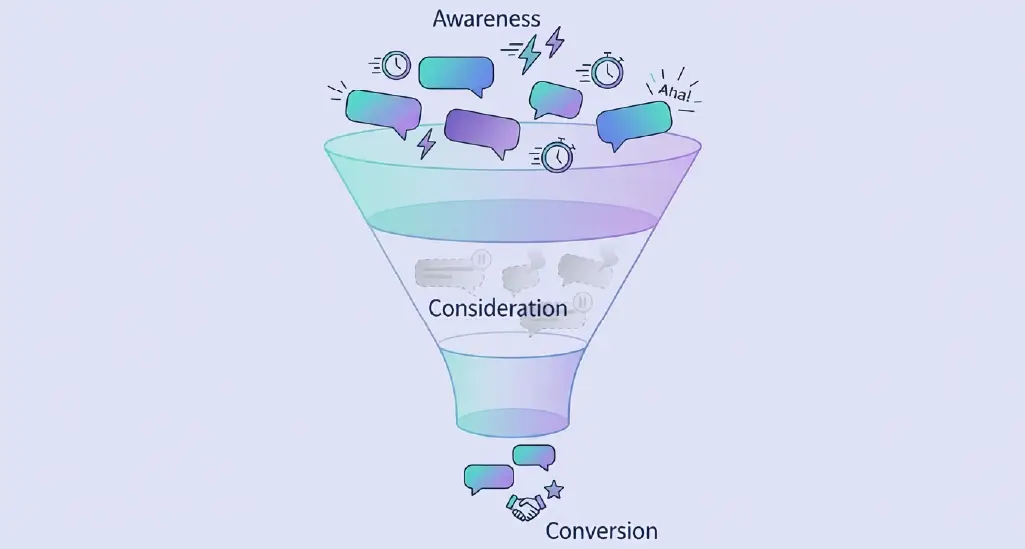
Digital funnels often look clean in analytics dashboards. Leads move from page views to form submissions to demo requests in neat progression charts.
Real conversations rarely follow such tidy paths.
Most buyers arrive with partial information and evolving questions. They explore pricing before understanding product capabilities. They ask about integrations before seeing the full feature set. They want reassurance about results before committing to a formal evaluation.
When engagement systems are designed purely around answering questions, they struggle to guide prospects through these messy decision journeys.
Instead of removing friction, the conversation can unintentionally leave uncertainty unresolved.
Consider a SaaS company offering AI-powered customer engagement tools. A prospect initiates a chat asking whether the platform supports automated follow-ups for website leads.
The support agent or AI assistant confirms that it does.
The answer is technically correct, but it does little to move the conversation forward. The prospect still wonders how the system handles lead qualification, how conversations are routed, and whether the automation feels natural to customers.
Without those answers, committing to a demo feels premature.
So the prospect leaves the chat window open for a moment, then quietly closes it.
Nothing went wrong in the interaction.
But nothing resolved the buyer’s uncertainty either.
Progression often requires more than information. It requires reassurance.
Buyers want signals that their concerns are understood and that the next step is safe to take.
In human conversations, reassurance appears naturally. A thoughtful salesperson might acknowledge a concern before explaining how other companies handled a similar situation. They might offer context about how long implementation typically takes or what resources are required.
These moments help reduce psychological risk.
In digital conversations, reassurance is often missing. Replies focus narrowly on answering questions rather than contextualizing them.
Imagine two responses to the same inquiry.
The first response simply confirms that a product integrates with Salesforce.
The second explains that many teams initially worry about CRM integrations but that the system connects directly through an existing API, typically requiring less than an hour to configure. It then asks whether the prospect currently uses Salesforce for both sales and support workflows.
Both responses deliver the same core information.
Only one moves the conversation forward.
The difference lies not in speed but in conversation design.
Also read: What Is Conversion Intelligence? The System That Turns AI Conversations Into Revenue

Another reason leads stall is that conversations often end without a clear path forward.
In many organizations, chat interactions or email responses function as standalone exchanges. The immediate question gets answered, and then the interaction ends.
For a buyer navigating a complex decision, this can feel like reaching the edge of a map.
Imagine researching a new analytics platform. You ask whether the product supports multi-touch attribution. The reply confirms that it does and briefly describes how the feature works.
But what should you do next?
Should you schedule a demo? Explore documentation? Try a free trial?
Without guidance, the safest option is often to postpone the decision.
Effective conversational engagement anticipates this moment. Instead of waiting for the prospect to ask what comes next, it gently introduces the next logical step.
A reply might explain how attribution works and then suggest seeing it applied to a real marketing funnel during a short walkthrough. Suddenly the conversation has direction.
Clarity about next steps transforms passive engagement into active progression.
A mid-sized SaaS company once believed their slow response times were costing them leads.
Prospects frequently initiated website chats but rarely progressed to product demos. Internal analysis showed that the average response time was nearly three minutes—far longer than the instant replies competitors promised.
The team invested in automation to reduce that delay. Within weeks, responses became nearly immediate.
Engagement rates improved slightly.
But demo bookings barely changed.
When the company reviewed actual conversation transcripts, the reason became clear.
Most interactions followed the same pattern. A prospect asked a product question, received a direct answer, and ended the conversation. Very few exchanges explored the prospect’s use case or guided them toward the next step.
The problem had never been speed.
It was that the conversation lacked structure.
Once the company redesigned its conversational flow—introducing contextual questions, sharing brief examples of how similar teams used the platform, and offering clear next actions—demo bookings increased significantly.
The response time stayed the same.
What changed was the experience of the conversation.

High-performing conversational engagement systems share one common characteristic: they treat each interaction as part of a journey rather than a series of isolated replies.
Every response acknowledges the prospect’s immediate question while also advancing the conversation slightly further along the decision path.
This requires anticipating the kinds of hesitation buyers experience.
A prospect asking about pricing may actually be wondering whether the product will justify its cost. A question about integrations may signal concerns about technical complexity. Even seemingly simple inquiries often carry deeper meaning.
Conversation design involves addressing those underlying concerns before they stall progression.
This does not mean overwhelming prospects with information. Instead, it means guiding them through small moments of clarity that gradually reduce uncertainty.
A conversation might begin with a quick answer, then introduce a short example, then invite the prospect to explore the feature in context.
Each step builds confidence.
Ironically, the rise of AI-powered engagement tools has made conversation design even more critical.
AI excels at speed. It can process inquiries instantly and generate responses in seconds. But without thoughtful design, those responses can remain purely reactive.
The result is an experience that feels efficient but shallow.
When AI systems are guided by well-designed conversational frameworks, however, they become powerful tools for progression. They can recognize patterns in lead behavior, identify common hesitation points, and introduce the right information at the right moment.
Instead of simply answering questions, the conversation becomes an intelligent guide through the buyer’s journey.
This shift—from response automation to conversation orchestration—is where many organizations are beginning to see real improvements in conversion rates.
Speed still matters, but it is no longer the defining advantage.
Understanding the psychology behind progression is.
Also read: Human-in-the-Loop AI Customer Engagement Strategy
Most teams focus on response speed, but the right metrics measure whether conversations actually move leads toward decisions. One reason the speed myth persists is that response time is easy to measure.
Dashboards can display average reply speeds, first-response times, and chat wait durations. These numbers create a comforting sense of control.
Metrics related to conversation quality are harder to quantify.
Did the interaction reduce uncertainty?
Did it build trust?
Did it help the prospect understand what to do next?
These questions rarely appear in standard analytics tools.
Yet they often determine whether a lead advances or disappears.
Organizations that shift their focus from speed metrics to conversation outcomes begin to see engagement differently. Instead of celebrating faster replies alone, they evaluate whether interactions move prospects closer to decisions.
The difference between those two perspectives is subtle but transformative.
The future of lead engagement focuses on intelligent, guided conversations that build trust and reduce friction. As digital communication becomes faster and more automated, the real competitive advantage will increasingly lie in how conversations are designed.
Companies that focus solely on response speed will deliver efficient interactions that feel interchangeable. Companies that design conversations around reassurance, clarity, and guided progression will create experiences that actually help buyers make decisions.
Also read: Voice AI for Lead Engagement: How AI Phone Agents Convert Leads Faster
The difference becomes visible in pipeline movement.
Leads do not simply start conversations—they continue them.
They feel comfortable asking deeper questions. They understand what comes next. They gradually move from curiosity to commitment.
Speed may open the door, but conversation quality determines whether anyone walks through it.

You turn conversations into conversions by consistently reducing uncertainty and helping prospects feel confident in their decision. Most marketing teams already understand how to attract leads. The harder challenge is helping those leads move forward once engagement begins.
Fast responses are part of that equation, but they are only the beginning.
Progression happens when conversations reduce hesitation, clarify value, and guide prospects toward confident next steps.
Platforms designed around conversational intelligence are beginning to bridge this gap by analyzing how real interactions unfold and identifying where momentum stalls. Instead of focusing only on response times, they reveal the moments where reassurance, context, or guidance are missing.
This is where solutions like Blazeo are reshaping the way companies approach engagement.
By combining AI-driven conversation analysis with real-time engagement tools, Blazeo helps teams understand not just how quickly they respond to leads, but how effectively those conversations move prospects toward decisions. The platform surfaces patterns inside conversations, highlights friction points, and enables teams to design engagement flows that build trust and clarity at every stage of the journey.
Because in modern marketing, winning the conversation is no longer about being the fastest to reply.
It is about being the most helpful voice in the room when a buyer is deciding what to do next.