SmartHub
 Automation
 Appointment Scheduler
 Lead Management
 Dashboard & Reports
 Task Management
 Communications Hub
 Live chat
 AI chatbot
 Voice AI
 Voice call centers
 Appointment scheduling
 Retainer signing
 Home services
 Lawyers and firms
 Medical services
 College admissions
 Real estate agents
 Marketing agencies
 About
About Partner program
 Estimate Your ROI
 Case Studies
 Blog
Blog FAQs
FAQs Login
LoginWhy Your 90% Bot Resolution Rate Is Killing High-Value Leads





Products
Industries
Company
Resources
As of March 2024 we have renamed Apexchat to Blazeo. We are excited to share the next part of our journey with our customers and partners.
The name ApexChat implies that we are primarily a chat company, which is no longer true. Now we have many offerings, such as call center services, AI, Appointment setting, SMS Enablement, Market Automation, and Sales acceleration (Q2 2024), that go beyond chat. The new name will not only allow us to convey the breadth of our offering but will also better convey our company’s mission and values.
Blazeo, which is derived from the word Blaze, evokes a sense of passion, speed, and energy. A “Blaze” is captivating, illuminates, and represents explosive growth. Blazeo encapsulates our mission to ignite such growth for our customers and partners by delivering innovation with passion, speed, and energy.

A 90% bot resolution rate looks like success on a dashboard, but a high bot resolution rate can quietly kill high-value leads by shutting down AI chat conversations too early. When teams obsess over why high bot resolution rates kill high-value leads, they start to see that those “successful” chats often suppress AI chat conversion instead of nurturing real opportunities. The number shows up confidently on the slide.
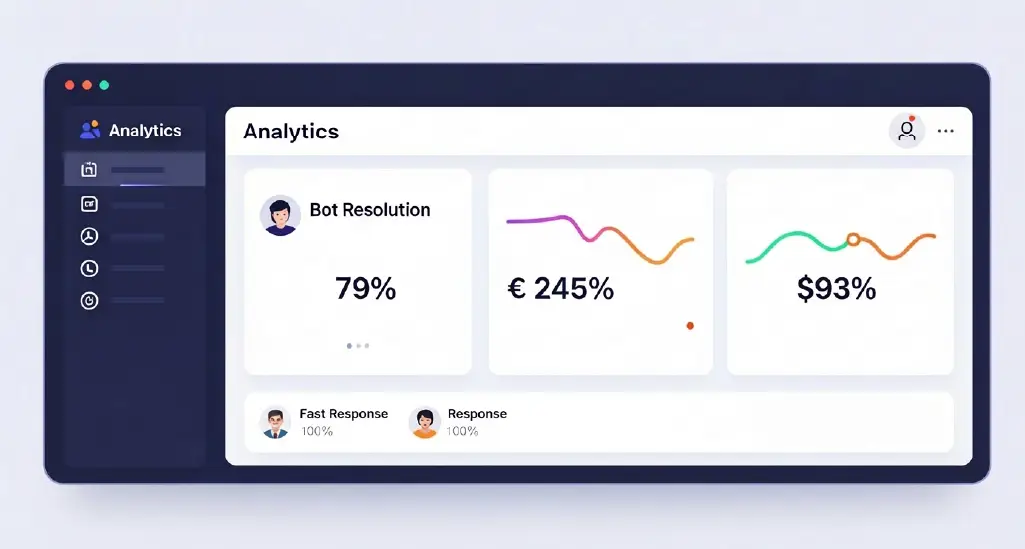
It’s usually framed as a breakthrough. Fewer escalations. Faster responses. Lower cost per conversation. Someone says what everyone is thinking: “The bot is doing its job.”
And in a narrow sense, it is. But when the business never questions why high bot resolution rates kill high-value leads, that impressive metric hides shrinking pipeline, weaker demos, and high-intent buyers who quietly disappear.
This disconnect isn’t a coincidence. It’s structural. When teams optimize relentlessly for a high bot resolution rate, they end up training their AI to end conversations—especially the ones that matter most. High-value leads don’t disappear because the bot is bad. They disappear because the bot is doing exactly what it was told to do.
Bot resolution rate measures how often an AI handles a conversation without involving a human—but this is also where you start to see why high bot resolution rates kill high-value leads when they’re used as a universal success metric.
But the problem begins when this metric becomes a universal goal.
Once AI moves into lead capture, pricing pages, onboarding flows, or sensitive customer journeys, resolution stops being a proxy for success. It becomes a proxy for silence. The bot is rewarded for closing conversations quickly, even when the business outcome depends on the conversation continuing.
Also read: AI Agents vs Human Agents in Sales: Cost, Speed & Conversion
A high bot resolution rate doesn’t necessarily mean the AI is effective; in many funnels, a high bot resolution rate quietly kills high-value leads by blocking access to the humans who close deals.

This is where automation-at-all-costs starts to erode ai chat conversion rather than improving it.
High-value leads rarely arrive asking simple questions. They arrive with constraints, urgency, and risk. They’re comparing options. They’re thinking about internal approval. They’re worried about compliance, timelines, failure modes, and accountability.
They ask questions that sound informational but are actually evaluative.
“Do you support SOC 2?”
“Can this integrate with our existing stack?”
“What happens if something breaks?”
“Have you worked with companies like ours?”
A resolution-focused bot hears a question and responds with an answer. A high-value lead hears something else entirely: Can I trust you with this decision?
When the AI responds with a link, a paragraph, or a neatly packaged explanation and then politely exits, it may have resolved the query—but it hasn’t resolved the hesitation, and this is one more example of how high bot resolution rates kill high-value leads who needed a human, not just an answer.

From a bot resolution rate perspective, this is a flawless interaction. From a conversion perspective, it’s incomplete—and it shows in miniature why high bot resolution rates kill high-value leads at precisely the moments when intent is strongest.
A visitor lands on your pricing page late at night. They’re not browsing casually. They’re there because they’ve been asked to shortlist vendors by morning. They open chat and ask about enterprise security requirements.
The bot answers perfectly. It confirms compliance. It links documentation. It asks if there’s anything else it can help with.
From a bot resolution rate perspective, this is a flawless interaction. From a conversion perspective, it’s incomplete.
That visitor didn’t need confirmation. They needed direction. They needed someone to say, “Yes, and I can help you get exactly what procurement will ask for. Are you evaluating this for an upcoming quarter? Do you want to speak to someone who’s handled this with similar teams?”
The lead didn’t leave because the bot failed. They left because the bot succeeded at the wrong thing.
One of the most damaging side effects of over-automation is emotional misalignment. Bots don’t struggle with information. They struggle with empathy.
In high-empathy scenarios—healthcare, finance, education, crisis support, or even high-stakes B2B decisions—customers aren’t just looking for answers. They’re looking for reassurance that someone competent is paying attention.
When a customer says, “This is urgent,” or “I’m really stressed about this,” a resolution-first bot often responds with a standard flow. It’s technically correct, but emotionally tone-deaf.
The same dynamic applies to high-value leads. Urgency, pressure, and uncertainty are signals. When those signals are flattened into “resolved,” trust erodes quietly.
That erosion doesn’t always show up in CSAT. It shows up in abandoned deals, stalled pipelines, and prospects who never come back.
Also read: How to Build A Customer Retention Strategy with AI & Automation
A 90% bot resolution rate feels like operational maturity because it’s clean, measurable, and easy to celebrate. But it often hides a deeper inefficiency: the loss of conversations that could have created disproportionate value.
High-value leads are, by definition, few. Losing even a small number of them can outweigh the gains from thousands of efficiently resolved low-stakes interactions, which is exactly why high bot resolution rates kill high-value leads long before the problem shows up in revenue reports.
This is where conversion intelligence becomes essential. Instead of asking how many conversations ended without humans, it asks what happened after the conversation ended. Did the lead move forward? Did intent turn into action? Did confidence increase or disappear?
Resolution rate answers an internal question. Conversion intelligence answers a business one.
There’s a persistent myth that scale is about removing humans. In reality, scale is about delivering the right outcome consistently at higher volume.
If your AI can handle ten thousand conversations a week but suppresses the moments that drive revenue, you’ve scaled activity, not growth.
True scale requires judgment. It requires knowing when automation helps and when it hurts. And that judgment can’t come from a single metric optimized in isolation.
High-performing teams don’t eliminate humans. They redeploy them strategically.
Certain moments in the customer journey carry more weight than others. Pricing discussions, migration questions, compliance concerns, contract timelines, and emotionally charged issues are not just informational checkpoints. They’re decision points.
Treating these moments as self-serve interactions because the bot can answer them ignores the reality that people don’t make high-stakes decisions alone. They look for signals of reliability and accountability.
A system optimized for bot resolution rate will often fail here because it treats escalation as failure. A system optimized for outcomes treats escalation as a tool.
Also read: AI-Driven Customer Journey Analytics Beyond Lead Capture
Hybrid customer engagement isn’t about choosing between bots and humans. It’s about designing the relationship between them intentionally.
In a hybrid model, AI handles speed, availability, and early context. It answers low-stakes questions instantly. It captures intent. It qualifies gently. It prepares the ground.
When the signals indicate value, urgency, or empathy, the system does something resolution-first bots resist: it brings a human in early, with context already collected.
Humans don’t start from zero. They step into a conversation that’s already shaped, already informed, already moving.
This is where managed live chat becomes a revenue lever rather than a cost center. The agent isn’t firefighting. They’re guiding.

Few examples illustrate this better than pricing.
When someone asks, “How much does it cost?” they’re rarely asking for a number alone. They might be asking whether they’re in scope, whether the purchase is justifiable internally, or whether they’re ready to take the next step.
A resolution-first bot responds with tiers and a link. A conversion-aware system responds with context and a path forward.
It answers, but it also listens. It adapts based on where the user is, not just what they typed.
That difference is subtle in a transcript and massive in outcome.
One of the clearest warning signs is when chat transcripts look clean, CSAT looks healthy, and nothing seems wrong—yet pipeline quality declines.
If your system can’t connect conversations to downstream outcomes, you’re optimizing blind. You might be celebrating thousands of “successful” chats that quietly went nowhere.
Conversion intelligence forces accountability. It connects engagement to lead quality, pipeline movement, deal velocity, retention, and expansion.
When you see those connections clearly, resolution rate loses its shine. It becomes a diagnostic, not a destination.
Escalation has a branding problem. In many organizations, it’s treated as something to avoid.
But for high-value leads, escalation is often the moment of truth. It’s the point where the business signals seriousness.
The most effective AI systems aren’t the ones that avoid humans. They’re the ones that know exactly when a human will change the outcome—and make that transition seamless.
This requires intent-aware routing, context preservation, and trained agents who understand that they’re not just answering questions. They’re closing gaps in trust.
Most teams don’t lose high-value leads because their AI is incapable. They lose them because the system was designed around the wrong success criteria.
If you tell the bot that success equals resolution, it will optimize for resolution. If you tell the system that success equals revenue movement, it will behave differently.
Design choices matter. Thresholds matter. Language detection matters. Page context matters. And above all, the willingness to let humans do what humans do best matters.
Over time, companies that over-optimize for automation start to feel distant. Not cold—just inaccessible. Efficient, but not reassuring.
High-value leads notice this first. They don’t always complain. They just choose differently.
And that’s how a dashboard full of green arrows can coexist with a shrinking sense of opportunity.
The way forward isn’t abandoning automation. It’s abandoning automation without judgment.
When AI is paired with thoughtful human engagement, it becomes a multiplier rather than a barrier. It speeds up what should be fast and slows down what should be careful.
That balance is what separates teams that look efficient from teams that actually convert.

Also read: The Hybrid Model: Where Voice AI and Humans Work Together
What is bot resolution rate in customer support and sales?
Bot resolution rate measures how often an AI or chatbot handles a conversation without involving a human, which can be useful for low-stakes support but risky when revenue is on the line.
Why can a 90% bot resolution rate hurt high-value leads?
A 90% bot resolution rate often means the AI is trained to end conversations quickly, which can shut down high-intent, high-value leads before they have a chance to build trust or talk to a human.
How do I know if my bot is suppressing AI chat conversion?
Warning signs include clean chat transcripts, strong CSAT, and impressive bot resolution numbers—paired with declining pipeline quality, fewer qualified demos, and stalled deals.
Should high-value lead conversations ever be fully automated?
No; pricing, compliance, migration, and other high-stakes questions are decision points where human judgment and reassurance are essential, so escalation should be a feature, not a failure.
What is a hybrid customer engagement model?
Hybrid customer engagement uses AI for speed and qualification, then routes high-intent or high-empathy moments to human agents who can move deals forward and protect revenue.
How does Blazeo help with bot resolution rate problems?
Blazeo combines AI-driven chat with managed live chat, treating bot resolution as a diagnostic rather than a goal and optimizing for qualified leads, pipeline movement, and revenue outcomes.
This is exactly the gap Blazeo is built to address.
Blazeo doesn’t treat a high bot resolution rate as the finish line; it’s built for teams that have seen firsthand how high bot resolution rates kill high-value leads and want a hybrid system that protects those moments instead of automating them away.
Instead of forcing AI to handle everything, Blazeo helps teams decide when it shouldn’t. Conversations are measured not just by whether they were resolved, but by whether they created qualified leads, moved pipeline forward, reduced churn, or increased confidence at critical moments.
That’s conversion intelligence in practice: measuring what actually matters, and designing engagement around outcomes rather than optics.
Because the goal isn’t to win a metric.
It’s to win the moments that decide revenue.
And sometimes, that means letting the bot step aside at exactly the right time.