 SmartHub
 Automation
 Appointment Scheduler
 Lead Management
 Dashboard & Reports
 Task Management
 Communications Hub
 Live chat
 AI chatbot
 Voice AI
 Voice call centers
 Appointment scheduling
 Retainer signing
 Home services
 Lawyers and firms
 Medical services
 College admissions
 Real estate agents
 Marketing agencies
 About
About Partner program
 Estimate Your ROI
 Case Studies
 Blog
Blog FAQs
FAQs Login
LoginWhy Clinics Need Workflow Automation For Behavioral Health




Products
Industries
Company
Resources
As of March 2024 we have renamed Apexchat to Blazeo. We are excited to share the next part of our journey with our customers and partners.
The name ApexChat implies that we are primarily a chat company, which is no longer true. Now we have many offerings, such as call center services, AI, Appointment setting, SMS Enablement, Market Automation, and Sales acceleration (Q2 2024), that go beyond chat. The new name will not only allow us to convey the breadth of our offering but will also better convey our company’s mission and values.
Blazeo, which is derived from the word Blaze, evokes a sense of passion, speed, and energy. A “Blaze” is captivating, illuminates, and represents explosive growth. Blazeo encapsulates our mission to ignite such growth for our customers and partners by delivering innovation with passion, speed, and energy.

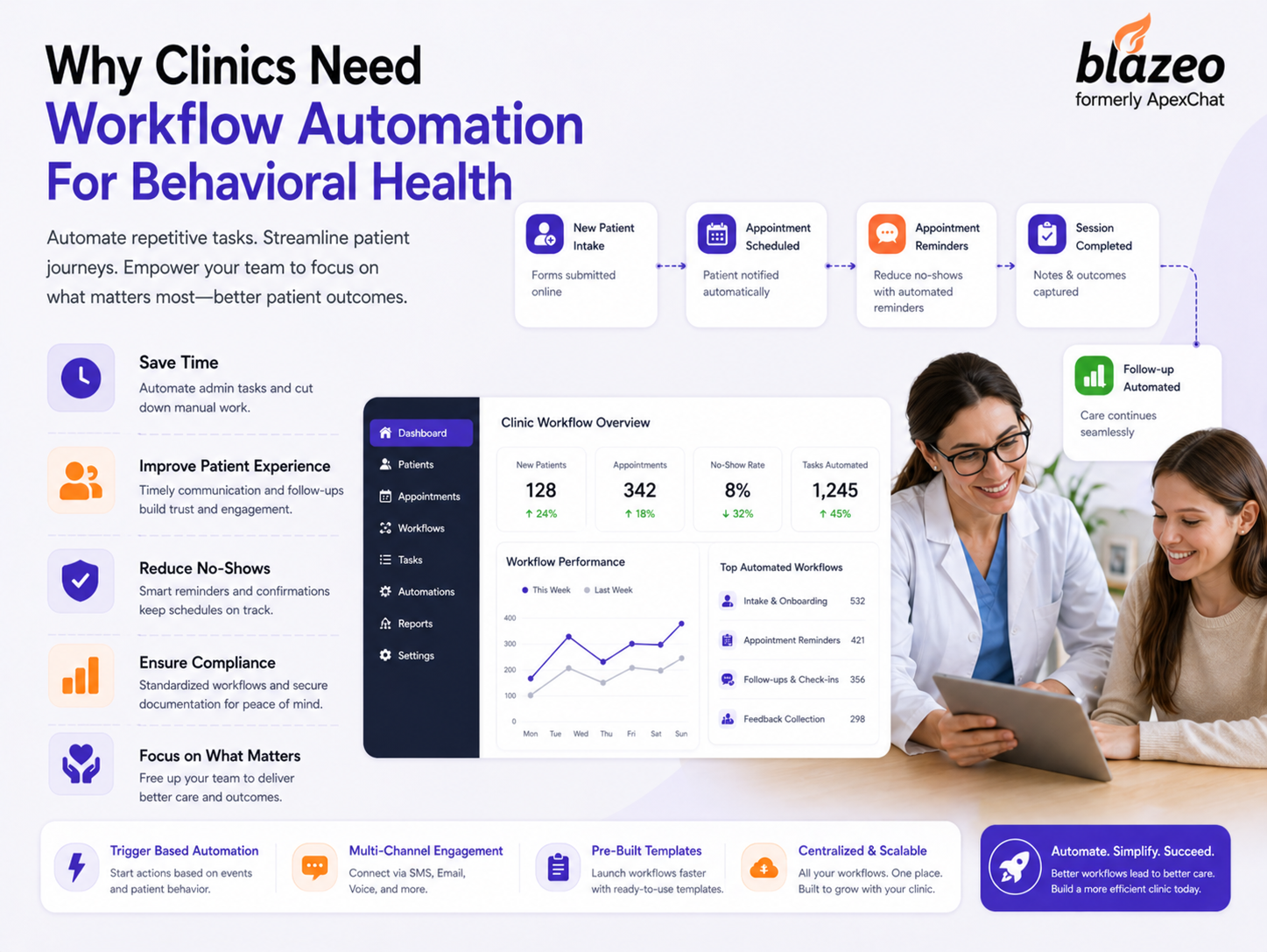
Nobody wakes up and thinks today's the day I'll spend six hours retyping patient forms. But that's Tuesday in most behavioral health clinics. And Wednesday. And Thursday. Staff isn't failing. The process is.
Workflow automation for behavioral health isn't a fix you roll out and forget. It's what actually stops the slow bleed of time, errors, and good people walking out the door. Healthcare workflow automation handles the stuff that shouldn't need a human touch, so the humans can do the work that actually matters.
This blog gets into where clinics are losing the most ground, what automation does about it, and how you make it work without blowing everything up in the process.
Most clinic managers already know what's wrong. They live it. The front desk is drowning, the biller is fixing the same mistakes again, and the care coordinator is sending reminders by hand because nobody set up anything better. It didn't happen overnight. It crept in slowly.
Clinical workflow optimization sounds like something a consultant puts in a slide deck. In reality, it just means stopping the part of everyone's day that adds zero value. Re-entering data that's already in another system. Playing phone tag for approvals that could've been automatic. Small stuff. But it stacks.
Workflow automation means a task that used to need a person now runs on its own. Patient books a slot, intake form goes out. Session ends, billing kicks off. Reminder fires three days before the appointment without anyone setting a calendar alert. Not complicated.
Workflow automation for behavioral health does that, but it is built around what a mental health or substance use clinic actually needs. HIPAA isn't optional. Sensitive data handling isn't a nice-to-have. Automated workflows for behavioral health are put together with those realities already accounted for, not bolted on afterward.
Intake is a mess. Billing is a mess. Scheduling is a mess. They're all connected, so fixing one without touching the others doesn't get you far. Workflow automation for behavioral health works when it goes after the places bleeding the most time first.
Walk a new patient through intake at most clinics, and you'll see the problem immediately. They fill out a paper form. Staff retypes it. Something gets missed. Then someone has to fix it before the visit even starts. It's broken, and everyone knows it.
Automated workflows for behavioral health fix this by sending forms out before the patient walks in. The data lands directly in the system. No retyping. No gaps. Patients book online, pick their slot, get a reminder without anyone scheduling it manually, and the clinic follows up on no-shows without a single phone call.
One wrong code holds up weeks of payment. Not because billing staff is sloppy, but because they're doing high-volume, detail-heavy work under pressure without anything catching errors before they go out.
Behavioral health practice management cleans up fast when billing isn't fully manual. Insurance checks run before the patient walks in. Codes come from clinical notes directly. Claims go out cleaner, come back approved more often, and the clinic stops chasing payments it already earned.
AI workflow automation doesn't just follow rules. It reads patterns and responds to them. That's a different thing from standard automation, and in a clinical setting, it matters more than people realize.
What does that look like day to day? A patient misses two sessions, and the system flags it. A clinician finishes a visit, and a draft note is waiting instead of a blank page. Care history shapes what comes next automatically. Workflow automation for behavioral health with AI underneath gives clinicians real hours back. At Blazeo, we've worked with practices where this cut daily documentation time by two to three hours per clinician.
Switching to automated workflows for behavioral health, the changes aren't subtle. First week admin time drops. In the second week, the billing queue looks different. By the end of month one, staff are leaving on time more often than not.
The part nobody talks about enough is what clinical workflow optimization does to turnover. People leave because they're exhausted by pointless work. Take that work away, and they stay. Staying means consistency. Consistency means better care. Clinics with high turnover keep missing this connection.
Generic healthcare software is fine until it isn't. It handles the basics, but the moment you need group session notes, a 90-day treatment plan, or records across three providers, it falls apart.
Behavioral health practice management software has to actually fit what you do. EHR integration without a workaround every time. HIPAA is built in, not added on later. Healthcare workflow automation that sits disconnected from everything else isn't saving time; it's creating a new problem to manage. Run the real numbers on what manual errors and staff hours cost monthly before any tool feels too expensive.
The technology part is usually fine. What breaks projects is starting without a clear picture of what needs changing and rolling things out in a way that catches staff off guard. Healthcare workflow automation sticks when the people using it were part of choosing it.
Before you pick a tool, sit with the people doing the work. Not a survey. An actual conversation where someone walks you through their day. Where does time disappear? What breaks every week? You need that before anything else.
Clinical workflow optimization without a baseline is guessing. Set a real target. Cutting no-shows by 30 percent in 90 days. Reducing claim rejections by half. Something specific you can actually track. Vague goals produce vague results, and that's how automation projects get abandoned.
Staff work around tools they don't trust. Not stubbornness, just human nature. If they weren't part of choosing it, they didn't get to flag the parts that won't work, and those parts become problems on day one.
Bring them in early. Let them push back. Run one process as a pilot before the whole clinic. Behavioral health practice management changes go wrong when they're dropped on people without warning. AI workflow automation needs real training too, not a link to a knowledge base nobody reads on a busy Tuesday.
Ten to fifteen staff hours recovered per week. That's what clinics running healthcare workflow automation actually report. Most of it comes from intake, scheduling, and billing, three areas eating time every day with nothing to show for it.
Workflow automation for behavioral health shows up in retention, too. Staff who aren't grinding through the same manual tasks don't burn out the same way. Blazeo has seen practices where retention shifted noticeably within the first two months of going live, not after some long adjustment period.
It runs repeat tasks like intake, reminders, billing, and note drafts without staff doing them by hand. That time goes back to patient care. It's less complicated in practice than it sounds on paper.
Burnout in behavioral health is mostly death by a thousand small tasks. When those run, the day automatically gets lighter. Clinics that make this shift keep their staff longer, pretty consistently.
Any platform worth using should have HIPAA compliance built in from day one. Verify it yourself before signing. Ask specifically, don't assume because it's labeled a healthcare tool.
Intake and appointment reminders. High volume, fully manual in most places, and visible results are fast. No-show rates drop, data gets cleaner, and staff hours free up. Start there and build out.
Four to twelve weeks for a phased rollout is typical. One process as a pilot first, keeps it manageable and gives staff time to adjust before it scales across the clinic.
Most platforms are priced by practice size. The better question is what your current manual workload costs you in hours and errors each month. That number is almost always higher than the tool.
No. It handles the admin layer so clinicians spend more time with patients. Drafts, scheduling, and billing checks. The actual clinical work still needs a person. That part isn't going anywhere.
Faster responses, fewer scheduling issues, follow-ups that actually happen. The experience improves not because staff work harder, but because the system stops dropping things.
Behavioral health clinics are carrying work that shouldn't be on human shoulders. The billing errors, the missed follow-ups, the staff burnout, they're not random. They come from a system that still depends on people to do things software should've been handling years ago.
Workflow automation for behavioral health takes that weight off by running the repeat work automatically, so your team puts energy where it counts. When the background noise stops, the actual work gets clearer and the people doing it last longer. AI workflow automation is where this goes next. Not someday. The clinics moving on this now aren't waiting for a perfect moment. They're just getting less buried while everyone else stays stuck.