 SmartHub
 Automation
 Appointment Scheduler
 Lead Management
 Dashboard & Reports
 Task Management
 Communications Hub
 Managed chat
 Voice Receptionist
 Appointment scheduling
 Retainer signing
 Home services
 Lawyers and firms
 Medical services
 College admissions
 Real estate agents
 Marketing agencies
 About
About Partner program
 Estimate Your ROI
 Case Studies
 Blog
Blog FAQs
FAQs Login
LoginWhat Top Teams Know About Live Chat for Lead Generation




Products
Industries
Company
Resources

Most teams running live chat never generate a qualified lead from it. Live Chat for Lead Generation fails not because the tool is inadequate, but because the operating approach is reactive responses, generic greetings, and no structured qualification process, which turns a pipeline asset into a support channel.
Visitors land on pricing pages, scroll through product comparisons, and exit without a conversation started. No trigger fires, no agent reaches out, and no follow-up sequence captures the contact. The lead disappears without ever entering the pipeline despite showing measurable buying intent on the page.
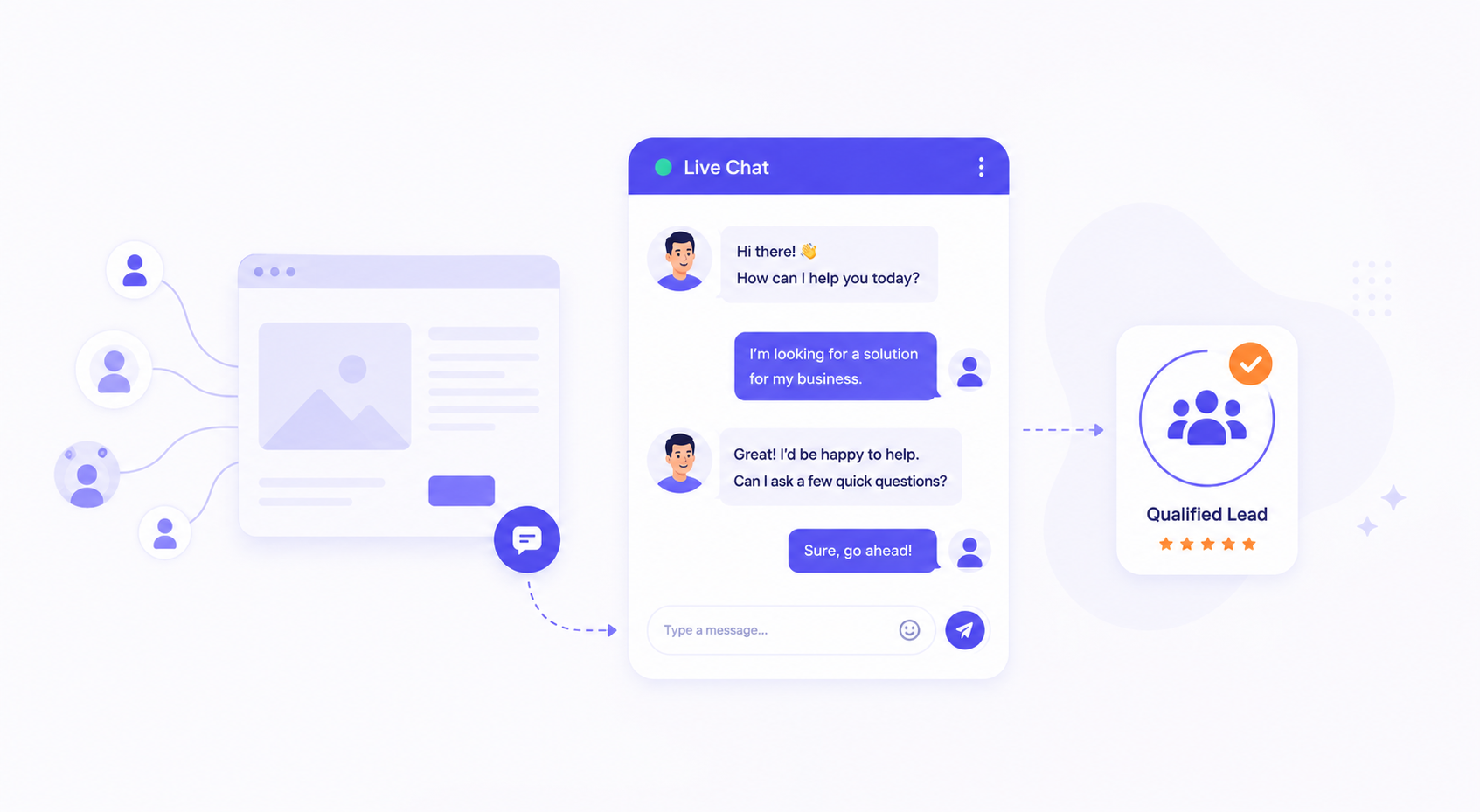
The teams capturing those visitors operate a three-component system: proactive triggers, in-chat qualification, and CRM-connected follow-up workflows. In this blog, each component handles a different stage of the lead generation process, and each section below covers how it functions in operational detail.
Lead generation live chat places teams in front of visitors at the exact moment buying intent is highest. Forms and email both delay that contact one through friction, the other through wait time, and delay is where lead generation opportunities go to die.
A visitor reading a pricing page is already evaluating. A form stops that evaluation cold and asks them to fill out fields before anyone responds. Chat opens a relevant conversation without breaking their research flow, which keeps intent alive long enough to capture real contact information and qualify the prospect.
Response speed determines who captures the lead. When two companies sell similar products, the one responding in 30 seconds wins the conversation and often the deal. Live Chat for Lead Generation removes the delay that forms, and an email is built into the process, putting teams in contact before interest fades.

Reactive chat is the wrong operating model for lead generation. Teams wait for visitors to type first, respond with scripted answers, and close tickets. The tool runs, agents stay busy, and the pipeline sees almost nothing from chat because nobody treated it as a sales function.
Generic openers signal to buyers that the conversation won't be worth their time. "Hi there, how can I help?" carries no context about what the visitor is reading, what problem they're solving, or why engaging right now serves their specific situation. High-intent buyers disengage before the second message.
Speed gaps cost leads directly. A live chat service lead generation strategy requires a response within 60 seconds. Beyond two minutes, most visitors have already moved to another tab. Staffing decisions, coverage windows, and after-hours chatbot setup all exist to solve this single, measurable problem in the process.
No follow-up process after chat ends is the most expensive failure. Visitors engage, ask real questions, leave without buying, and the team has nothing queued. No CRM entry, no email sequence, no next step assigned. A conversation without a follow-up system attached to it is just a support ticket wearing a sales label.
Lead capture through chat requires a built process, not a widget, and a willing agent. Teams producing qualified leads from chat run three connected steps: proactive triggers that start conversations, qualification questions that filter intent, and follow-up workflows that keep prospects moving after the chat window closes.
Without all three working together, the system has gaps. Triggers without qualification send unfiltered contacts to sales. Qualification without follow-up lets warm leads go cold overnight. The sections below cover each component with the specifics needed to build and run each one correctly.
Live chat lead capture starts before the visitor decides to engage. Behavior-based triggers fire chat messages automatically when visitors hit signals that indicate real interest, exit intent, 70% scroll depth on a product page, or 90 seconds of continuous reading on pricing or comparison pages.
Exit intent fires when the cursor moves toward the browser bar. At that moment, a visitor is deciding whether the page answered their question. A message referencing the specific page content gives them a reason to stay and ask rather than leave and search somewhere else for the same answer.
Time-on-page and scroll triggers work on the same logic. A visitor spending 90 seconds on a pricing page has read enough to form questions. Starting a conversation at that point with a message relevant to pricing meets them where their thinking already is, rather than interrupting with something unrelated.
Qualification runs inside the conversation, not after it. Agents ask three targeted questions early: what challenge the visitor is solving, what company size they're working within, and what their decision timeline looks like. Those three answers reveal whether the contact is worth passing to sales or needs more nurturing first.
Live chat for B2B sales depends on this filter. B2B sales teams operate with limited capacity, and unqualified leads consume the same time as qualified ones. Filtering at the chat stage means sales reps spend their time on prospects who have confirmed budget awareness, a real problem, and a defined timeline to act.
Buying signals appear mid-conversation as specific questions about pricing tiers, API integrations, onboarding timelines, and contract terms. When those appear, the agent shifts approach and moves the conversation toward booking a call or demo rather than continuing to answer informational questions without a next step attached.
Most visitors don't buy after one chat session. B2B buying cycles involve multiple stakeholders, internal approvals, and comparison research that takes days or weeks. The teams producing pipeline from chat account for that reality and build follow-up into the system from the start.
Live chat lead nurturing works by connecting chat outcomes to CRM workflows and email sequences. When a visitor engages but doesn't convert, the agent logs the contact, notes the conversation topic, and triggers a follow-up sequence tied to what that specific visitor discussed, not a generic drip campaign sent to everyone.
Follow-up emails referencing the chat topic perform better than generic nurture content because they demonstrate that the conversation was recorded and acted on. A prospect who asked about enterprise pricing and received a follow-up covering enterprise case studies knows the team paid attention. That specificity builds the trust needed to bring them back.
Platforms like Blazeo, we help teams build this entire nurturing workflow, connecting chat conversations directly to follow-up sequences so no lead goes cold. Live Chat for Lead Generation produces pipeline results only when capture, qualification, and nurture operate as one connected process rather than three separate efforts running independently.
Live Chat for Lead Generation in B2B contexts requires treating every chat conversation as a sales event with a defined next step, not an open-ended support interaction with no outcome attached. Teams that make that distinction fill their pipeline. Teams that don't use chat to answer questions and nothing more.
Live chat for B2B sales shortens sales cycles by resolving objections while the prospect is still engaged on the page. A question about integration compatibility answered in real time keeps the evaluation moving forward. The same question left unanswered sends the prospect into a research loop that delays the decision by days.
Personalization determines whether a B2B chat conversation builds trust or wastes both parties' time. Agents referencing a visitor's stated industry, company size, or use case create relevance from the first message. Relevance keeps the conversation moving, and a moving conversation is always closer to a booked call than a stalled one.

Measurement without a weekly review schedule produces no improvement. Teams that check metrics quarterly find out too late which triggers underperformed, which agents missed leads, and which follow-up sequences failed to bring prospects back. Weekly reviews catch those gaps while they're still fixable.
Chat-to-lead rate, first response time, conversation-to-conversion rate, and missed chat volume are the four numbers that explain live chat performance completely. Each one isolates a different failure point, and identifying the failure point is the only way to fix it before it compounds across hundreds of conversations.
Missed chat volume gets undertracked in most operations. Every missed chat represents a visitor who opened the widget, showed intent, and received no response. Live Chat for Lead Generation performance reviews need to start with this number because it shows the most direct, preventable revenue loss in the entire system each week.
Transcripts contain the clearest signal available about what visitors actually need. Recurring questions reveal information gaps on the website. Common objections point to messaging problems. Drop-off patterns in conversations show exactly where agents lose prospect interest before live chat lead capture produces a confirmed contact.
Weekly transcript reviews give teams the information needed to refine triggers, sharpen qualifying questions, and update messaging based on real visitor behavior. Lead quality improves through that review cycle, not through guesswork about why some conversations convert, and others drop off without producing a usable contact.

Live Chat for Lead Generation produces predictable results when the operating habits behind it stay in place, regardless of traffic volume or team size. The practices below are what high-performing teams run every week, not occasionally, and not only when results start dropping noticeably.
Agents trained on qualification and product knowledge produce better leads than agents following a generic response script. Lead generation live chat performance improves in direct proportion to agent preparation. An agent who understands the product, recognizes buying signals, and asks the right questions in the right order generates leads that sales teams can actually close.
Availability planning prevents coverage gaps that destroy credibility. A chat widget showing as online with no agent available signals disorganization to prospects evaluating multiple vendors. Teams staff for extended hours, deploy chatbots for off-hours capture, and use clear offline messaging so live chat lead nurturing continues even without a live agent present at every hour.
Data review drives the refinement that keeps performance from plateauing. Which triggers generated conversations, which conversations converted, and which drop-off points appeared most frequently? Reviewing those numbers weekly creates a clear picture of where to adjust. Live chat service lead generation scales when that review cycle runs on schedule rather than reactively.
High-performing teams back every best practice with the right platform. Blazeo gives teams the triggers, workflows, and analytics that turn these habits into a scalable live chat lead generation system so results don't depend on manual effort or individual agent performance alone.
Set scroll-depth and exit-intent triggers first. Agents need three qualifying questions ready before the first chat fires. CRM follow-up runs automatically after no manual logging.
Chat-to-lead rate tells you fast. Pull it weekly if it stays under 15 percent for three weeks; the triggers or agent messaging needs changing immediately.
Confirmed problem, right company size, decision expected within 90 days. Missing any one of those three means the contact goes to nurture, not sales.
9 am to 11 am Tuesday through Thursday for B2B. Pricing page visitors get contacted the second they hit 90 seconds, scheduled outreach can't compete with that timing.
70 percent scroll depth on a pricing page fires a trigger there. Visitors who reach that point have questions forming. Most won't type first without a prompt.
60 seconds is the hard limit on first response. Beyond that, the visitor is already on another tab. Chatbots cover nights and weekends when agents can't be everywhere.
You need both. Software fires triggers and captures data; while agents run qualification, pairing it with the best live chat software makes the whole system work. Remove either one, and leads won't close at the same rate.
Three to five B2B chats simultaneously; past that, agents stop catching buying signals. A question about pricing tiers gets missed. That missed question is a lost lead.
Triggers, qualification, and follow-up workflows are three separate functions that most chat teams run only one of them. Live Chat for Lead Generation raises contact rates and shortens sales cycles because agents reach visitors before they leave, not after they submit a form and wait.
Agents qualify visitors during chat and stop unfit contacts before they reach sales reps. Reps then spend time only on contacts carrying confirmed budget awareness and a decision timeline. That single filter changes how efficiently a sales team works through the pipeline each week.
Structured chat fills the pipeline. Reactive chat fills a support log. The widget is identical in both cases; what differs is the trigger setup, the questions agents ask, and whether a follow-up workflow runs after every session closes.