 SmartHub
 Automation
 Appointment Scheduler
 Lead Management
 Dashboard & Reports
 Task Management
 Communications Hub
 Live chat
 AI chatbot
 Voice AI
 Voice call centers
 Appointment scheduling
 Retainer signing
 Home services
 Lawyers and firms
 Medical services
 College admissions
 Real estate agents
 Marketing agencies
 About
About Partner program
 Estimate Your ROI
 Case Studies
 Blog
Blog FAQs
FAQs Login
LoginVoice SMS Chat Convergence for Unified Customer Journeys





Products
Industries
Company
Resources
As of March 2024 we have renamed Apexchat to Blazeo. We are excited to share the next part of our journey with our customers and partners.
The name ApexChat implies that we are primarily a chat company, which is no longer true. Now we have many offerings, such as call center services, AI, Appointment setting, SMS Enablement, Market Automation, and Sales acceleration (Q2 2024), that go beyond chat. The new name will not only allow us to convey the breadth of our offering but will also better convey our company’s mission and values.
Blazeo, which is derived from the word Blaze, evokes a sense of passion, speed, and energy. A “Blaze” is captivating, illuminates, and represents explosive growth. Blazeo encapsulates our mission to ignite such growth for our customers and partners by delivering innovation with passion, speed, and energy.

The first message rarely looks important.
It’s a quick “Hey, are you open Saturday?” typed into a website chat while someone is half-watching Netflix. Or a missed call that turns into a voicemail: “I’m calling about the estimate.” Or a short form submission with one line that says, “Need help ASAP.”
The second message is where intent reveals itself.
It’s the follow-up text because they didn’t want to wait on hold. It’s the chat reply because they’re in a meeting and can’t talk. It’s the call back because they have one question they don’t trust a form to answer.
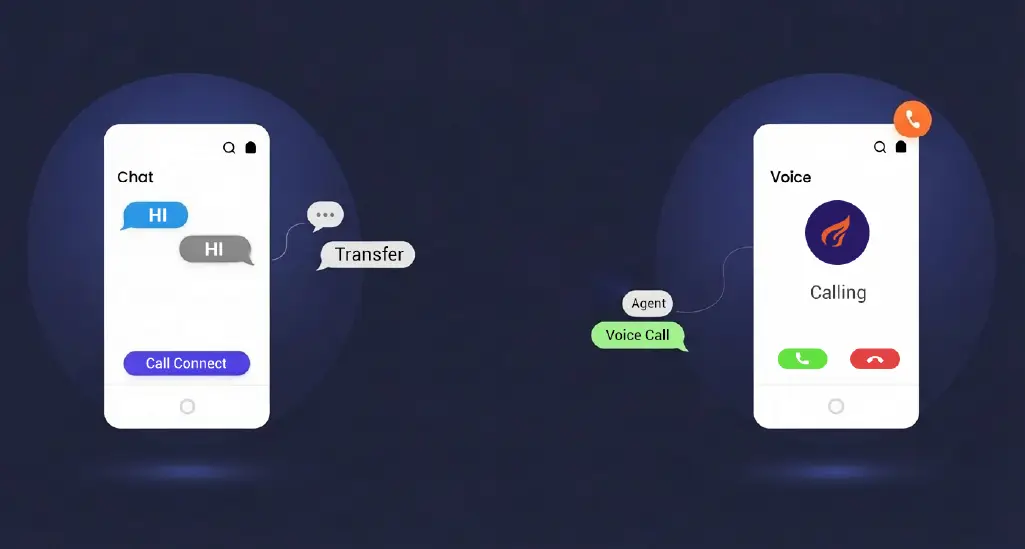
This is what modern customer engagement actually looks like—not one channel, but a movement between voice, SMS, and chat. Voice SMS chat convergence is the shift toward designing those movements as one connected conversation instead of isolated interactions.
Voice SMS chat convergence is the practice of unifying phone calls, text messages, and chat conversations into a single, continuous customer interaction. Instead of treating each channel as a separate experience, voice SMS chat convergence preserves context, intent, and conversation history as customers move between channels—so every message, text, or call feels like a continuation rather than a restart. The goal is simple: reduce friction, maintain momentum, and make customer engagement feel coherent and human, no matter where the conversation begins or ends.
Voice + SMS + chat convergence is the correction. It’s not omnichannel as a buzzword. It’s the discipline of building unified conversational journeys where every interaction feels like a continuation, not a restart. When it works, customers don’t think about channels at all. They just feel understood.
Definition: Voice SMS Chat Convergence
Voice SMS chat convergence is the unification of phone calls, text messages, and chat into a single continuous conversation—so customers can move between channels without losing context, repeating themselves, or restarting the interaction.
Most teams measure performance by channel: chat conversion rates, SMS response rates, call answer rates. These numbers matter, but they hide the real experience. Customers don’t experience channels. They experience momentum.
Momentum breaks the moment someone has to repeat their name, their problem, their availability, or their frustration. And it breaks quietly.
A prospect chats late at night and receives an automated response. The next morning, a generic text arrives that ignores what they already said. They reply anyway, get asked the same questions again, then call because they’re tired of typing—only to discover the agent has no context. Nothing technically failed. But the experience did. And the cost isn’t just annoyance. It’s delay. It’s doubt. It’s the subtle decision to choose a competitor that feels easier to deal with.
Unified conversational engagement begins when teams stop optimizing channels in isolation and start optimizing continuity end to end.

Picture a dental practice on a weekday afternoon. A parent opens chat and types, “My son chipped a tooth—do you handle emergencies?”
A basic chatbot would push a phone number or a form. A unified journey responds differently. It asks just enough in chat to assess urgency, then offers a next step that fits the moment. “If you can take a quick call, I can schedule you faster. If not, we can continue by text.”
Also read:AI Lead Qualification With Chatbots That Drive Revenue
If the parent chooses SMS, the conversation continues there with full context. Time slots are offered. Insurance details are confirmed. If they choose voice, the call doesn’t start from zero. The opening line reflects what’s already known. No repetition. No friction. Just progress.
That’s customer conversation continuity. Not more automation—better orchestration.
The same pattern plays out everywhere. In home services, where customers call while standing in their driveway. In SaaS, where prospects move from chat to text to a short call over a week. In property management, where tenants use whatever channel is easiest at the moment. In every case, the winning experience is the one that remembers.

Most omnichannel strategies focus on expansion. Add SMS. Add chat. Add voice. Add another platform. But the value isn’t in how many channels you support. It’s in how well a conversation travels between them.
Systems that feel human do three things consistently. They preserve context so the next interaction knows what just happened. They respect preference in real time, understanding that people don’t have one favorite channel—only what works best right now. And they make escalation effortless, so a human can step in naturally without forcing the customer to repeat themselves.
When these elements are present, SMS automation stops feeling like robotic follow-ups and starts feeling like a reliable assistant that knows what’s going on.
The mistake many teams make is starting with tools. The smarter starting point is intent.
Intent is what the customer is actually trying to do: book, reschedule, ask a question, check a status, get an estimate, resolve a problem. A unified conversational journey is built around one clear intent and designed as a single narrative that can begin anywhere.

Think of this as a conversation spine. The spine stays consistent whether it starts in chat, SMS, or voice. Channel becomes a wrapper, not a silo. State is what makes this possible. The system must always know where the customer is in the journey, what’s already been captured, and what the next step should be.
Without state, automation feels forgetful. With it, continuity becomes natural.
Orchestration comes next. This is where teams decide which channel reduces effort at each moment. Chat works best for exploration. SMS works best for confirmation and follow-up. Voice works best for nuance, urgency, or emotional complexity. A unified system uses each channel where it excels while keeping the story intact.
People don’t resent automation because it isn’t human. They resent it when it wastes their time.
Human-feeling systems are honest about what they are, concise in how they communicate, and respectful of boundaries. In voice, that means short turns and graceful exits. In SMS, it means restraint and relevance. In chat, it means fewer menus and more guided conversation.
Human tone isn’t friendliness. It’s competence.
Also read: The Hybrid Model: Where Voice AI and Humans Work Together
In home services, convergence often begins with missed calls. A customer calls early, gets no answer, and would normally move on. Instead, a follow-up text acknowledges the call and offers a next step. A short reply captures the issue and enables a callback that begins with context. The job gets booked because momentum wasn’t lost.

In SaaS, convergence shows up in demo qualification. A prospect asks a question in chat, receives a relevant answer, then gets scheduling options via SMS instead of another form. If a complex question arises, a short call resolves it quickly. Each step builds on the last instead of restarting.
In ecommerce and retail, chat handles routine questions, SMS delivers updates people actually read, and voice resolves exceptions. Automation reduces load, but continuity preserves trust.
The first failure is fragmentation. Different teams own different channels, and no one owns the journey. The second is excess. Too many messages, too little relevance. The third is memory loss. Conversations are logged, but not remembered.
When this happens, teams lose confidence in automation. They revert to manual work not because it’s better, but because it feels safer than systems they don’t trust.
If you want to justify voice + SMS + chat convergence, don’t start with AI. Start with leakage.
How many inbound conversations stall because of missed calls? How many chats end without a next step? How many SMS threads die because follow-ups lack context? How many appointments are no-show because reminders aren’t coordinated?

A simple ROI calculator can be built from these numbers. Estimate recovered conversations, apply your close rate, and add operational savings from reduced manual follow-up and fewer repetitive interactions. Then factor in time-to-response. As response time stabilizes, conversion becomes more predictable, forecasting improves, and customer satisfaction rises because the experience feels controlled rather than chaotic.
Unified conversational engagement doesn’t just improve conversion. It smooths the entire funnel.
The smartest way to begin isn’t with every journey. It’s with one that matters.
Booking is often the best first candidate because it touches both revenue and operations. Design the conversation spine. Make it work cleanly in one channel. Then add handoffs. Chat to SMS to voice is a common progression, but the order depends on your customers.
What matters is that the journey remains one story.

As AI becomes ubiquitous, the bar moves. Customers won’t reward you for having chat, SMS, and voice. They’ll reward you for making them feel remembered, responded to, and respected.
The companies that win won’t be the ones that automate the most. They’ll be the ones that automate with continuity. They’ll build systems that feel calm, coherent, and human—because they’re designed around momentum, not channels.
Voice + SMS + chat convergence isn’t a trend. It’s real customer behavior finally being reflected in how businesses engage. And when you build it the right way, the outcome isn’t just higher conversion. It’s a reputation for being easy to deal with.
In a world where attention is scarce, that reputation is worth more than any single channel metric will ever show.
Also read:Voice AI CRM for Customer Intelligence: The Future of CRM | Blazeo
Voice SMS chat convergence is the practice of unifying voice calls, text messages, and chat conversations into a single continuous customer journey. Instead of restarting interactions on each channel, businesses preserve context so every interaction feels like a natural continuation.
Traditional omnichannel strategies focus on offering multiple channels. Voice SMS chat convergence focuses on continuity, ensuring conversations move seamlessly between channels without losing context or forcing customers to repeat themselves.
Customers value momentum. When conversations reset, trust erodes and friction increases. Conversational continuity reduces effort, shortens response times, and makes businesses feel easier to work with.
Industries with time-sensitive or high-intent interactions benefit the most, including home services, healthcare, SaaS, property management, ecommerce, and customer support–driven businesses.
AI enhances convergence but isn’t the starting point. The foundation is shared context, conversation state, and intelligent orchestration. AI becomes valuable once continuity is already designed into the system.
The best approach is to start with one high-impact journey, such as booking or lead qualification. Design it as a single conversation that can move between chat, SMS, and voice without restarting.
Designing voice, SMS, and chat as a single, continuous experience requires shared context, intelligent orchestration, and handoffs that don’t break momentum. That’s the approach platforms like Blazeo are built around—helping teams unify conversations across channels so automation feels coherent rather than fragmented.
If you’re ready to reduce conversation drop-offs and build engagement that behaves like one conversation instead of three disconnected ones, start by mapping a single high-impact journey end to end—and assess whether your current systems can truly support it.
