 SmartHub
 Automation
 Appointment Scheduler
 Lead Management
 Dashboard & Reports
 Task Management
 Communications Hub
 Managed chat
 Voice Receptionist
 Appointment scheduling
 Retainer signing
 Home services
 Lawyers and firms
 Medical services
 College admissions
 Real estate agents
 Marketing agencies
 About
About Partner program
 Estimate Your ROI
 Case Studies
 Blog
Blog FAQs
FAQs Login
LoginThe Sales Funnel Doesn't End at "Lead Captured"




Products
Industries
Company
Resources

If you ask most businesses where their sales funnel begins, they'll point to their website, paid ads, social media campaigns, or SEO efforts. Ask where it ends, and many will confidently say, "When someone becomes a lead."
That answer reveals one of the biggest misconceptions in modern sales.
Capturing a lead is not the finish line. It's barely the starting point.
Every day, businesses spend thousands of dollars driving traffic to landing pages, optimizing forms, and increasing inquiry volume. Marketing teams celebrate growing lead counts while sales teams complain about poor conversion rates. Somewhere between those two departments, opportunities quietly disappear.
The problem isn't always lead quality. More often, it's what happens after a lead is generated.
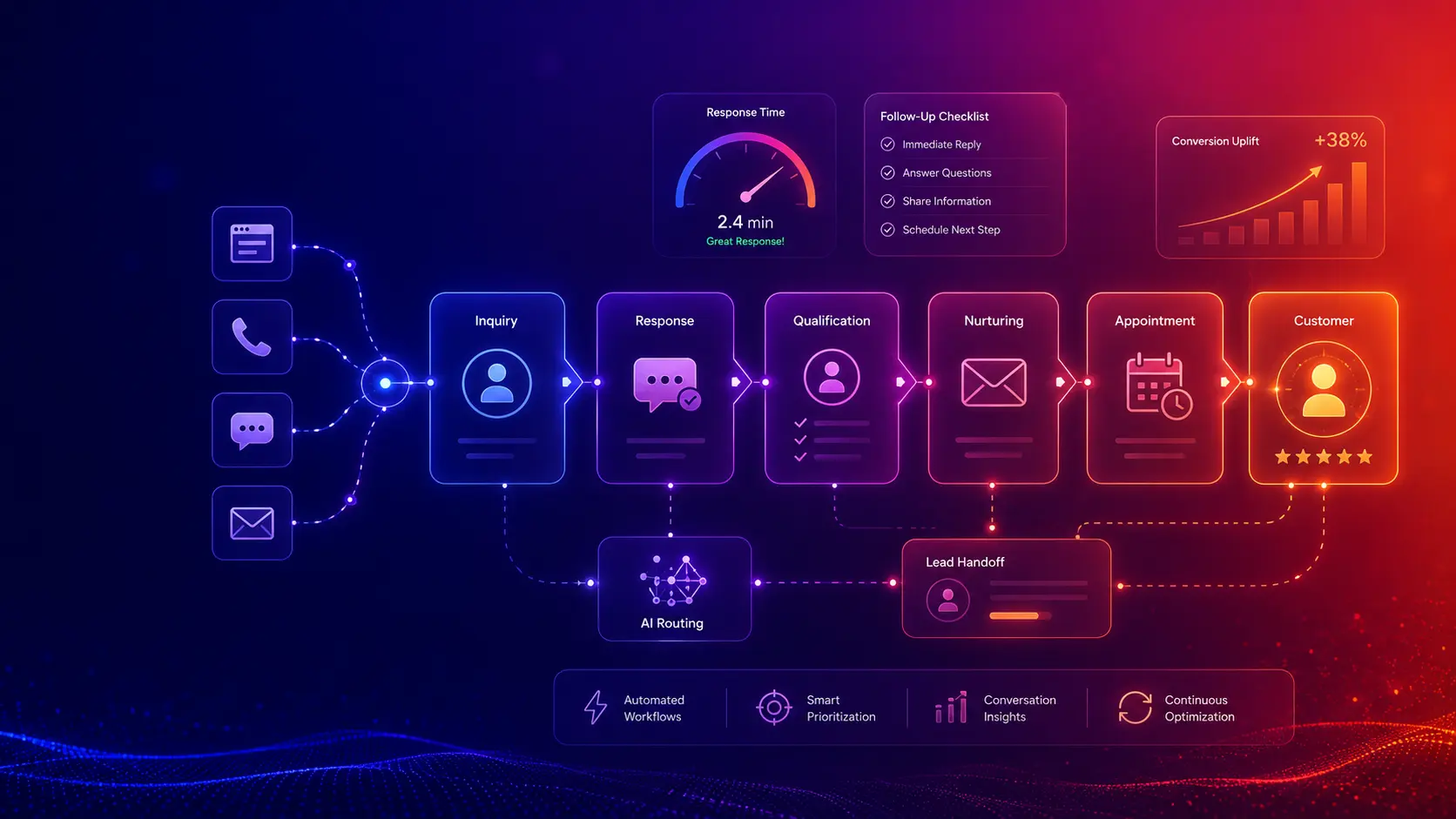
The minutes following a website inquiry, the quality of the first conversation, the consistency of follow-up, and the experience prospects have throughout the buying process determine whether someone eventually becomes a customer. This is where true sales funnel optimization happens—not at the point of capture, but in everything that follows.
Businesses obsessed with generating more leads often overlook the reality that improving what happens after lead capture can increase revenue without increasing marketing spend.
Imagine someone researching software for their growing business. They've spent weeks comparing options, reading reviews, and narrowing their shortlist. Eventually, they land on your website, fill out a demo form, and click Submit.
From your perspective, you've gained a new lead.
From theirs, they've started evaluating whether your business deserves their trust.
That distinction matters.
The customer isn't thinking about CRM entries or pipeline stages. They're wondering whether anyone will respond. They're questioning whether they'll have to repeat themselves during every conversation. They're evaluating whether your company seems organized enough to solve their problem.
The experience begins the second the inquiry is submitted.
Unfortunately, this is also where many companies unintentionally create friction.
Some wait hours before responding. Others send generic automated emails with no meaningful next step. Sales representatives reach out without understanding why the customer contacted them. Different departments ask identical questions because information isn't shared internally.
None of these failures happen during lead generation.
They happen after.
Understanding what happens after a lead is generated is often the missing piece in improving conversion rates.

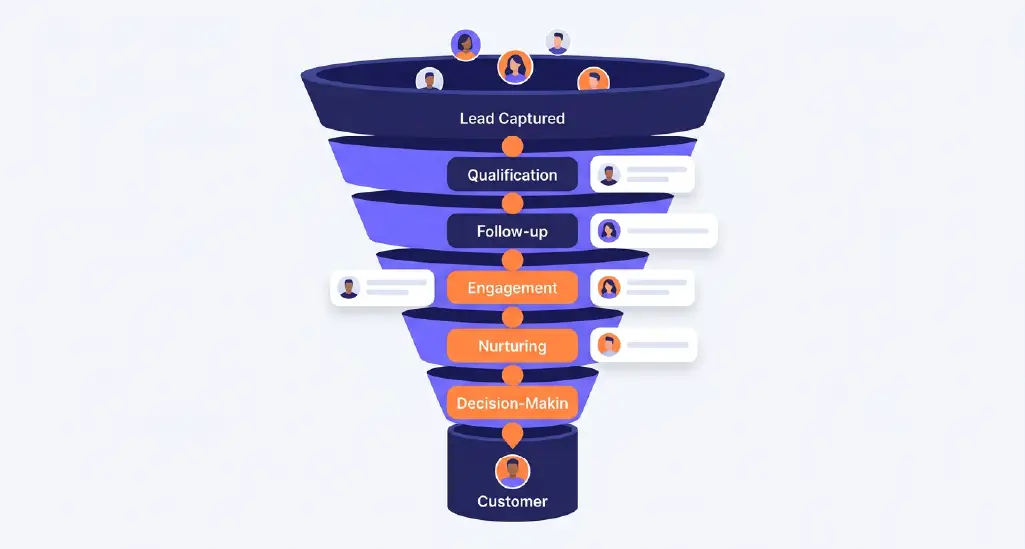
Many organizations visualize their funnel as a sequence of marketing activities ending with a captured lead. In reality, customers experience a much longer journey.
They move from awareness to curiosity, from inquiry to evaluation, from conversations to confidence before making a purchase.
Every stage introduces uncertainty.
Someone may genuinely want your service yet hesitate because responses feel inconsistent. Another prospect might compare three vendors and ultimately choose the company that simply communicated more clearly.
People rarely buy based solely on features anymore.
They buy based on confidence.
That confidence develops through dozens of interactions after lead capture.
Every email response, every phone call, every appointment reminder, every follow-up message, and every answered question shapes how customers perceive your business.
Companies that understand this invest as much effort into the middle of the funnel as they do attracting traffic.
Also read: Stop Chasing More Leads - Start Maximizing the Ones You Already Have
Response time has become one of the most discussed conversion metrics, and for good reason.
Prospects who reach out while actively researching are operating within a limited decision window. Delayed responses allow competitors to step in.
However, fast responses alone don't solve the problem.
Imagine receiving a reply within thirty seconds that says:
"Thanks for contacting us. Someone will get back to you."
Technically, the business responded quickly.
Practically, nothing moved forward.
Now compare that with a response that acknowledges the customer's inquiry, answers an initial question, suggests available meeting times, and clearly explains what happens next.
The difference isn't just speed.
It's momentum.
Effective sales funnel optimization means reducing uncertainty at every stage instead of merely reducing response times.
Marketing celebrates new leads.
Sales celebrates closed deals.
The transition between those two moments often receives surprisingly little attention.
Consider a home services company running successful Google Ads campaigns.
Marketing captures hundreds of inquiries every month. The CRM receives them instantly. But because leads aren't automatically assigned, some sit untouched until the following morning. Others reach sales representatives with incomplete information. Different employees call the same prospect while another inquiry receives no follow-up at all.
Marketing believes campaigns are performing well.
Sales believes marketing is delivering poor-quality leads.
The customer simply chooses another company.
The issue isn't lead generation.
It's operational consistency.
Strong lead handoffs ensure context travels with every prospect. Sales representatives should know which page someone visited, which service they requested, previous interactions they've had, and what prompted them to inquire.
Customers shouldn't feel like they're starting over every time they speak with someone new.
When people hear lead nurturing, they often imagine automated email sequences filled with newsletters and promotional offers.
Real lead nurturing is much broader.
It's the ongoing process of helping prospects feel informed enough to make a confident buying decision.
Some customers convert immediately.
Others need weeks.
Some require multiple conversations involving different stakeholders. Others simply need reassurance that your company understands their specific situation.
Consider a manufacturing business looking for new software.
The operations manager submits an inquiry.
The finance director wants pricing details.
The CEO wants implementation timelines.
The IT department asks about security.
Ignoring those conversations while repeatedly sending "Just checking in" emails isn't nurturing.
Answering the right questions at the right time is.
Effective lead nurturing adapts to where prospects are within their decision-making process instead of forcing everyone through identical sequences.

Businesses often hesitate to introduce automation because they're afraid it will make customer interactions feel robotic.
That concern is understandable.
Poor automation creates frustration.
Good automation creates better conversations.
Imagine a healthcare clinic receiving appointment requests overnight.
Instead of waiting until the next morning, an automated workflow confirms receipt, offers available scheduling options, captures additional patient information, and alerts staff before business hours begin.
When employees arrive, they aren't starting from scratch.
They're continuing a conversation that's already moving forward.
This is where sales process automation delivers its greatest value.
Automation shouldn't replace people.
It should eliminate repetitive administrative work so employees spend more time solving problems and building relationships.
The best technology quietly removes delays customers never wanted in the first place.
Also read: Marketing Automation Agency: How AI Turns Leads Into Clients
Businesses often search for dramatic reasons prospects disappear.
Pricing.
Competition.
Product limitations.
Sometimes those factors matter.
Often, customers leave because of dozens of smaller disappointments.
A missed follow-up.
A voicemail without a callback.
An unanswered email.
Confusing appointment scheduling.
Repeated questions.
Long wait times.
Each interaction seems insignificant in isolation.
Together, they shape the overall customer experience.
Think about the last time you received exceptional service.
Chances are it wasn't because of one remarkable moment.
It was because every interaction felt consistent.
Customers rarely notice operational excellence.
They simply notice when it's missing.
That consistency transforms ordinary interactions into trust.
Many organizations track website traffic, click-through rates, and lead volume. They also monitor revenue after deals close.
The middle remains surprisingly invisible.
That's unfortunate because it's often where the greatest opportunities for improvement exist.
Instead of focusing exclusively on new leads, businesses should examine questions like these.
How quickly does every inquiry receive a meaningful response?
How many prospects receive no follow-up after their initial interaction?
How often do customers repeat the same information?
Where do appointments get canceled or abandoned?
Which conversations consistently result in conversions?
These questions reveal where friction exists within the customer journey.
Once identified, those bottlenecks become far easier to solve.
Imagine two HVAC companies operating in the same city.
Both generate one hundred website inquiries every month.
Company A responds the following day. Different employees contact prospects using inconsistent messaging. Follow-ups depend entirely on individual sales representatives remembering to reach back out. Appointment scheduling happens manually through multiple phone calls.
Company B immediately acknowledges inquiries, routes them to the correct representative, schedules appointments through automated workflows, sends confirmation messages, and reminds customers before every visit. Sales representatives receive complete conversation histories before making contact.

Neither company generated more leads.
Neither increased advertising budgets.
Yet Company B consistently converts more inquiries because it optimized everything after lead capture.
This is precisely how to optimize the sales funnel after lead capture.
Instead of chasing more traffic, they improved the experience prospects encountered once they expressed interest.
One of the biggest sales funnel mistakes businesses make is believing marketing alone drives growth.
Marketing creates opportunities.
Operations convert them.
Another common mistake is treating every lead identically.
Not every prospect has the same urgency, buying intent, or decision timeline. Intelligent prioritization ensures sales teams focus attention where it's most valuable while nurturing longer-term opportunities appropriately.
Businesses also underestimate the importance of unified communication.
When conversations across phone calls, SMS, email, live chat, and forms exist in separate systems, customers experience disconnected interactions.
Finally, many organizations optimize individual departments instead of optimizing the customer experience.
Marketing improves campaigns.
Sales improves closing techniques.
Customer service improves support.
Meanwhile, prospects experience all three as one continuous relationship.
Customers don't care which department caused a delay.
They simply remember the delay.
Also read: What Happens When Your Business Responds to Leads in Under 60 Seconds
One overlooked reason businesses struggle to improve lead conversion after website inquiry is that they simply lack visibility.
Leaders know how many leads entered the system.
They know how many became customers.
Everything in between remains hidden.
Without conversation tracking, workflow visibility, and centralized communication, diagnosing conversion problems becomes guesswork.
Modern customer communication platforms make this middle stage measurable.
Businesses can identify where leads stall, which responses generate appointments, which conversations require escalation, and where automation can remove delays without sacrificing personalization.
Visibility turns assumptions into actionable improvements.
Customers never think about your CRM.
They don't know your workflow.
They aren't impressed by your automation software.
They simply remember how easy—or difficult—it felt to do business with you.
The strongest funnels don't feel like funnels at all.
They feel like natural conversations.
Questions receive timely answers.
Appointments happen smoothly.
Information flows between teams.
Nothing falls through the cracks.
By the time customers decide to buy, they already trust that the experience after the sale will be just as organized as everything leading up to it.
That confidence often becomes the deciding factor.

Also read:
Lead generation will always matter.
Without inquiries, there are no customers.
But businesses that focus exclusively on attracting more leads often overlook the far greater opportunity sitting inside their existing pipeline.
The real work begins after someone fills out a form, sends a message, or makes a phone call.
That is where trust develops.
That is where confidence grows.
And that is where revenue is either won or quietly lost.
If your business wants sustainable growth, don't just measure how many leads you're capturing. Measure how effectively you're guiding every prospect through the moments that follow.
At Blazeo, we help businesses optimize every stage after lead capture with intelligent automation, unified customer communication, and AI-powered workflows that turn more inquiries into lasting customer relationships. Because the best sales funnels don't stop at generating leads—they're designed to convert them.

