 SmartHub
 Automation
 Appointment Scheduler
 Lead Management
 Dashboard & Reports
 Task Management
 Communications Hub
 Managed chat
 Voice Receptionist
 Appointment scheduling
 Retainer signing
 Home services
 Lawyers and firms
 Medical services
 College admissions
 Real estate agents
 Marketing agencies
 About
 Partner program
 Estimate Your ROI
 Case Studies
 Blog
 FAQs
 Login
The Appointment Is Booked. Why Is the Customer Still Uncertain?




Products
Industries
Company
Resources

A customer books an appointment on Tuesday for the following Monday. The scheduling system accepts the booking, a confirmation message appears on the screen, and the business considers the interaction complete.
But by Thursday, the customer has questions. Was the appointment confirmed or merely requested? Should they bring anything? Will someone call beforehand? What happens if they arrive late? And if something changes over the weekend, will anyone be available to help?
The customer may have received an appointment, but they haven't necessarily received the reassurance needed to follow through with it.
This is a common gap in appointment scheduling. Businesses invest considerable effort in making appointments easier to book, yet often overlook what happens between the initial booking and the moment the customer arrives. Once an appointment enters the calendar, the operational focus shifts elsewhere, even though the customer experience is still unfolding.
Appointment confirmation automation can help close that gap, but its value goes beyond sending a message that a time slot is reserved. Effective scheduling communication gives customers the information, flexibility, and confidence they need to attend their appointments without unnecessary uncertainty.
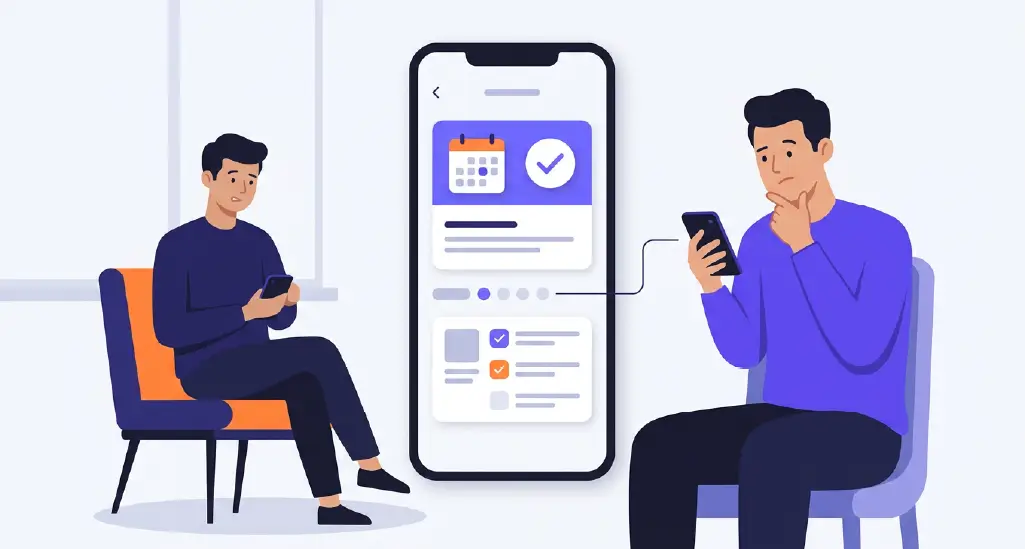
For a business, an appointment is often represented by a calendar entry. It has a date, a time, an assigned team member, and perhaps a customer record. From an operational perspective, everything appears to be in place.
Customers experience that same appointment differently.
They think about where they need to go, how long the visit will take, whether there are costs to anticipate, and what they need to do beforehand. Some may be arranging transportation or time away from work. Others may need to gather documents, coordinate with family members, or prepare questions for the person they are meeting.

Consider someone scheduling an initial consultation with a law firm. They may receive a confirmation containing the date and office address but no explanation of whether they should bring relevant paperwork, how long the consultation will last, or whether they will be speaking with an attorney or an intake specialist.
The appointment exists, but important expectations remain undefined.
Similar situations occur in healthcare, home services, financial consultations, and other appointment-based businesses. A homeowner waiting for a technician may not know whether the arrival time is exact or represents a service window. A patient may be unsure whether certain preparations are necessary before a visit.
These questions are not minor inconveniences. They influence whether customers feel ready to attend and whether the business can deliver the service efficiently.
A stronger customer appointment experience begins by recognizing that booking secures the opportunity for an interaction; communication prepares both parties to make that interaction productive.
Many appointment confirmation messages provide only the most basic information: the appointment date, time, and a generic acknowledgment.
While these details are essential, they rarely answer everything a customer needs to know.
A useful confirmation should clarify what was agreed upon and what happens next. Depending on the service, that may include the location or meeting link, expected duration, preparation requirements, relevant contact information, and a clear explanation of how to make changes.
The difference becomes apparent when comparing two confirmation experiences.
One customer receives a message stating that their consultation is scheduled for Monday at 11 AM.
Another receives the same information, along with the consultant's name, a map link, an estimated appointment duration, a brief note about documents they may wish to bring, and a direct way to ask questions or request a different time.
Both customers have confirmed appointments. Only the second has been given enough context to plan confidently.
This is where appointment confirmation automation becomes particularly valuable. Instead of relying on employees to remember which details to send, businesses can establish confirmation workflows that automatically deliver relevant information based on the appointment type.
A first-time consultation may require different instructions from a follow-up visit. An in-person appointment needs location details, while a virtual meeting requires a working access link and clear joining instructions.
Automation makes these distinctions easier to manage consistently, without requiring every message to be written manually.
The objective is not to make confirmations longer. It is to make them more useful.
Also read: Appointment Setting Service Cost: Per Appointment vs Subscription
Even a comprehensive confirmation can lose its usefulness when an appointment is several days or weeks away.
Customers have competing responsibilities. An appointment that felt important when booked may become harder to remember as work deadlines, family commitments, and unexpected obligations accumulate.
Automated appointment reminders help maintain awareness, but their effectiveness depends on when they arrive and what they communicate.
Research offers useful evidence. A systematic review published in PLOS ONE found that electronic notifications, including SMS reminders, were associated with improved attendance at healthcare appointments. The findings support the value of reminders, although results vary across settings and reminder approaches.
The practical lesson is that a reminder can influence attendance, but sending one is not necessarily enough.
A reminder delivered too early may be forgotten. One sent shortly before the appointment may leave insufficient time for the customer to reorganize their schedule. Repeated reminders without meaningful information can become background noise.
A more thoughtful communication sequence accounts for the time between booking and attendance.
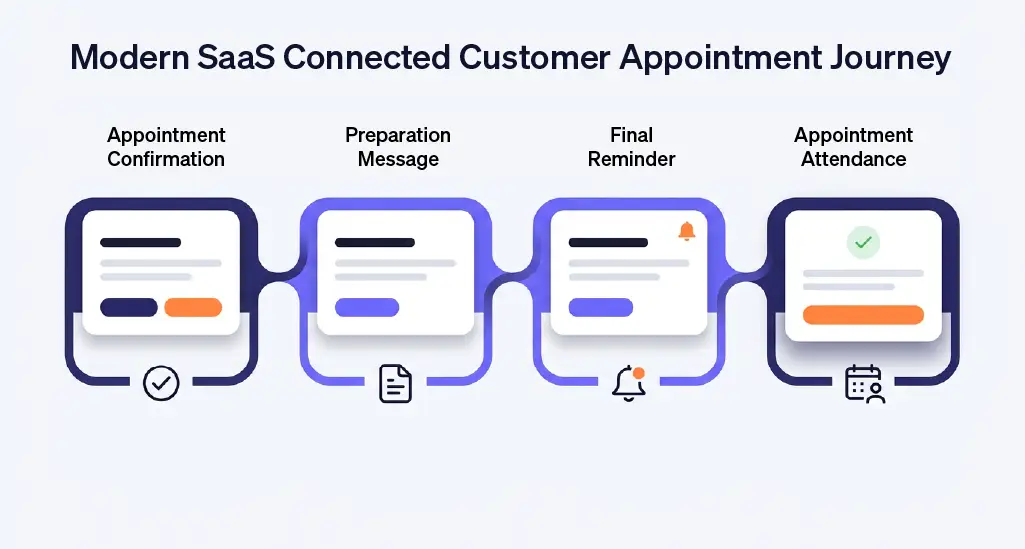
For example, a business might send an immediate confirmation, a preparation message several days before the appointment, and a final reminder the day before. For a service requiring substantial preparation, the earlier message may be particularly important. For a routine appointment, a simpler sequence may be sufficient.
Each communication should have a purpose. The first establishes certainty. The next helps the customer prepare. The final reminder provides an opportunity to confirm attendance or communicate a change.
This approach also creates opportunities for businesses to identify scheduling problems before they turn into missed appointments.
A customer who can easily reply that they need to reschedule is more useful to the business than one who silently fails to appear.
A customer who needs to change an appointment is not necessarily a customer who has lost interest.
Plans change. Meetings run late. Children get sick. Transportation falls through. A customer may still intend to use the service but needs a different time.
Unfortunately, many scheduling experiences make the original booking considerably easier than changing it.
A customer might book online in less than a minute but then be required to call during business hours to reschedule. If the line is busy or the office is closed, they may postpone the conversation until it is too late.

This creates an avoidable operational problem. The business continues holding a time slot that could have been offered to someone else, while the customer becomes increasingly uncertain about whether their appointment can be changed.
Accessible rescheduling offers a better alternative.
When customers can request changes through a confirmation link, text conversation, or scheduling assistant, they have a practical way to communicate changes as soon as they arise.
Blazeo's Automated Appointment Scheduler supports self-service scheduling, automated confirmations, reminders, and appointment changes, helping businesses maintain continuity without depending entirely on manual coordination.
Importantly, a rescheduled appointment should trigger an updated confirmation and replace outdated reminders. Otherwise, customers risk receiving conflicting information about which appointment is valid.
The aim is to preserve the relationship even when the original schedule cannot be preserved.
Also read: After-Hours Leads Aren’t the Problem. What Happens to Them Next Is
Not every scheduling concern requires changing an appointment. Sometimes customers simply need an answer.
A patient may want to confirm whether a referral is required. A homeowner may need to know whether someone must be present throughout a repair. A prospective client may want to understand whether an initial consultation carries a fee.
These questions often arise after the booking, when the customer has had time to think about the upcoming interaction.
If the only available support is a phone line operating during limited hours, a simple question can become a frustrating obstacle.
AI-powered communication can help businesses provide more accessible scheduling support by answering routine questions, checking approved appointment information, and directing customers toward the appropriate next step.
However, accessibility must not come at the expense of accuracy.
An automated assistant should not invent preparation instructions, promise unavailable appointments, or make decisions requiring professional judgment. Where information is uncertain or sensitive, the system should capture the question and route it to someone qualified to respond.
Blazeo's SmartHub centralizes communications across channels, allowing teams to review customer interactions and maintain context when follow-up is required.
Blazeo
This matters because customers should not have to repeat their booking history every time they ask another question.
Missed appointments affect more than an individual calendar entry.
For appointment-based businesses, an unused slot may represent lost revenue, wasted staff capacity, delayed service delivery, or an opportunity another customer could have used.
The financial impact varies by industry, but the relationship between reminders and attendance is well documented.
A 2016 systematic review and meta-analysis published in BMJ Open, examining 26 studies, found that patients receiving electronic text notifications were 23% more likely to attend appointments than those receiving no notification. The pooled no-show rates were 15% among patients receiving notifications compared with 21% among those receiving none.
A separate Cochrane review found that text reminders improved healthcare appointment attendance compared with no reminders and were less costly per attendance than telephone reminders in the studies reporting costs.
These findings come from healthcare settings, so businesses in other industries should not assume identical results. Nevertheless, they demonstrate why proactive communication deserves attention as an operational investment.
Businesses looking to reduce appointment no-shows with better communication should also examine why appointments are missed.
Forgetfulness may be one explanation, but incomplete instructions, unresolved questions, inconvenient rescheduling processes, and incorrect contact details can also contribute.
A reminder cannot solve every underlying problem. It works best as part of a scheduling process designed to remove obstacles before the appointment takes place.
Also read: Your Calendar Is Full. That Doesn’t Mean Your Scheduling Process Is Working
Businesses often evaluate appointment scheduling by counting how many bookings they generate.
That metric is useful, but incomplete.
A growing number of appointments means little if customers frequently cancel at the last minute, arrive unprepared, or fail to attend.
A more meaningful evaluation considers the entire journey from booking to attendance.
Businesses can compare booking volume with actual attendance, monitor when cancellations occur, examine how frequently customers reschedule, and identify recurring questions that arise before appointments.
For example, repeated inquiries about parking may indicate that confirmation messages lack useful arrival information. Frequent rescheduling immediately before appointments may suggest that reminders arrive too late for customers to adjust their plans.
These patterns help businesses refine their customer communication after booking instead of treating every missed appointment as an isolated incident.
The information also helps distinguish between a scheduling problem and a communication problem.
If customers consistently book but rarely attend, generating more appointments may not be the most effective solution. Improving the experience between booking and attendance may deliver greater value.
The most effective appointment experience is not necessarily the one with the greatest number of messages.
It is the one where customers receive the right information at the right moment, know how to make changes, and can access help when something is unclear.
Appointment confirmation automation provides the structure for that experience. Automated appointment reminders reinforce it. Accessible scheduling support makes it easier to maintain when circumstances change.
Together, these capabilities allow businesses to move beyond simply filling calendar slots and toward helping customers follow through with confidence.
A booking should represent the beginning of a well-coordinated service experience, not the point where communication stops.
Blazeo helps businesses connect appointment scheduling, automated confirmations, reminders, rescheduling, and customer communication through a more coordinated workflow. With Blazeo's SmartHub Appointment Scheduler, businesses can reduce manual scheduling work while making it easier for customers to stay informed and prepared.
Request a Blazeo demo to explore how better appointment communication can turn more bookings into completed customer interactions.

