 SmartHub
 Automation
 Appointment Scheduler
 Lead Management
 Dashboard & Reports
 Task Management
 Communications Hub
 Managed chat
 Voice Receptionist
 Appointment scheduling
 Retainer signing
 Home services
 Lawyers and firms
 Medical services
 College admissions
 Real estate agents
 Marketing agencies
 About
About Partner program
 Estimate Your ROI
 Case Studies
 Blog
Blog FAQs
FAQs Login
LoginReal Estate Answering Service: Secrets Most Agents Overlook




Products
Industries
Company
Resources

Most agents picture a real estate answering service as a glorified voicemail box. That assumption costs more deals than most agents realize. A buyer calling about a listing on a Saturday afternoon won't wait for a callback. They'll dial the next agent on the list instead. The agents who close the most deals treat call handling as part of the sales process, not an afterthought.
This guide breaks down what most agents overlook about how these services actually work, why after-hours coverage converts better than expected, and how the right setup pays for itself in commissions you'd otherwise lose. Each section below covers a specific gap between what agents assume and what actually happens on the call. It's a side of the business most training programs skip entirely.
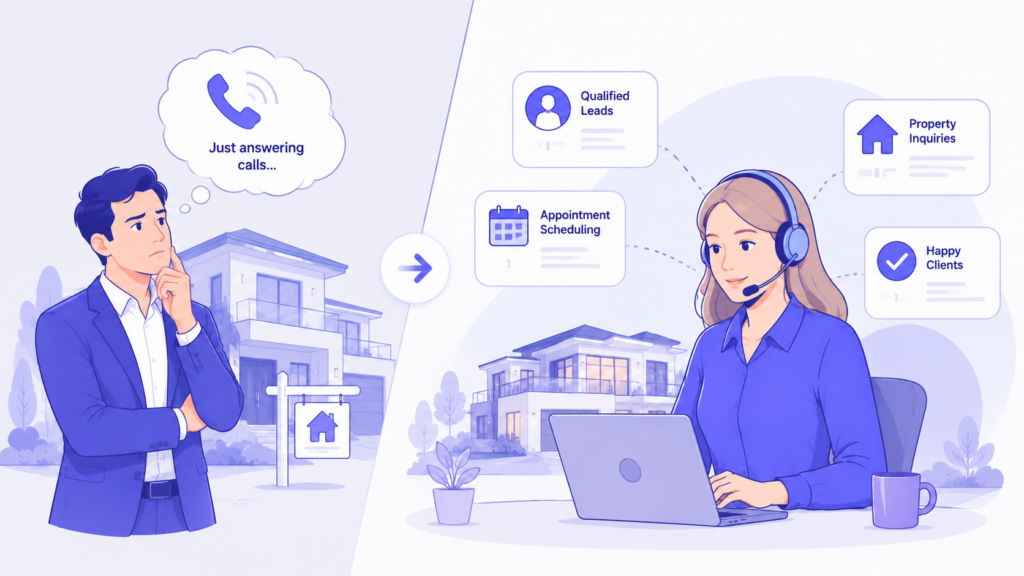
Ask ten agents what a real estate answering service does, and most will describe a basic message-taking line. They picture someone scribbling down a name and number, nothing more. That picture is outdated. A modern virtual receptionist realtor team's work does far more than relay messages; it screens callers, captures details a CRM can use, and routes urgent buyers straight to a live agent. The gap between what agents expect and what these services deliver is exactly where deals get lost, or won, depending on which side of that gap an agent lands on.
The myth goes like this: hire an answering service, plug it in where voicemail used to sit, and call it done. Voicemail collects a message and hopes someone calls back before the lead cools off. A real call handling system works while the agent is still mid-show. It doesn't wait for someone to check messages later. The difference matters most in the first five minutes after a buyer calls, since that's the window where most leads either convert or disappear for good.
A real virtual receptionist realtor team relies on qualifying the caller before the agent ever sees a missed-call notification. It asks whether they're pre-approved, what neighborhoods they're considering, and whether they're ready to see a property this week. That information lands in the CRM automatically, so the agent calls back already knowing who they're talking to. Instead of a blank "missed call" notification, the agent gets a warm lead with context attached, ready to convert into a showing.
A good answering service for real estate agents doesn't just answer the phone; it pre-qualifies the person on the other end. That means the difference between getting a callback list full of curious browsers and getting a callback list full of people ready to buy.
A trained agent or AI system on the call asks specific questions. Are they working with a lender already? Do they need to sell a home first? Are they looking in a specific price range? Each answer gets logged and passed along, so the listing agent isn't starting from zero on the callback.
This matters more in real estate than most other industries because the sales cycle moves fast and commissions depend entirely on closed deals, not just conversations. A service that filters out tire-kickers from serious buyers saves agents hours every week, time that goes straight back into showings and follow-ups instead of chasing dead ends.
Real estate doesn't run on a nine-to-five schedule, and buyers know it. Evening and weekend calls often come from the most motivated people: someone who just left an open house and wants more details, or a buyer who finally got their spouse on board after dinner.
These calls carry urgency that daytime calls don't always have, which makes missing them especially costly. An after hours answering service built for this industry treats those calls as a priority, not an inconvenience to be dealt with the next morning.
Industry response-time research has shown for years that contacting a lead within the first five minutes dramatically increases the odds of conversion compared to waiting even thirty minutes. After-hours callers already know they're reaching out outside business hours, which means they're motivated enough to call anyway. They aren't casually browsing listings online; they're ready to talk. An agent who picks up that call, or has it picked up properly, captures a buyer who's already past the window-shopping stage and into decision mode.
This is where a live answering service real estate teams trust earns its value. Instead of routing every after-hours call to an automated system alone, a live agent picks up, confirms the buyer's details, and can even schedule a showing on the spot. That combination of speed and a real human voice reassures callers they're dealing with a serious operation. Pair that with an after hours answering service that never closes, and an agent effectively never misses a window again.
Most agents assume they have to choose between cheap automation and expensive live receptionists. That's no longer how the best real estate answering service options work. The two aren't competitors anymore; they're built to hand off to each other depending on what the call needs. An AI system can answer instantly and gather the basics, then route anything that needs a human touch straight to a live agent, all within the same call and often within the same plan.
The AI layer typically answers the call within a second or two, which already beats most human response times. It asks simple qualifying questions, confirms the property or area of interest, and asks if the caller needs something urgent. For routine inquiries, such as a request for a listing’s square footage or asking price, the AI can answer directly without ever needing a human on the line, freeing up live agents for calls that actually need a person.
Anything more complex gets routed to a live person automatically, usually within the same call rather than a separate callback. If a buyer wants to negotiate, ask about financing options, or schedule a same-day showing, the system passes them straight to a human. Blazeo's setup pairs AI call answering with US-based live agents at no added cost, so agents get instant pickup and a real conversation whenever the call actually calls for one.
One of the most overlooked parts of a real estate answering service is what happens after the call ends. A basic service hands the agent a phone number and a name, leaving the agent to manually enter everything into their CRM and check their own calendar for openings. A connected setup skips that step entirely.
When a call comes in, the system can log the lead directly into the CRM the agent already uses, complete with notes from the conversation. If the caller wants to book a showing, the system checks the agent's real calendar availability and confirms a time on the spot, instead of leaving that back-and-forth for later. That single integration removes hours of manual data entry every month, and it means no lead slips through the cracks because someone forgot to write down a name on a sticky note.
Buyers calling about a property are often calling several agents or checking several listings at once. Whoever responds first usually gets the showing and often gets the deal. That single fact is the real reason a real estate answering service matters more than agents tend to assume.
Speed isn't just about picking up the phone quickly, either. It's about answering with enough information to keep the buyer engaged instead of stalling them with "let me check and call you back." We at Blazeo built our approach around closing that gap entirely, so the person answering the call already has access to listing details, availability, and next steps the moment the phone rings. A buyer who gets real answers immediately is far less likely to call the next name on their list, which is exactly the outcome that protects an agent's commission.
Not every option on the market delivers the same results, even though most marketing pages sound identical. Before signing up, run any realtor answering service through this checklist:
A service that checks all six boxes costs more in lost commissions to skip than it ever costs to use.
It answers calls on an agent's behalf, qualifies the caller, logs their details, and routes urgent buyers to a live agent. Modern setups also connect to CRMs and booking calendars, handling far more than simple message-taking.
Neither wins alone for a real estate agent's calls. AI answers instantly and handles routine questions, while live agents step in for negotiations or complex requests. The best results come from both working together on the same call.
Pricing for a realtor answering service varies based on call volume and whether AI, live agents, or both are included. Most services charge monthly plans rather than per-minute fees, making costs predictable for budgeting.
Yes, most modern real estate answering service platforms integrate directly with popular CRMs. Calls get logged automatically with caller details and notes, so agents don't need to manually enter information after every conversation.
Yes. Evening and weekend callers tend to be more motivated buyers, and missing those calls often means losing the lead to a competitor within hours. Live after-hours coverage captures deals that would otherwise slip away entirely.
Most systems disclose this naturally during the call. Many buyers don't mind speaking with AI for simple questions, especially when it answers immediately and hands off to a live agent when needed.
Most providers can have a basic call answering setup running within a few days. Full CRM and calendar integration may take slightly longer, depending on which platforms the agent already uses.
Reliable providers build in backup routing, so calls forward to a secondary number or live agent automatically if the primary system has an outage, preventing a missed call from turning into a lost lead.
Most agents still treat their real estate answering service as a background utility instead of a revenue tool, and that's the real secret behind this whole guide. Every missed call is a buyer who found someone else first. The fix isn't complicated: pair instant AI response with live human backup, qualify every lead before the callback, and make sure after-hours coverage is actually live, not just a recording.
Agents who set this up properly stop losing deals to slow response times and start converting calls they used to miss entirely. The next buyer who calls deserves an answer, not a voicemail greeting, and the agent on the other end deserves the commission that comes with it.