SmartHub
 Automation
 Appointment Scheduler
 Lead Management
 Dashboard & Reports
 Task Management
 Communications Hub
 Managed chat
 Voice Receptionist
 Appointment scheduling
 Retainer signing
 Home services
 Lawyers and firms
 Medical services
 College admissions
 Real estate agents
 Marketing agencies
 About
About Partner program
 Estimate Your ROI
 Case Studies
 Blog
Blog FAQs
FAQs Login
LoginFrom Visitor to Buyer Instantly: Power of E-commerce Live Chat




Products
Industries
Company
Resources

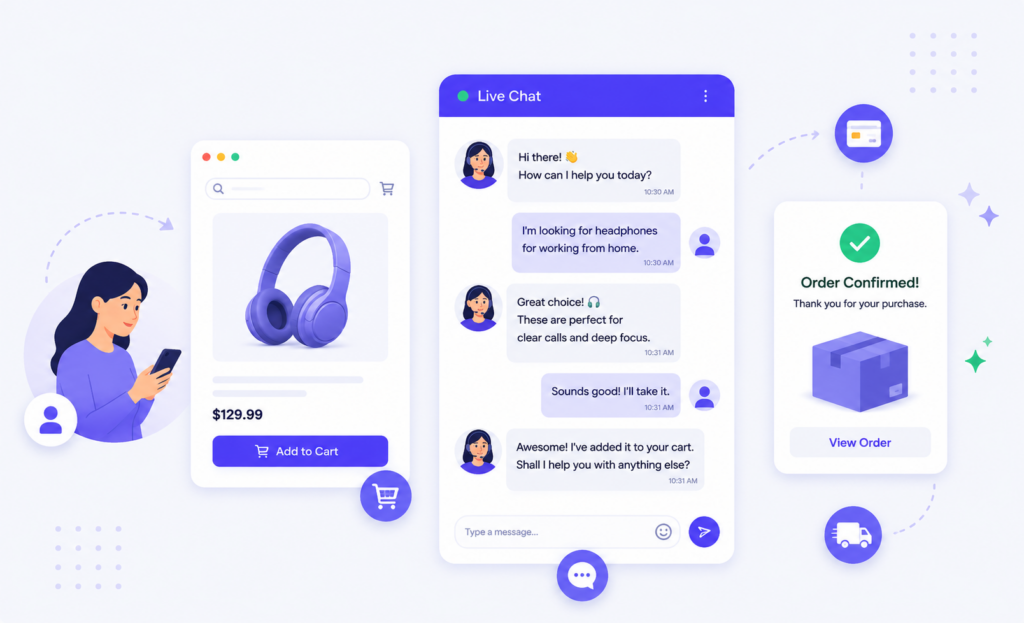
You've spent real money getting people to your store. Ads, SEO, social media. Then someone lands on your product page, sits there for two minutes, and leaves. No purchase. No message. Just gone. That's not a traffic problem. That's a conversation that never happened. E-commerce live chat exists to stop exactly that from happening.
In this blog, you'll learn why shoppers leave, how live chat turns hesitation into sales, what features actually matter, and which mistakes are quietly bleeding your revenue. If your live chat software for your website isn't pulling its weight, keep reading.
Here's something most store owners don't want to hear. The shopper who just left your site probably wanted to buy. They weren't browsing casually. They were on your product page, reading the description, checking the images. Then something stopped them. A question popped into their head. "Does this ship fast enough?" "What if it doesn't fit?" "Is this brand actually legit?" And nobody was there to answer it. So they closed the tab and went somewhere else.
That's exactly what live chat support services are built to prevent. Not fancy features. Not automation gimmicks. Just someone being there when the doubt shows up. The research backs this up consistently. Cart abandonment rates hover around 70% across most e-commerce categories. A big chunk of those abandoned carts comes from unanswered questions, not pricing objections.
Shoppers aren't always leaving because you're too expensive. They're leaving because they weren't sure, and nobody gave them a reason to stay. Live chat service lead generation begins the moment a visitor lands on your page. Every second they spend without engagement is a second closer to them leaving. Proactive chat flips that script entirely.

Most store owners think of chat as a support tool. Something you add so customers can reach someone who isn't in your email inbox. That's a very limited way to see it. E-commerce live chat is a sales channel. A direct one. When your team uses it correctly, it catches buyers at the highest-intent moment they'll ever be in, which is when they're on your product page with their credit card nearby, and it gives them the one thing they need to complete the purchase.
The difference between reactive and proactive chat is massive. Reactive chat sits in the corner waiting to be clicked. Most visitors never click it. Proactive chat shows up based on behavior. Does someone spend 90 seconds on a product page without adding to the cart? Chat appears. Someone tries to leave? Chat appears. That's not annoying. That's attentive.
Not every visitor converts on the first visit. That's just reality. But losing them completely is avoidable. When chat engages a visitor who isn't ready to buy, the goal shifts. Instead of closing a sale, you're capturing a lead. A name. An email. A product interest. That visitor who wasn't ready today becomes a warm prospect tomorrow. Live chat service lead generation works this way because a conversation feels personal. Filling out a form feels like homework.
Live chat software solutions that connect directly with your CRM make this process automatic. Your agent captures the lead, the data flows into your pipeline, and your marketing team picks it up from there. Nothing slips through. No manual entry. No follow-up falling through the cracks.
The other thing proactive chat does is qualify visitors in real time. Not everyone who chats is a buyer. Some are just curious. Knowing the difference early saves your agents time and helps you focus energy on the people most likely to convert.
This is the part that actually shows up in your revenue numbers. A visitor is comparing your product to a competitor's. They have one specific question. Your agent answers it clearly, confidently, and fast. Your agent closes the sale. That's not a complicated scenario. It happens dozens of times a day for stores that have chat set up correctly.
Good agents don't just answer questions. They read the conversation. "Most customers who buy this also grab the carrying case" is not a pushy upsell. It's genuinely helpful. That's the tone live chat support services should always carry. Helpful first. Salesy never.
Response time is a bigger deal than most people realize. Thirty seconds feels instant to a shopper. Three minutes feels like being ignored. Live chat software for e-commerce with smart routing makes sure the right agent picks up the right chat before the buyer loses patience and goes elsewhere.
Not all live chat tools are worth your money. Some look impressive in a demo and underdeliver the moment real customers show up. The features below are what actually determine whether your chat drives revenue or just sits there collecting dust.
These are the non-negotiables. If a tool doesn't offer these, move on.
Live chat software for e-commerce without these basics will frustrate your team as much as your customers. Get these right before looking at anything else.
Live chat software for website setup should feel straightforward. If it takes more than a day to install and configure, that tells you the developers didn't build it with real store owners in mind.
Once the core is solid, these are what separate average results from genuinely strong ones. Behavioral triggers are the most underrated feature in live chat. Chat appearing based on cart value, time on page, or which product category someone is browsing isn't random. It's intentional. A visitor with $300 in their cart who has been on the checkout page for four minutes deserves a different message than someone who just landed on the homepage. Live chat software solutions with this level of targeting let you treat every visitor as an individual rather than a number.
CRM integration means your agents already know who they're talking to before they send the first message. Order history, browsing behavior, and previous conversations. That context changes everything. Conversation analytics close the loop by showing you which chats actually led to purchases. Live chat software for a website that tracks this data turns your chat from a gut-feel exercise into something you can measure and improve week over week.

This decision matters more than most store owners give it credit for. The wrong provider costs you time, money, and a lot of missed sales. The right one becomes one of your most consistent revenue sources, which is why it's worth comparing the best live chat software options
Before you sign anything, ask these questions directly:
Live chat service providers who can't answer these clearly aren't ready for serious e-commerce clients. Don't let a slick demo distract you from asking the hard questions.
At Blazeo, we offer managed live chat with real trained agents backed by AI support, built specifically for e-commerce stores. We don't make you choose between a bot and a human. Our clients get both working together, which means faster responses for simple questions and smarter conversations for complex ones. Live chat software for e-commerce at this level is what actually changes revenue numbers rather than just support metrics.
Watch out for providers who lock you into long contracts with no performance accountability, platforms with no mobile widget, and tools that don't connect with your existing tech stack. Those are red flags worth taking seriously.
The smartest stores don't treat chat as a standalone tool. They connect it to everything. Your chat conversations are full of intelligence that most businesses ignore completely. Shoppers tell you exactly what's confusing about your product pages. They tell you what's making them hesitate. They tell you what objections your ads aren't addressing. That information should flow directly into your content team, your product descriptions, and your ad copy. E-commerce live chat data is live market research. If you treat it as only a support log, you're leaving serious money on the table.
Connect chat to your email flows. A visitor who chatted but didn't buy can trigger a follow-up sequence automatically. Connect it to retargeting. Someone who asked about a specific product is the warmest possible audience for an ad featuring that exact item. Live chat service providers who offer these integrations aren't just selling a chat widget. They're giving you a connected system where every touchpoint reinforces the others.
At Blazeo, we've built our platform around exactly this kind of integration. Our clients connect chat with their CRM, tag conversations by intent, and feed that data into their marketing workflows automatically. For stores that want to grow without hiring a bigger team, that kind of setup genuinely changes how the business runs. Live chat software solutions that grow with your business save you from rebuilding everything on a new platform every time you hit a growth milestone.
Retention is the angle most stores overlook entirely. Post-purchase chat support reduces return rates and builds the kind of loyalty that turns one-time buyers into repeat customers. Someone who gets fast, helpful support after a problem is far more likely to buy again than someone who waits four days for a reply.
A lot of stores add live chat, see no results, and assume chat doesn't work. Usually, the tool isn't the problem. The most common issue is passivity. Reactive chat, where you sit and wait for customers to start the conversation, catches maybe 10 to 15 percent of the people who have a question. The rest leave quietly. Proactive chat, triggered by behavior, catches people before they make that decision. That shift alone changes results dramatically.
Live chat support services only perform when your team builds a real system around them. Trained agents, clear response guidelines, escalation paths for tricky conversations, and someone reviewing performance data regularly. Without that structure, chat becomes a box you check rather than a channel that works.
Q1: Do I really need live chat for my online store?
Yes, especially if cart abandonment is eating into your numbers. Shoppers who get instant answers buy far more often. E-commerce live chat isn't optional anymore for stores serious about competing on customer experience.
Q2: How much does live chat software actually cost?
Pricing ranges from free basic tools to several hundred dollars monthly for managed services. Live chat software solutions with real agents cost more upfront but typically deliver a return on investment faster than self-serve platforms do.
Q3: Can live chat really increase my online sales?
Yes, and consistently so for stores that use proactive triggers rather than just reactive support. Your team reaching out first is what drives the numbers. Waiting for customers to click the chat icon rarely moves the needle.
Q4: What questions do customers ask most in live chat?
Shipping timelines, return policies, sizing, and payment options come up constantly. Good live chat support services keep ready-made answers for these, so your agents reply fast without sacrificing accuracy or sounding robotic.
Q5: How do I set up live chat on Shopify quickly?
Most live chat software for website tools offer a Shopify app or a simple embed code. You can install it in minutes. The real work is writing your opening messages and setting your behavioral triggers correctly.
Q6: Should I use a chatbot or hire someone for live chat?
Both work best together. Bots handle repetitive questions after hours. Human agents handle anything requiring real judgment. Live chat service providers who offer this hybrid model give you strong coverage without the cost of running a full in-house team around the clock.
Q7: How do I find reliable live chat support staff?
Look for people with strong written communication skills and a customer service background. Many businesses work with managed providers instead of hiring directly, which cuts training time significantly. Live chat service lead generation-focused providers often include agent management as part of their core offering.
Q8: How do I train my team for better live chat support?
Start with deep product knowledge, then work on tone and response time targets. Your team should review real chat transcripts together weekly and talk through what worked and what didn't. Consistent practice beats a one-time training session every single time.
Every visitor who left without buying had a reason. Most of the time, it was a question your team never got the chance to answer. E-commerce live chat changes that dynamic completely. It puts real help at the exact moment buyers need it, captures leads before they disappear, and builds the kind of trust that turns first-time visitors into paying customers. The stores growing consistently right now aren't running more ads than everyone else.
They're just better at holding onto the visitors they already have. Build your chat system properly, work with live chat service providers who genuinely understand what e-commerce demands are, and the results will follow.