 SmartHub
 Automation
 Appointment Scheduler
 Lead Management
 Dashboard & Reports
 Task Management
 Communications Hub
 Live chat
 AI chatbot
 Voice AI
 Voice call centers
 Appointment scheduling
 Retainer signing
 Home services
 Lawyers and firms
 Medical services
 College admissions
 Real estate agents
 Marketing agencies
 About
About Partner program
 Estimate Your ROI
 Case Studies
 Blog
Blog FAQs
FAQs Login
LoginEthical AI in Customer Engagement: Responsible Automation at Scale




Products
Industries
Company
Resources
As of March 2024 we have renamed Apexchat to Blazeo. We are excited to share the next part of our journey with our customers and partners.
The name ApexChat implies that we are primarily a chat company, which is no longer true. Now we have many offerings, such as call center services, AI, Appointment setting, SMS Enablement, Market Automation, and Sales acceleration (Q2 2024), that go beyond chat. The new name will not only allow us to convey the breadth of our offering but will also better convey our company’s mission and values.
Blazeo, which is derived from the word Blaze, evokes a sense of passion, speed, and energy. A “Blaze” is captivating, illuminates, and represents explosive growth. Blazeo encapsulates our mission to ignite such growth for our customers and partners by delivering innovation with passion, speed, and energy.


Ethical AI in customer engagement is now a business requirement, not a future ideal. As automation becomes the default way companies communicate, it directly shapes trust, privacy, and customer perception.
AI systems now qualify leads, send messages, and guide conversations at scale. These systems act faster than humans and influence decisions before a person intervenes.
When designed responsibly, automation improves relevance and efficiency. When designed carelessly, it creates bias, erodes transparency, and treats customers as data instead of people.
The challenge is not whether AI should be used. The challenge is how organizations apply ethical AI in customer engagement without violating privacy, undermining human dignity, or creating trust gaps that quietly damage performance.
Teams that solve this don’t just scale automation. They scale trust.
Ethical AI in customer engagement is the practice of using automation and artificial intelligence to interact with customers in ways that are transparent, privacy-respectful, bias-aware, and guided by human oversight.

Ethical failures in customer engagement rarely come from bad intent. They come from speed. A model is trained to optimize response time, not emotional context. A workflow is built to maximize conversion probability, not human dignity. Somewhere along the way, automation begins acting in moments where restraint would have been more appropriate.
Consider automated follow-ups that trigger after a medical inquiry or bereavement-related contact. Or AI lead-scoring systems that deprioritize prospects based on geography, language patterns, or time-of-day behavior that quietly correlates with socioeconomic bias. None of these systems were “designed” to discriminate or dehumanize. They simply optimized the wrong thing for too long without oversight.
This is the trust gap automation creates. Customers don’t object to AI because it’s artificial. They object when it feels careless, opaque, or predatory.
Also read: AI Agents vs Human Agents in Sales: Cost, Speed & Conversion
Responsible AI automation starts with transparency, not as a disclaimer but as an experience. Customers should know when they’re interacting with an AI system, what it can and cannot do, and how to reach a human when stakes rise. When this clarity is missing, even helpful automation feels manipulative.
Transparency also applies internally. Growth teams need to understand why an AI system made a recommendation, routed a conversation, or suppressed a lead. Black-box decisioning doesn’t just undermine ethics; it erodes confidence across sales, support, and marketing teams who are expected to act on those outputs.
This is why regulatory frameworks like the GDPR and the forthcoming EU AI Act emphasize explainability and user rights. But even outside compliance, transparency is a competitive advantage. When customers understand the logic behind engagement, they are more likely to trust it—and stay.
AI bias in customer engagement is rarely obvious. It doesn’t announce itself. It accumulates quietly through training data, feedback loops, and performance metrics that reward efficiency over fairness. A system trained on past “high-value” customers will replicate past exclusion. A conversational model optimized for speed may mishandle non-standard language or accents.
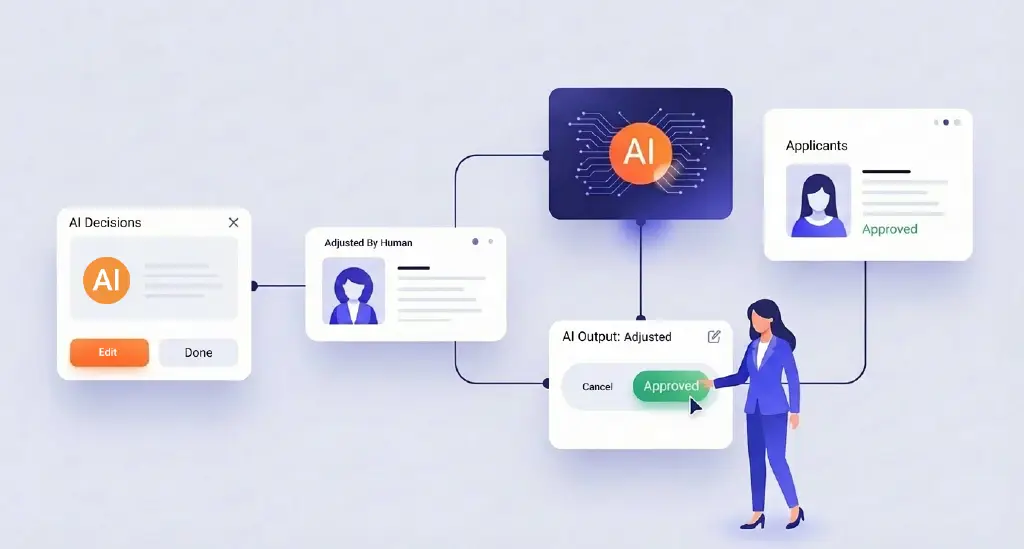
Responsible AI teams don’t assume neutrality. They assume drift. Bias mitigation becomes an ongoing practice, not a one-time audit. Engagement outcomes are monitored across segments. Escalation rates, response quality, and conversion paths are examined for disparities. When models behave unexpectedly, humans intervene—not to override intelligence, but to recalibrate it.
This is where human-centered AI becomes practical, not rhetorical. Automation handles volume and consistency. Humans protect judgment, context, and dignity.
Personalization is only powerful when it feels invited. When AI uses data customers didn’t realize they shared—or uses it longer than expected—trust erodes instantly. Ethical AI marketing treats privacy as a relationship, not a checkbox.
This means collecting only what’s necessary, being explicit about how data is used, and designing automation that respects boundaries by default. Responsible systems don’t chase maximum personalization; they aim for appropriate relevance. They avoid sensitive inference. They make opt-outs easy and honored across channels.
Privacy compliance isn’t just about avoiding penalties. It’s about signaling restraint. Brands that show discipline with data earn permission to engage more deeply over time.
Also read: AI Appointment Frameworks: Fully Automated vs. Human-Led

The most ethical AI systems know when to stop. They recognize emotional complexity, uncertainty, or escalation risk and route conversations to humans without friction. Customers don’t want to “fight” automation to reach a person. They want reassurance that a person is available when needed.
Human-centered AI doesn’t eliminate jobs; it reshapes them. Agents become decision-makers, not script-readers. Sales teams focus on qualified conversations, not chasing misclassified leads. Support teams handle nuance instead of repetitive triage. Automation becomes an amplifier, not a replacement.
One of the biggest mistakes companies make is treating ethics as a cost center. In reality, responsible automation produces measurable gains when teams know where to look. Reduced opt-out rates improve deliverability. Fairer qualification increases pipeline quality. Transparent engagement lowers complaint resolution costs. Trust compounds lifetime value.
This is where ROI calculators belong—not as sales gimmicks, but as decision tools. By modeling scenarios with and without ethical safeguards, growth teams can quantify the cost of shortcuts. Over time, responsible AI reduces churn volatility, improves data quality, and stabilizes acquisition economics.
Ethics doesn’t slow growth. It removes hidden friction that quietly taxes it.
Also read: AI-Driven Customer Journey Analytics Beyond Lead Capture
What is ethical AI in customer engagement?
Ethical AI in customer engagement means using automation and artificial intelligence in ways that respect privacy, minimize bias, remain transparent, and preserve human dignity—while still supporting business growth.
Why is ethical AI important for customer experience?
Because customers notice when automation feels invasive, biased, or careless. Ethical AI builds trust, improves long-term engagement, and reduces opt-outs, complaints, and churn.
How does responsible AI automation affect trust?
Responsible automation earns trust by being transparent, explainable, and respectful. Customers are more likely to engage when they understand how AI is used and can easily reach a human when needed.
Can AI automation be both ethical and scalable?
Yes. Ethical AI doesn’t slow growth—it removes hidden friction. Systems designed with privacy, fairness, and human oversight scale more sustainably and perform better over time.
What role do humans play in ethical AI systems?
Humans provide judgment, context, and accountability. Ethical AI systems know when to hand off conversations, escalate sensitive situations, and allow people to intervene when nuance matters.
Does ethical AI improve business performance?
Yes. Ethical AI reduces churn volatility, improves data quality, increases engagement rates, and strengthens lifetime customer value—making trust a measurable asset.

Responsible AI doesn’t belong solely to legal or compliance teams. Ownership must be shared across marketing operations, revenue operations, product, and customer experience. Clear governance defines who audits models, who approves automation logic, and who owns escalation protocols.
Without governance, ethics becomes reactive. With it, responsible AI becomes repeatable. Teams move faster because guardrails are clear. Decisions are documented. Accountability exists before something goes wrong—not after.
As AI becomes ubiquitous, differentiation shifts. Customers will assume automation. What they will notice is how it treats them. Brands that prioritize ethical AI marketing, transparency, privacy compliance, and human dignity will stand out—not because they talk about ethics, but because their engagement feels respectful by default.

Irresponsible automation may win short-term efficiency. Responsible automation wins markets. It builds systems customers are willing to stay inside, recommend, and return to. This is where platforms like Blazeo focus their advantage—enabling AI-driven conversations that are transparent, privacy-conscious, and designed with clear human-in-the-loop controls, so growth teams can scale without eroding trust.
The future of customer engagement won’t be defined by who automates the fastest. It will belong to the teams who automate with intention—proving, at scale, that intelligence and integrity are not trade-offs, but multipliers.

