 SmartHub
 Automation
 Appointment Scheduler
 Lead Management
 Dashboard & Reports
 Task Management
 Communications Hub
 Live chat
 AI chatbot
 Voice AI
 Voice call centers
 Appointment scheduling
 Retainer signing
 Home services
 Lawyers and firms
 Medical services
 College admissions
 Real estate agents
 Marketing agencies
 About
About Partner program
 Estimate Your ROI
 Case Studies
 Blog
Blog FAQs
FAQs Login
LoginHow CRM Strengthens Post-Sale Customer Relationships





Products
Industries
Company
Resources
As of March 2024 we have renamed Apexchat to Blazeo. We are excited to share the next part of our journey with our customers and partners.
The name ApexChat implies that we are primarily a chat company, which is no longer true. Now we have many offerings, such as call center services, AI, Appointment setting, SMS Enablement, Market Automation, and Sales acceleration (Q2 2024), that go beyond chat. The new name will not only allow us to convey the breadth of our offering but will also better convey our company’s mission and values.
Blazeo, which is derived from the word Blaze, evokes a sense of passion, speed, and energy. A “Blaze” is captivating, illuminates, and represents explosive growth. Blazeo encapsulates our mission to ignite such growth for our customers and partners by delivering innovation with passion, speed, and energy.

There’s a moment in every growing business when the truth becomes impossible to ignore. It usually sneaks in quietly—during a customer complaint that should’ve been preventable, or a renewal that never materialized, or a loyal client who suddenly faded out without explanation. And someone, often in a weekly meeting that was supposed to be about lead performance, finally asks:
“Are we actually staying connected to people after they buy?”
It’s an innocent question, but it hits with the force of a confession.
Because the honest answer, for most teams, is no.
The attention, the urgency, the coordination—all of it is poured into the pre-sale stage. The pursuit is exciting. New leads feel like new beginnings. Everyone rallies, everyone contributes, everyone knows which dashboard to check or which funnel to optimize. Acquisition is the thrilling part of the relationship.
But relationships aren’t built in thrilling moments. They’re built in the quiet ones.
After the deal closes.
>After the email thread ends.
>After the welcome call is done.
That’s where customers decide whether they want this relationship to be a one-time interaction… or something that grows roots.
And that’s exactly where most businesses lose the plot.

Customers rarely leave because the business failed them in one dramatic moment. They leave because the business forgot them in many small ones.
A follow-up that never went out.
A question they had to repeat because the last conversation wasn’t logged.
A support ticket lost between departments.
An appointment reminder that should have been automatic, but wasn’t.
A renewal date that slipped through cracks no one even knew existed.
It’s almost never intentional.
It’s almost always structural.
Because in growing teams, customer information tends to live everywhere except in one place. A conversation in someone’s inbox. A screenshot in someone’s phone. A complaint in someone’s Slack DM. A promise that was made verbally but never documented. A chat transcript stuck inside the live-chat tool. A quote sitting in a PDF that no one revisited.
The customer remembers everything.
The business remembers almost nothing.
Not because people don’t care, but because memory is a bad system for managing relationships.
A CRM becomes the remedy—not a tool for sales pipelines or reporting dashboards, but the company’s memory. And memory is where loyalty begins.
Every customer wants to feel like more than a line item. They want to feel like the company knows them—really knows them. Not in a creepy way. In a context-driven, “you actually heard me the first time” kind of way.
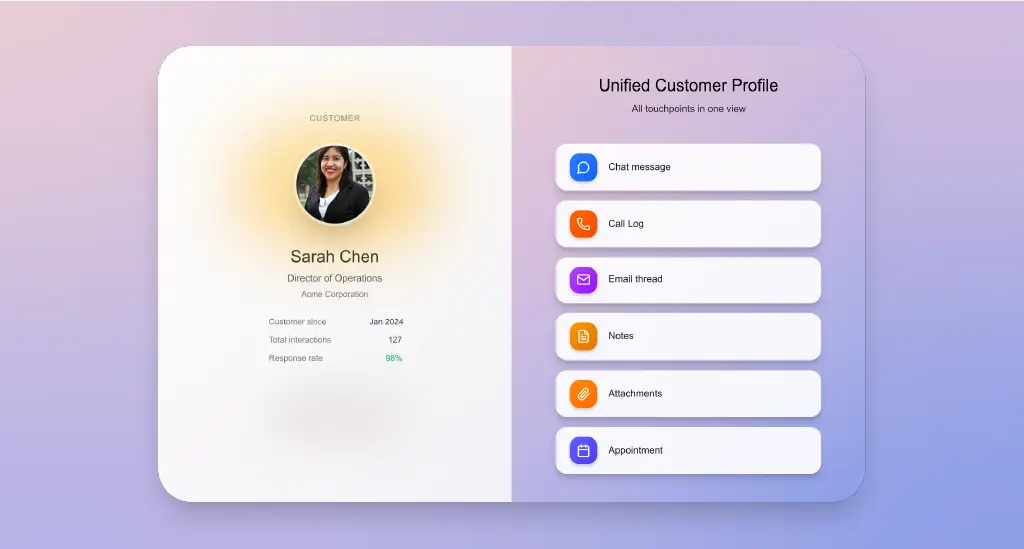
Imagine a customer reaching out three months after purchase with a simple question. There is nothing extraordinary about the situation. But something extraordinary happens when the person responding already sees the entire story. The initial chat. The purchase conversation. The email thread with a previous agent. The notes someone left internally. The attachment the customer sent. The appointment date. The follow-up that happened (or didn’t).
The customer doesn’t have to repeat anything.
They don’t have to explain themselves again.
They don’t have to fear being passed around like a parcel.
Instead, they feel known.
And people stay where they feel known.
Blazeo’s CRM, with its unified customer record, quietly facilitates this sense of recognition. Not by drowning teams in features, but by giving them the full picture every single time, so the customer never experiences the burden of reintroducing themselves.
Retention is not a discount strategy.
Retention is a recognition strategy.
Also read: Voice AI CRM for Customer Intelligence | The Future of CRM | Blazeo
Most companies believe loyalty is built during service delivery—when things are happening, when emails are active, when the relationship feels “live.”
But anyone who has ever been a customer knows that the most meaningful part of the journey happens between the action items. The check-in after installation. The small message after a support call. The reassurance that arrives before anxiety does. The reminder that lands before a deadline is forgotten.
These micro-moments, the ones no one remembers to manually send, are the heartbeat of the relationship. When they disappear, the heartbeat slows. When they’re consistent, the relationship feels alive.
Workflows inside a CRM are often misunderstood as automation.
But the more accurate description is rhythm.
Businesses don’t lose customers because they don’t care.
They lose them because relationships without rhythm fall apart.
When Blazeo’s CRM sends a follow-up without being asked, when it nudges a customer gently at the right moment, when it checks on someone after a lull that could have turned into silence—the company feels present. The experience feels human even when powered by systems.
This is how customers stay long before they consciously decide to stay.
Referrals are often treated like a marketing lever. “Ask for them.” “Offer an incentive.” “Send a link.”
But people don’t refer because a business asked.
People refer because the business made their life easier.
They refer when they feel confident that whoever they recommend will experience the same care they did. That confidence grows even more when they trust the company not to embarrass them. And referrals become almost effortless when the relationship was strong enough that they’re willing to stake a bit of their own reputation on it.
And the feeling that creates that confidence is the feeling of effortlessness.
The seamless communication.
The proactive updates.
The lack of friction.
The absence of surprises.
A CRM makes this possible not through gimmicks, but through consistency. When every exchange is logged, when every team member speaks with the same context, when customers never face the chaos of starting over, the experience becomes predictable in the best possible way.
That predictability cultivates trust.
Trust cultivates referrals.
The CRM can suggest the perfect moment to ask—after a resolved issue, after a successful appointment, after a visible sign of customer happiness. And because the ask comes on the other side of a positive emotional moment, it doesn’t feel like a tactic. It feels like a continuation.
Referrals grow in the soil of genuine satisfaction, not marketing prompts.
There is something delicate about renewals.
>They don’t come with the excitement of new sales.
>They don’t trigger the adrenaline of closing a deal.
>They don’t get celebrated with champagne or Slack emojis.
But they are the quiet engine of predictable growth.
And yet, companies lose renewal revenue more often than they lose customers. Which is to say: many customers intended to stay… but the business never asked at the right time.
Proper renewal management is not about persuasion. It’s about presence.
Customers renew when the relationship has felt continuous.
>They renew when they’ve been checked on before they need help.
>They renew when they’ve received reminders without being overwhelmed.
>They renew when the experience never drops them into a black hole of silence.
A CRM handles this not by sending robotic “your renewal is due” emails, but by maintaining a living timeline. When contract dates sit right next to appointment histories, when workflow nudges occur naturally, when reminders flow through SMS or email depending on what the customer responds to—renewals become less of a chase and more of a natural next step.
Blazeo CRM makes this process feel almost invisible. Customers feel guided, not pressured. They simply keep moving through a relationship that already works.
Renewals are loyalty made visible.
Also read: Integrate Sales & Support in a Unified CRM
There is an interesting shift that happens once businesses begin to experience loyalty as a measurable outcome rather than a philosophical ideal. They start to see that the warmth customers feel—the effortless communication, the intuitive follow-ups, the seamless handovers—has financial weight.
This is where the ROI Calculator becomes more than a feature. It turns into a mirror—one that makes everything a little clearer. Suddenly, the hours saved through automated follow-ups start to stand out. Then the recovered revenue from leads that no longer slip through the cracks comes into focus. Easier renewals show their impact next, bringing in steady income without extra effort. Referrals begin to reveal how much they trim acquisition costs. And finally, retention proves how it brings real stability to forecasting.
It quantifies the value of something deeply human: showing up at the right time.
Because loyalty isn’t just sentiment.
Loyalty is economics disguised as sentiment.

Companies that grow sustainably don’t chase the most leads. They steward their relationships the best.
A CRM designed for the full journey makes that stewardship possible.
Not by being complicated.
Not by being loud.
But by being the silent infrastructure that keeps every customer’s story continuous.
Blazeo CRM becomes the connective tissue—linking sales to support, support to operations, operations to marketing, and every team back to the customer. It ensures no moment is lost, no detail forgotten, no relationship abandoned in the noise of busy days.
The shift from leads to loyalists is not dramatic.
It is subtle, intentional, and deeply human.
It is the difference between chasing customers and keeping them.
Between having transactions and building trust.
Between being a service provider and becoming a constant.
In the end, loyalty isn’t built by the CRM.
It’s built by the team.
The CRM just ensures the team never forgets to show up.
And in a world filled with noise, the businesses that show up—consistently, thoughtfully, and with context—are the ones customers stay with, return to, and proudly recommend.
Because growth doesn’t begin with the sale.
It begins every day after.
Also read: Real-Time CRM for Faster Lead Response | Blazeo Advantage
Post-sale communication reassures customers, prevents silence, and creates continuity. When businesses show up consistently after a purchase, customers feel supported—not abandoned.
A CRM stores every interaction, note, appointment, and message. This unified context makes customers feel known and prevents them from repeating themselves—building trust and loyalty.
Key features include automated follow-ups, customer timelines, unified records, proactive reminders, workflow triggers, and renewal tracking.
Referrals grow when experiences feel effortless and consistent. A CRM ensures customers enjoy reliable communication, making them more confident about recommending your business.
CRMs keep contract dates, reminders, and customer histories organized. Timely nudges and consistent engagement make renewals feel natural—not forced.
Improved retention, higher renewal rates, recovered revenue, stronger referrals, and less manual work all contribute to measurable growth and operational efficiency.
If you want a system that helps you show up consistently, respond with context, follow through without forgetting, and build the kind of customer experience people talk about with their friends, then the journey starts with choosing a CRM that treats relationships the way you do — with care and intentionality.
Blazeo’s CRM was built for that kind of company.
Not the loudest.
Not the flashiest.
But the one that wants to remember its customers as well as its customers remember it.
If that’s the business you’re building, Blazeo is here to back you with the structure, the clarity, and the heartbeat your customer experience deserves.