 SmartHub
 Automation
 Appointment Scheduler
 Lead Management
 Dashboard & Reports
 Task Management
 Communications Hub
 Managed chat
 Voice Receptionist
 Appointment scheduling
 Retainer signing
 Home services
 Lawyers and firms
 Medical services
 College admissions
 Real estate agents
 Marketing agencies
 About
About Partner program
 Estimate Your ROI
 Case Studies
 Blog
Blog FAQs
FAQs Login
LoginCRM And Sales Automation: Best Practices For Your Business




Products
Industries
Company
Resources

Sales teams don't lose deals because they lack effort. They lose them because the process has too many gaps. A lead comes in at 4 pm on a Friday. Nobody follows up until Tuesday. By then, that person has already moved on. CRM and sales automation fill those gaps. Not perfectly, not magically, but consistently. And in sales, consistent beats brilliant almost every time.
This blog covers what actually works when setting up and running CRM and sales automation for your business. What to look for in a tool, where most teams go wrong, and how to measure whether any of it is actually doing what you paid for.
Nobody wakes up excited about data entry. But that's what sales looked like before any of this existed. Reps manually updating records, guessing which leads were warm, following up based on memory. It worked until it didn't.
Crm sales force automation is what happens when you stop running your sales process on memory and start running it on a system. CRM holds the history. Automation acts on it. Together, they make sure your pipeline moves forward even on the days your team is buried in everything else.
Think about the last time a lead came in after hours. Someone filled out a form at 9 pm. Did your team know about it by morning? Was it scored, routed, and sitting in the right rep's queue? Or did it land somewhere and wait for someone to manually check?
That's the gap a real sales automation system closes. Not just emails on a schedule but an actual process running in the background when nobody is watching:
Picture a typical sales day without any automation behind it. Rep opens inbox. Tries to remember who needed a follow-up. Opens spreadsheet. Updates three fields. Gets pulled into a call. Forgets two callbacks. Leads go cold.
That's not a people problem. That's a system problem. Sales automation in CRM fixes the system. Logging happens on its own. Follow-ups go out regardless of how the rep's day went. Everyone pulls from the same data instead of their own version of it stored somewhere in their head.
Small teams don't have the luxury of a missed follow-up. When you've got two or three reps handling everything, one bad week can quietly wipe out a month's worth of pipeline work.
Sales automation in CRM doesn't add people, but it does make sure the people you have aren't losing deals to something as fixable as a forgotten reminder. Response times stay fast. The pipeline stays visible. And nobody drops a warm lead because they got pulled into something else and lost track.
Bigger teams don't forget to follow up. Their problem is consistency across scale. Twelve reps, four regions, hundreds of active deals, and everyone doing things slightly differently.
Crm sales force automation is what keeps that from turning into chaos. Forecasting stops being a guessing game when the data comes from the system instead of whatever reps submitted before the Monday standup. Reporting reflects what's actually happening, not what someone remembered to log.
Every sales automation platform looks perfect during a demo. The workflow is clean, the dashboard is polished, and the sales rep knows exactly which buttons to press. Six months later, half the team has stopped logging in, and nobody can explain why.
The right platform isn't the flashiest one. It's the one that actually fits how your team works on a regular Tuesday, not an ideal Tuesday.
Cloud wins for most businesses, and that's just where things stand now. A cloud-based sales automation platform is up and running in days, updates itself, and works from wherever your team happens to be sitting.
On-premise gives you tighter control over your data. Some industries genuinely need that. But the setup takes longer, internal IT has to maintain it, and every change to the system becomes a project. For most sales teams, that trade-off rarely makes sense unless there's a specific compliance requirement pushing them in that direction.
A CRM that lives separately from everything else your team uses isn't solving the problem. It's just creating a different one. Automated sales CRM software needs to connect cleanly with your email platform, calendar, communication tools, and reporting software.
If someone still has to manually move data from one system into another, the automation isn't actually saving anyone time. That's the real test. Not whether the integration exists, but whether it actually removes a step from your team's day.
Buying the tool is the easy part. Most teams treat implementation like it ends when the account gets created. It doesn't. That's actually where the real work starts.
Automated sales CRM software needs clear goals before a single workflow gets built. At Blazeo, we've sat with teams who had everything switched on and still saw nothing move. Not a tool problem. A setup problem. Nobody had written down what they were actually trying to fix. Map the process first. Build the second. Train like it matters because it does.
Here's something most vendors won't tell you. CRM and sales automation can make your sales process worse if it's set up without any real thought behind it. Prospects start feeling like numbers. Reps stop updating the system because they don't trust it. Managers make calls based on data that stopped being accurate two months ago.
By the time anyone notices something's wrong, it's already been wrong for a while:
Most teams check their numbers at the end of the month. By then, whatever went wrong two weeks ago has already cost them three deals they'll never know about.
Your sales automation system should be something you check weekly at a minimum. Lead conversion rate, response time, and deal velocity. If any of those shift after you make a change to your automation, that's your signal. Something either started working better or quietly broke. Weekly reviews are the only way to know which one it is.
The teams that actually get results from CRM sales force automation do one thing differently. They go back in. They rewrite sequences that started sounding like a bot wrote them. They switch off workflows that stopped making sense. They update the system when the process changes instead of letting automation run on outdated logic for months.
At Blazeo, what separates teams that see results from teams that don't usually comes down to this one habit. Treat it like something alive, not something finished.
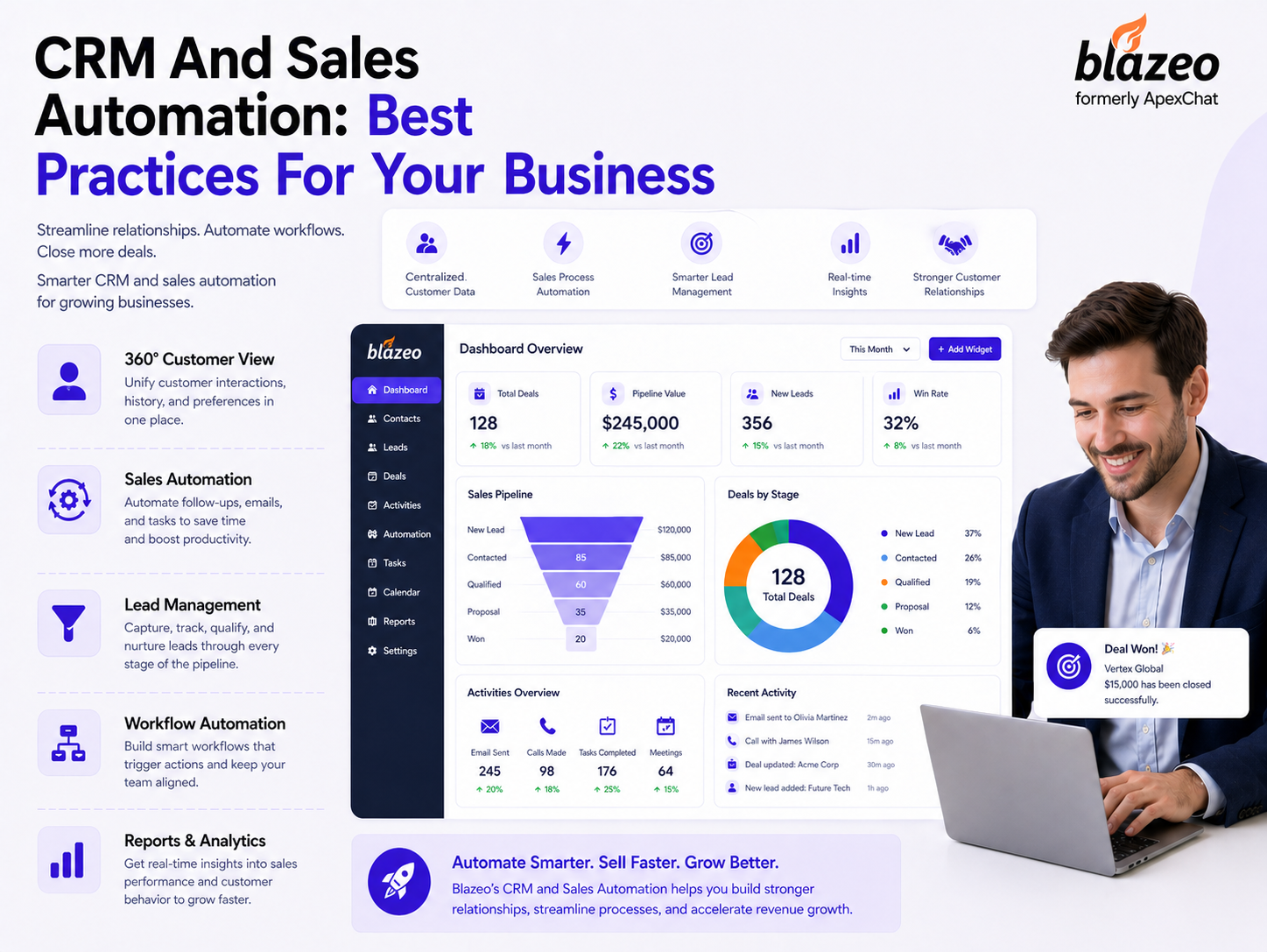
CRM is where your customer data, deal history, and contact records live. Automation is what acts on that data without someone manually pushing each step. Put them together, and you get a CRM and sales automation setup where your pipeline moves forward on its own most of the time.
It takes the repetitive parts of selling and hands them to software. Things like data entry, follow-up emails, lead routing, and activity logging. Your reps stop spending half their day on admin and start spending it on conversations that can actually go somewhere.
Orders get processed faster, errors drop, and your team stops chasing down status updates manually. Real-time visibility into every order means customers get accurate answers quickly, and the fulfillment side runs with far less back and forth.
Start with what your team actually needs today, not what you might need eventually. A sales automation platform that's too complex gets abandoned fast. Look for clean integrations, real support, and something your team can manage without needing a technical background.
Genuinely yes. A sales automation system lets a small team keep up with much larger competitors. Leads get followed up consistently, nothing gets dropped mid-cycle, and you get pipeline visibility that used to require a whole operations function to maintain.
At minimum, automated sales CRM software needs lead scoring, pipeline tracking, email sequences, and solid reporting. Integrations matter more than most people realize. And if demos and calls are central to how your team sells, scheduling support should be near the top of your list.
Weekly for anything obviously broken. Every quarter for a proper review. Sales processes change, and workflows that made complete sense six months ago sometimes don't reflect how things actually run anymore. Most teams audit far less often than they should.
Sales automation in CRM means the system handles the repetitive steps so your team doesn't have to. Follow-ups, lead assignment, status updates. It matters because your process shouldn't depend on everyone having a perfect week. The system stays consistent even when people can't.
Sales don't fall apart because people stop caring. It falls apart because the process behind it stops holding up. One missed follow-up, one cold lead, one week where everything got busy, and nothing got logged.
CRM and sales automation are what keep that from becoming a pattern. Clean pipeline. Consistent outreach. Reps focused on selling instead of chasing their own notes. None of this needs a massive rollout or a technical team behind it. It just needs someone to take it seriously from the start instead of treating setup as the finish line.
Start with one part of your process that keeps breaking. Fix that first. Then build from there. CRM and sales automation compound when it's built with real intention behind it.

