 SmartHub
 Automation
 Appointment Scheduler
 Lead Management
 Dashboard & Reports
 Task Management
 Communications Hub
 Live chat
 AI chatbot
 Voice AI
 Voice call centers
 Appointment scheduling
 Retainer signing
 Home services
 Lawyers and firms
 Medical services
 College admissions
 Real estate agents
 Marketing agencies
 About
About Partner program
 Estimate Your ROI
 Case Studies
 Blog
Blog FAQs
FAQs Login
LoginThe Hidden Cost of Fragmented Data in Business





Products
Industries
Company
Resources
As of March 2024 we have renamed Apexchat to Blazeo. We are excited to share the next part of our journey with our customers and partners.
The name ApexChat implies that we are primarily a chat company, which is no longer true. Now we have many offerings, such as call center services, AI, Appointment setting, SMS Enablement, Market Automation, and Sales acceleration (Q2 2024), that go beyond chat. The new name will not only allow us to convey the breadth of our offering but will also better convey our company’s mission and values.
Blazeo, which is derived from the word Blaze, evokes a sense of passion, speed, and energy. A “Blaze” is captivating, illuminates, and represents explosive growth. Blazeo encapsulates our mission to ignite such growth for our customers and partners by delivering innovation with passion, speed, and energy.

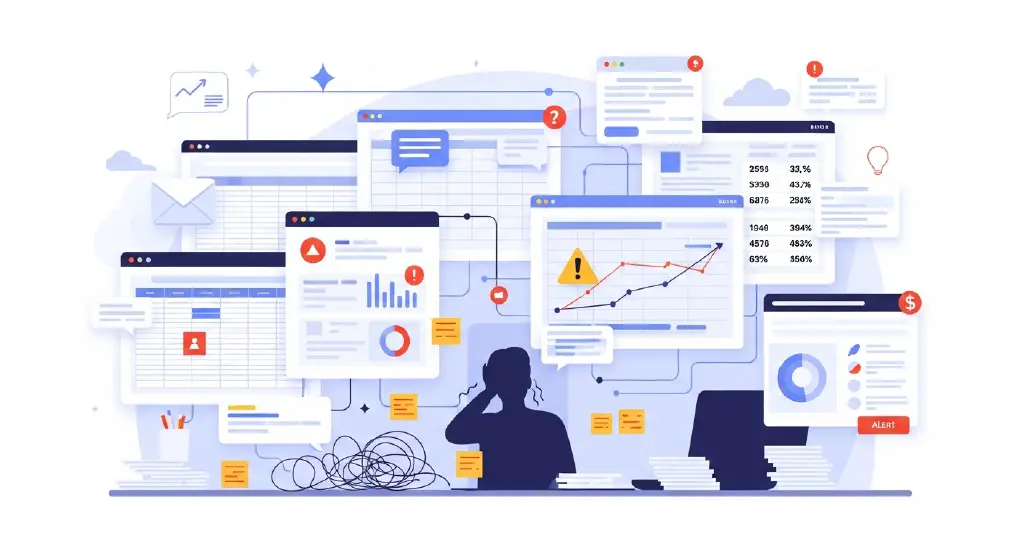
Every growing business eventually reaches a breaking point — a moment where things stop slipping and start spilling. A lead that was “definitely going to close” suddenly disappears. A support agent asks a customer for information they already shared two weeks ago. A renewal reminder gets missed because the spreadsheet wasn’t updated. Someone updates a figure in one tool, someone else updates it somewhere else, and no one realizes they’re not looking at the same truth.
It never happens dramatically. It happens slowly, through the quiet accumulation of scattered conversations, outdated records, and well-intentioned tools that don’t talk to each other.
And then one day, someone in a meeting finally says out loud what everyone has been thinking:
“We don’t actually know which data is correct anymore.”
The room goes still, because deep down, everyone understands the weight of that sentence.
This is the hidden cost of fragmented data.
Not the cost of software.
Not the cost of tools.
The cost of uncertainty.
Uncertainty that affects revenue.
>Uncertainty that weakens alignment.
>Uncertainty that quietly erodes the customer experience.
>Uncertainty that leaves businesses exposed to compliance risks they didn’t even realize they were carrying.
In a landscape where speed, personalization, and precision are the minimum expectations, scattered information isn’t just inconvenient — it’s dangerous.
And this is where a unified CRM stops being a tool and becomes an operating philosophy.
Fragmentation rarely begins with chaos.
It begins with success.
A business starts small. Everyone communicates through the same channels. Notes get passed along quickly. The team shares context without trying. Information is tribal — held collectively in the minds of the people who have been there from the start.
But then things grow.
More leads.
>More customers.
>More support tickets.
>More campaigns.
>More salespeople.
>More tools.
>More data.

What once lived neatly in a founder’s memory now lives in ten inboxes, six spreadsheets, three WhatsApp threads, an email trail that’s too long to scroll, and a CRM that holds only half the story.
Customer A is in the sales CRM.
>Customer B’s details are stuck in the support inbox.
>Customer C’s billing trail lives inside accounting software.
>Customer D’s appointment history sits inside a calendar app.
>Customer E’s conversation transcripts are in a chat widget.
And the full customer is nowhere.
Fragmentation doesn’t announce itself.
It arrives quietly — one missing detail at a time.
Behind every “fragmented data problem” is a very human experience:
A salesperson who doesn’t know the support team already spoke to the customer.
A support agent who doesn’t know the salesperson promised something specific.
A billing rep who doesn’t realize the customer is on a discounted plan.
A manager who thinks numbers look off but can’t tell why.
A customer who repeats themselves so many times they decide not to renew.
This is where missed revenue doesn’t feel like lost opportunities — it feels like organizational exhaustion.
Teams don’t burn out from work; they burn out from repeat work.
>They burn out from searching for information.
>They burn out from stitching context together manually.
>They burn out from apologizing for mistakes caused by systems, not people.
When Blazeo CRM brings email logs, chat histories, appointments, notes, and workflow actions into one timeline, the first thing teams experience is relief. Not productivity. Not efficient.
Relief.
Relief that they don’t have to ask customers the same questions.
>Relief that they aren’t blind to what happened before.
>Relief that they aren’t starting from zero with every conversation.
That relief becomes the doorway to alignment.
Also read: CRM Selection Checklist for 2026: What Actually Matters
Businesses rarely tie revenue loss to bad data hygiene. They tie it to market downturns, bad leads, “seasonal dips,” or slow months.
But the real leakage happens long before any of that.
A lead goes cold because the follow-up task lived in the wrong tool.
A prospect loses trust because two different reps gave them different answers.
A high-value customer churns because support didn’t have context on the last three conversations.
A cross-sell opportunity gets missed because the success team can’t see past purchases.

A renewal date passes because the spreadsheet didn’t get updated.
A marketing campaign targets the wrong segment because half the data was stale.
And leadership makes decisions based on numbers that disagree with each other.
Fragmentation makes every department feel like they’re doing their best individually while collectively underperforming.
The cost isn’t measured in dollars alone — it’s measured in decisions that were almost right.
And “almost right” is where revenue dies.
Every business has at least one story like this:
A salesperson spends an hour preparing a proposal unaware that a colleague already created a version of it last week.
Support manually compiles customer notes that already exist somewhere else.
Marketing recreates buyer lists by hand because they don’t trust the CRM’s accuracy.
Operations asks customers for documentation they’ve already sent.
These aren’t inefficiencies.
They are symptoms of missing truth.
A unified CRM doesn’t just save time — it saves dignity. It tells teams, “Your effort is valuable enough to protect from duplication.” And when Blazeo CRM centralizes lead histories, syncs communications, and links all actions to one record, the work stops feeling like a scavenger hunt.
Suddenly, nobody is reinventing work that was already done.
Nobody is chasing information that should have been right there.
Nobody is guessing.
Fragmentation steals clarity.
A unified CRM returns it.
Compliance issues don’t always look like scandals. Sometimes they look like a missing paper trail, an unlogged consent, or a detail that fell out of someone’s inbox months ago.
Businesses face risk when information lives everywhere except the place it’s supposed to.
A customer withdraws consent through email but the CRM isn’t updated.
A policy document is agreed to verbally but never attached to the record.
A support agent makes an exception that no one else knows about.
A customer asks for their full record and the company can’t produce it accurately.
A technician documents an incident through a message that never gets recorded.
In regulated industries — legal, financial, healthcare-adjacent, or even home services handling warranties — fragmented data can turn into liability overnight.
When Blazeo CRM stores every action, note, attachment, and communication on the customer timeline, businesses suddenly have what they didn’t realize they lacked: an audit trail.
Compliance is not paperwork.
Compliance is continuity.
Truth sounds philosophical, but in operations, it’s highly practical.
A CRM becomes a “single source of truth” when it stops being a place where people enter data and starts being the place where all data lives naturally.
A unified truth is not built through effort.
It’s built through flow.
The sales email? Logged automatically.
The support SMS thread? Captured instantly.
The appointment change? Added to the timeline.
The workflow message? Stored without asking.
The lead source? Saved from the moment the customer arrives.
The agent who made a change? Visible in the activity log.
Blazeo CRM doesn’t centralize truth.
It accumulates.
Piece by piece, action by action, minute by minute.
And this creates something no scattered tool ever can: a living memory of the customer.
Not a database.
A narrative.
Also read: Voice AI CRM for Customer Intelligence: The Future of CRM | Blazeo
Imagine a company selling both services and support. The sales team uses one system to track opportunities. The support team logs issues in a helpdesk tool. The accounting team stores invoices separately. And marketing runs campaigns on yet another platform.
On paper, everything looks fine.
But beneath the surface, misalignment is brewing.
Sales promises a feature support didn’t know was sold.
Support fixes an issue sales didn’t know existed.
Marketing pushes a message that contradicts what operations can deliver.
Finance chases a payment the customer already sent.
Leadership thinks revenue dipped because of a market shift, not because leads never reached sales.
Image Idea: A team collaboration visual works well here — people around a table, someone presenting data, or a cohesive workflow illustration. The goal is to represent cross-department unity.
No one is wrong.
Everyone is blind.
Then everything moves into Blazeo CRM.
At first, nothing magical happens.
People simply stop asking for details that already exist.
New leads appear in front of the right people without delay.
Support sees the full relationship before responding.
Sales notices signals that would’ve been buried before.
Marketing sees actual engagement instead of assumed interest.
Operations finally sees the whole story.
And leadership sees something they haven’t seen in years:
Agreement.
Agreement between numbers.
>Agreement between teams.
>Agreement between expectations and delivery.
The cost of fragmentation disappears the moment truth becomes shared.
Most ROI tools oversell.
Blazeo’s ROI Calculator doesn’t.
It simply reveals what fragmented data hides.
The hours lost searching for information.
The revenue lost to slow response.
The churn caused by missing context.
The duplicate work inflates labor costs.
The campaigns wasted on bad segments.
The deals were lost because data wasn’t visible.

The calculator brings clarity to what teams feel but can’t quantify.
And once the numbers appear — clean, direct, undeniable — the path forward becomes obvious.
A single source of truth isn’t a convenience.
It’s a cost-saving mechanism.
A revenue engine.
A risk reducer.
An alignment builder.
It’s the foundation of informed decisions.
Businesses don’t fall apart because they lack talent, effort, or ambition.
They fall apart because information stops moving the way the business does.
Fragmented tools create fragmented truths.
>Fragmented truths create fragmented decisions.
>Fragmented decisions create fragmented experiences.
And customers can feel fragmentation long before companies can see it.
A unified CRM brings everything back into coherence.
It becomes the backbone of alignment, the keeper of context, and the guardian of accuracy.
It ensures every department sees the same story and every customer feels the same consistency.
In a world full of noise, truth becomes a competitive advantage.

And Blazeo CRM — with its unified timeline, automated logs, real-time visibility, connected workflows, and measurable ROI — gives businesses the one thing fragmentation can never offer:
Confidence.
Not confidence in tools.
Confidence in truth.
And from truth, every strong decision — and every lasting relationship — is built.
Fragmented data happens when customer or operational information lives across multiple tools, inboxes, spreadsheets, or platforms. No one has the full picture, causing misalignment and errors.
Revenue slips through cracks when follow-ups are missed, teams make decisions using incomplete information, or customers receive inconsistent communication.
A single source of truth ensures every team works from the same accurate, updated customer story. This reduces mistakes, improves efficiency, and strengthens customer trust.
Missing consent logs, inconsistent notes, or untracked communication can lead to legal exposure—especially in industries with data retention or regulatory requirements.
A unified CRM centralizes communication, notes, tasks, support interactions, timelines, and workflow activity so teams always see the same record in one place.
Repeating work, asking customers for the same info, mismatched numbers, duplicate tasks, and teams not trusting their tools are all symptoms of fragmented data.