 SmartHub
 Automation
 Appointment Scheduler
 Lead Management
 Dashboard & Reports
 Task Management
 Communications Hub
 Live chat
 AI chatbot
 Voice AI
 Voice call centers
 Appointment scheduling
 Retainer signing
 Home services
 Lawyers and firms
 Medical services
 College admissions
 Real estate agents
 Marketing agencies
 About
About Partner program
 Estimate Your ROI
 Case Studies
 Blog
Blog FAQs
FAQs Login
LoginFrom Intake to Revenue: How Conversational AI Impacts the Entire Sales Pipeline





Products
Industries
Company
Resources
As of March 2024 we have renamed Apexchat to Blazeo. We are excited to share the next part of our journey with our customers and partners.
The name ApexChat implies that we are primarily a chat company, which is no longer true. Now we have many offerings, such as call center services, AI, Appointment setting, SMS Enablement, Market Automation, and Sales acceleration (Q2 2024), that go beyond chat. The new name will not only allow us to convey the breadth of our offering but will also better convey our company’s mission and values.
Blazeo, which is derived from the word Blaze, evokes a sense of passion, speed, and energy. A “Blaze” is captivating, illuminates, and represents explosive growth. Blazeo encapsulates our mission to ignite such growth for our customers and partners by delivering innovation with passion, speed, and energy.

What Is Conversational AI Sales Pipeline Optimization?
Conversational AI sales pipeline optimization is the practice of using AI-driven chat interactions to improve lead scoring, routing, forecasting, and revenue performance across the entire sales funnel.
In many legal, medical, and service-based businesses, the sales pipeline officially begins with intake.
A form submission.
A phone call logged.
A chat that captures a name, an email, and a short description of the issue.
That moment is treated as the starting line. Everything after it—qualification, follow-up, conversion—is considered “sales.”
But anyone who has actually worked these pipelines knows the truth: by the time intake happens, the story has already begun. The urgency, the intent, the hesitation, the emotional context—all of it shows up before the lead ever becomes a lead.
Conversational AI sits right in the middle of that invisible stretch. And when used properly, it doesn’t just collect inquiries. It reshapes how the entire pipeline behaves, from lead scoring and velocity to forecasting and close rates.
When used poorly, it becomes just another digital receptionist.
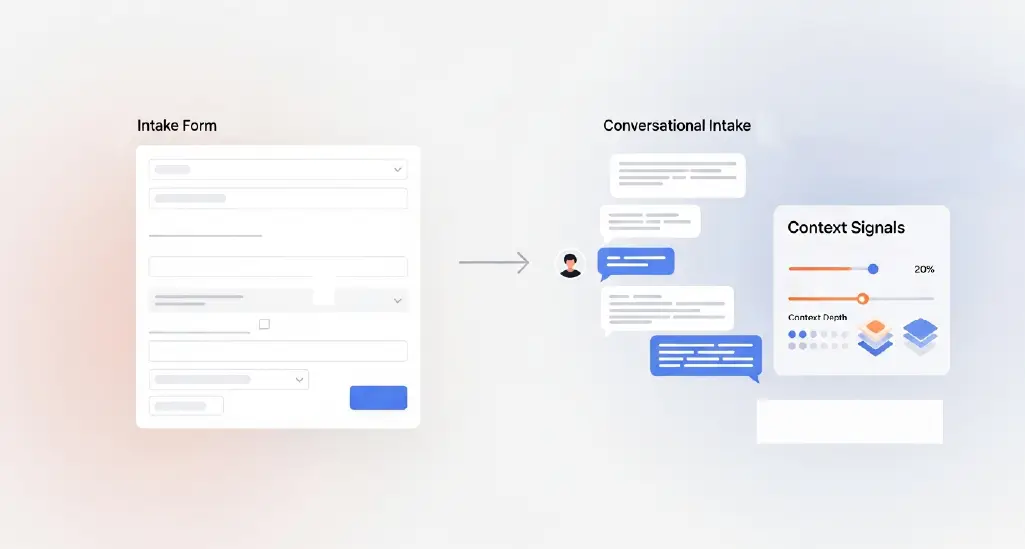
Most organizations treat intake as a data capture problem. The goal is to get information into a system as cleanly and quickly as possible.
Name.
Contact details.
Reason for inquiry.
Submit.
That mindset made sense when intake was static. Forms didn’t talk back. Calls were summarized after the fact. Context was expensive to capture.
Conversational AI changes that equation entirely.
A chat conversation doesn’t just gather data—it uncovers intent. Through natural dialogue, urgency becomes visible. Subtle signals like hesitation and confusion begin to surface. Emotional weight and decision readiness emerge long before a salesperson, attorney, or intake coordinator ever steps in.
The problem is that most teams still treat chat like a gate at the top of the funnel rather than a sensor feeding the entire system.

In theory, conversational AI lives at the top of the funnel. In practice, it touches nearly every stage.
Before intake, it engages visitors who aren’t ready to fill out a form but are ready to talk.
During intake, it captures structured and unstructured data simultaneously.
After intake, it influences how leads are scored, routed, prioritized, and followed up.
Downstream, it affects how fast deals move, how predictable the pipeline is, and how confident teams feel in their forecasts.
This is why thinking about conversational AI purely as a “lead capture tool” dramatically understates its impact.
It’s not just answering questions. It’s shaping the quality and momentum of the pipeline itself.
Also read: AI Agents vs Human Agents in Sales: Cost, Speed & Conversion
Consider a mid-sized personal injury law firm.
They had plenty of inbound demand. Website traffic was strong. Phone calls were steady. Chat volume was growing.
But conversion rates were inconsistent. Some cases closed quickly. Others stalled. Some high-value cases were followed up too late. Some low-value cases consumed too much attorney time.
On paper, intake looked fine. Every lead was captured. Every inquiry was logged.
The problem lived in what intake didn’t capture.
A late-night chat from someone injured in a recent accident carried very different intent than a casual daytime inquiry about eligibility. But both scored the same. Routed the same. Followed up the same.
When conversational AI was redesigned to ask better questions and preserve conversational context—how recent the incident was, whether medical treatment had already occurred, how urgent the situation felt—the downstream pipeline changed.
Lead scoring improved not because the algorithm got smarter, but because the input became richer.
Pipeline velocity improved because the right cases reached the right people faster.
Close rates improved because attorneys walked into conversations with context instead of guesswork.
The AI didn’t replace intake. It made intake intelligible.

Traditional lead scoring relies heavily on proxies.
Page visits.
Form fields.
Campaign source.
Time on site.
Those signals matter, but they’re shallow compared to what a real conversation reveals.
Conversational AI captures language. And language carries intent.
A medical clinic discovered this when they analyzed chat transcripts instead of just form completions. Patients who used words like “pain,” “urgent,” or “can’t wait” converted at significantly higher rates than those asking general availability questions—even when both booked appointments.
That insight changed how leads were prioritized. Urgency wasn’t inferred from timing or source. It was expressed directly in the conversation.
This is ai lead scoring in its most practical form: not scoring people based on guesses, but on what they actually say.
Also read: AI-Powered Lead Scoring: Prioritize Prospects & Boost Conversions
Pipeline velocity is often treated as a sales execution issue. Follow-ups are too slow. Too many handoffs. Not enough capacity.
But conversational AI quietly influences velocity long before a rep gets involved.
When intake conversations capture clarity early—what the customer needs, how urgent it is, what constraints exist—the handoff is cleaner. There’s less back-and-forth. Fewer clarification calls. Less friction.
In service-based businesses, this matters enormously.
A home services company found that jobs booked through chat closed faster not because chat was faster, but because the AI gathered details technicians normally had to extract later. The first human interaction was already halfway through the qualification process.
Velocity didn’t increase because people worked harder. It increased because uncertainty was reduced earlier.
Forecasting struggles when pipelines are full of ambiguity.
Leads exist, but their likelihood to convert feels fuzzy. Confidence is low. Teams hedge their projections.
Conversational AI helps here in a way most CRMs can’t.
When you analyze conversational patterns—depth of engagement, number of follow-up questions, expressions of urgency, readiness indicators—you start to see which leads are real and which are exploratory.
A healthcare provider noticed that patients who asked follow-up questions during chat were far more likely to show up for appointments than those who simply booked without interaction. That conversational engagement became an early indicator of show rate.
Forecasts became more accurate not because models got complex, but because signal quality improved.
This is sales funnel intelligence at work: understanding not just where leads are, but how they behave before they enter the formal pipeline.
Close rates are usually blamed on sales skill, pricing, or competition. Rarely on intake.
But conversational AI influences closing more than most teams realize.
When a salesperson, attorney, or advisor enters a conversation already aware of the prospect’s concerns, expectations, and emotional state, the interaction shifts.
They don’t waste time diagnosing.
>They don’t repeat basic questions.
>They don’t miss subtle objections already surfaced in chat.
That alignment builds trust quickly.
In legal and medical contexts especially, trust is not a “nice to have.” It’s the deciding factor.
Conversational AI doesn’t close deals. But it creates the conditions where closing becomes more likely.
Product-led SaaS companies often have self-serve paths. Service-based businesses rarely do.
Legal, medical, and professional services sell outcomes, not features. The buying decision is personal, emotional, and often urgent.
That makes conversational data far more valuable than static data.
When someone initiates a chat with a clinic, law firm, or consultancy, it isn’t casual browsing. Instead, they’re looking for reassurance. In many cases, responsiveness becomes their first test. Ultimately, competence is what they’re quietly evaluating.
Conversational AI captures those signals at scale—something human teams alone struggle to do consistently.
But only if the data flows forward.
When chat transcripts die in a dashboard, their value is lost. When they feed lead pipeline optimization, they become a strategic asset.
Many organizations invest in conversational AI and then isolate it.
Chats live in one tool. CRM lives in another. Sales works off summaries or incomplete notes.
The result is a broken loop.
The AI gathers insight.
The insight never reaches decision-makers.
The pipeline behaves as if the conversation never happened.
In those cases, conversational AI underperforms not because it’s ineffective, but because it’s disconnected.
The real value emerges when conversational data is treated as first-class pipeline input.
In high-performing setups, conversational AI data doesn’t stop at intake.
It informs lead scoring rules.
>It influences routing decisions.
>It shapes follow-up timing.
>It feeds forecasting models.
>It provides context at the point of close.
A service firm implemented this flow and saw something unexpected: sales conversations became shorter, not longer. Because the discovery phase had already happened.
The pipeline didn’t just move faster. It moved with less friction and fewer surprises.
Conversion rates and velocity tell part of the story. Trust tells the rest.
When customers feel heard early, they’re more forgiving later. They’re more responsive. They’re less price-sensitive.
Conversational AI plays a quiet role here by ensuring that early interactions feel intentional rather than transactional.
This is where many “AI-first” approaches fail. They optimize efficiency at the cost of empathy.
The best systems do the opposite: they use AI to protect empathy at scale.
There’s a persistent fear that conversational AI is about automation replacing humans.
In reality, its greatest impact is in making humans more effective.
By the time a human steps in, they should already know why the person reached out, what they’re worried about, and what outcome they’re hoping for.
Conversational AI makes that possible—if the system is designed to pass insight forward rather than trap it at the top of the funnel.
Also read: AI + Human Support: Ultimate Conversion Power
The difference between conversational AI that “works” and conversational AI that drives revenue isn’t technology. It’s design.
It’s deciding whether chat is a checkbox or a signal.
>It’s deciding whether intake is an endpoint or a beginning.
>It’s deciding whether data flows forward or dies quietly.
When those choices are made intentionally, the entire pipeline benefits.
Lead quality improves.
Velocity stabilizes.
Forecasts gain confidence.
Close rates rise.
Not because AI replaced sales, but because sales finally saw the whole picture.

Conversational AI was never meant to stop at intake. When conversations are captured and forgotten, pipelines stall, forecasts lose confidence, and sales teams operate on partial truth.
When conversations are treated as signals instead, intake becomes intelligence. Chat becomes context. Early language reveals urgency, value, and likelihood to close. This is the difference between collecting leads and understanding them.
For legal, medical, and service-based businesses—where trust and nuance drive decisions—conversational AI only creates value when its data flows forward into scoring, prioritization, forecasting, and human follow-up.
Conversational AI analyzes language, urgency, and engagement patterns in chat conversations. This creates richer inputs for lead scoring models compared to static forms alone.
Yes. When chat captures intent and qualification details early, sales teams spend less time clarifying and more time closing, increasing pipeline speed.
No. It enhances human performance by providing context and insight before the first direct conversation.
Forms capture structured data. Conversations reveal intent, emotion, urgency, and readiness—signals that significantly impact conversion likelihood.
By analyzing conversational engagement patterns, teams can better predict show rates, deal progression, and likelihood to close.
No. When integrated properly, conversational AI supports routing, prioritization, follow-up timing, forecasting, and revenue intelligence across the entire pipeline.
That’s where Blazeo comes in. Blazeo ensures conversations don’t die at the top of the funnel, connecting conversational AI with hybrid engagement and pipeline analytics so insight captured in chat directly informs who gets prioritized, how fast deals move, and where revenue is most likely to close.

Because intake was never just about capturing information. It was about capturing intent—and carrying it all the way through the pipeline.
