 SmartHub
 Automation
 Appointment Scheduler
 Lead Management
 Dashboard & Reports
 Task Management
 Communications Hub
 Live chat
 AI chatbot
 Voice AI
 Voice call centers
 Appointment scheduling
 Retainer signing
 Home services
 Lawyers and firms
 Medical services
 College admissions
 Real estate agents
 Marketing agencies
 About
About Partner program
 Estimate Your ROI
 Case Studies
 Blog
Blog FAQs
FAQs Login
LoginAI Search Trust & Citation Authority: Why Accuracy Isn’t Enough





Products
Industries
Company
Resources
As of March 2024 we have renamed Apexchat to Blazeo. We are excited to share the next part of our journey with our customers and partners.
The name ApexChat implies that we are primarily a chat company, which is no longer true. Now we have many offerings, such as call center services, AI, Appointment setting, SMS Enablement, Market Automation, and Sales acceleration (Q2 2024), that go beyond chat. The new name will not only allow us to convey the breadth of our offering but will also better convey our company’s mission and values.
Blazeo, which is derived from the word Blaze, evokes a sense of passion, speed, and energy. A “Blaze” is captivating, illuminates, and represents explosive growth. Blazeo encapsulates our mission to ignite such growth for our customers and partners by delivering innovation with passion, speed, and energy.

A revenue leader opens Google during a pipeline review and types a question that didn’t exist five years ago: “How do high-intent leads behave before they convert?”
She doesn’t skim articles or browse long-form content. Instead of opening multiple tabs, she goes straight to the AI-generated answer that appears instantly. After nodding at the clarity and briefly checking the citations, she moves on. In that brief moment, the brands referenced in the response subtly influence how she thinks about attribution, response time, and conversion friction.
What she never sees are the dozens of accurate, well-written blog posts that didn’t make the cut.
This is the new reality of AI search. Visibility is no longer awarded to the most optimized page. It’s awarded to the source the system feels safe citing.
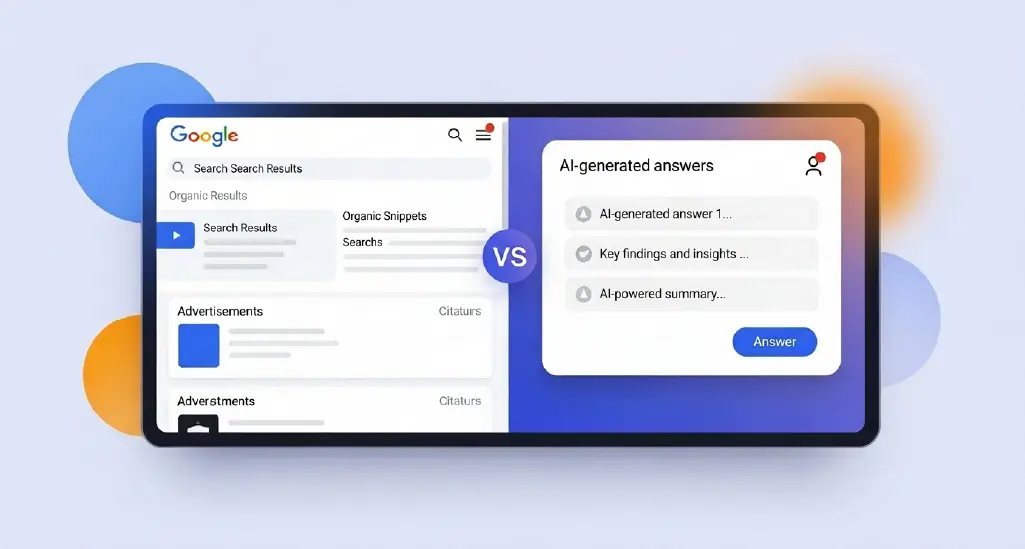
And that’s where the trust gap begins.
For years, content teams were trained to chase correctness and coverage. Answer the question thoroughly. Include the right keywords. Update the post once a year. If you did those things well enough, search engines rewarded you with rankings.
AI search breaks that contract.
Today, being accurate is no longer a differentiator. It’s the minimum requirement. The real competition happens after correctness, when the system decides whether your content is stable, authoritative, and legible enough to be referenced inside an answer that millions of users may treat as truth.
That’s why brands with solid rankings are still disappearing from AI-generated answers. Not because they’re wrong, but because they’re not trusted enough.
This is what “ai search trust” actually means in practice: the difference between content that informs and content that gets cited.
Traditional search asked users to evaluate information themselves. AI search flips that dynamic. The system evaluates sources on the user’s behalf and presents a synthesized response with citations as proof, not as options.
That changes the psychology of search.
When users read an AI answer, they aren’t browsing. They’re delegating judgment. They assume the system has already filtered out unreliable sources, exaggerated claims, and weak evidence. The citations serve as reassurance, not invitations.
For businesses, this means something subtle but profound: you’re no longer competing for attention. You’re competing for endorsement.
And endorsements come with risk. Every citation is a decision the system has to defend.
Also read: AI-Enabled Competitive Intelligence for Growth Teams

Imagine two SaaS companies publishing content about lead response time.
The first publishes a polished article explaining that faster responses generally improve conversion rates. It’s accurate. It’s readable. It references common industry wisdom. It ranks reasonably well.
The second publishes a piece that defines what “response time” actually means in different contexts, explains how intent level changes urgency, shares anonymized aggregate patterns from real conversations, and clearly separates observed data from interpretation. It explains edge cases. It includes dates, authorship, and context for when the data applies.
Both are correct.
Only one feels safe to cite.
This is where “citation authority” quietly replaces keyword authority. AI systems aren’t just asking, “Is this relevant?” They’re asking, “If I quote this, will it still be defensible out of context?”
Pages that rely on generalizations, vague claims, or implied expertise struggle here. Pages that show their thinking—clearly, calmly, and with restraint—win.
Experience, Expertise, Authoritativeness, and Trust used to sound like principles you nodded along to and then ignored when deadlines hit.
In AI search, E-E-A-T becomes operational.
Experience shows up when content reflects lived reality, not recycled summaries. In SaaS, that often means writing from the vantage point of real customer conversations, real sales friction, real operational constraints. It’s the difference between saying “leads want fast responses” and explaining why certain leads disengage after specific moments of silence.

Expertise becomes visible through specificity. Not credentials alone, but precision. Clear definitions set the foundation. Explicit boundaries provide structure. Honest acknowledgment of uncertainty builds trust.
Authoritativeness emerges over time through consistency. When a brand publishes coherently across topics, references its own frameworks responsibly, and is cited by others, the web starts to recognize it as an entity, not just a URL.
Trust is what ties it all together. Transparent authorship. Updated content that reflects actual changes, not cosmetic edits. Claims that can be traced back to evidence or clearly labeled insight.
This is why “eeat seo” and “answer engine seo” are now inseparable. One feeds the other.
There’s an uncomfortable truth many writers resist: AI search doesn’t read like a human. It extracts.
That doesn’t mean your writing should become robotic. It means it should be stable under extraction. If a paragraph is lifted into an answer, it should still make sense. If a sentence is quoted, it shouldn’t overpromise.
This is where many otherwise strong pieces fail. Many pieces rely on narrative buildup without anchoring key definitions early. Too often, conclusions are buried deep within the page. In place of clarity, clever language is used where precision would serve the reader better.
Also read: Ethical AI in Customer Engagement: Responsible Automation at Scale
Citation-ready content does the opposite. Above all, it respects the reader’s time. Rather than circling the point, it states the answer first and then earns it. Throughout, the language remains precise without becoming cold.
This is not a downgrade in writing quality. It’s a maturation.

Consider how AI search treats content about conversational AI and lead engagement.
There’s no shortage of articles claiming that chatbots increase conversion or that automation improves efficiency. Most of them are directionally true. Few of them get cited.
Why?
Because in high-stakes funnels—legal inquiries, healthcare forms, enterprise demos—conversion isn’t just a function of speed. It’s a function of confidence. And confidence is shaped by how conversations are handled when things get complex.
Some platforms, like Blazeo, sit at an interesting intersection here. They don’t just automate responses. They observe and orchestrate conversations across chat, voice, and follow-up, often with humans in the loop. The value isn’t in the automation itself; it’s in understanding where automation helps and where it hurts.

When content reflects that nuance—acknowledging that over-automation can suppress high-intent leads, explaining how hybrid models preserve trust while maintaining speed—it aligns with how AI systems think about risk. It shows judgment.
That kind of content doesn’t just inform readers. It signals to answer engines that the source understands the trade-offs, not just the trend.
And systems that are designed to reduce hallucination and reputational risk tend to favor sources that demonstrate restraint.
Another reason accurate content fails to surface is fragmentation.
AI systems rely heavily on entity understanding. They build internal maps of brands, products, people, and concepts, and they look for consistency across the web to validate those entities.
If your brand describes itself one way on its website, another way on LinkedIn, and a third way in guest posts, you introduce ambiguity. Ambiguity is a risk. Risk reduces citations.
This is where “knowledge graph seo” becomes practical. Consistent naming. Clear positioning. Stable descriptions of what you do and who you serve. The less guesswork the system has to do, the more confident it can be citing you.
Trust isn’t just earned on-page. It’s reinforced everywhere your entity appears.
It’s tempting to think AI optimization means stripping content down to facts. That’s a mistake.
Narrative is how humans evaluate credibility. We trust sources that show they understand context, consequences, and nuance. AI systems are trained on that same human behavior.
The best-performing content in AI search doesn’t read like documentation. It reads like an expert explaining something important to someone who needs to make a decision.
That’s why narrative-driven writing still wins. Not storytelling for its own sake, but grounded storytelling that reveals how and why something works, where it fails, and what to watch out for.
When you write that way, you don’t just attract readers. You attract citations.
Also read: AI Lead Qualification With Chatbots That Drive Revenue
In AI search, traffic is no longer the only—or even the primary—signal of success.
The real question is whether your brand is present at the moment the system synthesizes an answer.
When AI systems cite you, your perspective frames the category. Your definitions become the defaults others follow.
That is the quiet power of being cited.
It doesn’t always produce immediate clicks. But it produces long-term authority. It influences how buyers think before they ever land on a site. It builds trust upstream.
What does “AI search trust” actually mean?
AI search trust refers to how confident an AI system is that a source is safe, reliable, and defensible to cite inside an AI-generated answer. Accuracy is assumed; trust is evaluated.
Why doesn’t accurate content always appear in AI-generated answers?
Because AI systems prioritize citation authority. Content must be clear, well-structured, and stable when quoted out of context—not just correct.
What is citation authority in AI search?
Citation authority is a source’s perceived reliability when referenced directly inside an AI answer. It’s built through specificity, transparency, and consistent expertise.
How does E-E-A-T affect AI search visibility?
E-E-A-T becomes operational in AI search. Systems evaluate lived experience, precision, author clarity, and trust signals before citing a source.
What makes content “citation-ready” for AI search?
Citation-ready content defines terms clearly, separates data from interpretation, acknowledges uncertainty, and remains accurate even when extracted as a standalone quote.
Is traffic still the main KPI for AI search optimization?
No. The new KPI is whether your brand appears at the moment an AI system synthesizes an answer. Citations build long-term authority—even without clicks.
AI search doesn’t eliminate discovery—it compresses it. Instead of progressing through multiple clicks and comparisons, users now resolve questions within a single synthesized answer. Consequently, the interface itself signals trust, and in this environment, brands gain visibility only when AI systems choose to reference them—not when users simply discover them.
For businesses, trust no longer comes from content volume or keyword tactics alone. Teams build it through consistency—between what they publish, how they engage, and what their systems reveal about real customer intent. When those signals align, AI systems more readily treat a brand’s perspective as stable and worth citing.
At that point, trust stops functioning as a messaging problem and becomes an operational one. Real conversations and real response patterns shape credible content, not generic best practices. When teams can observe how intent unfolds across chat, voice, and follow-ups, their content reflects lived reality instead of abstract theory.
Blazeo operates at that intersection. By unifying conversational data and balancing automation with human context, it enables teams to understand how trust forms in high-intent journeys—and to translate that understanding into knowledge AI search engines are willing to reference.
Closing the trust gap doesn’t require chasing AI.
It requires becoming a source the system can confidently stand behind.