SmartHub
 Automation
 Appointment Scheduler
 Lead Management
 Dashboard & Reports
 Task Management
 Communications Hub
 Live chat
 AI chatbot
 Voice AI
 Voice call centers
 Appointment scheduling
 Retainer signing
 Home services
 Lawyers and firms
 Medical services
 College admissions
 Real estate agents
 Marketing agencies
 About
About Partner program
 Estimate Your ROI
 Case Studies
 Blog
Blog FAQs
FAQs Login
LoginAI Lead Qualification With Chatbots That Drive Revenue




Products
Industries
Company
Resources
As of March 2024 we have renamed Apexchat to Blazeo. We are excited to share the next part of our journey with our customers and partners.
The name ApexChat implies that we are primarily a chat company, which is no longer true. Now we have many offerings, such as call center services, AI, Appointment setting, SMS Enablement, Market Automation, and Sales acceleration (Q2 2024), that go beyond chat. The new name will not only allow us to convey the breadth of our offering but will also better convey our company’s mission and values.
Blazeo, which is derived from the word Blaze, evokes a sense of passion, speed, and energy. A “Blaze” is captivating, illuminates, and represents explosive growth. Blazeo encapsulates our mission to ignite such growth for our customers and partners by delivering innovation with passion, speed, and energy.

Most businesses today are not short on leads. They are drowning in them. Website forms fill up, chat widgets light up, ads drive clicks, and CRMs swell with names, emails, and phone numbers. Yet revenue doesn’t scale at the same pace. Sales teams complain about “bad leads.” Marketing teams defend their numbers. And somewhere in the middle, opportunity quietly leaks out of the funnel.
The uncomfortable truth is that traditional lead qualification was never built for how people actually behave online. Static forms, delayed follow-ups, and rule-based scoring models assume intent is linear and predictable. It isn’t. Buyers arrive with different levels of urgency, awareness, and readiness, and they expect to be understood in the moment, not sorted later.
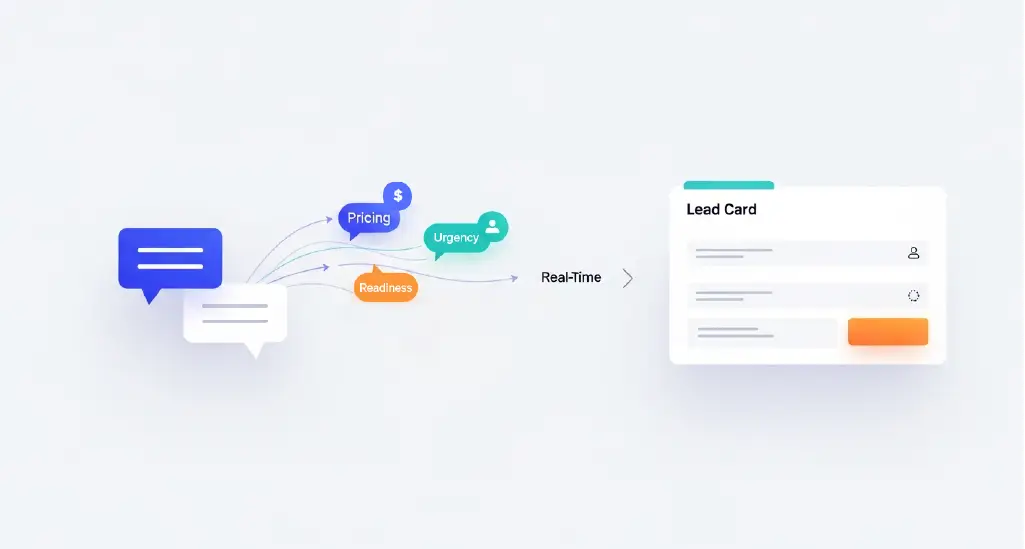
This is where AI-driven lead qualification changes the game. Not as a buzzword, not as a bolt-on chatbot that asks three generic questions, but as a real-time intelligence layer that listens, interprets, adapts, and qualifies while the conversation is still alive.
This article breaks down what true AI lead qualification looks like, why most “AI lead scoring” solutions fall short, and how conversational intelligence can turn raw inquiries into genuinely qualified leads with measurable ROI.

Most lead scoring systems still rely on assumptions made a decade ago. They assign points based on page visits, form fields, or demographic data and then pass the lead downstream once a threshold is crossed. On paper, this looks logical. In reality, it ignores the most valuable signal of all: live intent.
A visitor who spends five minutes on a pricing page may be curious, or they may be stuck. A form submission might indicate high intent, or it might simply be someone downloading a resource with no buying authority. Static scoring models treat these scenarios as identical because they lack context.
Even worse, traditional systems operate after the fact. They score leads once the interaction is over, long after the moment when curiosity, urgency, or frustration was at its peak. By the time a human follows up, the buyer has often moved on.
AI chatbots, when designed properly, solve this timing problem by qualifying leads inside the conversation itself. Instead of guessing intent from behavior trails, they surface it directly through dialogue.
True AI qualification is not about disqualifying leads faster. It’s about understanding them better, sooner, and with more nuance than any form or rule-based workflow ever could.
At its core, an AI lead qualification system does three things simultaneously. It listens to what the prospect says, how they say it, and when they say it. It interprets those signals in real time using context, patterns, and historical outcomes. And it responds dynamically, adjusting the conversation to uncover what actually matters before deciding how the lead should move forward.
This is fundamentally different from a scripted chatbot. Scripted bots follow paths. AI-driven chatbots follow meaning.
When someone says, “I’m just exploring options right now,” a rules-based system might downgrade them automatically. A conversational AI understands whether that statement reflects early-stage research or polite deflection masking real urgency. It probes intelligently, asking the right follow-up questions without sounding interrogative.
This is where automated lead segmentation becomes powerful rather than mechanical.
Also read: AI Chatbots vs. Human Agents for Lead Generation | Blazeo Insights
Instead of waiting for post-conversion analysis, AI evaluates leads as they engage. It notices patterns humans miss. The speed of responses. The specificity of questions. The shift from general curiosity to concrete scenarios. The emotional signals that indicate frustration, urgency, or confidence.

Consider a B2B SaaS website where two visitors start chats within minutes of each other. Both ask about pricing. One follows up with questions about integrations, implementation timelines, and security compliance. The other asks whether there’s a free trial and goes quiet.
A traditional system might score both leads similarly because they hit the same page and asked the same initial question. An AI-driven lead scoring system immediately recognizes the difference. One conversation reflects buying intent and readiness. The other reflects exploration.
This distinction matters because it determines what happens next. Immediate sales routing becomes clear for high-intent leads. Nurture paths emerge for prospects who need more time. The appropriate next step—demo invitation or educational content—reveals itself through intent.
Real-time lead assessment ensures that high-intent leads are acted on while the intent is still warm, not hours or days later when momentum is lost.
One of the reasons many businesses hesitate to adopt chatbot lead qualification is fear of friction. Nobody wants to replace a human conversation with a robotic interrogation.
The irony is that AI, when done right, feels more human than most forms ever did.
Instead of asking ten questions upfront, conversational AI qualifies progressively. It adapts its depth based on engagement. If a visitor shows strong intent early, the conversation deepens. If they hesitate, the AI pulls back, offering value instead of pressure.
This mirrors how good sales conversations work. You don’t ask for budget, authority, and timeline in the first thirty seconds. You earn the right to ask.
AI chatbots excel at this because they don’t rely on fixed sequences. They rely on context. They understand when to ask, when to clarify, and when to simply listen.
Over time, this creates a more accurate picture of lead quality than any static form ever could.

An AI-qualified lead is not just someone who meets demographic criteria. It’s someone whose intent, readiness, and needs have been understood through conversation.
This clarity transforms how sales teams operate. Rather than opening a CRM record filled with assumptions, reps receive real context. Insight into what the prospect cares about becomes immediately clear. Awareness of the buyer’s current stage follows naturally. Previously surfaced objections are already visible before the first human touch.
Also read: How CRM Strengthens Post-Sale Customer Relationships
This shortens sales cycles because the first human touchpoint doesn’t restart the conversation. It continues.
For marketing teams, AI-qualified leads close the attribution gap. When conversations are captured and analyzed, it becomes clear which channels, messages, and campaigns are driving meaningful engagement rather than empty volume.
This is where lead-gen automation stops being about efficiency and starts being about effectiveness.
Segmentation is often treated as a back-office task. Leads are sorted into buckets after they convert, based on static criteria defined weeks or months earlier.
AI flips this approach by segmenting leads dynamically as conversations unfold.
Someone who starts as a cold visitor can move into a high-intent segment within minutes. Someone who appears promising on paper can be downgraded based on conversational signals that indicate misalignment.
This fluid segmentation is critical because buyer intent is not fixed. It evolves in real time, and your systems should evolve with it.
AI chatbots enable segmentation based on intent signals rather than assumptions. Industry relevance, urgency, budget readiness, use case complexity, and decision-making authority all emerge naturally through dialogue.
This results in cleaner pipelines and fewer wasted handoffs.
All of this sounds compelling, but the real question decision-makers ask is simple. Does it make money?
The ROI of AI-driven lead qualification shows up in three places.
First, response time drops to near zero. High-intent leads are engaged immediately, increasing conversion rates before competitors even respond.
Second, sales efficiency improves. Reps spend less time chasing unqualified leads and more time closing conversations that already have momentum.

Third, marketing spend becomes more accountable. When lead quality improves, cost per qualified lead drops even if traffic volume stays the same.
This is where ROI calculators become powerful, not as marketing gimmicks but as internal alignment tools. When teams model the impact of faster response times, higher qualification accuracy, and improved close rates, the financial case becomes obvious.

For example, increasing qualification accuracy by even a small margin can dramatically change revenue outcomes when applied across hundreds or thousands of conversations per month. AI makes those gains scalable without adding headcount.
Also read: Measure CRM ROI Beyond Revenue: The Real ROI Equation
Many tools labeled as “AI lead scoring” simply automate old models. They apply machine learning to historical data without addressing the real problem: lack of live context.
These systems still score leads after the interaction is over. They still rely on proxy signals instead of direct conversation. They still treat qualification as a backend process rather than a frontline experience.
The difference with conversational AI platforms like Blazeo is philosophical as much as technical. Qualification is not an afterthought. It is the conversation itself.
By embedding intelligence directly into customer interactions, Blazeo turns every chat into a qualification engine that learns, adapts, and improves over time.
This is why competitors struggle to match depth. It’s easier to score data than to understand people.
What is AI lead qualification with chatbots?
AI lead qualification with chatbots uses conversational intelligence to assess a prospect’s intent, readiness, and needs in real time—during the conversation, not after it ends.
How is AI lead qualification different from traditional lead scoring?
Traditional lead scoring relies on static data and delayed analysis. AI lead qualification evaluates live conversational signals, providing more accurate and timely insights.
Can AI chatbots really detect buying intent?
Yes. Advanced AI chatbots analyze language patterns, follow-up questions, urgency, and engagement depth to identify buying intent more accurately than form-based systems.
Does AI lead qualification replace sales teams?
No. It supports sales teams by delivering better-qualified leads with full conversational context, allowing reps to focus on closing instead of chasing.
What types of businesses benefit most from AI lead qualification?
B2B SaaS, professional services, and high-consideration sales models benefit the most—especially companies handling high inbound lead volume.
How does AI lead qualification impact revenue?
By responding instantly, improving lead quality, and reducing wasted sales effort, AI lead qualification increases conversion rates and shortens sales cycles.
Prospects don’t want to be filtered. They want to be understood. When conversations feel relevant, timely, and respectful, trust builds naturally.
That trust carries forward into the sales process. Leads who feel heard are more likely to engage, more likely to convert, and more likely to stay.
This is the quiet advantage of AI-driven conversations. They improve the experience for both sides of the funnel.

Lead qualification no longer happens after the conversation. It is the conversation.
As buyer expectations shift toward instant, relevant interactions, static forms and delayed scoring models are quietly becoming liabilities. AI-driven lead qualification changes that by recognizing intent in real time, adapting to it, and acting while it still matters.
That’s the philosophy behind Blazeo. By embedding intelligence directly into conversations, Blazeo helps teams qualify leads as they engage, route high-intent prospects faster, and turn more interactions into revenue—without adding friction or headcount.
If you’re exploring what this shift could mean for your pipeline, Blazeo’s ROI Calculator offers a practical starting point. It shows how faster response times and better qualification translate into measurable revenue impact—using your own numbers, not assumptions.
Because once qualification happens in real time, the difference isn’t subtle. It’s structural.