 SmartHub
 Automation
 Appointment Scheduler
 Lead Management
 Dashboard & Reports
 Task Management
 Communications Hub
 Live chat
 AI chatbot
 Voice AI
 Voice call centers
 Appointment scheduling
 Retainer signing
 Home services
 Lawyers and firms
 Medical services
 College admissions
 Real estate agents
 Marketing agencies
 About
About Partner program
 Estimate Your ROI
 Case Studies
 Blog
Blog FAQs
FAQs Login
LoginAI-Enabled Competitive Intelligence for Growth Teams





Products
Industries
Company
Resources
As of March 2024 we have renamed Apexchat to Blazeo. We are excited to share the next part of our journey with our customers and partners.
The name ApexChat implies that we are primarily a chat company, which is no longer true. Now we have many offerings, such as call center services, AI, Appointment setting, SMS Enablement, Market Automation, and Sales acceleration (Q2 2024), that go beyond chat. The new name will not only allow us to convey the breadth of our offering but will also better convey our company’s mission and values.
Blazeo, which is derived from the word Blaze, evokes a sense of passion, speed, and energy. A “Blaze” is captivating, illuminates, and represents explosive growth. Blazeo encapsulates our mission to ignite such growth for our customers and partners by delivering innovation with passion, speed, and energy.

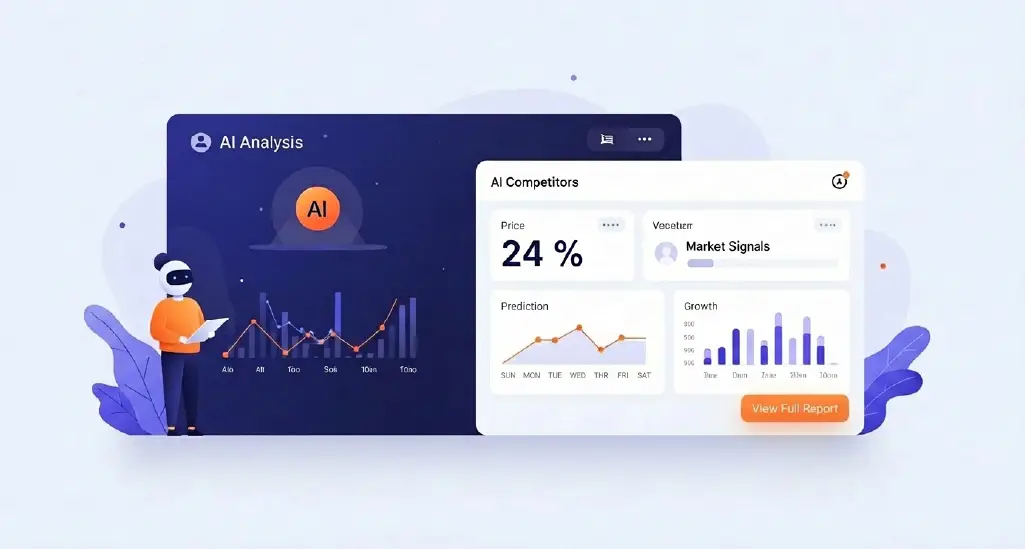
For most growth teams, competitive intelligence still happens in fragments. A sales rep drops a note in Slack about losing a deal to a cheaper alternative. A product marketer screenshots a competitor’s landing page before it changes again. Someone forwards a pricing update they noticed on LinkedIn. None of it lives in one place, none of it updates itself, and almost none of it turns into a decision with real velocity.

The problem isn’t that companies don’t care about competitors. It’s that competitor analysis has traditionally been slow, manual, and reactive. By the time a quarterly competitive review is presented, the market has already moved on. Messaging has shifted. Pricing has changed. A feature that once differentiated you is now table stakes.
AI has changed this dynamic quietly but decisively. Not by making competitive intelligence flashier, but by making it continuous, contextual, and directly usable by growth teams that need answers now, not retrospectives later. AI-enabled competitive intelligence is no longer about tracking competitors for the sake of awareness. It’s about translating market movement into revenue decisions while there’s still time to act.
Growth teams that understand this are no longer asking who their competitors are. They’re asking where competitors are winning, why buyers respond to certain narratives, and which gaps exist that the market itself is signaling but no one has formalized yet.
That shift in mindset is where AI becomes transformational.
The moment a company begins to scale beyond a handful of customers, competitive intelligence stops being a side task and starts becoming infrastructure. Unfortunately, most organizations never build that infrastructure. They rely on static battlecards, anecdotal feedback from sales calls, and sporadic market research projects that age the moment they’re published.
This creates a dangerous illusion of confidence. Teams believe they understand the market because they once did. But competitive positioning is not a fixed truth. It’s a moving target shaped by pricing pressure, feature convergence, category narratives, and buyer expectations that shift faster than internal processes can keep up.
AI competitor analysis addresses this structural weakness by replacing episodic analysis with living intelligence. Instead of collecting data quarterly, AI systems continuously ingest competitor websites, product updates, pricing pages, release notes, review platforms, sales conversations, and public market signals. More importantly, they interpret patterns across this data rather than presenting raw noise.
The difference is subtle but profound. Manual competitive research tells you what changed. AI-driven competitive intelligence tells you why it matters and where it intersects with your growth motion.
Also read: AI Agents vs Human Agents in Sales: Cost, Speed & Conversion
One of the most underappreciated advantages of AI market insights is the ability to measure momentum rather than snapshots. Traditional tools might show you a competitor’s current pricing or feature set. AI reveals the trajectory. It detects how often messaging themes change, which features are emphasized more aggressively over time, and how positioning evolves in response to market pressure.
Consider a mid-market SaaS company selling sales automation software. For years, they believed their primary competitor was another automation platform with similar features and pricing. Sales losses were attributed to price sensitivity. But once the growth team began using AI-enabled competitive intelligence, a different picture emerged.

The AI system analyzed competitor messaging updates, demo transcripts, and customer reviews over several months. It surfaced a pattern that wasn’t obvious from surface-level analysis. The competitor wasn’t winning on price. They were winning on narrative clarity. Their messaging had shifted from automation features to speed-to-lead outcomes, while the company in question was still leading with technical capability.
This insight changed everything. Product marketing reframed the homepage. Sales scripts were adjusted. Even onboarding language shifted to reinforce time-to-value rather than feature depth. Conversion rates improved not because the product changed, but because the team finally aligned with how buyers were being persuaded elsewhere in the market.
This is the core promise of AI competitive intelligence. It doesn’t just tell you what competitors are doing. It reveals how markets respond.
Sales competitive benchmarking has historically been backward-looking. Teams compare win rates, deal sizes, and sales cycles after the fact, often months too late to influence outcomes. AI changes benchmarking by turning it into a real-time diagnostic layer.

Instead of asking how your sales performance compares in aggregate, AI allows teams to benchmark contextually. It can analyze why deals are won or lost at specific stages, against specific competitors, under specific pricing or feature conditions. This matters because competitive performance is rarely uniform. You may outperform a competitor in enterprise deals but consistently lose in mid-market. You may win on inbound leads but struggle in outbound.
AI surfaces these patterns automatically by correlating sales data with competitor signals. Over time, it creates a feedback loop where growth teams can see which competitors are gaining ground in which segments and why. This shifts competitive intelligence from a static asset to an operational input.
For sales leaders, this means fewer generic enablement updates and more targeted intervention. For growth teams, it means messaging, pricing, and positioning decisions grounded in live market reality rather than assumptions.
Also read: AI Lead Qualification With Chatbots That Drive Revenue
Pricing intelligence is one of the most sensitive and valuable forms of competitive insight. Yet it’s also one of the least reliable when handled manually. Competitors rarely make pricing changes loudly. They test quietly, adjust packaging subtly, and often personalize offers behind closed doors.
AI competitor analysis doesn’t magically reveal private discounts, but it excels at detecting patterns that signal pricing pressure. By monitoring public pricing changes, feature gating adjustments, contract language references in reviews, and sales conversation cues, AI systems can infer where competitors are undercutting, bundling differently, or repositioning value.

This allows growth teams to respond strategically rather than reactively. Instead of racing to the bottom on price, teams can identify where value perception diverges. In many cases, the insight isn’t that competitors are cheaper, but that they are clearer about what buyers are paying for.
This is where an ROI calculator fits naturally into the narrative. When AI surfaces that competitors are framing value in outcomes rather than features, it creates an opportunity to reinforce economic impact. An ROI calculator embedded into pricing or sales conversations doesn’t feel like a gimmick in this context. It becomes a direct response to market behavior.

Rather than asking buyers to trust abstract claims, the calculator allows them to quantify the value themselves. It reframes pricing discussions from cost to return, which is exactly how sophisticated buyers already think. The difference is that AI competitive intelligence tells you when this shift matters and which segments respond best to it.
Messaging decay is real, even for strong brands. What once differentiated you eventually becomes expected. What once felt bold becomes generic. Growth teams often sense this intuitively but struggle to diagnose it precisely.
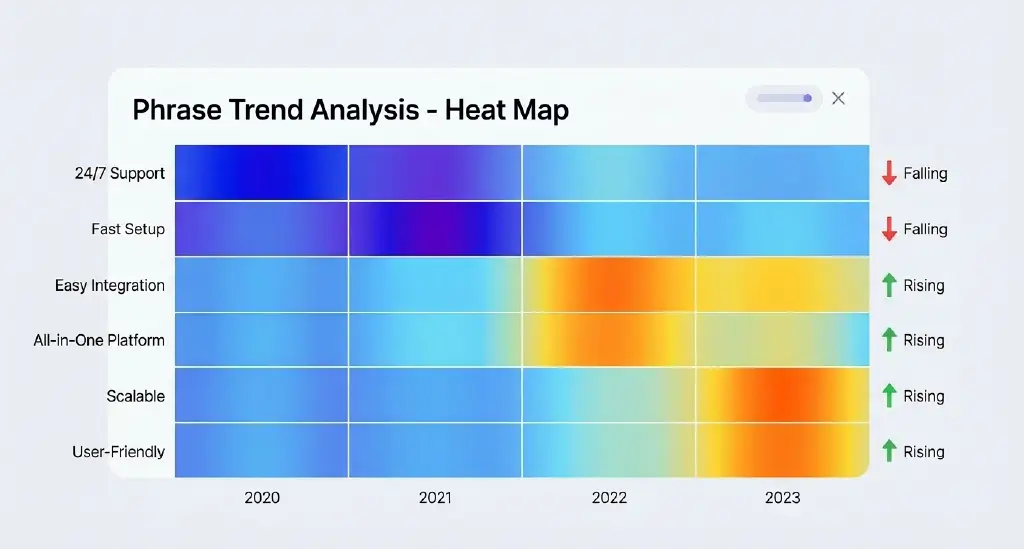
AI market intelligence tools excel at tracking language drift across competitor ecosystems. They analyze how often certain phrases appear, which claims become ubiquitous, and which narratives lose traction over time. More importantly, they can correlate these changes with engagement signals, conversion outcomes, and review sentiment.
This turns messaging from a creative exercise into an evidence-informed discipline. Growth teams can see when a narrative is saturated and when a new angle begins to resonate. They can detect early signals before trends become obvious.
In practice, this means fewer brand overhauls and more continuous refinement. Messaging becomes something that evolves alongside the market rather than lagging behind it.
The most advanced growth teams no longer treat competitive intelligence as a separate function. They embed it into decision-making across marketing, sales, and product. AI makes this possible because it reduces the cost and friction of insight generation.
When competitive intelligence updates itself, teams stop hoarding information and start acting on it. Product teams identify feature gaps earlier. Marketing teams adjust positioning faster. Sales teams enter conversations better prepared. Over time, this creates a compounding advantage.

This is the flywheel effect of AI-enabled competitive intelligence. Each insight improves execution, which generates better data, which feeds smarter analysis. The system becomes more valuable the longer it runs.
Importantly, this isn’t about chasing competitors obsessively. It’s about understanding the market well enough to make confident decisions without second-guessing.
One of the quiet benefits of AI competitor analysis is internal alignment. Growth teams often struggle to convince stakeholders that a change is necessary. Sales blames marketing. Marketing blames the product. Product points to roadmap constraints.
AI introduces a neutral source of truth. When insights are derived from consistent market signals rather than opinions, conversations change. Decisions feel less political and more pragmatic. Teams spend less time debating whether something is true and more time deciding what to do about it.
This trust effect is difficult to quantify but deeply impactful. It accelerates decision-making and reduces friction across teams that need to move together to drive growth.
Also read: The Hybrid Model: Where Voice AI and Humans Work Together
What is AI-enabled competitive intelligence?
AI-enabled competitive intelligence uses machine learning and data analysis to continuously track competitors, market signals, pricing changes, and messaging shifts—turning raw data into actionable insights for growth teams.
How is AI competitive intelligence different from traditional competitor analysis?
Traditional competitor analysis is manual, static, and retrospective. AI competitive intelligence is continuous, automated, and contextual, revealing momentum, patterns, and market impact in real time rather than snapshots.
Who benefits most from AI-enabled competitive intelligence?
Growth teams across marketing, sales, and product benefit most—especially SaaS companies competing in fast-moving markets where positioning, pricing, and buyer narratives change quickly.
Can AI competitive intelligence improve sales performance?
Yes. By benchmarking deals against competitors, identifying narrative gaps, and surfacing pricing pressure early, AI competitive intelligence helps sales teams win more consistently and intervene earlier in the funnel.
Does AI competitive intelligence replace human judgment?
No. It strengthens human judgment by providing evidence-based insights. AI highlights patterns and signals, while teams decide how to act strategically.
How often should competitive intelligence be updated?
With AI-enabled systems, competitive intelligence updates continuously. This allows teams to respond to market changes as they happen instead of waiting for quarterly reviews.
AI-enabled competitive intelligence is not about knowing more for the sake of knowing more. It’s about knowing what matters before it becomes obvious. It gives growth teams the ability to see around corners, test assumptions, and invest resources where they will have the greatest impact.
In markets where products converge quickly and differentiation erodes faster than ever, this capability is no longer optional. It’s a growth lever hiding in plain sight—one that separates teams reacting to competitors from those setting the pace of the category.
The teams that win with AI competitive intelligence are not the ones drowning in dashboards or waiting for perfect certainty. They are the ones translating live market signals into action—adjusting pricing with confidence, refining messaging while it still resonates, and backing decisions with clear economic impact rather than intuition alone.
This is where platforms like Blazeo come into play—not as another analytics layer, but as a way for growth teams to turn competitive insight into real conversations, real decisions, and real outcomes. When intelligence connects directly to how leads are engaged, qualified, and converted, competitive advantage stops being theoretical and starts showing up in pipeline and revenue.
In that sense, AI doesn’t replace human judgment. It sharpens it. It turns intuition into evidence and guesswork into strategy. And for growth teams navigating increasingly competitive SaaS markets, the real question becomes whether your competitive intelligence sits in reports—or actively shapes what happens next.