 SmartHub
 Automation
 Appointment Scheduler
 Lead Management
 Dashboard & Reports
 Task Management
 Communications Hub
 Live chat
 AI chatbot
 Voice AI
 Voice call centers
 Appointment scheduling
 Retainer signing
 Home services
 Lawyers and firms
 Medical services
 College admissions
 Real estate agents
 Marketing agencies
 About
About Partner program
 Estimate Your ROI
 Case Studies
 Blog
Blog FAQs
FAQs Login
LoginAI-Driven Customer Journey Analytics Beyond Lead Capture





Products
Industries
Company
Resources
As of March 2024 we have renamed Apexchat to Blazeo. We are excited to share the next part of our journey with our customers and partners.
The name ApexChat implies that we are primarily a chat company, which is no longer true. Now we have many offerings, such as call center services, AI, Appointment setting, SMS Enablement, Market Automation, and Sales acceleration (Q2 2024), that go beyond chat. The new name will not only allow us to convey the breadth of our offering but will also better convey our company’s mission and values.
Blazeo, which is derived from the word Blaze, evokes a sense of passion, speed, and energy. A “Blaze” is captivating, illuminates, and represents explosive growth. Blazeo encapsulates our mission to ignite such growth for our customers and partners by delivering innovation with passion, speed, and energy.

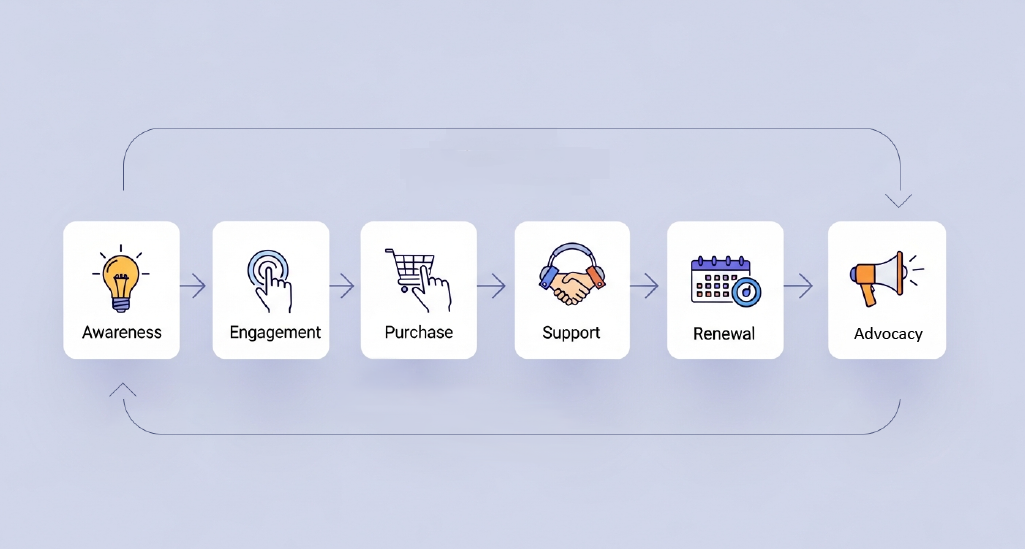
Most businesses still think of analytics as something that happens at the top of the funnel. A lead fills out a form. A chatbot answers a question. A sales rep makes a call. Conversion is tracked, dashboards light up, and the system moves on to the next name in the pipeline.
But customers don’t move in straight lines, and they certainly don’t stop existing once a deal closes.
The real story of growth unfolds after the lead becomes a customer. It shows up in how people onboard, how often they come back, when their engagement dips, what makes them stay, and why some quietly disappear. This is where traditional analytics runs out of depth—and where AI-driven customer journey analytics starts to matter.
Instead of asking whether a lead converted, AI looks at how an entire relationship evolves over time. It watches behavior across touchpoints, learns from patterns humans miss, and connects actions today to revenue outcomes months or years later. This shift—from lead capture to lifecycle intelligence—is what separates short-term acquisition wins from sustainable growth.
For years, marketing and sales teams optimized for volume. More traffic, more leads, faster response times. These metrics made sense when demand was predictable and acquisition costs were low. Today, they’re increasingly misleading.
Two customers can convert on the same day and look identical in a CRM, yet behave completely differently over the next six months. One might explore features, ask questions, upgrade, and advocate. The other might go silent, open fewer emails, and quietly churn. Traditional dashboards don’t explain why. They simply record outcomes after it’s too late to intervene.
Customer journey analytics changes the lens. Instead of measuring isolated events, it studies sequences. It pays attention to timing, frequency, channel shifts, and emotional signals hidden in conversations. AI takes this further by analyzing thousands of these sequences at once, identifying which journeys lead to expansion and which drift toward churn.
This is not about replacing human judgment. It’s about giving teams a clearer picture of reality—one that reflects how customers actually behave rather than how funnels are designed on slides.

A customer journey is not a checklist. It’s a trajectory shaped by intent, friction, trust, and context. Someone might discover your brand through a paid ad, research through content, speak to an AI assistant at midnight, talk to a sales rep a week later, and only convert after a follow-up triggered by inactivity. After conversion, their journey continues through onboarding, support interactions, feature usage, renewals, and referrals.
AI customer journey analytics treats this entire lifecycle as a living system. It connects signals across channels—calls, chats, emails, website behavior, product usage—and models how these signals influence one another over time. Instead of static stages, it builds probability-based paths that update as new behavior appears.

For example, when a customer who normally engages weekly suddenly drops to monthly interactions, AI doesn’t just log inactivity. It compares that pattern against thousands of similar customers and recognizes early churn risk. When another customer starts using advanced features faster than average, the system identifies expansion potential before a human notices.
The power here is not prediction alone. It’s context. AI understands what “normal” looks like for different segments and flags deviations that matter.
Also read: AI Lead Recovery for Website Visitors That Drives Revenue
Most retention strategies are built on hindsight. A customer cancels, a survey goes out, a churn report is reviewed. By the time insights surface, revenue is already gone.

AI retention analytics flips this sequence. Instead of asking why customers left, it asks which customers are about to leave and why. It looks at behavioral decay, sentiment changes in conversations, slower response patterns, and reduced feature adoption. None of these signals matter much on their own. Together, they tell a story.
Consider a SaaS company that noticed churn clustering around the 90-day mark. Traditional analysis blamed onboarding. AI journey analytics revealed something more specific: customers who didn’t complete a certain workflow within their first three weeks were far more likely to disengage later, even if they logged in regularly. Armed with this insight, the company adjusted in-app guidance and proactive outreach. Churn dropped without increasing support headcount.
This kind of insight rarely comes from dashboards built around averages. It comes from AI models trained to spot subtle relationships across time.
Churn prediction is often misunderstood as a warning light that turns red. In reality, its value lies in timing and prioritization.
AI doesn’t just predict who might churn. It estimates when intervention is most effective and what kind of action is likely to help. A customer showing early signs of confusion may respond well to education. One showing frustration in support conversations may need faster resolution. Another showing declining usage might simply need a reminder of unused value.
By understanding where a customer is in their journey, AI helps teams act with relevance rather than desperation. This reduces the common problem of over-communicating with low-risk customers while missing those who quietly disengage.
The result is not just better retention metrics but healthier relationships. Customers feel understood rather than monitored.
Also read: AI Appointment Frameworks: Fully Automated vs. Human-Led
Customer lifetime value has traditionally been treated as a static estimate, calculated once and rarely revisited. AI turns CLV into a dynamic signal that evolves with behavior.
Customer lifetime value AI models continuously update projections based on real interactions. When a customer adopts new features, increases engagement, or shows advocacy signals, their projected value rises. When usage drops or sentiment declines, projections adjust downward. This allows teams to allocate resources intelligently instead of evenly.
Sales teams can prioritize expansion conversations with customers showing high upside. Support teams can identify accounts where proactive care protects long-term revenue. Marketing can shift spend toward channels that attract customers with higher lifetime value, not just lower acquisition cost.
This is where ROI conversations change. Instead of debating whether a campaign generated leads, teams can see how it influenced lifetime revenue. Tools like an ROI calculator become far more meaningful when fed with lifecycle data rather than one-time conversions. When AI ties acquisition behavior to long-term outcomes, ROI stops being theoretical and becomes observable.
The most compelling argument for AI-driven journey analytics is how quietly it improves outcomes.
A multi-location service business used AI to analyze call transcripts, booking behavior, and repeat visits. They discovered that customers who asked pricing questions twice before booking were far more likely to cancel later unless reassured proactively. By training AI assistants to address these concerns earlier and flagging such cases for follow-up, the company reduced cancellations and increased repeat bookings without changing pricing.
An e-commerce brand applied lifecycle analytics to post-purchase behavior. AI identified that customers who contacted support within 48 hours of delivery, even for minor issues, had significantly higher lifetime value when the interaction was handled empathetically and quickly. This insight reshaped staffing decisions and justified investment using an ROI calculator that connected support quality to repeat revenue.
In both cases, growth didn’t come from more leads. It came from understanding journeys better.
One of the reasons many analytics initiatives fail is that they overwhelm teams with numbers without context. AI-driven journey analytics works best when treated as a storytelling tool.
Every customer journey is a narrative with a beginning, middle, and potential continuation. AI helps surface these narratives at scale, but humans still interpret and act on them. When teams understand not just what happened but why it happened and what usually happens next, decisions become clearer.
This is especially important when aligning stakeholders. A CFO may not care about engagement scores, but they care deeply about predictable lifetime value. A support manager may not care about marketing attribution, but they care about preventing burnout and reducing repeat issues. AI provides a shared language grounded in outcomes rather than vanity metrics.
Also read: AI Lead Qualification With Chatbots That Drive Revenue
The future of customer analytics is not more charts. It’s better questions.
AI-driven customer journey analytics invites organizations to ask how behavior compounds over time, how early experiences shape long-term value, and how intervention can be both timely and respectful. It replaces static reporting with adaptive intelligence that learns alongside customers.
Platforms like Blazeo are already moving in this direction by unifying conversations, behavior, and revenue signals into a single lifecycle view. When AI assistants, journey analytics, and ROI calculators operate on the same data foundation, teams gain clarity without complexity. Decisions become faster, interventions become smarter, and growth becomes more sustainable.
What is AI-driven customer journey analytics?
AI-driven customer journey analytics uses machine learning to analyze customer behavior across the entire lifecycle—not just lead conversion. It connects interactions over time to outcomes like retention, churn, and lifetime value.
How is AI-driven customer journey analytics different from traditional analytics?
Traditional analytics track isolated events, such as form fills or conversions. AI-driven customer journey analytics focuses on behavior patterns, timing, and sequences, helping businesses understand why customers stay, expand, or churn.
Can AI-driven customer journey analytics predict churn?
Yes. By detecting early behavioral and sentiment changes, AI-driven customer journey analytics identifies churn risk before customers cancel—allowing proactive intervention.
How does AI-driven customer journey analytics improve retention?
It helps teams intervene at the right moment with the right action, whether that’s education, support, or outreach—making retention proactive rather than reactive.
Does AI-driven customer journey analytics impact customer lifetime value?
Absolutely. By continuously updating lifetime value projections based on real behavior, AI-driven customer journey analytics helps businesses focus resources on the customers with the highest long-term potential.
Is AI-driven customer journey analytics useful beyond SaaS companies?
Yes. Any business with repeat interactions—e-commerce, services, healthcare, or multi-location businesses—can use AI-driven customer journey analytics to improve loyalty and revenue outcomes.
The biggest shift is not technological. It’s philosophical.

Businesses that succeed with AI-driven customer journey analytics stop treating customers as transactions and start treating them as relationships with momentum. They understand that value is created over time—through consistent experiences, timely responses, and an ability to recognize risk and opportunity before it becomes visible.
In a market where acquisition costs keep rising and attention keeps shrinking, this mindset is no longer optional. It’s how retention, expansion, and trust are built.
Lead capture may open the door. AI-driven lifecycle analytics shows you how—and whether—customers choose to stay.

If you want to understand how changes in engagement, response speed, or retention could translate into long-term revenue, Blazeo’s ROI Calculator helps you model that impact using your own numbers—before churn shows up on a report.