 SmartHub
 Automation
 Appointment Scheduler
 Lead Management
 Dashboard & Reports
 Task Management
 Communications Hub
 Managed chat
 Voice Receptionist
 Appointment scheduling
 Retainer signing
 Home services
 Lawyers and firms
 Medical services
 College admissions
 Real estate agents
 Marketing agencies
 About
About Partner program
 Estimate Your ROI
 Case Studies
 Blog
Blog FAQs
FAQs Login
LoginAI Chatbot for Healthcare




Products
Industries
Company
Resources

It's 11 p.m., and a patient opens their clinic's app, worried about a fever that won't break. A chat window pops up instead of hold music and a voicemail prompt. A few questions later, they know whether to head to urgent care or ride it out at home overnight. That's the actual job of an AI chatbot for healthcare in most clinics and telehealth platforms today: not replacing doctors, just filling the dead hours between appointments and phone lines.
Patients get an answer faster, even outside office hours. Front-desk staff stop fielding the same three questions all day long. And the clinic gets coverage that doesn't clock out at 5 p.m., leaving patients waiting until morning. Small shift on paper, but it changes how a practice actually runs day to day.
Strip away the marketing language, and an AI chatbot for healthcare is fairly simple: software that communicates with patients via text or voice, books appointments, answers common questions, and gathers basic symptom details before a visit. Under the hood, most run on natural language processing trained specifically on medical terms and the kinds of things patients typically ask.
The real value shows up in the plumbing behind it. These bots plug into a clinic's scheduling software, EHR, or patient portal, so they can check open slots, fire off reminders, and log updates without a staff member re-typing anything. Staff gets pulled off repetitive tasks and freed up for patients who actually need a human in the room.
There's no single reason clinics adopt these tools; it's usually a handful of everyday problems solved at once.
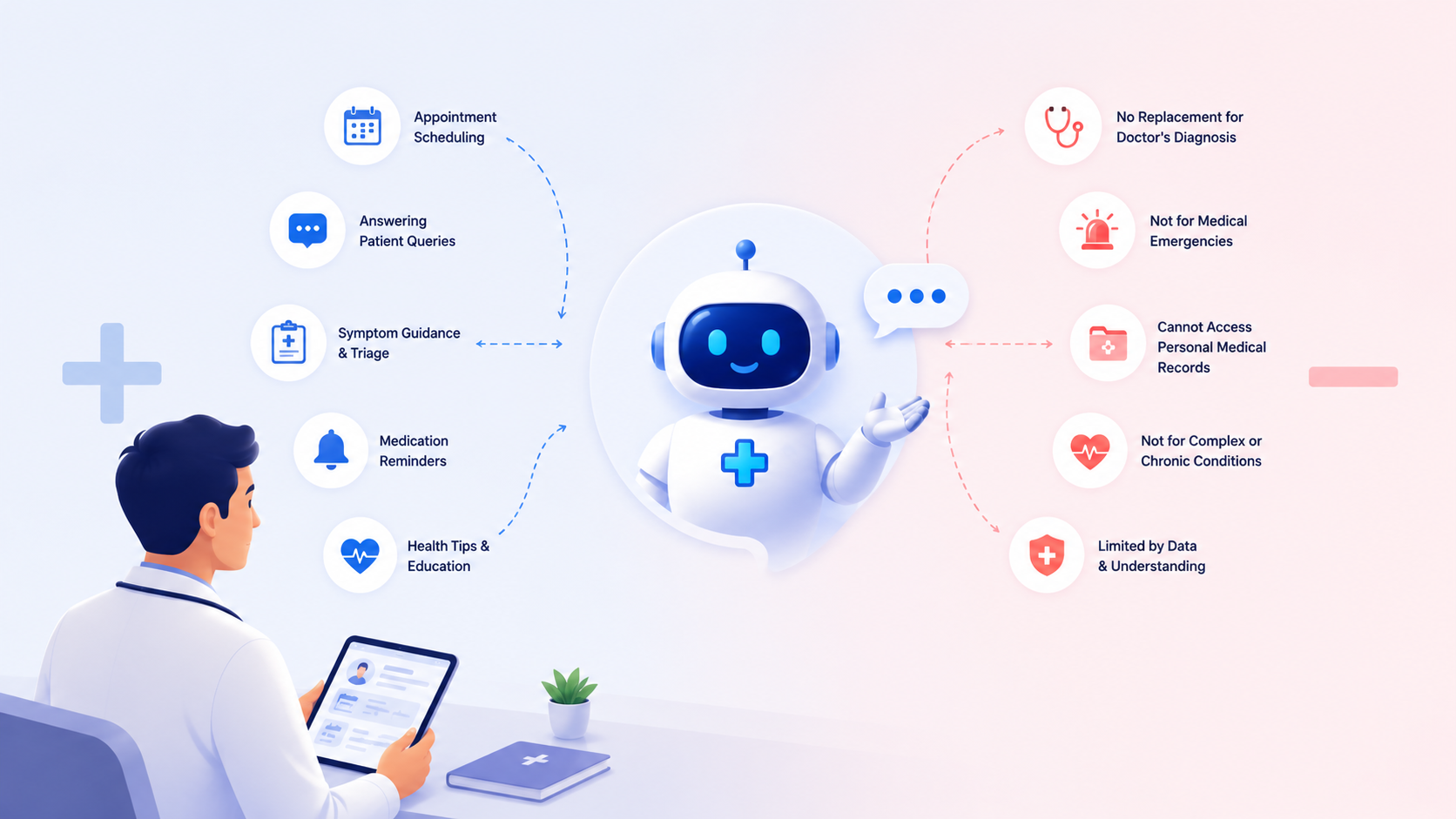
Appointment scheduling in healthcare is the feature almost every clinic starts with. Patients book, reschedule, or cancel at 2 a.m. if they want to, and the bot checks availability and locks in the slot without anyone picking up a phone.
Reminders sent the day before cut no-shows noticeably. A short text or app ping with the date, time, and prep instructions is often all it takes. Small nudge, but it keeps the schedule full instead of leaving gaps that don't get filled.
AI chatbots for medical triage walk patients through structured questions about what hurts, for how long, and how bad, and point them toward self-care, a scheduled visit, or urgent care. No diagnosis happens here. It's routing, not medicine.
Where this earns its keep is flu season, or any high-volume stretch when a nurse can't get to every call fast enough. A triage bot sorts by urgency first, so the sickest patients aren't waiting behind routine ones.
Insurance coverage, office hours, refill steps, what to bring to a visit patients ask the same handful of things over and over. A chatbot handles all of it instantly, at any hour, without tying up a receptionist.
That frees the phone lines for calls that actually need a person: billing disputes, scheduling conflicts, anything with nuance. The bot absorbs the predictable stuff so staff isn't stuck repeating themselves all day.
According to MGMA data, scheduling accounts for the largest share of front-desk call volume, with 81% of practices naming it a top-three reason patients call in. Chatbots absorb much of this volume directly, since booking, rescheduling, and reminders are exactly the tasks they handle best.
Smaller clinics feel this most. One receptionist can manage a full waiting room instead of also fielding scheduling calls, because the bot handles those before they ever reach the front desk.
These tools are genuinely useful, but nobody should mistake them for clinical judgment. Two situations expose the gap clearly.
A chatbot can ask how long a headache's lasted and how severe it feels. What it can't do is weigh a patient's family history, medication interactions, or the hesitation in their voice the stuff a clinician picks up on instinctively. Overlapping or vague symptoms need a trained person, not a decision tree.
Lean on chatbot triage too heavily in unclear cases and care gets delayed. Good systems escalate to a human fast when things get murky, but that only works if the bot actually recognizes it's out of its depth.
A difficult diagnosis. Mental health concerns. End-of-life decisions. These need empathy, and a scripted chatbot response, even a technically correct one, can land as cold or dismissive in the moment.
Most providers route sensitive topics to staff right away rather than let the bot attempt them. Its job here isn't to comfort anyone. It's to recognize the topic and step aside.
Hospitals often lean on chatbots for post-discharge check-ins: did the medication get picked up, how's the recovery going? Telehealth platforms use them as the first stop before a video visit, so the doctor walks in already knowing the symptoms.
Smaller practices usually start narrow: scheduling and reminders only, since that's the clearest win with the least risk. Larger systems expand into triage and follow-ups once staff trusts the bot's accuracy and uptime enough to hand it more.
Insurance companies have picked this up too, mostly for benefits questions and claims status. Not strictly clinical, but still part of the same patient journey.
Not every AI chatbot for healthcare is built to the same standard, and the gap between a good one and a bad one shows up fast once it's live.
Before signing anything, check for:
Push vendors on how patient data actually moves through the system; it needs the same protection as anything in an EHR. And test the scheduling feature yourself before signing; a clunky sync undermines trust in everything else the bot does.
Escalation logic deserves just as much scrutiny as the chatbot's answers themselves. Vague or slow handoffs put patients at risk in exactly the moments they can least afford it. Clinics that ask these questions upfront tend to have far smoother rollouts than the ones that find out the hard way.
Before signing a contract, a few honest questions can save months of frustration:
Teams that answer these questions before buying tend to get far more value than teams that buy first and figure out the details later. This is something we've watched play out again and again with clinics weighing this decision.
Q1) Is it safe to let an AI chatbot handle a patient's symptoms?
It's safe for basic triage and routing, not diagnosis. The chatbot should point patients toward the right level of care, then hand off anything ambiguous or urgent to a clinician right away.
Q2) Can an AI chatbot for healthcare replace a nurse or receptionist?
No. It's built for repetitive tasks like scheduling and routine questions. Judgment calls, emotional conversations, and clinical decisions still need trained staff for safe, accurate care.
Q3) What is the best AI chatbot for healthcare?
It depends on your clinic's size and biggest bottleneck. Compare vendors on HIPAA compliance, scheduling integration, and escalation logic before letting price alone decide it.
Q4) Why do some patients prefer not to use a healthcare chatbot?
Some want a human voice, especially on sensitive topics. Others just don't trust automated systems with their health data. A clear opt-out to a person keeps these patients from feeling brushed off.
Q5) Do AI chatbots work for scheduling as well as symptom questions?
Scheduling is generally the more reliable use case. Triage works fine for basic sorting, but it needs solid escalation logic for anything ambiguous or complex.
Q6) How much does an AI chatbot for healthcare typically cost to implement?
Costs range widely by vendor and feature set, anywhere from a few hundred to several thousand dollars monthly. Scheduling-only tools run cheaper than full triage and EHR-integrated systems.
Q7) Are AI chatbots in healthcare compliant with patient privacy laws?
Reputable vendors design for HIPAA compliance, but it varies from provider to provider. Confirm data handling and storage practices directly before adopting anything.
An AI chatbot for healthcare earns its spot by handling the predictable work scheduling, reminders, routine questions, and early triage that used to eat up staff time. Where it struggles is exactly where the stakes are highest: ambiguous symptoms that need real clinical judgment, and sensitive moments that need real human empathy.
Treat it as a full substitute for a nurse or doctor, and that's where things start to go wrong for patients. The honest tradeoff is this: a chatbot buys back staff time, but only when there's a clear path to handing off to a human for anything it can't safely handle alone. Clinics that test carefully before a full rollout, and build strong escalation logic from day one, tend to see the real upside without absorbing the added risk.