 SmartHub
 Automation
 Appointment Scheduler
 Lead Management
 Dashboard & Reports
 Task Management
 Communications Hub
 Managed chat
 Voice Receptionist
 Appointment scheduling
 Retainer signing
 Home services
 Lawyers and firms
 Medical services
 College admissions
 Real estate agents
 Marketing agencies
 About
About Partner program
 Estimate Your ROI
 Case Studies
 Blog
Blog FAQs
FAQs Login
LoginHow an AI Chatbot for E-Commerce Boosts Your Store Revenue




Products
Industries
Company
Resources

Missed sales hurt most when the reason is sitting right there in your traffic data. Someone spent eleven minutes on your store, clicked four product pages, and left because their question got no answer before patience ran out. Your competitor had a response ready in seconds; your store never even clocked the visit.
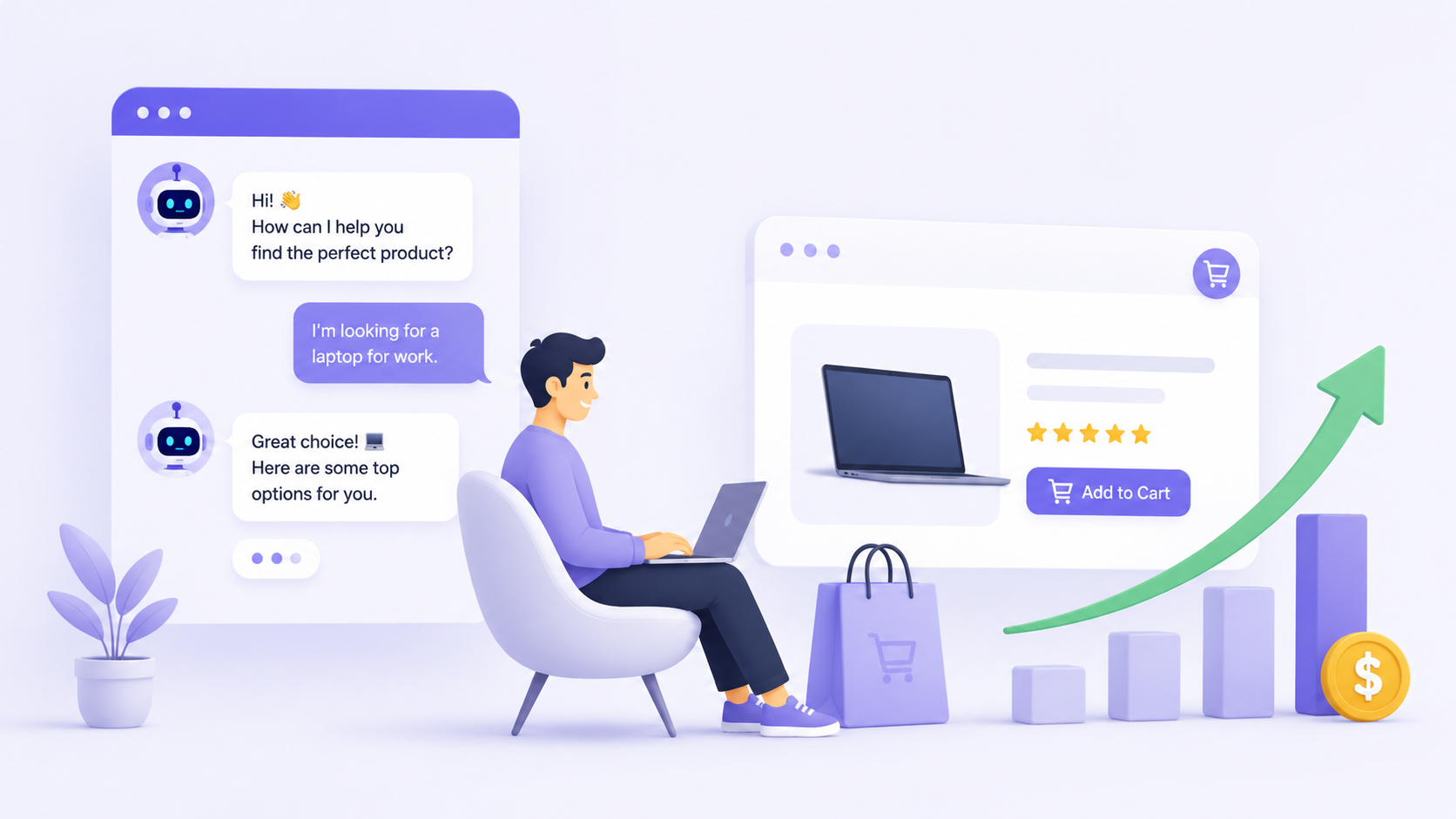
Businesses using an AI chatbot for e-commerce plug that gap by keeping shopper conversations moving on their own, quietly pulling in lead details, and holding the checkout process together at every hour of the day and night. Stores running this technology are not just cutting support overhead; they are closing sales that used to vanish before anyone on the team realized they were ever there.
Calling a chatbot a question-answering tool is like calling a car a seat with wheels, technically true, but nowhere near the full picture. The better frame is a sales assistant who never clocks out, never loses the thread mid-conversation, and never lets a shopper who paused too long on a product page drift away without asking what stopped them. That reliability alone changes how much revenue a store captures on a slow Thursday night with no team member online.
Good AI chatbot solutions for e-commerce connect directly into your product catalog, order records, and customer database from day one. When someone asks about delivery windows or stock availability, the chatbot pulls a real answer in real time rather than redirecting shoppers to a FAQ page three clicks away. Getting the answer right the first time builds the kind of trust that moves a hesitant browser across the line into an actual buyer before they open a competitor tab instead.
Availability drives the clearest daily revenue difference for most stores running this technology seriously. Human teams have shift limits, sick days, and a hard ceiling on simultaneous conversations before quality starts slipping noticeably. A chatbot handles hundreds of parallel conversations at identical quality, which means your busiest traffic periods stop being the hours your store loses the most potential customers to slower handling times.
Choosing the wrong chatbot type costs more money than running no chatbot at all, and stores fall into this trap more often than vendors ever advertise openly. Fixed-script systems hand shoppers preset menu options, step outside those, and the whole thing collapses into a dead end that sends buyers to competitors without a second thought about returning.
Chatbot automation built on real artificial intelligence reads actual shopper intent rather than hunting for keyword matches inside a rigid decision tree. Someone typing "anything waterproof for hiking under sixty dollars" gets a useful product suggestion rather than a confused system error that kills the conversation entirely. Keeping buyers engaged beyond that first response is what separates stores that convert browsers into customers from those that watch them silently leave.
Three things drive e-commerce revenue upward: more purchases completed, higher spend per order, and customers returning after their first purchase. An AI chatbot for e-commerce pushes on all three simultaneously without touching your payroll or dropping new tasks onto your management plate. Most stores start noticing the difference in their sales numbers somewhere between the second and third week of live operation on real traffic.
Product discovery is where a chatbot earns its keep most visibly for store owners watching conversion data closely. Left alone, shoppers wade through hundreds of listings until decision fatigue sends them somewhere else entirely. The chatbot asks a few pointed questions, cuts options down fast, and walks the shopper toward something that genuinely fits their situation. A shorter path to checkout means more orders are completing across every traffic segment, hitting the store daily.
Order value climbs when smart suggestions land naturally inside real conversations rather than through static banners most shoppers have learned to ignore completely. A buyer picking up a camera gets a natural mention of the memory card or case that pairs with it, not a hard upsell, just a relevant suggestion made at exactly the right moment. Multiply that across thousands of monthly conversations, and the revenue addition becomes genuinely significant without any extra effort required from your team.
A shopper sitting on a product page with an unresolved question will not wait long before making a decision that costs your store a sale permanently. Uncertainty around sizing, shipping speed, or return conditions pushes buyers toward whichever competitor answers first, usually just one open browser tab away, already waiting. The lost sale never shows cleanly in analytics; it just never converts, and the unanswered question causing it stays invisible forever.
A chatbot for sales catches these moments by watching page behavior and stepping into a conversation the instant a shopper lingers too long without moving toward checkout naturally. That one proactive reach-out at the exact moment of hesitation has a measurable effect on conversion rates for every store, reviewing data carefully before and after turning it on.
First-time visitors rarely buy on their first session; that is simply not how online shopping works for most people browsing with genuine intent. They compare across multiple tabs, sleep on it, and come back to buy from whichever store stays memorable long enough. Without something capturing those visitors on the way out, your store loses people who had real buying intent and simply needed a short runway before committing to a purchase decision.
An AI chatbot for lead generation works by opening a useful exchange before the exit happens, rather than chasing people after they have already gone. The chatbot puts something worth trading contact details for in front of the shopper: a personalized product match, a relevant comparison, or a discount tied directly to items they were browsing minutes earlier. That trade happens inside a natural conversation rather than through an aggressive pop-up; most shoppers close before the animation even finishes loading on screen.
Every lead collected this way enters follow-up campaigns with real context already attached rather than just a cold email address with no story behind it. A shopper who spent time browsing outdoor furniture gets a follow-up referencing outdoor furniture specifically, not a generic blast treating every subscriber as identical, regardless of what originally brought them to the store. That specificity is what turns captured leads into actual revenue in the days following the original visit rather than sitting unused.
Blazeo's AI chatbot for lead generation focuses on conversation quality over raw contact volume because the downstream revenue difference is significant and measurable. Three hundred warm leads consistently outperform a thousand low-intent contacts collected with no genuine buying interest behind the exchange. Businesses running this approach report stronger follow-up conversion rates because people entering the pipeline were genuinely close to buying from the very start.
Manual conversation handling works fine at low volume; that part is not disputed by anyone who has run a small store with a tight team. The moment daily traffic picks up seriously, the operation starts leaking money in ways that are difficult to trace until revenue figures make the problem impossible to ignore any longer. Response times stretch, leads slip through gaps nobody catches, and the team burns most of their shift answering the same five questions on repeat.
An AI chatbot for e-commerce removes that problem from the operation without a restructuring conversation or a new hiring budget. Routine conversations run automatically while your team handles complex situations, unhappy customers, and decisions that genuinely need human thinking to resolve in a way the customer finds acceptable. That division makes the entire operation cleaner, faster, and more consistently profitable across every traffic level the store encounters.
Mapping the cost difference between chatbot coverage and human coverage honestly makes the argument without needing embellishment from anyone. One agent handles one conversation at a time, works a defined shift, and draws a salary regardless of whether the day is packed or completely dead. A chatbot runs across your full traffic volume simultaneously every single hour without any of those fixed costs building up against your monthly margin.
Certain situations exist where chatbot automation consistently beats human agents on speed, cost per outcome, and direct revenue contribution to the store. Recognizing those situations stops store owners from wasting skilled human effort on interactions that a well-configured chatbot handles better without any human involvement required at any point.
The table below makes the performance gap clear across factors that actually drive revenue in e-commerce:
| AI Chatbot | Human Agent | |
| Cost per Interaction | Low | High |
| Availability | 24/7 | Business hours only |
| Response Time | Instant | Minutes to hours |
| Scalability | Handles thousands simultaneously | Limited per agent |
| Consistency | Always consistent | Varies by agent |
| Best For | Routine sales & lead queries | Complex or sensitive issues |
Speed, cost, and scale drive e-commerce revenue harder than almost any other operational variable, and the chatbot wins across all three without argument. Human agents stay essential for refunds, escalated disputes, and situations where genuine empathy is what the customer actually needs to feel properly heard.
Cart abandonment rarely happens because a shopper genuinely changed their mind about wanting the product sitting in their cart. Something small blocked the path at exactly the wrong moment: a surprising shipping cost, a payment option they were unsure about, or a return policy buried somewhere they could not quickly locate under pressure. None of those obstacles permanently end a sale if someone addresses them before the tab closes and attention moves on elsewhere.
A chatbot for sales monitors cart activity live and enters the conversation when behavioral signals suggest a shopper is about to leave without finishing. When checkout progress stalls or reverses direction, the chatbot opens a focused exchange asking if anything needs clearing up right now before the shopper makes a final decision. Resolving that small friction point in real time saves sales disappearing silently across a full, busy month of store traffic.
Catching shoppers while the page is still open beats chasing them after they have already left mentally and emotionally. Email retargeting reaches people hours later, when the buying mood has usually cooled from what it was during the original session on your store. The chatbot reaches them while the decision is still live, product visible, intention still present, and one useful response away from closing the sale before the window shuts permanently.
AI chatbot solutions for e-commerce also reach shoppers who abandoned carts and left the site entirely. Messages referencing specific products left behind consistently outperform vague reminder emails, and pairing that specificity with a relevant incentive is what turns follow-up sequences from ignored noise into recovered revenue. We built this recovery approach around that specificity because it separates follow-up messages that close sales from ones sitting permanently unread in inboxes.
Store owners assume integrating a chatbot means weeks of technical disruption across systems running fine before. Most current platforms connect with major e-commerce setups in hours rather than days, and the actual technical side is far less painful than the reputation around it suggests. The real investment goes into building a knowledge base, making the chatbot genuinely useful from the first live conversation rather than wrestling with installation problems that refuse to cooperate with existing infrastructure.
Finding a platform connecting natively with your existing product catalog, order system, and customer records is where the whole process starts properly. A chatbot pulling real-time data directly from your store delivers accurate answers from day one without anyone manually feeding it updated information after every inventory shift. Solutions requiring custom development just to access basic store data create maintenance burdens, quietly dragging performance downward over the months following the launch date.
The knowledge base built during setup determines how well the chatbot handles real shopper questions from the first week of actual operation. Stores covering products, shipping policies, return conditions, and common question patterns thoroughly before going live see faster performance gains and fewer escalations to human agents afterward. That upfront configuration investment pays consistent dividends in customer experience quality and every revenue metric tied directly to how well shoppers get served throughout their visit.
Picking the wrong platform creates customer experience friction, costing far more to fix later than a careful pre-selection evaluation would have taken from the beginning. A focused checklist separates platforms delivering real revenue results on live traffic from ones performing well in controlled demos but falling apart once real shoppers start asking unpredictable questions at scale across busy periods.
An automated conversational tool engaging shoppers in real time, answering product and policy questions, capturing lead details, and supporting purchases without a human agent handling every individual exchange personally throughout the day.
Recovers carts before shoppers exit, upsells naturally during active product conversations, captures leads through after-hours traffic, and shortens the distance between product discovery and completed checkout for every store visitor arriving daily.
Handles routine sales conversations and lead capture reliably without human involvement, but agents remain necessary for refunds, escalated complaints, and situations where genuine empathy resolves the issue correctly for the customer.
Live chat puts a human into the conversation in real time. Chatbot automation handles interactions through AI continuously without staffing requirements or response delays tied to human availability constraints at every hour of operation.
Monitors checkout behavior and opens targeted conversations when hesitation signals appear, addressing shipping questions, payment concerns, and discount queries before the shopper makes a final decision to leave the page.
Smaller stores often gain the most because chatbots replace dedicated support staffing needs, handle after-hours visitors without gaps, and capture leads permanently lost without additional hiring investment from the business.
Platform connection with most major e-commerce systems takes a few hours. Building the knowledge base covering products, policies, and conversation flows adds one to three days, depending on catalog size and complexity.
Stores managing high daily traffic, broad product catalogs, international audiences across multiple time zones, or lean support teams consistently see the strongest revenue impact after chatbot implementation goes live properly.
Revenue grows when shoppers stop leaving with unanswered questions, leads stop disappearing after business hours, and abandoned carts start getting recovered before the opportunity closes permanently. An AI chatbot for e-commerce handles all three without adding headcount, stretching your team thin, or creating operational weight your store was never built to carry comfortably.
Businesses seeing the clearest results started early and kept adjusting based on real conversation data rather than waiting for conditions that never quite lined up perfectly. Chatbot technology keeps getting sharper, more personalized, and better at reading shopper intent before the question even gets typed.
Getting the right system live now means your store captures that advantage while competitors are still debating whether the timing is right for them. Every conversation your chatbot handles today is a confirmed sale your store simply would not have closed yesterday without it running.