 SmartHub
 Automation
 Appointment Scheduler
 Lead Management
 Dashboard & Reports
 Task Management
 Communications Hub
 Managed chat
 Voice Receptionist
 Appointment scheduling
 Retainer signing
 Home services
 Lawyers and firms
 Medical services
 College admissions
 Real estate agents
 Marketing agencies
 About
About Partner program
 Estimate Your ROI
 Case Studies
 Blog
Blog FAQs
FAQs Login
LoginAI Agents vs Human Agents in Sales: Cost, Speed & Conversion





Products
Industries
Company
Resources

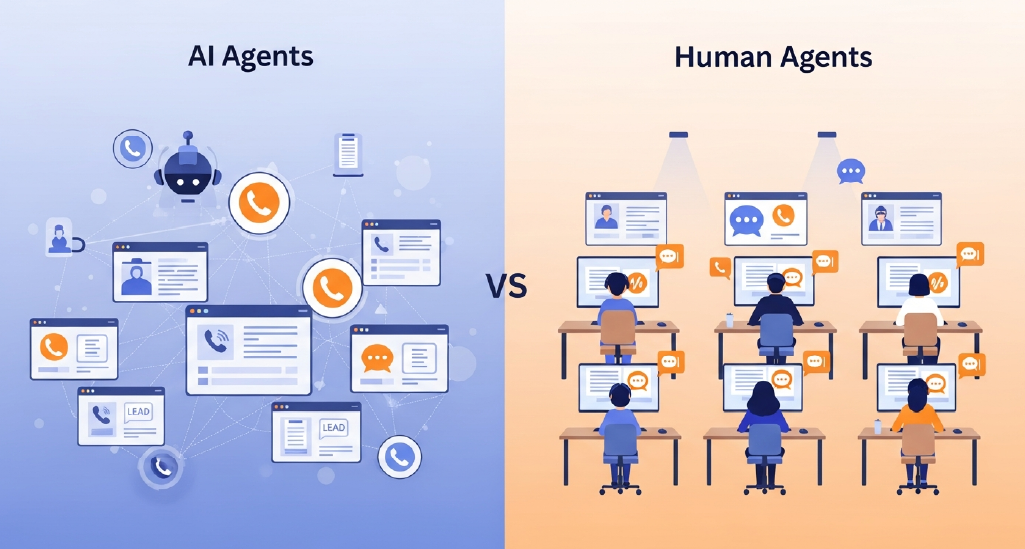
For decades, sales operations were built around one assumption: if you want more conversations, you need more people.
Additional agents were added to answer calls. Appointment setters were brought in to follow up on leads. Increased headcount helped cover longer operating hours. That approach worked well enough when volume was predictable, response time expectations were forgiving, and labor costs were easier to absorb.
That world no longer exists.
Today, leads arrive around the clock. Buyers expect immediate responses. Missed calls turn into lost revenue within minutes. And the cost of maintaining human-only sales coverage keeps rising while tolerance for delay keeps shrinking.
This is why the conversation has shifted from human agents versus automation to something more specific and more practical: AI agents versus human agents. Not as a philosophical debate, but as an operational one.
The real question businesses are asking now is not whether AI can replace people. It’s whether relying solely on human agents still makes economic and performance sense in a high-speed, high-volume sales environment.
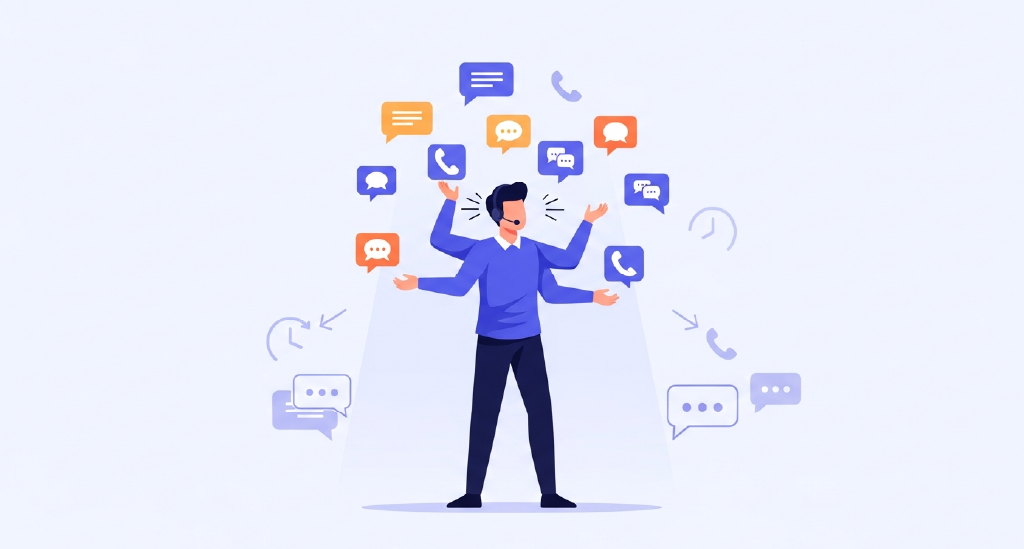
Human agents bring empathy, nuance, and adaptability. In complex sales cycles, that matters. But when it comes to first-touch response, qualification, and appointment setting, human-led operations come with inherent constraints.
A human agent can only manage one conversation at a time. Regular breaks are required. Fixed shifts define availability. Illness can interrupt coverage. Errors still occur. Hiring, training, and retention also make human agents expensive to sustain.
Consider a mid-sized service business running inbound lead generation through ads and website forms. Leads come in throughout the day and evening. Calls spike after work hours. Messages arrive late at night.
When a business staffs appointment setters only from 9 to 6, inquiries outside that window become a gamble. Certain leads end up waiting. Others never receive a response. In many cases, those prospects book elsewhere.
Even during business hours, response speed depends on availability. If all agents are busy, calls roll to voicemail. If inboxes pile up, follow-ups get delayed. The system is fragile by design.
None of this reflects poor performance by human agents. It reflects structural limits.
AI agents don’t replace human judgment. They replace human latency.
An AI appointment setter responds instantly. Consistency is maintained every time. Availability extends to any hour. Dozens or even hundreds of conversations can be handled simultaneously without loss of speed or accuracy. During spikes, performance remains stable. Follow-ups are never forgotten. Incoming calls are never missed because another conversation arrived first.

When a lead arrives, the AI engages immediately, asks context-aware questions, qualifies intent, and books appointments according to real-time availability. If escalation is needed, it passes the conversation to a human with full context.
The key difference is not intelligence versus empathy. It’s availability versus delay.
Also read: AI Appointment Frameworks: Fully Automated vs. Human-Led
A single full-time human appointment setter comes with a salary, benefits, training costs, management overhead, and turnover risk. In many markets, this easily adds up to tens of thousands of dollars per year per agent. To cover extended hours, you need shifts. To cover nights and weekends, you need more people.
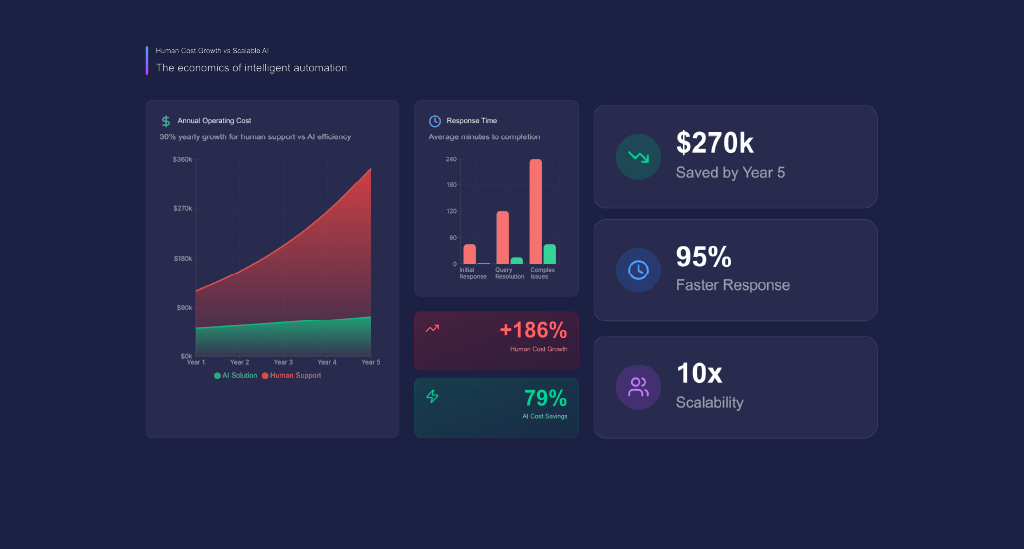
AI agents operate on a completely different cost curve. Once deployed, they scale without linear cost increases. Handling ten conversations costs roughly the same as handling one hundred. Coverage doesn’t require overtime. Expansion doesn’t require hiring.
What’s often missed in cost comparisons is opportunity cost. When a human agent misses a call or delays a response, the cost isn’t just the salary. It’s the revenue that never materializes because the lead moved on.
AI agents reduce that invisible loss.
This is where ROI calculators become useful, not as marketing tools but as operational mirrors. When teams model how many leads arrive outside staffed hours, how many calls go unanswered, and how many appointments are lost to slow response, the cost of relying solely on human agents becomes painfully clear.
Speed is the single most decisive factor in modern lead conversion.
Multiple studies across industries show that responding within the first minute dramatically increases the likelihood of conversion. After five minutes, conversion rates drop sharply. After thirty minutes, most opportunities are effectively gone.
Human agents, no matter how skilled, cannot consistently respond within seconds across all channels, all hours, and all volumes.
AI agents can.
When a lead submits a form, starts a chat, or calls in, the AI responds instantly. There is no queue. No “we’ll get back to you shortly.” No voicemail.
This speed changes buyer behavior. Leads stay engaged. Conversations continue. Appointments get booked while intent is still high.
In practice, this often produces conversion lifts that feel disproportionate to the change made. Businesses don’t necessarily get more leads. They convert more of the leads they already have.
There’s a common assumption that humans convert better because they’re human. In long, consultative sales, that’s often true. But the appointment setting is not at that stage.
At the top of the funnel, buyers want clarity, speed, and ease. They want to know if you can help them and when you’re available. They don’t want friction.
AI agents excel here because they remove friction entirely.
Consider a healthcare clinic receiving inquiries after hours. A human team responds the next morning. An AI agent responds immediately, answers basic questions, and books an appointment for the next available slot. By morning, the appointment is already on the calendar.
The conversion didn’t happen because the AI was persuasive. It happened because the AI was present.
Over time, businesses see higher show-up rates as well. When appointments are booked immediately, with confirmations and reminders automated, commitment increases. No-shows decrease. Schedules stabilize.
Human performance varies across teams. Certain agents perform at an exceptional level. Others deliver average results. Over time, some experience burnout. Eventually, some leave altogether.
Training helps, but it never eliminates variability. Scripts drift. Follow-ups get missed. Notes get inconsistent.
By contrast, AI agents operate with perfect consistency. Each lead receives the same level of attention. Qualification flows consistently follow best practices. Bookings always respect defined rules and real-time availability.
This consistency matters at scale. It ensures that performance doesn’t depend on who happens to be on shift. It also makes optimization easier. When results change, you know it’s because of system adjustments, not human variance.
Also read:The Hybrid Model: Where Voice AI and Humans Work Together
This isn’t an argument for removing humans from sales operations. It’s an argument for using them where they create the most value.
Human agents shine in complex conversations, objection handling, relationship building, and closing. AI agents shine in speed, availability, and volume handling.
The most effective sales operations are AI-first, not AI-only.
AI handles the first touch, qualification, and scheduling. Humans step in when nuance, empathy, and strategic thinking are required. The handoff is clean, contextual, and timely.
This division of labor doesn’t reduce human impact. It amplifies it.
A home services company growing across multiple cities faced a familiar problem. Lead volume was increasing, but hiring and training appointment setters couldn’t keep pace. Response times slipped. Missed calls increased. Conversion plateaued.
By introducing AI call handling and appointment setting, the company stabilized response times overnight. Every call was answered. Every inquiry received immediate follow-up. Human agents were reassigned to handle escalations and complex cases.
The result wasn’t just cost savings. It was revenue growth without proportional headcount growth. The company scaled operations without scaling payroll.
This is the operational leverage AI agents provide.
Beyond salaries, human-only operations carry hidden costs that rarely show up in spreadsheets.
Turnover disrupts performance. Training takes time. Coverage gaps appear unexpectedly. Management overhead grows with team size.
AI agents don’t quit. They don’t need onboarding. They don’t require supervision. Once configured, they perform continuously.
This reliability is especially valuable in industries where demand fluctuates. AI absorbs spikes without stress. Humans don’t have to.
Deciding between AI agents and human agents shouldn’t be ideological. It should be numerical.
This is where ROI modeling becomes essential. By looking at current lead volume, response times, conversion rates, and staffing costs, businesses can model what happens when AI handles first-touch interactions.

Often, the model reveals that AI doesn’t need to outperform humans dramatically to justify itself. It only needs to be consistently faster and consistently present.
Small gains in speed and availability compound quickly across hundreds or thousands of leads.
Also read: Measure CRM ROI Beyond Revenue: The Real ROI Equation
As buyer expectations continue to rise, tolerance for delay continues to fall. Businesses that rely exclusively on human agents will find themselves structurally disadvantaged, not because their people aren’t capable, but because the system they operate in has changed.
AI agents are not a replacement for human skill. They are a response to a speed problem humans cannot solve alone.
The shift to AI-first sales operations isn’t about technology enthusiasm. It’s about operational realism.
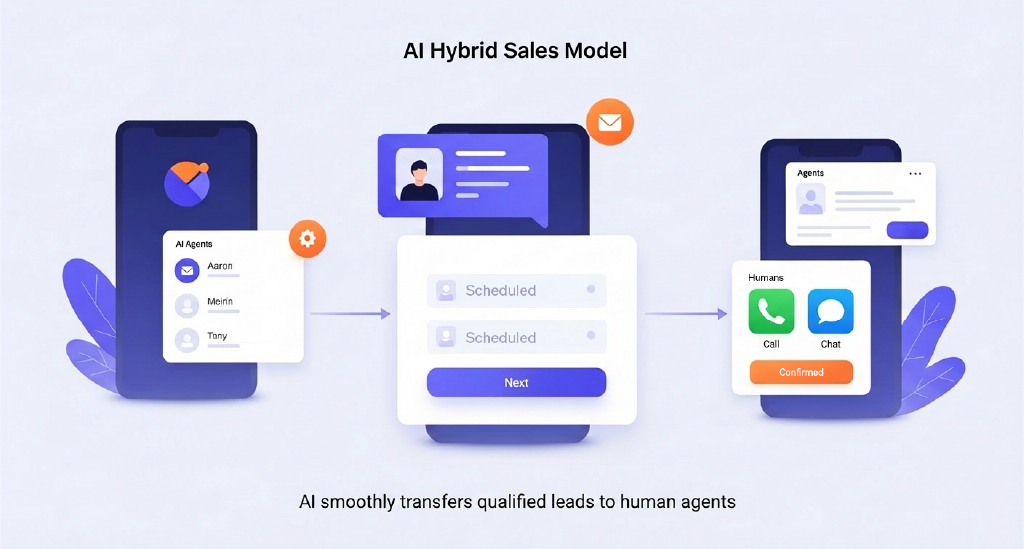
The most successful sales teams of the next decade will not be fully automated or fully human. They will be intelligently hybrid.
AI agents will handle volume, speed, and scheduling. Human agents will handle depth, relationships, and closing.
This combination delivers what neither can achieve alone: scale with quality.
And in a market where speed, cost efficiency, and conversion all matter, that balance becomes a competitive advantage.
What is the difference between AI agents and human agents in sales?
AI agents specialize in speed, availability, and handling large volumes of conversations simultaneously. Human agents excel at complex discussions, relationship building, and closing deals. The difference is less about capability and more about response time and scale.
Are AI agents replacing human sales agents?
No. In modern sales operations, AI agents replace delays—not people. They handle first-touch engagement, qualification, and scheduling, while human agents focus on high-value conversations and closing.
Do AI agents convert better than human agents?
At the top of the funnel, AI agents often convert more leads because they respond instantly. Faster response times lead to higher appointment rates, especially for inbound and after-hours leads.
How do AI agents reduce sales costs?
AI agents eliminate the need for expanded headcount to cover nights, weekends, and lead spikes. They scale without linear cost increases and reduce lost revenue from missed or delayed responses.
When should a business still use human sales agents?
Human agents are essential for complex sales cycles, objection handling, emotional intelligence, and relationship-driven decisions. AI works best when paired with humans in a hybrid model.
What is a hybrid AI and human sales model?
A hybrid model uses AI agents for first-touch engagement, qualification, and scheduling, then hands off qualified conversations to human agents. This approach combines speed with human expertise.
The shift to hybrid sales teams isn’t philosophical — it’s economic. The real question is how much speed, coverage, and conversion your current setup is leaving on the table. Blazeo’s ROI Calculator helps you compare the cost and performance of human-only teams against AI-first operations, using your actual lead volume, response times, and staffing costs.
Because once the numbers are clear, the decision usually is too.
