 SmartHub
 Automation
 Appointment Scheduler
 Lead Management
 Dashboard & Reports
 Task Management
 Communications Hub
 Managed chat
 Voice Receptionist
 Appointment scheduling
 Retainer signing
 Home services
 Lawyers and firms
 Medical services
 College admissions
 Real estate agents
 Marketing agencies
 About
About Partner program
 Estimate Your ROI
 Case Studies
 Blog
Blog FAQs
FAQs Login
LoginThe 24/7 Expectation: What “Always Available” Actually Means for Growing Businesses




Products
Industries
Company
Resources

There was a time when customers understood business hours as a boundary. If they called at 8PM and heard a recorded message telling them to try again tomorrow, that was simply how business worked. An email sent on Saturday might reasonably sit unanswered until Monday morning.
That boundary has quietly disappeared.
Customers can order groceries at midnight, move money from their phones on a Sunday, track a package in real time, book a hotel from another time zone, and receive instant answers from digital services at almost any hour. Those experiences have changed the standard against which every other business is judged.
A customer who sends an inquiry at 10:47PM. may know perfectly well that your office is closed. What they are less willing to accept is feeling as though their inquiry has disappeared into a black hole until someone happens to open an inbox the next morning.
This is the real challenge behind 24/7 customer support. Customers are not necessarily demanding that every company employ someone at a desk at three in the morning. They are expecting their needs to be acknowledged, understood, and moved forward without being dictated entirely by a company's operating hours.
For growing businesses, that distinction changes the problem considerably. The goal is not to keep every employee working around the clock. It is to build a customer communication system that never completely switches off.

Customers rarely decide to contact a company according to its staffing schedule.
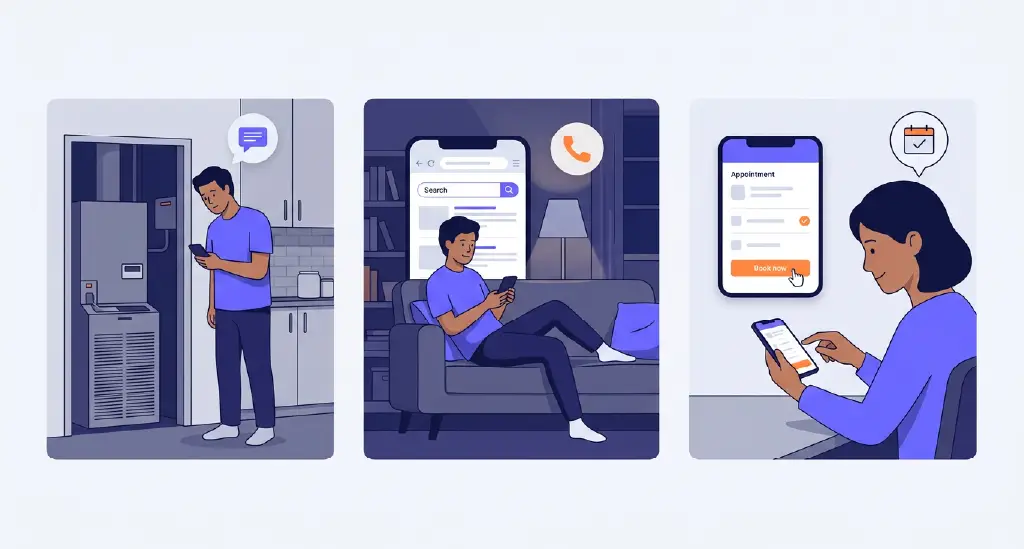
A homeowner notices the air conditioning has stopped working after putting the children to bed. Someone researching an attorney finally has time to inquire after dinner. A potential patient remembers to request an appointment on Sunday afternoon. A buyer comparing service providers fills out several forms late at night.
These moments matter because customer intent has a shelf life.
By the time the business opens the following morning, that homeowner may have called another HVAC company. The legal prospect may already have spoken with another firm. The patient may have booked elsewhere.
The business did not necessarily provide poor service. It simply was not present at the moment the customer was ready to engage.
That difference is becoming increasingly important. Zendesk's 2026 CX Trends research found that 74% of consumers now expect customer service to be available 24/7, while 88% expect faster response times than they did a year earlier.
Technology has not merely given businesses new ways to communicate. It has conditioned customers to expect less waiting.
That is why after-hours customer service should no longer be treated as a problem affecting only large contact centers or global companies. For a growing business, the question is increasingly simple: what happens when someone wants to talk to you while your team is unavailable?
The obvious response to rising expectations is to imagine more staffing.
If inquiries arrive overnight, perhaps somebody needs to work overnight. If weekend demand increases, perhaps a weekend team is required. Continue that logic far enough and 24/7 customer support becomes an expensive staffing problem.
But that assumes every customer interaction requires the same level of human involvement.
It doesn't.
Imagine someone contacting a home services company at 11:30 p.m. because their furnace has stopped working. The customer may initially need only a few things: confirmation that their request was received, some basic questions about the problem, information about emergency service, and perhaps the opportunity to schedule the earliest available appointment.
None of those steps necessarily requires waking an employee.
Now imagine that the customer reports smelling gas. Suddenly the interaction is very different. A predefined emergency protocol or human escalation may become necessary.
The value of an always-on service model comes from recognizing that distinction.
Automation and AI should handle the interactions that can safely and effectively be handled automatically. Humans should enter when judgment, empathy, expertise, urgency, or complexity makes their involvement valuable.
The objective is not replacing people. It is making human attention available where it matters most.
Also read: Every Inquiry Answered: How Omnichannel Communication Increases Conversion Rates

One of the biggest mistakes businesses make with after-hours inquiries is treating response time as purely a customer-service metric.
It is often a revenue metric too.
Consider a potential customer researching personal injury attorneys at night. They visit three websites and submit three inquiries.
Firm A sends an automated email: “Thanks for contacting us. Someone will respond during normal business hours.”
Firm B immediately begins a conversation. It asks what happened, determines whether the person is looking for legal representation, gathers essential contact information, and explains that someone from the firm will follow up.
Firm C says nothing until morning.
None of these firms necessarily has an attorney working at midnight. Yet from the customer's perspective, the experiences are radically different.
Firm B has already created momentum.
The prospect has been acknowledged. Their reason for reaching out has been captured. The next step is clear. When the human team starts work, it is not opening an anonymous form submission and beginning from zero. It is continuing a conversation that has already begun.
This is where automated customer support becomes more valuable than the traditional autoresponder.
An autoresponder confirms receipt.
A well-designed automated conversation creates progress.
There is another misconception hiding inside the phrase “24/7.”
Businesses often think availability means answering something immediately. Customers tend to experience availability more broadly.
They want continuity.
If a customer explains their problem to an AI assistant at midnight and then has to explain everything again to an employee at 9AM., the company may technically have been available around the clock, but the experience does not feel seamless.
Zendesk's 2026 research found that 74% of consumers are frustrated when they have to repeat their story to different agents, while 81% want service interactions to continue without forcing them to backtrack.
That points to a more useful definition of always-on customer service.
The interaction should survive the handoff.
If automation captures a customer's name, issue, urgency, preferences, previous interactions, and next step, that information should follow the customer into the human conversation. The morning agent should be able to say, in effect, “I can see what happened. Here's what we can do next.”
That feels completely different from, “Can you explain the problem again?”
Always-on service is therefore not simply about extending operating hours through technology. It is about maintaining context across time, channels, systems, and people.
The easiest way to create bad automated customer support is to automate without deciding what the automation is actually supposed to accomplish.
Customers have encountered enough useless chatbots to recognize the pattern.
“Choose from the following options.”
“My problem isn't listed.”
“Please select one of the following options.”
“Speak to someone.”
“Our team is currently unavailable.”
That may technically qualify as automation. It does not qualify as meaningful service.
Useful after-hours automation begins with a different question: what can we genuinely help this customer accomplish right now?
For an appointment-based business, the answer might be scheduling or rescheduling. For an ecommerce company, it could be checking an order or answering a return question. For a law firm, it might be capturing intake information and identifying urgent inquiries. For a home services business, it could involve understanding the problem and distinguishing an emergency from a routine appointment request.
The best automation reduces uncertainty.
The customer should leave the interaction knowing more, having accomplished something, or understanding exactly what happens next.
Without that outcome, “always available” becomes little more than “our chatbot is always online.”
Traditional automation worked best when conversations followed predictable paths. AI has expanded that territory considerably.
Instead of forcing customers through rigid menus, AI-powered systems can interpret natural-language questions, identify intent, collect relevant information, answer common questions, summarize conversations, route inquiries, and support scheduling.
That is one reason AI is becoming increasingly central to service operations. Salesforce's seventh State of Service report says AI is expected to resolve 50% of service cases by 2027, up from 30% in 2025. Zendesk, meanwhile, reports that 80% of CX leaders already using AI say it has positively affected response speed.
The practical implication for a smaller company is important.
24/7 customer communication for small businesses no longer has to resemble the infrastructure of a multinational call center.
A business can create an intelligent first layer of availability that continues operating when employees leave for the day.
But the emphasis belongs on the first layer.
AI becomes dangerous to the customer experience when businesses confuse its ability to respond with its ability to handle everything.
A customer asking, “What time do you open tomorrow?” and a customer saying, “I've been charged twice, and I'm furious” have both contacted support.
They do not necessarily need the same type of support.
The second interaction carries emotion, risk, and potentially greater consequences. A customer facing a complicated billing dispute, sensitive legal issue, unusual medical question, safety concern, or repeated service failure may need something automation cannot provide well enough on its own.
This is where human escalation becomes part of the architecture rather than evidence that automation has failed.
A strong 24/7 customer support system knows its limits.
It recognizes certain languages or situations as higher priority. It knows when confidence in an answer is too low. It understands when a customer has tried repeatedly to resolve the same problem. And it gives customers a route toward human assistance rather than trapping them inside an endless automated conversation.
Zendesk's research reflects why that human dimension still matters: its 2025 CX Trends report found that 67% of consumers consider qualities such as empathy, friendliness, and creativity important in AI interactions.
Customers may accept automation. They do not suddenly stop valuing how they are treated.
Also read: What Smart Businesses Automate First — And What Still Needs a Human Touch

The debate around customer-service automation is often framed too dramatically.
Will AI replace agents? Should companies keep supporting humans? Which one delivers a better experience?
For growing businesses, the more useful question is where each one belongs.
At 2AM, AI may answer an initial inquiry, collect information, qualify intent, retrieve basic account details, provide an appropriate answer, or schedule an appointment.
At 9AM, a human employee may review the conversation and take over exactly where it stopped.
During business hours, the same technology may quietly support human agents by summarizing previous conversations or surfacing relevant information, reducing the time employees spend searching through systems.
Zendesk says nine out of 10 agents using AI-powered assistance report saving time, averaging roughly seven hours per week.
That illustrates what effective automation can accomplish. It does not simply absorb customer conversations. It can remove repetitive work around those conversations, leaving employees with more capacity for situations where their involvement makes a meaningful difference.
The result is not a less human service operation.
Designed properly, it can be a more human one.

The benefits of after-hours customer service are easiest to see at night, but some of the biggest operational effects appear the next morning.
Without automation, employees may arrive in a queue of missed calls, voicemails, form submissions, emails, chat messages, and social inquiries.
Everything looks urgent because nothing has been processed.
Someone has to determine who needs an answer, what each person wants, which inquiries are qualified, which are duplicates, and which require immediate attention.
With a well-designed always-on system, much of that ambiguity can disappear before the team signs in.
Routine questions may already be resolved. Appointments may already be booked. Customer information may already be collected. Conversations may already be categorized. High-intent opportunities may be surfaced for rapid follow-up.
Instead of starting every morning by excavating yesterday's unanswered demand, employees can start with a clearer picture of what actually needs human attention.
For a growing company, that is where automating customer support after business hours stops being merely a convenience for customers and becomes an operational advantage.
There is one important warning for businesses pursuing always-on service.
Do not promise availability that your systems cannot genuinely deliver.
A chatbot icon does not make a company responsive. Neither does an instant email acknowledging a request. Poor automation can actually make the experience worse because it creates the appearance that help is available while preventing customers from reaching meaningful assistance.
Customers quickly recognize fake availability.
They recognize generic answers that ignore their question. They recognize loops. They recognize when automation is pretending to understand. They recognize when they have provided information that a human later asks them to provide again.
The standard should therefore never be “Did the system respond?”
It should be “Did the interaction move the customer forward?”
That might mean resolving the problem completely. It might mean booking an appointment. It might mean collecting enough information for a productive follow-up. It might simply mean giving the customer an accurate expectation about when a specialist will become available.
A useful answer at midnight is better than an instant but meaningless one.
For growing businesses, sustainable always-on service begins by separating availability from staffing.
You do not necessarily need someone awake every hour. You need a system capable of understanding what happens when someone reaches out every hour.
Start with the conversations that already occur outside business hours. Look at what customers ask, which inquiries frequently become sales opportunities, which questions can be resolved safely without an employee, and which situations require escalation.
Then design automation around those realities rather than around everything the technology could theoretically do.
The goal should be progressive.
A customer reaches out. The system understands why. It resolves what it can. It captures what a human will need. It escalates when appropriate. And the context follows the customer throughout the process.
That is a far more practical answer to how to provide 24/7 customer support than attempting to replicate the daytime team overnight.
Also read: More Conversations, Same Team: How Businesses Scale Customer Engagement Without Burning Out
The 24/7 expectation can sound unreasonable when interpreted literally.
Most customers do not need every employee at every business available every minute of every day. What they increasingly expect is something more fundamental: that reaching out to a company does not become a dead end simply because the clock says 7:03 p.m.
They want acknowledgement when their intent is strongest. They want simple needs handled without unnecessary waiting. They want context preserved when a human becomes involved. And when the situation genuinely requires a person, they want a clear path toward one.
That is the opportunity for growing businesses.
The future of 24/7 customer support is not an enormous overnight workforce or a wall of bots keeping humans away. It is a thoughtfully designed combination of AI, automation, and people, each handling the part of the conversation they are best equipped to handle.
Blazeo helps businesses build that kind of always-on customer engagement, combining AI-powered conversations with human support so leads and customers can keep moving forward even when your team is offline. Because being available 24/7 should not mean asking your people to work 24/7. It should mean making sure an important conversation never goes unanswered.

