 SmartHub
 Automation
 Appointment Scheduler
 Lead Management
 Dashboard & Reports
 Task Management
 Communications Hub
 Managed chat
 Voice Receptionist
 Appointment scheduling
 Retainer signing
 Home services
 Lawyers and firms
 Medical services
 College admissions
 Real estate agents
 Marketing agencies
 About
 Partner program
 Estimate Your ROI
 Case Studies
 Blog
 FAQs
 Login
Outsourced Intake Does Not Outsource Professional Responsibility




Products
Industries
Company
Resources

For a law firm, the first conversation with a prospective client can carry more weight than it initially appears to. Someone may be calling after an accident, facing a family dispute, responding to a legal notice, or trying to understand whether they have a case. They may be anxious, unfamiliar with legal procedures, and unsure of what information matters.
That first interaction shapes expectations. It also creates responsibilities that cannot simply be transferred to whoever answers the phone.
As firms grow, many turn to outsourced legal intake to manage call volumes, extend availability, and reduce the administrative demands placed on attorneys and support staff. Done well, outsourcing can make a firm more responsive without forcing every inquiry through an already stretched internal team.
But there is an important distinction between delegating an operational task and transferring professional responsibility.
An outside intake provider may answer calls, collect preliminary information, schedule consultations, and route urgent inquiries. The law firm, however, remains responsible for ensuring that these activities are performed within appropriate legal, ethical, and operational boundaries.
The question, then, is not simply whether a firm should outsource intake. It is whether the firm has established the controls needed to make that arrangement reliable, accountable, and consistent with its professional obligations.

Consider a prospective personal injury client calling a law firm on a Saturday evening. An outsourced intake representative answers, asks about the accident, and records the caller's contact information.
So far, the interaction is administrative.
But what happens if the caller asks whether they have a strong case? Or whether the firm can guarantee compensation? Or whether they should wait before contacting their insurance company?
These questions introduce legal judgment into what began as a routine intake conversation.
The representative may be trained to sound reassuring, but reassurance can become problematic when it crosses into legal advice or creates expectations the firm has not authorized.
This is why outsourced intake cannot be treated as a function that operates independently of the firm's professional standards.
Under the American Bar Association's Model Rule 5.3, lawyers with managerial or supervisory responsibilities must make reasonable efforts to ensure that nonlawyer assistance is compatible with their professional obligations. The rule addresses both nonlawyers employed within a firm and assistance provided outside it.
The ABA's Formal Opinion 08-451 further explains how lawyers' duties of supervision, confidentiality, competence, and communication apply when legal and nonlegal support services are outsourced.
These principles do not prohibit outsourcing. They establish that a firm's responsibilities continue even when another organization performs part of the work.
That distinction should influence how a law firm selects an intake provider, defines its scope of work, trains representatives, reviews interactions, and responds when something goes wrong.

One of the most common operational weaknesses in legal intake outsourcing is an unclear boundary between information collection and legal assessment.
A representative needs enough information to identify the nature of an inquiry and determine its next step. Yet collecting information is not the same as interpreting it.
For example, an intake representative handling an employment law inquiry may appropriately ask when an incident occurred, where the caller worked, whether the employment relationship has ended, and how the caller can be contacted.
The representative should not independently determine whether the facts establish unlawful discrimination, whether the caller has a viable claim, or which legal remedy is most appropriate.
Similarly, a representative answering calls for a family law practice may gather information about the type of matter and schedule a consultation without recommending a custody strategy or predicting a court's decision.
The difference may appear straightforward on paper. In live conversations, it is much less predictable.
Callers rarely follow scripts. They interrupt, ask follow-up questions, introduce new details, and seek immediate reassurance. A representative trying to be helpful may answer a question that should have been referred to an attorney.
This makes approved intake language particularly important.
A firm should establish which questions representatives may ask, which factual details they may record, which administrative information they may provide, and which subjects require an attorney's involvement.
Prohibited statements deserve equal attention. Representatives should not promise representation, offer legal conclusions, guarantee outcomes, interpret deadlines, or make commitments about fees and case acceptance beyond what the firm has expressly authorized.
Even seemingly harmless language can create confusion.
Telling a caller, "Your case sounds strong," may be intended as encouragement. The caller, however, may understand it as a preliminary legal opinion from someone speaking on the firm's behalf.
A safer response would acknowledge the information provided and explain that an attorney must review the matter before any assessment can be made.
For firms evaluating law firm intake services, this distinction should be built into scripts, training, quality reviews, and escalation procedures rather than left to individual judgment.
Also read: Legal Intake Call Center: How Law Firms Handle More New Client Calls
An individual does not necessarily become a client merely by contacting a law firm. That does not mean the information shared during the initial conversation is unprotected.
Under ABA Model Rule 1.18, lawyers may owe confidentiality-related duties to prospective clients, including people who discuss the possibility of forming an attorney-client relationship but never ultimately retain the firm.
This has practical consequences for outsourced intake.

A caller might disclose medical information, employment records, financial circumstances, family disputes, or details about a potential claim. An intake provider handling these conversations becomes part of the firm's information-handling environment.
The firm therefore needs to understand where information is stored, who can access it, how it is transmitted, whether conversations are recorded, and what happens to the records after the provider relationship ends.
Access should reflect operational necessity. A representative collecting information for a particular practice area does not automatically need unrestricted access to the firm's entire client database.
The same principle applies to transcripts, call recordings, intake summaries, and supporting documents.
Data security is not simply a contractual promise that information will remain confidential. It requires enforceable access controls, appropriate retention practices, secure integrations, and procedures for identifying and responding to unauthorized disclosure.
Firms should also consider how their intake process limits unnecessary disclosure before conflicts are checked. Collecting extensive sensitive information from every caller may create avoidable confidentiality and conflict-management complications.
An effective process gathers enough information to route the inquiry appropriately without encouraging disclosures beyond what is needed at that stage.
This is particularly important when a provider serves multiple law firms or practice areas. The technology and operational arrangements should prevent information from being exposed across client accounts.
Outsourcing may change who initially receives the information. It does not eliminate the firm's obligation to protect it.
An intake script cannot anticipate every situation. That is why escalation rules matter as much as the initial questions.
Imagine a caller contacting a firm about an employment termination. During the conversation, the caller mentions receiving a legal notice with a response deadline approaching the next morning.
An intake representative may recognize that the inquiry is urgent, but recognizing urgency is not the same as determining the legal consequences of missing the deadline.
The appropriate response is to follow a predefined escalation procedure that brings the matter to an authorized member of the legal team.
That procedure needs more detail than an instruction to "flag urgent calls."
The firm should identify which circumstances require immediate attention, who receives those notifications, how quickly they must be acknowledged, and what happens when the designated person is unavailable.
A missed escalation is not always caused by an inattentive representative. Sometimes the representative follows the process correctly, but the notification reaches an unattended inbox. In other cases, an inquiry is categorized incorrectly and enters a routine follow-up queue.
Both situations expose a weakness in the workflow.
A reliable intake arrangement therefore needs confirmation that an escalation has been received, a fallback recipient when necessary, and a record of the actions taken.
For a law firm, this is where responsiveness becomes an operational responsibility rather than merely a customer-service objective.
Also read: AI-Driven Legal Intake Funnels: 7 Must-Know Benefits
Even carefully written procedures lose value when representatives do not understand how to apply them.
Training for nonlawyer legal intake should go beyond learning the firm's greeting, preferred terminology, and appointment scheduling process.
Representatives need to understand why particular questions are permitted, why others are restricted, and when a conversation must move beyond their authority.
A personal injury practice, for example, may encounter callers describing ongoing medical emergencies. An estate planning practice may receive inquiries involving a person's capacity to make decisions. A criminal defense practice may hear from someone facing an imminent court appearance.
Each setting introduces different sensitivities, although none authorizes an intake representative to provide independent legal advice.
Training should therefore include realistic scenarios, not simply memorized scripts.
Representatives should practice handling callers who insist on receiving an immediate opinion, misunderstand the provider's role, disclose information outside the approved scope, or become distressed when told that an attorney must review their matter.
Refresher training is equally important when the firm changes practice areas, modifies intake criteria, updates its procedures, or introduces new technology.
The ABA's Formal Opinion 498 emphasizes the importance of policies, technology competence, confidentiality, and supervision in virtual legal practice. Although the opinion addresses virtual practice broadly, its guidance is relevant to firms relying on distributed teams and technology-enabled support.
The practical lesson is that training should be treated as a continuing process, supported by documented updates and evidence that representatives understand their responsibilities.
Outsourcing arrangements are frequently evaluated through operational metrics such as call answer rates, average handling time, appointment volume, and conversion rates.
These measures are useful, but they cannot establish whether an intake interaction was professionally appropriate.
A representative might complete a call quickly and schedule a consultation while also making an unauthorized statement about the likely outcome of a case.
From a conventional performance dashboard, that interaction could appear successful.
From a supervision perspective, it may require immediate correction.

The need for effective intake is supported by Clio's 2024 Legal Trends Report. In a secret-shopper study involving 500 law firms, only 40% answered phone inquiries, while just 33% responded to emails. Overall, 48% were effectively unreachable by phone, including firms that did not return missed calls.
These findings illustrate why firms seek additional intake capacity. They do not, however, measure the ethical quality of outsourced conversations.
A firm needs to examine both dimensions.
Where recording and retention are lawful and appropriately disclosed, reviewing selected calls or transcripts can reveal whether representatives stayed within approved language, collected necessary information, identified urgent matters, and explained the next steps accurately.
Reviews should include routine interactions as well as calls involving complaints, unusual circumstances, or escalations.
The firm should also examine patterns. Repeatedly missing a particular question, misclassifying a practice area, or giving callers an inaccurate expectation about response times may indicate a process problem rather than an isolated mistake.
Platforms that support call documentation, summaries, routing, and integration with existing workflows can make this oversight more practical. Blazeo's AI-enabled and live-agent communication solutions provide a relevant starting point for firms exploring how to coordinate intake interactions and follow-up.
The important consideration is not simply whether a provider generates records, but whether the firm can access and use the records needed for meaningful supervision.
Also read: Stop Measuring Activity. Start Measuring Conversation Outcomes
No intake process is entirely free from mistakes. The more revealing question is what happens after one is discovered.
Suppose a representative tells a prospective client that the firm will accept their case, even though no attorney has reviewed the facts.
The provider may identify the statement during a quality review. But identifying it is only the beginning.
The firm must determine whether the caller needs clarification, whether any reliance or other consequences require attention, and whether the interaction raises professional responsibility concerns.
The provider may need to retrain the representative, revise the script, or investigate whether similar statements have occurred elsewhere.
Responsibility for these actions should be established before an incident arises.
A strong arrangement distinguishes between the provider's responsibility to investigate and correct operational failures and the law firm's responsibility to determine the legal and professional response.
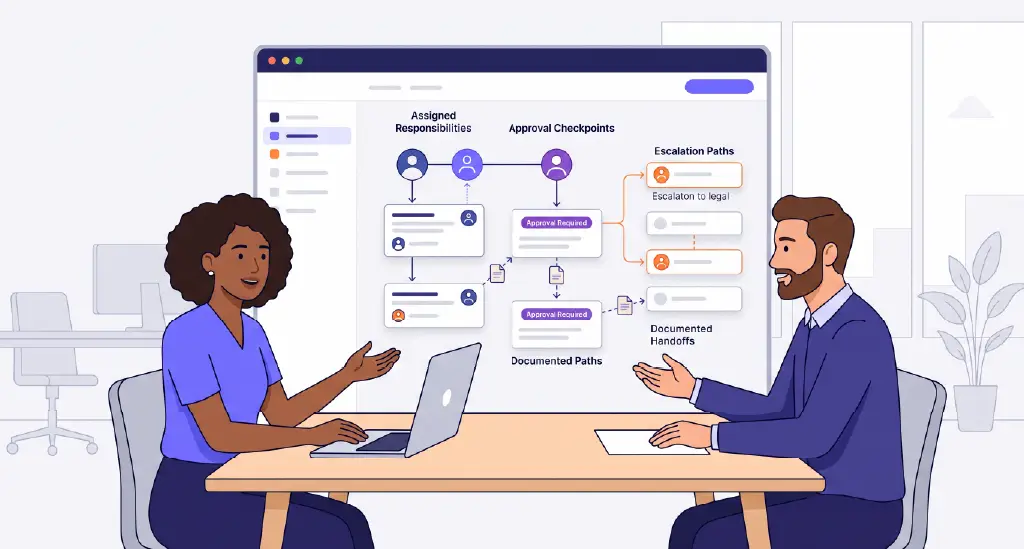
There should also be a documented path for reporting deviations, identifying their causes, recording corrective action, and verifying that the problem has been addressed.
Without that structure, a firm may receive assurances that an issue has been resolved without understanding what changed.
AI-assisted intake introduces another dimension to this discussion.
Automated systems can help answer inquiries, collect approved information, route conversations, and schedule consultations. They may also support consistency by following defined workflows.
Yet automation creates its own supervisory questions.
What happens when a caller asks a question outside the system's approved scope? Can the system recognize when a conversation requires human intervention? Who reviews inaccurate responses? How are changes to scripts, instructions, or workflows tested before deployment?
A law firm cannot assume that an automated interaction is compliant merely because it follows a configured process.
The process itself may be incomplete, outdated, or unsuitable for a particular situation.
Human oversight remains important, particularly when conversations involve legal judgment, sensitive disclosures, urgent circumstances, or uncertainty about what the caller is requesting.
For firms considering a combination of AI and live-agent support, Blazeo's communication solutions offer an opportunity to examine how automated intake, human transfers, scheduling, and follow-up can work within firm-approved boundaries.
The appropriate balance will depend on the firm's practice areas, risk profile, and ability to supervise the resulting interactions.
Technology should help enforce the firm's policies, not become a substitute for them.
Also read: What Smart Businesses Automate First — And What Still Needs a Human Touch
Before entering an outsourcing arrangement, firms should look beyond pricing, coverage hours, and the promise of fewer missed calls.
The provider's operating model matters.
A law firm should understand how representatives are recruited and trained, whether they serve multiple clients, how information is separated between accounts, and how the provider handles complaints or deviations from approved procedures.
Contractual terms should address confidentiality, authorized activities, subcontracting, record access, incident notification, service changes, and termination procedures.
The firm's ability to review and correct the provider's work is particularly important.
For example, if the firm changes its consultation policy, there should be a clear process for updating the provider's instructions and confirming that the change has taken effect.
If a representative repeatedly misroutes a particular type of inquiry, the firm should be able to request a review and understand the corrective measures.
The Illinois State Bar Association's Ethics Opinion 19-04 reinforces the importance of reasonable supervision, protection of client information, and conflict safeguards when outsourcing legal and support services. It also illustrates why firms must examine applicable jurisdiction-specific requirements rather than assuming that one general outsourcing policy will satisfy every obligation.
Ultimately, the provider should operate within a framework the firm understands, approves, and can meaningfully oversee.
The case for outsourced legal intake is not difficult to understand. Law firms need to respond to inquiries while preserving attorneys' time for work that requires their professional judgment.
But responsiveness alone does not define successful intake.
A caller who receives an immediate answer but inaccurate guidance has not necessarily received better service. Neither has someone whose urgent inquiry is documented but never reaches the appropriate attorney.
Effective outsourcing depends on the relationship between accessibility and accountability.
The firm defines the permissible scope of intake, the provider carries out those functions, and both parties maintain clear processes for supervision, escalation, review, and correction.
When these responsibilities are established from the beginning, outsourcing can strengthen operations without creating unnecessary ambiguity about who remains accountable.
Blazeo helps law firms build more responsive intake workflows through AI-enabled and live-agent communication solutions. Explore Blazeo to discuss how answering, routing, scheduling, and follow-up can support your firm's intake process while keeping professional oversight where it belongs.

